

Your earlobes don't need to be forced into submission to reach your goal gauge. While the industry often pushes quick fixes, dead stretching stands as the most anatomically respectful method for sizing up your ears. It's a philosophy of patience that relies on your body's natural elasticity rather than mechanical force. You've likely felt the anxiety of a potential blowout or the sharp sting of a taper that didn't want to glide through. We understand that concern. At BodyJ4You, we believe your journey toward self-expression should be rooted in healthy, safe, and effective care.
You deserve thick, healthy, and resilient lobes without the burden of scar tissue. We promise to help you master this technique with professional precision, ensuring a pain-free experience as you level up your look. This guide provides a clear path forward by covering the essential role of non-porous materials like single flare glass or surgical steel, the 1mm increment rule for sizes under 8mm, and why the Association of Professional Piercers recommends waiting a minimum of three months between each transition to maintain your skin's integrity.
Key Takeaways
- Learn how to utilize your body's natural skin cell production to safely expand your piercings without the trauma of mechanical force.
- Discover why high-quality, non-porous materials are essential for dead stretching, providing the gentle passive tension needed to loosen tissue naturally.
- Master the "no pain" rule and understand why a 3 to 6-month timeline ensures your lobes remain thick and healthy throughout the expansion process.
- Identify your body’s unique warning signals and learn how to use the down-sizing method to stimulate blood flow and overcome stalled stretches.
- Explore expert aftercare routines using saline and specialized oils to nurture your skin as it transitions into its new, empowered state.
What is Dead Stretching? The Anatomical Approach to Gauging
Expanding your ears is a journey of patience, not a race to the finish line. To understand What is Dead Stretching?, one must look at the body’s innate ability to adapt. This method involves inserting a larger gauge jewelry piece into a fully healed piercing without the assistance of tapers or expansion tools. It's a passive technique. While active methods like tapering use mechanical force to widen the earlobe, dead stretching relies on the natural looseness your body creates over time. By choosing this path, you embrace a philosophy that prioritizes skin health over speed. Our mission at BodyJ4You is to ensure your journey is rooted in the Rule of Three: results that are healthy, safe, and effective.
The Science of Skin Elasticity
Your earlobes are biological masterpieces composed of collagen and elastin. When you wear high-quality jewelry, its subtle weight creates consistent micro-tension on the internal walls of the piercing. This tension signals your body to trigger a fibroblast response, which is the production of new skin cells to accommodate the pressure. Collagen provides the necessary structural strength, while elastin allows the tissue to remain flexible. If you rush the process, you snap these delicate fibers. This leads to thinning lobes and permanent damage. A healed state is defined as a fully matured fistula that has exhibited zero redness, crusting, or sensitivity for a minimum of 90 days before any stretch is attempted.
Dead Stretching vs. Tapers: Why Professionals Prefer Passive Methods
Tapers are often misunderstood as jewelry, but they're actually tools designed for guided insertion. The danger lies in their shape. Because they act as a wedge, it's remarkably easy to force a stretch before the tissue is ready. This often results in "blowouts," where the internal skin is pushed out through the back of the lobe. Dead stretching eliminates this risk. If the next size doesn't slide in with ease, your ear simply isn't ready. This passive approach ensures you never bypass your body's natural warning signals. For those beginning their journey, we recommend reviewing the Wise Guardian’s Guide to Safe Gauging to establish a solid foundation in piercing health. By letting the jewelry do the work, you protect the integrity of your skin and ensure a lifetime of comfortable wear.
Essential Materials: Why High-Quality Jewelry is Non-Negotiable
Success in dead stretching depends entirely on the tools you choose. Unlike other methods that rely on external force, this technique uses the jewelry itself as a functional weight. This weight provides consistent, passive tension that encourages the tissue to relax and expand. Choosing the wrong material can halt your progress or cause unnecessary irritation. At BodyJ4You, we prioritize materials that are healthy, safe, and effective. Non-porous surfaces are vital during the loosening phase. Porous materials like acrylic can trap bacteria or even allow skin to adhere to the jewelry, leading to tears. If you're ready to begin, Choosing the Best Gauge Stretching Kit will help you identify the right starting point for your unique anatomy.
Single-Flare Glass and Surgical Steel
Single-flare jewelry is the only appropriate choice for an active stretch. Double-flared plugs require the lobe to already be larger than the target size to accommodate the flare, which causes trauma. 316L Surgical Steel is a preferred choice for many because it's hypoallergenic, smooth, and significantly heavier than organic materials. This added heft facilitates the dead stretching process by providing the gentle pull your lobes need. Glass remains the gold standard for those with extreme skin sensitivities. It's manufactured with a mirror-smooth finish and is available in precise incremental sizes, allowing for a more customized transition between gauges. These materials ensure your skin remains calm as it adapts to new dimensions.
The Role of Lubrication and Aftercare
Dry stretching is a common mistake that leads to micro-tears and scar tissue. While some guides overlook the biological benefits of lubrication, we believe it's essential for maintaining skin suppleness. Jojoba and Rosehip oils are particularly effective because they mimic the body's natural sebum, deeply hydrating the tissue to increase elasticity. Using a Saline Piercing Aftercare Spray ensures the environment remains sterile during the transition. Our aftercare products are Born in the USA, meeting high quality-control standards to protect your skin. For long-term maintenance, a Gauges Balm creates a protective barrier that locks in moisture and prevents the "ear cheese" odor often associated with stretching. This comprehensive approach supports your self-expression while guarding your physical well-being. You might consider incorporating a dedicated daily massage routine to keep your lobes thick and resilient.
The Dead Stretching Process: A Step-by-Step Guide to Natural Expansion
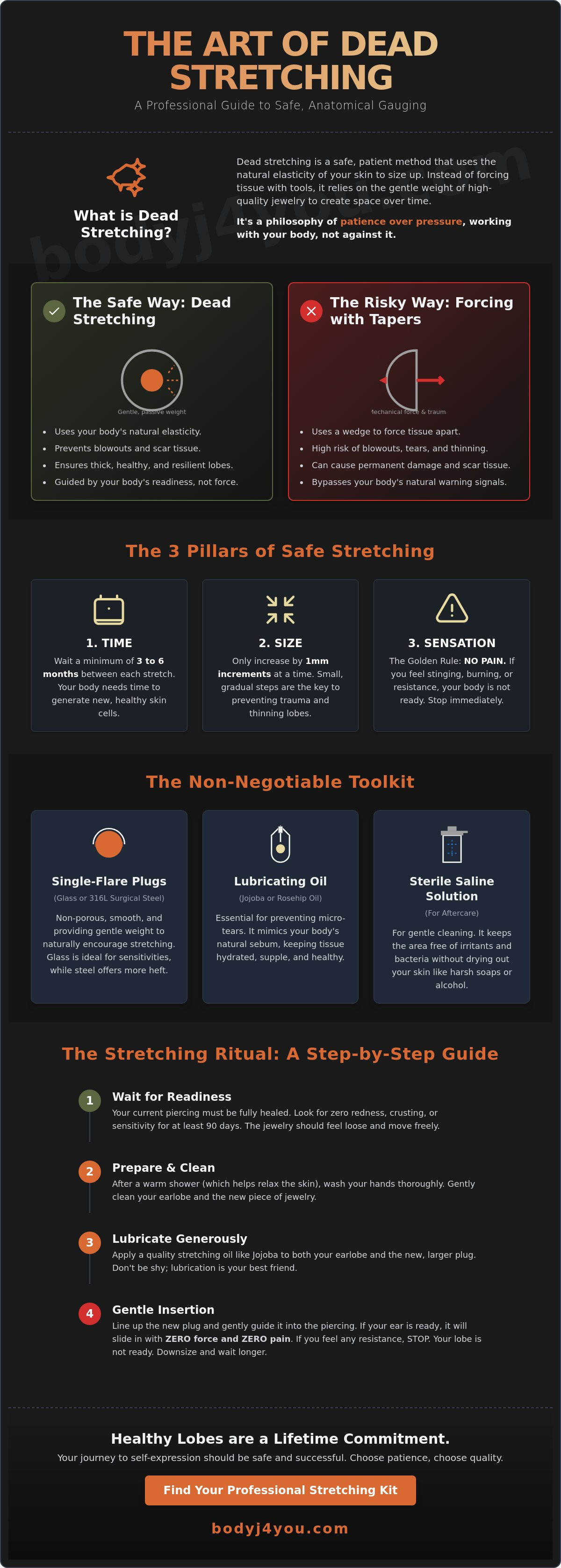
Transitioning from theory to practice requires a shift in mindset. Patience isn't just a virtue; it's a physiological requirement. While some enthusiasts rush the process, true dead stretching typically demands a window of 3 to 6 months between transitions. This duration allows the skin cells to reorganize and the fistula to thicken. Before attempting a new size, look for "daylight." This is a visible gap between the jewelry and the lobe when you gently tug the plug downward. It indicates the tissue has naturally loosened enough to accept a larger gauge. If you're approaching the 8mm mark, consult our 0g Ears Milestone Guide for specific anatomical advice regarding larger gauge transitions.
One strategy often overlooked by generic guides is the use of 0.5mm half-sizes. Moving from one full gauge to the next can be a significant jump for your anatomy. By utilizing half-size increments, you reduce the physical stress on your lobes by 50%. This makes the dead stretching process smoother and virtually eliminates the risk of micro-tears that lead to long-term damage.
Step 1-3: Preparation and Testing
Start with a 10-minute warm water soak or a hot shower. The heat dilates the blood vessels, which increases blood flow and maximizes skin pliability. This makes the tissue significantly more receptive to movement. Next, perform a dedicated massage with Jojoba oil for at least five minutes. This natural lubricant helps break down any micro-scar tissue and deeply hydrates the skin fibers to improve overall elasticity. The final stage of preparation is the "Gentle Test." Attempt to slide the next size in slowly without using any force. If you feel even a slight pinch or resistance, your ear is signaling that it needs more time to produce the necessary skin cells.
Step 4-5: Insertion and Aftercare
When the ear is truly ready, a lubricated single-flare plug should essentially "fall" into the piercing. You shouldn't need to push or wiggle the jewelry. Once inserted, use a sterile saline spray to soothe the area and maintain a clean environment. A successful stretch feels like nothing at all. You should experience a sense of coolness, comfort, and zero pressure. If there is any throbbing, stinging, or heat, you've likely forced the stretch. In such cases, you must downsize immediately to protect your progress and prevent the formation of permanent scar tissue. This disciplined approach ensures your lobes remain thick, healthy, and resilient as you level up your self-expression.
Listening to Your Lobes: Identifying Signs of Readiness and Warning Signals
BodyJ4You acts as your Wise Guardian throughout this transformative process. We've supported thousands of individuals over our 20 year history, and we know that the most common frustration is the "waiting game." You might wonder why your friend reached their goal gauge in four months while you're still waiting at the six-month mark. Individual biology is the primary factor here. Your skin’s unique collagen density, local blood circulation, and even your hydration levels dictate how quickly your fibroblasts produce new tissue. Patience isn't just a suggestion; it’s a biological necessity for maintaining thick, resilient lobes.
Rushing a dead stretch leads to micro-tears. These tiny, internal lacerations aren't always visible, but they cause the body to produce dense scar tissue as a defense mechanism. This scar tissue lacks the elasticity of healthy skin, which creates a "plateau" that makes future stretching significantly more difficult. If you're feeling tempted to use tools to bypass your body’s natural timeline, consult our Ear Tapers Myth-Busting guide to understand why mechanical force often results in a permanent setback for your aesthetics.
The Green Lights: When You Are Ready
Before you even pick up the next size, your ears should exhibit clear signs of readiness. These indicators suggest the fistula has matured and is capable of accepting more volume without trauma:
- Jewelry Movement: Your current plugs should feel loose or "heavy" in the lobe, often rotating freely during your daily cleaning.
- Visible Gaps: When you gently pull the jewelry downward, you should see a clear gap or "daylight" at the top of the piercing.
- Clinical Calm: Your lobes must exhibit zero redness, crusting, or tenderness for a minimum of 4 consecutive weeks before you attempt to level up.
The Red Lights: When to Stop Immediately
Your body is highly communicative. If you encounter any of the following "red lights" during an attempted insertion, you must stop immediately and downsize to your previous comfortable gauge:
- Sensory Alarms: Any sensation of stinging, burning, or sharp throbbing is a sign that the tissue is tearing rather than expanding.
- Fluid Production: The presence of blood or clear "lymph" fluid indicates an open wound that requires immediate sterile care.
- Textural Changes: A "cat-butt" appearance, characterized by a wrinkled or irritated internal fistula, is a clear signal of chronic inflammation and over-stretching.
If your lobes are showing signs of irritation, it's time to prioritize healing over expansion. Shop our expert-crafted aftercare kits to provide your skin with the nutrient-rich support it needs to recover and remain supple.
Nurturing Your Progress: Aftercare and Long-Term Lobe Health
The journey of dead stretching doesn't conclude the moment your new jewelry slides into place. In fact, the insertion marks the beginning of a critical biological transition. Your body now needs to stabilize the newly expanded fistula and reinforce the skin's structural integrity. This healing phase requires the same discipline as the preparation phase. If you encounter a "stalled" stretch where the ear refuses to loosen after several months, don't force it. The most effective solution is often to down-size for 14 to 21 days. This temporary reduction in pressure stimulates localized blood flow and encourages the production of fresh fibroblasts, often making the subsequent attempt at the larger size much smoother.
Once your lobes have reached a stable, healed state at a specific gauge, you should begin "naked training." This involves removing your jewelry for 30 to 60 minutes a day. This practice allows your lobes to breathe and restores full circulation to the tissue, which can be restricted by constant jewelry wear. It keeps the skin thick, elastic, and healthy. Our mission at BodyJ4You is to empower your self-expression through safe, high-quality care, ensuring your body modification journey is as sustainable as it is beautiful.
The Daily Maintenance Routine
Consistency is the foundation of long-term lobe health. You should clean both your jewelry and your lobes daily using mild, fragrance-free soap and our Piercing Aftercare Spray. This saline-based solution maintains a balanced pH and removes debris without irritating the skin. As a Wise Guardian tip, we recommend nightly massages using Jojoba or Rosehip oil. These sessions break down tension and ensure the fistula remains supple rather than becoming tight. Regular cleaning is also the only way to prevent the accumulation of dead skin cells and sebum. This natural buildup occurs in all piercings, but a dedicated hygiene routine keeps your aesthetics fresh and odor-free.
Level Up Your Journey
As your ears mature, you'll eventually want to transition from basic surgical steel or glass to decorative organic materials. Wood, stone, and bone are beautiful options for self-expression, but they should only be worn in fully healed piercings due to their porous nature. When you prepare for the more significant jumps, such as the 2mm gap between 2g and 0g, remember the importance of half-sizes. Using a 7mm (1g) plug as a bridge prevents the trauma often associated with these larger milestones. At BodyJ4You, we are here to support every step of your expansion. Explore our Dead Stretching Kits and Aftercare Essentials to ensure your progress is always Crafted by Experts, Trusted by Thousands, and Rooted in Care.
Embrace Your Anatomical Journey
Your path toward self-expression is a marathon, not a sprint. By choosing dead stretching, you've committed to a method that honors your skin's biological limits while achieving the aesthetic you desire. You now understand that patience is your most valuable tool; it often requires three to six months between sizes to ensure your lobes remain thick and resilient. You also recognize that high-quality, non-porous materials are the only choice for a safe, healthy transition.
At BodyJ4You, we've spent over 20 years perfecting the balance between beauty and biology. Our products are Born in the USA, ensuring the highest standards of quality control for every piece of jewelry we craft. We support your healing with a USDA Certified Organic aftercare line designed to nourish and protect your skin at every stage. You don't have to guess about your safety when you have a Wise Guardian by your side. It's time to level up with confidence.
Crafted by Experts. Trusted by Thousands. Shop BodyJ4You Stretching Kits.
Your body is capable of incredible transformation when you treat it with the respect it deserves. We are honored to be part of your journey.
Frequently Asked Questions
How long should I wait between dead stretches?
You should wait a minimum of 3 to 6 months between each transition to allow for full tissue maturation. For those moving into gauges over 0, a 12 to 14 week window is the absolute minimum required to maintain lobe thickness. This timeline ensures your body has enough time to produce the skin cells necessary for a healthy, natural expansion.
Does dead stretching hurt more than using tapers?
Dead stretching should be entirely pain-free, whereas tapers often cause a stinging sensation because they use mechanical force. If you feel any pinch or pressure during insertion, your ear simply isn't ready for the next size. This method relies on the body's natural looseness. It's the most respectful way to level up your look without the risk of tearing delicate skin fibers.
What are the best materials for dead stretching?
Single flare glass and 316L surgical steel are the gold standards for this technique. These materials are non-porous and provide the necessary passive weight to encourage tissue relaxation. Glass is especially beneficial for those with sensitive skin. It's hypoallergenic and manufactured with a mirror-smooth finish that prevents bacteria from becoming trapped during the loosening phase.
Can I dead stretch with silicone or acrylic jewelry?
You should never use silicone or acrylic for the active phase of dead stretching. These materials are porous and can trap moisture and bacteria against the fistula. Silicone specifically can create a vacuum effect or even fuse to the skin if the tissue is slightly irritated. Save these materials for fully healed piercings that have been stable for at least 8 weeks.
What should I do if my ear won’t take the next size?
You must downsize immediately to your previous gauge and wait another 4 to 8 weeks before trying again. Attempting to force the jewelry will result in permanent scar tissue that halts future progress. Consider using 0.5mm half-size increments to bridge the gap if you're struggling with a full 1mm jump. This strategy reduces physical stress on your lobes by 50 percent.
Is it possible to dead stretch a septum piercing?
Yes, you can dead stretch a septum, but the timeline is significantly longer due to the nature of cartilage. Most enthusiasts wait 6 to 9 months between sizes to avoid "dent" pain against the nasal bone. The process remains the same as lobe stretching. You rely on the weight of high-quality jewelry to create space naturally without using aggressive tools.
How do I know if I have a blowout from dead stretching?
A blowout is identified by a visible lip of skin pushing out from the back of the piercing. This usually happens when the internal fistula is forced outward by jewelry that's too large. If you notice this tissue buildup or persistent swelling, you must remove your jewelry and downsize immediately. This allows the skin to retract and heal before permanent damage occurs.
Why is my ear red after a dead stretch if there was no pain?
Mild redness is often caused by increased blood flow to the area after jewelry insertion. While it doesn't always signal a problem, you should monitor the lobe for heat or throbbing. Use a saline piercing aftercare spray twice daily to soothe the tissue. This maintains a sterile environment during the transition period and keeps your skin calm as it adapts.


