

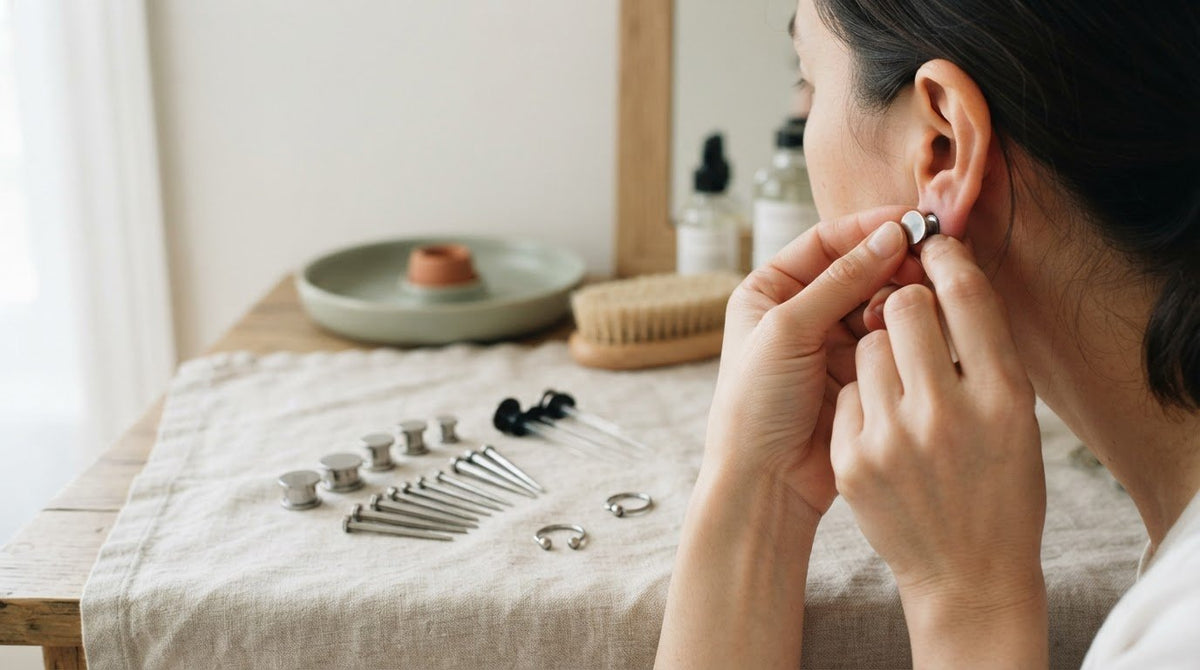
A lower price doesn’t have to mean settling for jewelry that feels like an afterthought. Finding affordable high quality body jewelry starts with matching the material and fit to your piercing, then choosing a style you’ll enjoy wearing. Circular barbells and captive bead rings offer versatile ways to try a look beyond standard studs.
Look beyond appearance: the right piece should suit both your piercing and your personal style. This guide explains how materials, sizing, and placement shape your choice, and what to consider when selecting plugs, tunnels, rings, and other jewelry. You’ll also learn how to weigh design against practical details and stay within your budget.
Key Takeaways
- Match jewelry shapes to your piercing’s placement and how you want the piece to sit.
- Learn which material considerations can help you make a more informed choice, especially if nickel sensitivity is a concern.
- See how plugs and tunnels differ in appearance and what to consider when choosing between them.
- Explore how circular barbells and captive bead rings can bring a distinctive look to suitable piercings.
Jewelry categories and piercing placements
Clean removable jewelry with warm water and mild soap, then rinse and dry it thoroughly. For a healing piercing, follow its aftercare instructions and use saline spray or cleaning swabs as directed. Avoid removing jewelry unless it is appropriate for that piercing.
Placement affects both shape and movement. A nostril piercing commonly uses a small stud or hoop, while a septum piercing can suit a circular barbell. Lip piercings often use labret-style jewelry, and navel jewelry typically follows the curve of the navel. These examples show why one shape won’t fit every piercing comfortably.
Ear piercings offer a wide range of placements and silhouettes. A lobe piercing can take a stud, hoop, or plug, while cartilage locations such as the helix often suit a fitted stud or ring. For an industrial piercing, a straight barbell connects two ear piercings. Match the jewelry’s shape to the piercing’s position, not just the overall look of the ear.
Consider how the piece will sit during everyday activities. A hoop can move more than a close-fitting stud, while a barbell spans a specific path through the ear. For multiple ear piercings, vary the jewelry by placement, such as pairing a small stud in one lobe with a hoop in another. Check that each piece fits its piercing without pressing against nearby jewelry.
Fake piercings let you try a placement without adding a piercing. Clip-on cuffs can sit along the outer ear, while magnetic or clip-on pieces create the look of a nose or septum ring. For example, try an ear cuff beside a helix piercing before choosing a permanent placement. These accessories decorate the surface rather than passing through a piercing.
- Choose by location: consider the route and position of each piercing.
- Plan the look: use studs, hoops, or cuffs to create contrast.
- Care thoughtfully: clean removable pieces and follow healing-piercing aftercare instructions.
Body jewelry materials
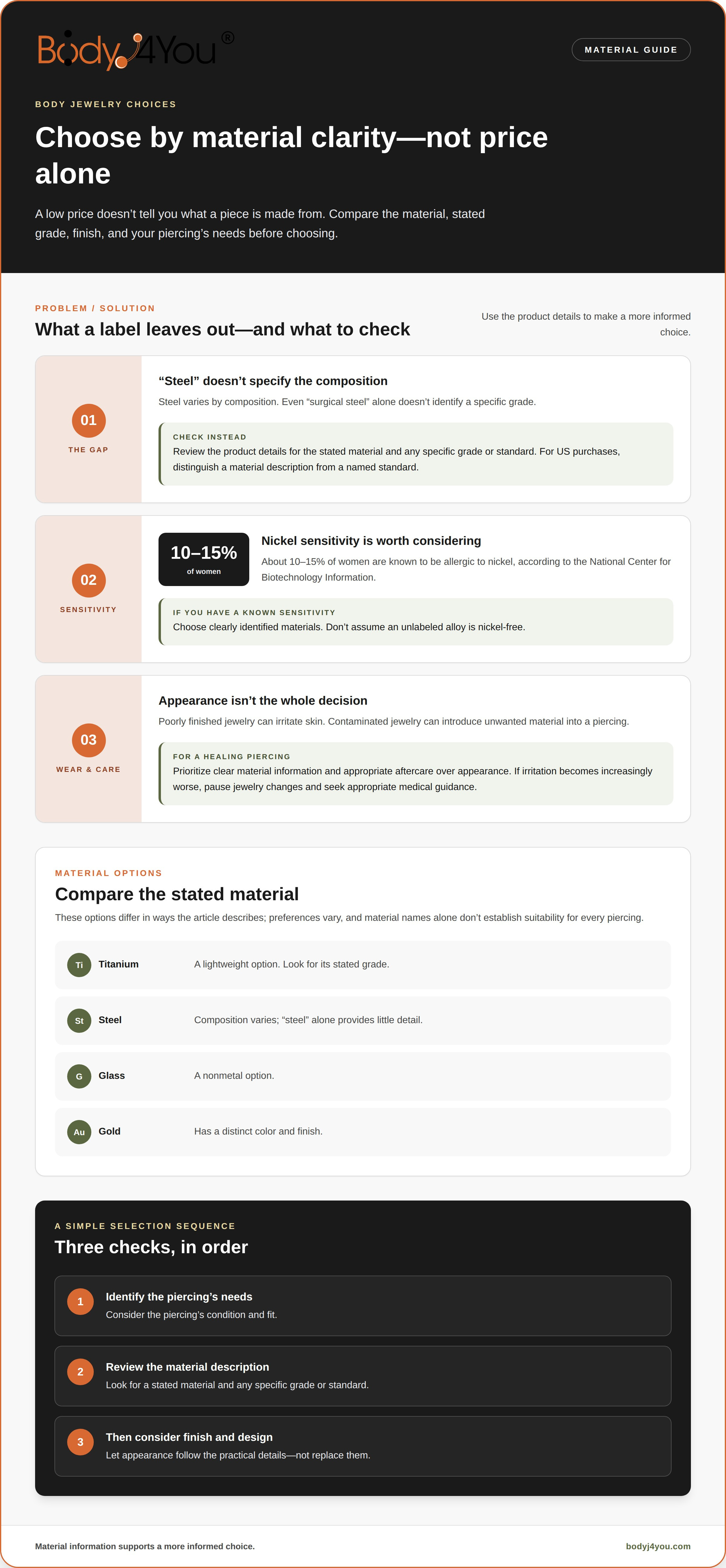
Material affects appearance, wear, and sensitivity. Compare the composition, finish, and any stated grade before choosing.
Material Options
Titanium is a lightweight option, so look for its stated grade. Steel varies by composition, which means “steel” alone provides little detail. Glass offers a nonmetal option, while gold has a distinct color and finish. Preferences differ, but the piercing’s condition matters too. For a healing piercing, prioritize clear material information and appropriate aftercare over appearance alone.
Material Standards and Labeling
For US purchases, distinguish a material description from a named standard. A label that says “steel” doesn’t identify the exact composition, and “surgical steel” alone doesn’t specify a grade. Review the product details for the stated material and any specific grade or standard. Labels can clarify what a piece is made from, but a material name alone doesn’t establish suitability for every piercing.
Risks of Cheap Jewelry
Price alone doesn’t reveal composition or finish. Poorly finished jewelry can irritate skin, while contaminated jewelry can introduce unwanted material into a piercing. Nickel sensitivity is another consideration: about 10-15% of women are known to be allergic to nickel, according to the National Center for Biotechnology Information. If you have a known sensitivity, choose clearly identified materials and avoid assuming that an unlabeled alloy is nickel-free.
Follow a simple selection sequence: identify the piercing’s needs, review the material description, then consider the finish and design. For stretched ears, a Surgical Steel Taper and Plug Kit is a category-specific option; material choice still matters, especially if sensitivity is a concern. If a piercing becomes increasingly irritated, pause jewelry changes and seek appropriate medical guidance rather than relying on material labels alone.
Plugs and tunnels
For stretched ear piercings, plugs and tunnels create different silhouettes. A plug fills the opening with a solid face, while a tunnel leaves an open center that frames the earlobe. Both come in varied shapes and finishes, so the choice changes the look from the front and side. Compare the wearable area, ends, and material before choosing. These details help narrow affordable high quality body jewelry options to pieces that suit your style.
Fit comes first. Match the jewelry’s stated size to the size your piercing currently wears comfortably. Don’t treat a new plug as a stretching tool. For example, a flared end may not pass through an opening like a straight-sided plug. Check how the ends are shaped and secured, then consider whether the piece sits smoothly without pinching or slipping.
Plugs can create an even display across stretched lobes. Tunnels show the opening and can create contrast with the skin or background. A pair of black tunnels creates a different effect from polished metal plugs. These are styling examples, not material recommendations. When choosing affordable high quality body jewelry, consider the stated material alongside your piercing’s needs.
- Plugs: solid fronts offer a filled-in look for stretched lobes.
- Tunnels: open centers make the piercing visible through the jewelry.
- Weights and hangers: decorative pieces add movement and visual emphasis.
Weights and hangers differ from standard plugs because their designs draw the eye downward. A decorative hanger may suit a planned outfit, while a plain plug can be a quieter everyday choice. Consider how the piece moves and rests during wear. Don’t use heavy-looking jewelry to force a stretch; appearance alone doesn’t show whether the size is appropriate.
Choose with fit, shape, and occasion in mind. First, identify the size your piercing currently wears comfortably. Next, choose a plug or tunnel design that matches it. Then decide whether a solid face, open center, or hanging silhouette suits your look. This sequence helps you choose thoughtfully without treating jewelry as a substitute for gradual stretching.
Circular barbells and captive bead rings
Circular barbells and captive bead rings create a curved silhouette, but their closures differ. A circular barbell forms a horseshoe, with an opening between its ends. A captive bead ring forms a complete circle, with a bead held between the ends. This small design difference affects both the look and how each piece opens.
Circular barbells can suit piercings where a curved bar sits comfortably, such as septum or eyebrow piercings. Their visible ends may be simple balls or decorative details. Before choosing one, match its gauge and diameter to the established jewelry size for the piercing. A diameter that’s too small can feel tight; one that’s too large may sit awkwardly or catch during wear.
A captive bead ring creates an uninterrupted circular outline, with the bead as a focal point that can add a contrasting finish or detail. Depending on fit, these rings can be used for nostril, septum, and ear piercings. Check that the ring’s diameter suits the piercing and that the bead sits securely. Don’t force the bead or ring into place.
- Choose a circular barbell for a curved shape with visible ends.
- Choose a captive bead ring for a continuous circle and centered bead.
- Compare fit details such as gauge, diameter, and closure style.
For either design, comfort depends on proportion, not appearance alone. A slim ring can look understated, while a larger diameter creates a more open curve. If the piercing is healing, don’t change jewelry based only on styling; movement and fit matter. For a healed piercing, consider how the ring rests and whether the closure feels secure during everyday wear.
Explore captive bead rings and industrial barbells to compare these curved and bar-based styles for your jewelry collection.
BodyJ4You
BodyJ4You brings together body jewelry and piercing-care options for different needs. If you’re choosing pieces for stretched ears, the Acrylic Ear Stretching Kit and Surgical Steel Taper and Plug Kit offer focused options to explore. For other style choices, Captive Bead Rings provide a distinct circular design.
Care matters alongside appearance. Saline Piercing Aftercare Spray, Piercing Bump Treatment Oil, and Piercing Cleaning Swabs support piercing-care routines. Choose jewelry with your piercing’s placement, fit, and material needs in mind, then select care products suited to your routine. This approach helps you consider style and upkeep together, rather than treating them as separate decisions.
For help exploring body jewelry and piercing-care options, contact BodyJ4You.
Choose Your Next Piece With Confidence
Your next jewelry choice can reflect your style while respecting what feels right for your piercing. Keep fit, material, and placement in view, then choose a design that feels like you. With affordable high quality body jewelry, thoughtful selection matters more than chasing a trend. For those looking to extend that thoughtful approach to their overall skincare and self-care routine, Devotion Beautique provides tailored treatments and curated skincare solutions that support your personal aesthetic.
BodyJ4You offers options for different stages and preferences, including the Acrylic Ear Stretching Kit, Surgical Steel Taper and Plug Kit, and Saline Piercing Aftercare Spray. These products can help you explore stretching-related jewelry or support an established care routine, while your choice of jewelry remains personal to your placement and needs.
Take the next step at your own pace. If you’d like help exploring these options, contact BodyJ4You for help. Choose with care, express your style, and let your jewelry feel at home with you.
Frequently Asked Questions
What materials are safest for body jewelry, such as implant-grade titanium, niobium, and 14k gold?
No single material suits every wearer or piercing. Implant-grade titanium, niobium, and 14k gold are material options people may consider, but the exact composition and grade matter. For example, someone sensitive to a particular metal should prioritize precise material details over color or finish. For a healing piercing, choose jewelry based on its needs and seek professional guidance when material suitability is uncertain.
How can I identify high-quality body jewelry and verify material certifications?
Look for a specific material description and, where relevant, a stated grade or standard. A broad label such as “metal” provides little detail, while a named material makes comparison more informed. If a seller mentions a certification, check the product information to see what it covers. Smooth finishing, secure closures, and clearly stated dimensions are practical details to assess.
Where can I buy affordable body jewelry from reputable US retailers?
BodyJ4You is a US-based online retailer offering body jewelry and piercing-care products. Its range includes Captive Bead Rings and Internal Threaded Labret Studs, alongside stretching kits and aftercare options. ” Review the item’s material description and fit information before choosing, especially when replacing jewelry for a specific piercing.
How do body jewelry prices and quality compare across titanium, surgical steel, gold, and bioplast?
Compare the stated composition, material grade, finish, and construction instead of relying on material names alone. Titanium, surgical steel, gold, and bioplast differ in composition and appearance, so the right comparison depends on the piercing and your preferences. Closure details matter too: a ring’s bead or a barbell’s ends affect its construction. A price comparison alone can’t establish quality without matching product details.
What body jewelry sizes and gauge measurements are most common?
There isn’t one size for every piercing. Jewelry dimensions vary by location and design, so compare the gauge, wearable length, and ring diameter listed for the specific piece. For example, a curved barbell and a labret stud need different measurements, even if both suit facial piercings. Use the dimensions of jewelry that currently fits comfortably as a reference, not the appearance in a photo.
How do I choose body jewelry that fits a piercing correctly?
Match the jewelry’s gauge and wearable dimensions to the piercing’s established fit. A labret stud needs a wearable length that sits comfortably, while a captive bead ring needs an appropriate diameter and a secure bead. Consider the piercing’s position and how nearby jewelry may interact. Don’t force a piece that catches, presses, or feels too tight. Let fit guide the choice, not styling alone.


