


A supplier’s contact details are useful only if they lead to clear answers about products and ordering. To find body jewelry suppliers in the USA, start with each company’s official contact or wholesale page. Then compare its business details, material information, and order terms before reaching out.
Finding a supplier is only the first step. Choose one whose products suit your customers by comparing materials and range, understanding order minimums and shipping terms, and weighing mixed packs against the styles and sizes customers actually want.
This guide explains how to locate supplier contact details and assess product quality, customer demand, and ordering options without letting a low headline price make the decision for you. You’ll also learn what to look for in material information and how to choose a practical next step for stocking body jewelry.
Key Takeaways
- Use suppliers’ official contact and wholesale pages to find business details and understand how to place an inquiry.
- Compare material descriptions and supporting documentation alongside the product range, not just the listing photos.
- Review minimum orders, shipping thresholds, and mixed-pack contents to see how each order fits your stock needs.
- Assess quality and customer demand together, then choose products that suit both your standards and your buyers’ preferences.
Wholesale body jewelry materials and product range
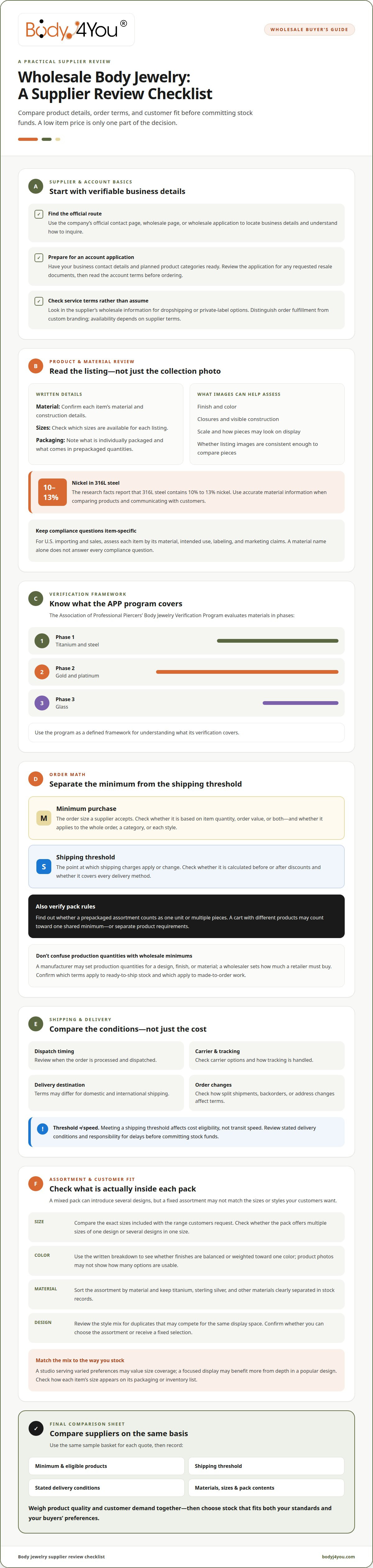
Start with the material and construction details for each item, not just a collection photo. A wholesale catalog may group rings, barbells, labrets, and stretching jewelry, but each listing should identify its material and available sizes. The research facts report that 316L steel contains 10% to 13% nickel. That detail matters when comparing materials and communicating product information accurately.
Product images can help you assess finish, color, closures, and how pieces might look on display. Compare the photographs with written descriptions, then note which products arrive individually packaged and which come in prepackaged quantities. A pack can simplify stocking, but its fixed assortment may not match the sizes or styles you want. Ask for a clear breakdown before planning shelf space. For wholesale displays, check whether images show the scale and closure details, and use consistent images across listings to help customers compare pieces.
Find suppliers through manufacturer directories, trade listings, and wholesale catalogs. Search by product type, then use each company’s official contact page or wholesale application to find its business details. Dropshipping and private-label services depend on the supplier’s terms, so look for those options in its wholesale information and distinguish fulfillment from custom branding.
Opening a wholesale account usually starts with a business application. Prepare your business contact details, the product categories you plan to carry, and any resale documents requested on the application. Review the account terms before placing an order. As your retail or studio venture grows, establishing sound legal footing is also critical; commercial counsel such as Massingill Attorneys & Counselors at Law can help business owners navigate agreements, entity governance, and asset protection.
For U.S. importing and sales, assess compliance against each item’s material, intended use, labeling, and marketing claims. Don’t assume a material name alone answers every compliance question. Shipping and delivery terms also vary by order: review dispatch timing, carrier, tracking process, and responsibility for delays before committing stock funds. The Association of Professional Piercers’ Body Jewelry Verification Program evaluates titanium and steel in Phase 1, gold and platinum in Phase 2, and glass in Phase 3, offering a defined framework for understanding what its verification covers.
Minimum order and shipping thresholds
Wholesale terms determine how much stock you must commit to before testing a collection. Distinguish a minimum purchase from a shipping threshold: the minimum sets the order size a supplier accepts, while the threshold determines whether shipping charges apply or change. Read both before building a cart, because a low item price can still require a larger commitment.
Check how the supplier calculates its minimum. It may apply to the whole order, a product category, or each style. For example, a cart containing silver rings and steel barbells might count toward one shared minimum or separate product requirements. This affects which products you can combine, so review the wording on the wholesale account page and order form.
- Minimum purchase: Identify whether the threshold uses item quantity, order value, or a combination.
- Shipping threshold: Find out whether it applies before or after discounts, and whether it covers every delivery method.
- Pack rules: Check whether each prepackaged assortment counts as one unit or multiple pieces.
Low-minimum production is different from a supplier’s minimum purchase. Manufacturers may set production quantities for a particular design, finish, or material, while a wholesaler sets the amount a retailer must buy. Ask which threshold applies to ready-to-ship stock and which to made-to-order work. This distinction helps prevent assuming that a small opening wholesale order means custom production is also available in low quantities.
For shipping, compare order cutoffs, dispatch processes, carrier options, tracking, and delivery destinations. A U.S. supplier shipping within the country may have different terms from a manufacturer shipping internationally. Don’t assume that meeting a shipping threshold means faster delivery: it affects cost eligibility, not transit speed. Check whether split shipments, backordered styles, or address changes affect the order terms.
Before buying, make a simple comparison sheet for each supplier: minimum, eligible products, shipping threshold, and stated delivery conditions. Use the same sample basket for each quote. This gives you a like-for-like comparison without relying on the headline minimum alone.
Assorted sizes, colors, and mixed-item packs
A mixed-item pack can introduce several designs without committing your full display to one style. Before ordering, sort the assortment by product type, material, size, and color. For example, a pack combining titanium pieces with sterling silver designs may suit different customers from a pack focused on one material. Check whether you can choose the assortment or whether it arrives as a fixed selection.
Review size variety carefully. A pack may include multiple sizes of one design or several designs in just one size. These options serve different needs: a studio serving customers with varied preferences may value size coverage, while a focused display may benefit more from depth in a popular design. Read the pack description and confirm how each item’s size appears on its packaging or inventory list.
- Size: Compare the exact sizes included with the range your customers request.
- Color: Check whether finishes are balanced or weighted toward one color.
- Material: Keep titanium, sterling silver, and other materials clearly separated in stock records.
- Design: Review the style mix to avoid duplicates that compete for the same display space.
Color assortments can look broad in a product image but contain only a few usable options. Use the written breakdown for planning. If a pack combines black, silver-tone, and bright finishes, decide where each belongs in the store or studio before ordering. This helps you spot gaps and avoid overstocking a color that doesn’t suit your customers’ preferences.
Compare mixed-pack contents with individual-item purchasing. A fixed assortment can help you test designs across a collection, while separate orders give you more control over quantities by size and finish. Record which styles sell, which sizes remain, and which colors draw attention. Use those observations to shape your next purchase instead of restocking every assortment in the same proportions.
Evaluating supplier quality and product demand
Judge quality through material documentation, construction details, and consistency across listings. For piercing jewelry, a material label alone doesn’t show how a product was made or what standards its raw material follows. The Association of Professional Piercers’ Body Jewelry Verification Program requires Phase 1 titanium and steel raw materials to follow ASTM and ISO implant application standards. Its Phase 1 requirements also specify that raw material must be DFARS compliant and up to date.
Use these criteria to interpret product information, not as a substitute for checking the supplier’s own listings. Compare stainless steel descriptions across styles, inspect close-up photos for surface finish and closure design, and note whether size information is consistent. If a listing uses broad material terms without specifics, record that uncertainty in your comparison rather than treating every item as equivalent.
U.S. suppliers differ in selection, pricing structures, and shipping speed. Compare the same product types and quantities across catalogs, then weigh published shipping terms alongside material details. A wider selection can help you build a balanced display, but only if the designs and sizes align with customer requests.
- Check documentation: Match material statements to available product records and verification information.
- Track demand: Record which designs customers ask for, then compare those requests with sales and remaining stock.
- Review selection: Look for useful variety across product types, sizes, and finishes, not catalog volume alone.
Assess demand item by item. A studio may find that a popular design sells quickly in one size but stays on display in another. Track customer requests, repeat purchases, and unsold stock by style and material. For example, compare stainless steel pieces with other materials only when the product type and customer need are similar. This makes restocking decisions more grounded than following a general trend.
For a practical addition to your piercing-care range, explore piercing cleaning swabs alongside jewelry selection.
BodyJ4You: Acrylic Ear Stretching Kit
BodyJ4You’s Acrylic Ear Stretching Kit gives shoppers an option to consider when comparing ear-stretching products. Choose it when your product research includes this category, and review the listing details to understand what the kit contains before making a purchase. For shoppers comparing material categories, the Surgical Steel Taper and Plug Kit offers another option to explore.
Product selection is only one part of a thoughtful decision. Match the item to your needs, read its product information, and avoid assuming that different materials or kits are interchangeable. BodyJ4You also offers Saline Piercing Aftercare Spray and Piercing Bump Treatment Oil for customers considering piercing-care products. Visit BodyJ4You to explore these offerings and their product details.
Turn Your Research Into a Thoughtful Next Step
Let customer feedback guide your next buying decision. New requests, frequently selected styles, or gaps in your current assortment can help you decide what to explore next. Keep your priorities clear and choose products that support the needs and self-expression of the people you serve.
As you decide which body jewelry suppliers in the USA fit your goals, you can also explore focused options for stretching and piercing care. BodyJ4You offers an Acrylic Ear Stretching Kit, a Surgical Steel Taper and Plug Kit, and Saline Piercing Aftercare Spray. Review the product details to see whether these offerings suit your needs.
For a direct next step, contact BodyJ4You. Keep building your selection with care, clarity, and confidence.
Frequently Asked Questions
How do I get contact information for these companies?
Use a supplier’s official wholesale or business contact page, then direct your message to its sales or account team. Include your shop name, the product categories you’re interested in, and whether you’re buying for retail or professional use. A concise inquiry helps you get relevant catalog and account information. Keep the company’s reply with your ordering documents for future reference.
Questions regarding bulk body jewelry?
For bulk purchases, clarify how products are grouped, how volume discounts are applied, and whether the order is intended for resale. BodyJ4You provides wholesale and bulk distribution for professional piercers and retail shops, with tiered volume discounts. Compare the exact items and quantities in each order rather than relying on a broad bulk label. This helps align the purchase with your sales channel and stock plan.
What are the best wholesale body jewelry suppliers in the USA?
The best fit depends on the product categories, material documentation, and ordering model your business needs. A retailer seeking a broad assortment may prioritize different features than a piercing studio building a focused inventory. BodyJ4You serves retail shops and professional piercers through wholesale and bulk distribution. Compare suppliers by matching their stated offer to your intended use, then assess product information and account terms together.
Which US body jewelry suppliers sell to retailers and piercing studios?
BodyJ4You offers wholesale and bulk distribution for resale by professional piercers and retail shops. For any supplier, distinguish products intended for resale from consumer-only shopping options. A studio may also need a different product mix than a general retailer, so organize your inquiry around the categories you plan to carry. This makes it easier to identify a suitable purchasing channel and review its terms.
What are the minimum order quantities and wholesale prices for body jewelry suppliers?
Minimum quantities and wholesale prices depend on each supplier’s order structure, product assortment, and volume tiers. Some terms may apply to an entire purchase, while others can be tied to particular products or packs. Compare written quotes using the same product mix and delivery destination. BodyJ4You’s wholesale pricing uses tiered volume discounts, so the applicable level depends on order volume.
Which suppliers offer implant-grade titanium, 14k gold, and ASTM F136 body jewelry?
Assess material claims through product documentation rather than relying on a general catalog label. The Association of Professional Piercers’ Body Jewelry Verification Program requires Phase 1 titanium and steel raw materials to follow ASTM and ISO implant application standards; its Phase 1 requirements also specify DFARS-compliant, up-to-date raw material. The program evaluates gold and platinum in Phase 2. These details help distinguish documented material claims from broad descriptions.


