

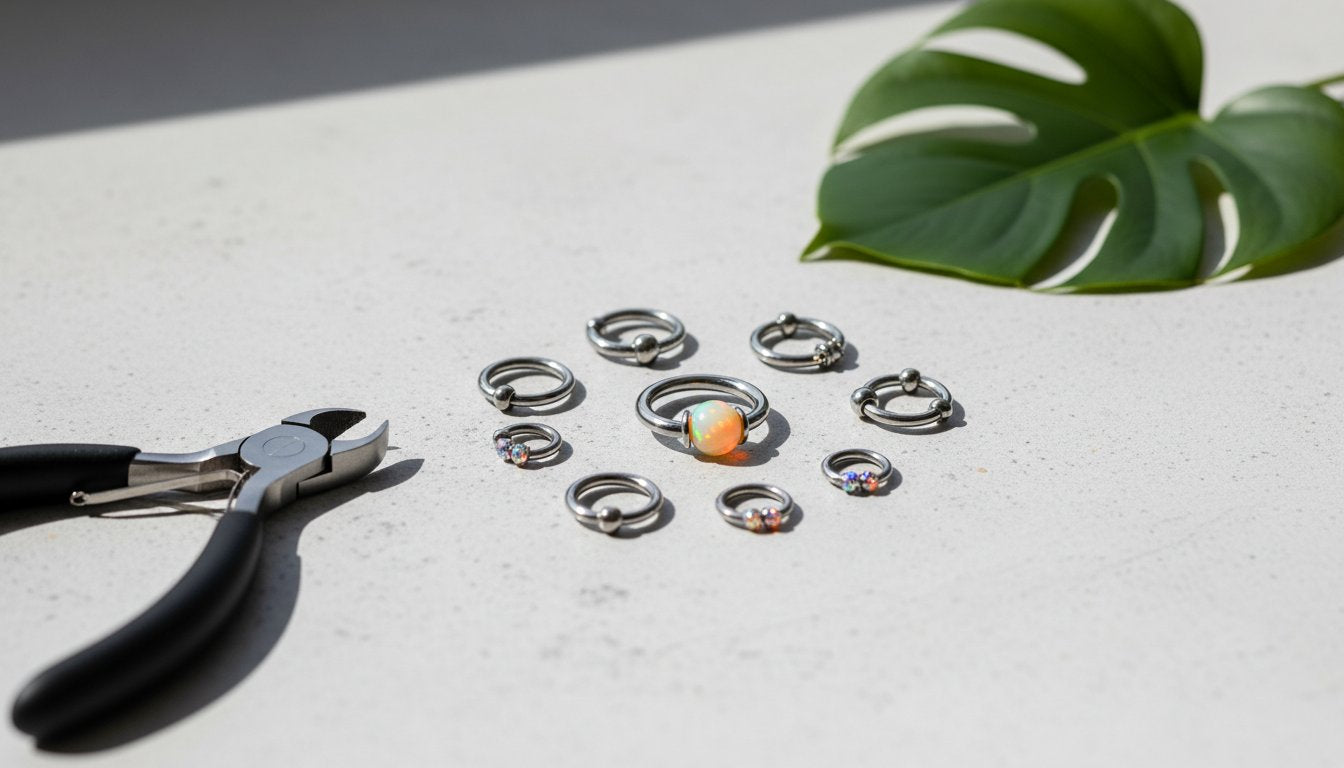
The most reliable piece of jewelry in your collection isn't the one that clicks into place; it's the one held together by the elegant physics of tension. While clickers offer convenience, they often lack the 360-degree structural integrity found in captive bead rings, leaving many enthusiasts worried about losing beads or struggling with complex sizing. You want your self-expression to feel secure, safe, and effortless, yet the confusion over gauge diameters and the fear of jewelry falling out often create unnecessary stress. It's frustrating to feel like you need a professional toolkit just to refresh your look at home.
At BodyJ4You, we believe body modification is a journey toward empowerment that requires both creative flair and clinical precision. With the United States leading 21.4% of the global jewelry market, understanding the mechanics of your hardware is more important than ever. This guide will help you master the tension-set system, navigate biocompatible standards like ASTM F136 titanium, and gain the confidence to change your jewelry safely. We'll explore everything from $4 opal ends to high-end sculptural pieces, ensuring your collection remains healthy, safe, and effective. Level up your style by learning the expert techniques behind the industry's most versatile essential.
Key Takeaways
- Master the physics of tension to ensure your jewelry remains secure and structurally sound without the risk of loose components.
- Identify the clinical differences between 316L surgical steel and Grade 23 titanium to protect your skin's health and long-term wellness.
- Learn the professional techniques for opening and closing captive bead rings at home using both manual methods and specialized tools.
- Discover how to curate a sophisticated, high-end aesthetic by mixing ring diameters and bead materials for a personalized look.
- Understand the importance of material certifications like ASTM F136 to ensure your collection remains healthy, safe, and effective.
What is a Captive Bead Ring (CBR)? Understanding the Basics
A Captive Bead Ring is a masterpiece of functional design. It relies on the natural tension of metal to create a secure, 360-degree loop. Unlike traditional earrings that use friction backs or clickers with delicate hinges, these rings are held together by the hoop's inherent desire to close. This creates a "captive" environment for the bead, which sits firmly between the two ends of the wire. The result is a piece of jewelry that is healthy, safe, and effective for long-term wear in almost any placement.
Historically, the body modification community embraced this style for its extreme reliability. It has no threads to strip and no hinges to fail. This makes it a foundational piece for anyone prioritizing skin health and jewelry longevity. Whether you are styling a classic lobe or a complex daith, captive bead rings offer a level of stability that other styles simply cannot match. With the global body piercing jewelry market projected to reach $15,690.75 million by 2033, the demand for these structural essentials remains rooted in their proven performance.
The Anatomy of a Captive Ring
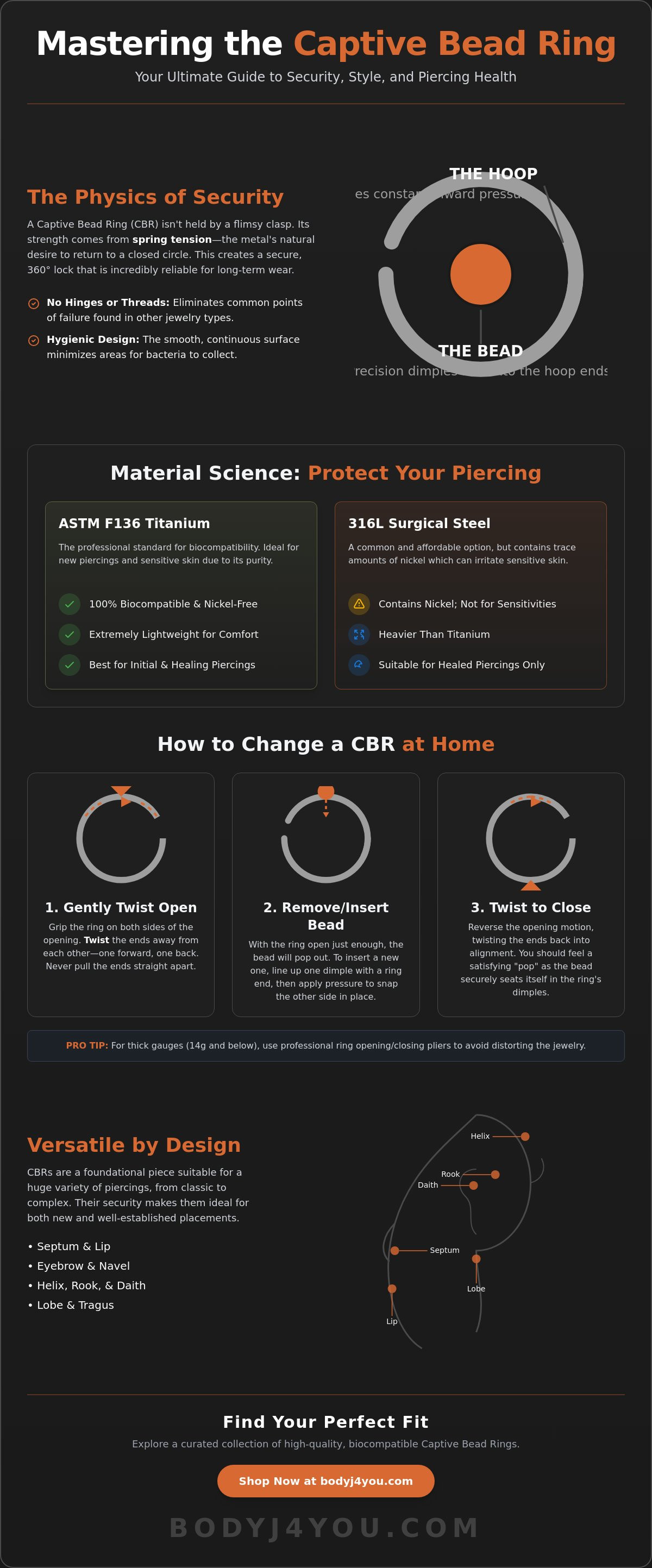
The hoop is the engine of the jewelry. It is crafted with "metal memory," a property that ensures the wire constantly pushes inward. The bead features two precision-carved dimples on opposite sides. When you align the hoop ends with these dimples, the tension locks the bead in place. While "fixed bead rings" weld the bead to one side for easier installation, a true captive ring allows the bead to be fully removed. This design is empowering for those with sensitive skin, as it eliminates the hidden nooks where bacteria often collect.
Captive Bead Rings vs. Segment Rings
Segment rings offer a seamless, infinite loop aesthetic, but they often sacrifice security for style. A CBR uses the bead as both a focal point and a structural anchor. This makes them significantly harder to knock loose during daily activities or sleep. For beginners, the bead provides a clear visual indicator of a successful closure. Segment rings can be notoriously difficult to align without professional help. In contrast, captive bead rings are more approachable for at-home changes once you master the basic mechanics.
Common placements for this versatile jewelry include:
- Ears: Helix, rook, daith, and standard lobes.
- Face: Septum, eyebrow, and lip piercings.
- Body: Navel and various intimate locations.
Choosing the right hardware is about more than just aesthetics; it's about the integrity of your skin. By understanding these basics, you can level up your collection with confidence and professional precision.
The Mechanics of Tension: How Captive Jewelry Stays Secure
The security of captive bead rings isn't based on a screw or a latch. It's grounded in the physical property of spring tension. When a hoop is manufactured, it's tempered to stay in a closed circle. To insert the bead, you must briefly pull those ends apart. The metal naturally resists this displacement. This constant inward pressure is what keeps the bead "captive." It's a stabilizing force that protects your piercing from accidental snags or jewelry loss. Understanding this physics makes the jewelry feel less like a puzzle and more like a reliable tool for self-expression.
Physics works in your favor here. Because the ring is always pushing inward, it creates a closed loop that's incredibly difficult to break by accident. This is why many athletes and active individuals prefer this style. It doesn't have a hinge that can flip open or a thread that can unscrew. It simply stays put. This reliability is why the Association of Professional Piercers often highlights the importance of choosing properly structured jewelry for both new and healed sites. When your jewelry is secure, your skin stays healthy.
Dimpled Beads and Locking Grooves
The bead isn't just a decorative ball. It features two small indentations or dimples. These are precision-engineered to match the curvature of the ring's ends. When the hoop snaps into these dimples, it creates a locking mechanism that prevents the bead from rotating or sliding out. Some high-end designs use notched beads for even deeper security. If the bead size isn't perfectly calibrated to the ring diameter, the tension will be uneven. This can lead to a loose feel that compromises the jewelry's integrity. A perfect fit ensures the bead stays centered and stable.
The Strength of Different Gauges
Gauge thickness dictates exactly how much force you need to apply. For 18g and 16g rings, most people can manage the tension with their fingers. These are common for ear cartilage and nose piercings. However, once you move to 14g or larger, the metal's resistance increases significantly. At this thickness, the hoop is incredibly rigid. You'll likely need ring opening pliers to create enough space for the bead. Larger diameters also affect the feel. A small 8mm ring in 14g will feel much stiffer than a 12mm ring of the same gauge because the shorter arc of the metal provides less leverage.
Even the best jewelry has limits. If you pull the hoop open too wide, you can exceed the metal's elastic limit. This results in an over-stretched ring where the gap is now wider than the bead. You'll know this has happened if the bead spins freely or falls out with a light touch. It's a safety risk. A ring that has lost its memory can no longer provide the protective tension required for a secure fit. If you notice your hardware is losing its grip, it might be time to refresh your collection with a new, high-tension piece to keep your look safe and effective.
Material Science: Choosing the Right Metal for Your Skin
Selecting the right material for your jewelry is a decision that bridges the gap between beauty and biology. Your skin is a living organ, and the metal it hosts must be healthy, safe, and effective. While 316L surgical steel remains the industry standard for its durability and affordability, it often contains trace amounts of nickel. For those with sensitive systems, even small concentrations can trigger irritation. This is why many enthusiasts are shifting toward implant-grade options that meet rigorous biocompatibility requirements. Captive bead rings crafted from materials that follow ASTM F138 or ASTM F136 standards ensure that your self-expression never compromises your physical well-being.
Grade 23 Titanium (ASTM F136) is the premier choice for long-term wear. It is entirely nickel-free and highly resistant to corrosion from body fluids. If you prefer a splash of color without the risks of low-quality plating, Niobium is an excellent alternative. It is a "soft" metal that allows for vibrant anodized finishes and easier hand-adjustments. For those seeking luxury, solid 14k gold offers a timeless aesthetic, though PVD (Physical Vapor Deposition) coatings on titanium can provide a similar look with superior durability for daily use. Always ask for a Mill Test Report to verify the chemical composition of your hardware.
Hypoallergenic Options for Healing Piercings
Fresh piercings require a non-porous surface to prevent bacteria from colonizing the wound site. Following the Oregon Health Authority jewelry standards, only specific biocompatible metals should be used in initial procedures to ensure a stable recovery. Titanium is the gold standard here because it is chemically inert and won't react with your body's natural healing process. This reduces the risk of the dreaded "piercing bump" and keeps the surrounding tissue calm and healthy. Using high-quality captive bead rings during the transition from a fresh to a healed piercing is a proactive way to protect your skin's integrity.
Weight and Comfort Factors
Metal density plays a significant role in your daily comfort, especially in piercings prone to "sagging" like the earlobes. Titanium is approximately 45% lighter than stainless steel, providing a "barely there" feel that prevents tissue stretching over time. Thermal conductivity is another vital consideration. In cold environments, steel can rapidly sap heat from your skin, leading to discomfort or "jewelry bite." Titanium and Niobium have lower thermal conductivity, making them far more comfortable in extreme weather. By choosing a metal with a high weight-to-strength ratio, you can level up your style without the physical burden of heavy hardware.
The Practical Guide to Opening, Closing, and Troubleshooting
Mastering the installation of captive bead rings is an empowering milestone in your journey of self-expression. It requires a blend of patience, precision, and practice. For common sizes like 18g or 16g, you can often manage the process with your fingers alone. Start by holding the ring firmly and seating one end into a dimple on the bead. Using your thumb as a lever, apply steady pressure to the other side of the ring until the second end clicks into the opposite dimple. It should feel stable and centered. If you're struggling, stop and take a breath. Excessive fumbling can irritate the skin or lead to a piercing bump, which compromises your long-term wellness.
Safety and maintenance are the foundations of a healthy piercing. You should never use household pliers from a standard toolbox. These tools have serrated teeth designed for industrial grip, not for the delicate surface of body jewelry. They will leave microscopic scratches that can harbor bacteria and cause internal irritation. To keep your hardware in peak condition, use a saline solution to keep the tension points free of debris. Skin cells and oils naturally accumulate in the dimples over time. If left uncleaned, this buildup can eventually cause the bead to slip or the metal to lose its grip. Clean jewelry is safe jewelry.
Using Ring Opening Pliers Safely
Specialized ring opening pliers are designed with small grooves on the outside of the jaws. These hold the hoop securely while you apply gentle outward pressure. The goal is to expand the gap just enough for the bead to slide in or out. If you apply too much force, you'll exceed the metal's elastic limit and ruin the spring tension. To re-set a ring that has become too loose, you'll need ring closing pliers to carefully bring the ends back together. This professional approach ensures your jewelry remains healthy, safe, and effective for years to come.
The Lost Bead Dilemma
It happens to even the most experienced enthusiasts: a bead drops and vanishes into the carpet. If you're in public, don't panic. You can temporarily secure the hoop by rotating it so the gap stays away from the exit points of the piercing, but this is only a short-term solution. To find a replacement that fits, you must know your ring's exact gauge and the bead's diameter. Most 16g captive bead rings utilize a 3mm or 4mm bead. Using a digital caliper is the most accurate way to measure your hardware. If your jewelry feels loose or you've lost a component, shop our selection of replacement beads and tools to restore your look with expert-crafted hardware.
Curating Your Look: Styling Captive Rings for Every Piercing
The "Curated Ear" aesthetic is a modern movement toward intentional, sculptural design. It isn't just about adding more jewelry; it's about balance. Mixing captive bead rings with delicate studs and seamless hoops creates a rhythmic flow across the ear's anatomy. This trend is driving significant growth, as the global body piercing jewelry market is estimated to reach USD 8,120.50 million in 2026. For areas that experience constant movement, such as nipple or navel placements, the CBR is the superior choice. Its lack of sharp edges or protruding bars makes it healthy, safe, and effective for active lifestyles. The ring's circular profile distributes pressure evenly, which helps prevent the irritation often caused by straight barbells in high-friction zones.
Your jewelry choice is a signature of your identity. With North America holding a 35.7% share of the market, the variety of available designs has never been greater. You can choose from minimalist polished steel to ornate beads featuring synthetic opals or genuine stones. This versatility allows you to transition your look from "quiet luxury" to bold, sculptural statements without changing the fundamental hardware. It's a way to support your journey toward self-expression while maintaining the clinical precision required for long-term skin health. By selecting the right diameter and material, you ensure your collection is both beautiful and biologically compatible.
CBRs in Facial Piercings
Septum styling is particularly versatile. Choosing a snug 8mm diameter creates a minimalist look, while a 12mm ring offers a dramatic, bold statement. You can level up the aesthetic by swapping standard beads for opals or gemstones. When styling septum piercings, the bead acts as a central anchor for the face. Similarly, achieving symmetry with snake bites piercing sets requires precise diameter matching to ensure both rings sit at the same angle against the lip. Eyebrow placements often benefit from a smaller 16g or 18g ring to minimize the risk of rejection in shallow tissue.
Large Gauge Captive Rings
Heavy-duty hardware is a staple for those with stretched ear lobes. A 10g or 8g CBR provides a substantial, weighted feel that many enthusiasts find grounding. You can wear these directly through the lobe or stack them through a silicone tunnel for a layered look. Managing the weight of 10g+ jewelry is essential for tissue health. If a ring is too heavy, it can cause thinning at the bottom of the lobe over time. Choosing titanium for these larger sizes is a smart way to keep the big look without the excessive weight of steel. This keeps your self-expression rooted in care and long-term wellness.
Master Your Style with Precision Hardware
Your journey toward self-expression deserves jewelry that is as resilient as it is beautiful. By mastering the tension-set mechanics and prioritizing biocompatible materials like ASTM F136 titanium, you ensure your piercings remain a healthy part of your aesthetic. We've explored how these structural essentials provide 360-degree security and how professional tools help you maintain that perfect fit at home. Whether you're building a curated ear or styling a bold septum, captive bead rings remain the ultimate versatile choice for any collection.
Choosing the right hardware is a commitment to your long-term skin health. At BodyJ4You, our products are Crafted by Experts and Trusted by Thousands, ensuring you receive the highest level of Born in the USA Quality Control. Don't settle for hardware that compromises your comfort or safety. Shop our curated collection of high-quality Captive Bead Rings to find pieces that are rooted in care and designed for longevity. Level up your look with confidence knowing you're supported by our twenty-year history of industry expertise. Your style is an evolution; make sure your jewelry can keep up.
Frequently Asked Questions
How do I know what size captive bead ring I need?
Measure the internal diameter of your current jewelry using digital calipers for the most accurate result. Most ear cartilage piercings utilize an 8mm or 10mm diameter, while septum piercings vary based on your specific anatomy. It's also vital to confirm your gauge, which is typically 16g or 18g for standard ear placements. Consulting a professional piercer ensures your jewelry provides a healthy and comfortable fit without unnecessary pressure.
Are captive bead rings supposed to be hard to open?
Yes, they are designed with high spring tension to ensure the bead remains secure during daily activity. This resistance is a deliberate safety feature that prevents the jewelry from falling out. While 18g and 16g rings can often be manipulated by hand, thicker gauges require significant force to open. If a ring feels loose or opens too easily, it likely has insufficient tension and should be replaced immediately.
Can I sleep in my captive bead rings?
You can sleep in them comfortably because their circular design lacks the sharp posts found in traditional earrings. This makes them an excellent choice for healed piercings in high-movement areas like the ears or navel. Just ensure the bead is fully seated in the dimples before you go to bed. If you experience any pressure or irritation, consider switching to a more lightweight material like Grade 23 titanium for better comfort.
What happens if I lose the bead to my captive ring?
You must replace the bead immediately to maintain the structural integrity of the jewelry. Without the bead, the hoop can shift or fall out, which may lead to your piercing closing or becoming irritated. You can purchase individual replacement beads in various materials and designs. Always match the bead size to your ring's gauge; for example, a 16g ring typically requires a 3mm or 4mm bead for a secure fit.
Is titanium better than surgical steel for captive rings?
Titanium is generally superior for those with sensitive skin because it is 100% nickel-free and approximately 45% lighter than steel. While 316L surgical steel is durable and affordable, it contains trace amounts of nickel that can cause long-term irritation for some individuals. Choosing implant-grade titanium (ASTM F136) ensures your captive bead rings remain healthy, safe, and effective for both new and healed piercings throughout your modification journey.
Can I use a captive bead ring for a new piercing?
You can use them for new piercings provided they are made of biocompatible materials and have a large enough diameter to accommodate initial swelling. Professional piercers often recommend them for specific locations like the daith or septum. However, because they can rotate, they may carry bacteria into the wound if not cleaned properly. Always follow expert aftercare protocols and use a sterile saline spray to keep the site stable during healing.
How do I stop my captive bead ring from spinning?
You cannot stop a circular ring from spinning entirely, but choosing a diameter that fits snugly against your anatomy can significantly reduce movement. Excessive spinning often occurs when the ring is too large for the placement. If this movement causes irritation or leads to the development of piercing bumps, switching to a smaller size may be necessary. Keeping the jewelry clean also prevents debris from causing additional friction during rotation.
Do I need special pliers for a 14g captive ring?
You will almost certainly need ring opening and closing pliers for a 14g ring due to the metal's thickness. At this gauge, the spring tension is too high for most people to manipulate with their fingers safely. Using specialized tools prevents you from scratching the metal or straining your hands during installation. These tools are designed with protective grooves that hold captive bead rings securely without damaging the polished, high-end surface of the hardware.


