


Wait until your conch piercing is fully healed before changing a stud to a hoop. Knowing how to change a conch stud to a hoop starts with timing: a piercing that looks settled on the outside may still be healing internally, and hoops move more than studs.
It’s natural to want the look you’ve been waiting for, but changing jewelry too soon can cause irritation, soreness, or swelling. This guide explains how to recognize healing, choose a comfortable hoop, and approach the change carefully. If your piercing is still tender or unsettled, leave the stud in place.
Key Takeaways
- Use healing progress, not appearance alone, to decide when a hoop may be appropriate.
- Choose a hoop that matches the piercing’s gauge and suits your ear’s anatomy.
- Recognize signs of irritation that mean it’s best to keep the stud in place.
- Learn how careful timing and a gentle jewelry change can help avoid unnecessary irritation.
When Can I Change My Conch Piercing?
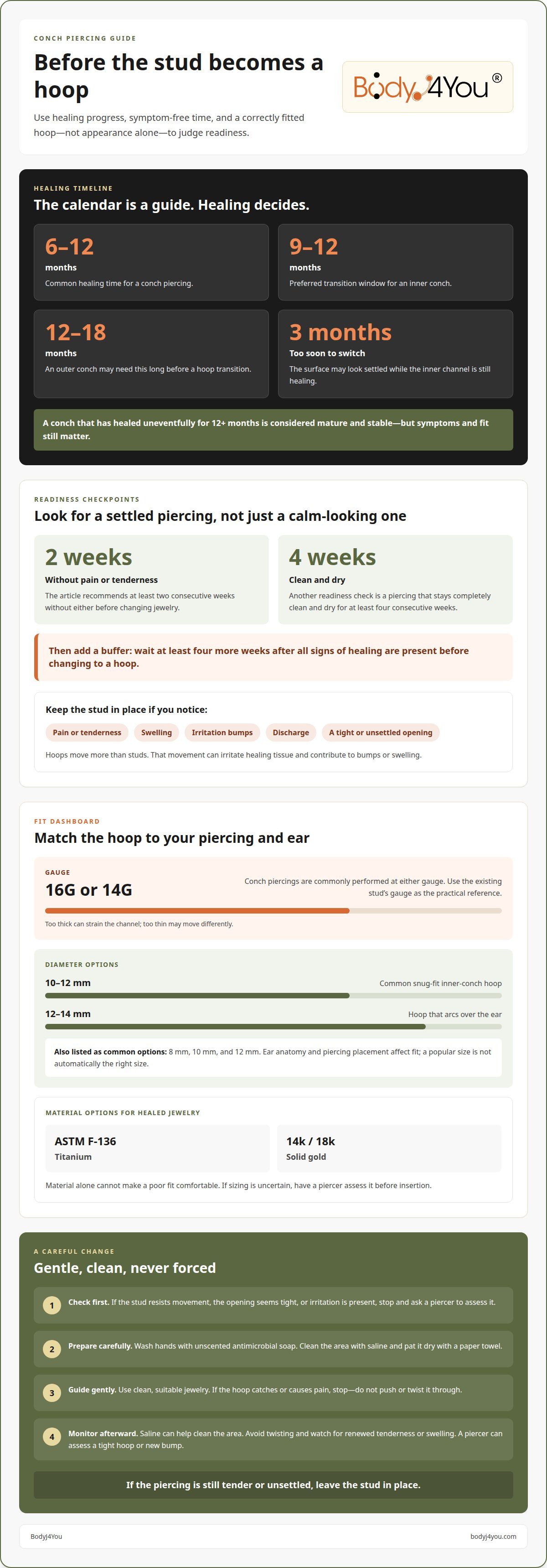
- Wait until the piercing is fully healed before switching from a stud to a hoop. An inner conch commonly transitions after 9-12 months, while the exact timing depends on healing and irritation. A piercing that looks calm externally can still be healing inside, so don't use appearance alone to decide.
- Match the hoop’s gauge to the healed piercing and the post you’ve been wearing. Conch piercings are commonly performed at 16 or 14 gauge, and hoops may be available in 16G or 14G. A hoop that’s too thick can strain the channel; one that’s too thin may move differently. The existing stud’s gauge is the practical reference.
- Choose diameter according to how you want the hoop to sit against your ear. A snug-fit inner-conch hoop is commonly 10-12 mm, while a hoop that arcs over the ear may be 12-14 mm. Common options also include 8 mm, 10 mm, and 12 mm. Ear anatomy and placement affect the fit, so a popular size isn’t automatically the right size for you.
- Prioritize room over a tight fit. A hoop that presses against the ear bowl or catches on the helix rim can feel uncomfortable and rub against the piercing. Decide whether you want a close-fitting circle or a more visible arc, then choose a diameter suited to that shape and your piercing’s position.
- Select a high-quality material suitable for healed piercing jewelry. ASTM F-136 titanium or 14k/18k solid gold are options commonly recommended for an inner-conch hoop. Check that the jewelry’s gauge and diameter both suit your piercing; material alone can’t make an ill-fitting hoop comfortable. If the fit is uncertain, have a piercer assess the sizing before insertion.
Signs a conch piercing is ready for a jewelry change
A fully healed conch piercing should feel comfortable, look settled, and stay clean and dry. Before changing jewelry, look for at least two consecutive weeks without pain or tenderness and no ongoing irritation. Healing can continue beneath the surface even when the outside looks calm.
- Assess the piercing before touching it. Look for persistent soreness, swelling, irritation bumps, or discharge. These signs may mean the channel is still unsettled, so leave the stud in place. Hoops move more than studs, and that movement can irritate healing tissue and contribute to bumps or swelling.
- Choose a professional change if you’re unsure. A piercer can assess whether the piercing is ready and help prevent jewelry from being forced through a sensitive channel. This is especially helpful if the stud resists movement, the opening seems tight, or you’ve experienced irritation. Stop rather than pushing or twisting the jewelry.
- Prepare carefully if the piercing is healed and you’re changing it yourself. Wash your hands with unscented antimicrobial soap, then clean the area with saline and pat it dry with a paper towel. Use clean, suitable jewelry, such as ASTM F-136 titanium or 14k/18k solid gold. Guide the hoop gently through the channel; if it catches or causes pain, stop and have a piercer change it.
- Keep aftercare gentle. Saline can help clean the area after the change. A Saline Piercing Aftercare Spray offers a convenient way to apply saline. Avoid twisting the jewelry, and monitor the piercing for renewed tenderness or swelling rather than repeatedly handling it.
- Respond promptly to irritation. If a new hoop feels tight or a bump develops, stop manipulating the jewelry. A piercer can assess the fit and whether switching back to a flat-back stud is appropriate. Changing jewelry should feel controlled, never forced.
Waiting for full healing before switching to a hoop
- Use the full healing timeline, not the first calm-looking weeks. A conch piercing commonly takes 6-12 months to heal. An outer conch may need 12-18 months before a hoop transition. Keep the flat-back stud in place during healing, since a hoop’s movement can disturb tissue that is still settling inside the channel.
- Don’t mistake surface healing for complete healing. The outside may appear healed within three to four months, while internal tissue continues to recover. A smooth-looking opening alone doesn’t show whether the entire channel is ready. Don’t switch based only on appearance, especially if the piercing has recently been sore, swollen, or irritated.
- Account for pressure and setbacks. Sleeping on the ear, snags, knocks, early jewelry changes, and aftercare can all affect healing time. Repeated pressure may prolong healing, which can sometimes take up to a year. Keep pressure off the ear and let the stud remain undisturbed while the tissue recovers.
- Look for a sustained symptom-free period. Before changing jewelry, the piercing should have no pain or tenderness for at least two consecutive weeks. It should also be clean and dry. If tenderness returns during this period, keep the stud in place and begin observing again once symptoms settle.
- Add a buffer after the readiness signs appear. Once all signs of healing are present, wait at least four more weeks before changing to a hoop. A conch with 12+ months of uneventful healing is considered mature and stable. This extra time gives the channel a steadier foundation before wearing jewelry that moves more than a stud.
How long to wait before changing a conch stud to a hoop
- Set a realistic earliest date. Don’t switch at three months, even if the piercing looks settled. Wait at least six months, with 9-12 months the preferred window for an inner conch. The full timeline matters because the channel can keep healing beneath the surface after the outside appears calm.
- Consider symptoms and time together. Before changing jewelry, the piercing should be completely clean and dry for at least four consecutive weeks. No date alone means a piercing is ready if it remains sore, swollen, or irritated. If symptoms return, leave the stud in and allow more time for healing.
- Account for delays. Sleeping pressure, snags, knocks, aftercare, and early jewelry changes can affect healing. A conch piercing may take up to a year to heal if it’s slept on or receives improper aftercare. Don’t treat the earliest timeline as a deadline; let the piercing’s condition guide your decision.
- Gather simple supplies before changing healed jewelry. You’ll need clean hands, unscented antimicrobial soap, saline solution, a paper towel, and a properly sized hoop. Holding a warm saline-soaked pad against the ear for five minutes can prepare the area. Don’t twist or force jewelry if you feel resistance.
- Choose help if the change isn’t smooth. A piercer can insert a seamless hoop, a process described as taking 10-30 seconds. If you’re preparing for aftercare, choose saline piercing aftercare supplies for gentle cleaning. Stop if insertion causes pain or the jewelry catches, rather than pushing through discomfort.
BodyJ4You: Internal Threaded Labret Studs
BodyJ4You’s Internal Threaded Labret Studs offer a stud option while your conch piercing continues healing. If tenderness or irritation means it’s too soon for a hoop, keeping a suitable stud in place supports a more cautious approach to changing jewelry. The goal is to wait until the piercing is fully healed, not to rush toward a different shape.
For routine cleaning, BodyJ4You also offers Saline Piercing Aftercare Spray. Use saline as part of gentle aftercare, and avoid twisting or repeatedly handling healing jewelry. Once your piercing is ready, use the timing and fit guidance above to plan the transition to a hoop.
If you have questions about BodyJ4You’s Internal Threaded Labret Studs, contact BodyJ4You.
Choose Your Next Step With Care
A conch hoop can be a meaningful style change, but a successful switch starts with choosing a time when your piercing is ready and jewelry suited to its placement. Keep it simple: don’t rush or feel pressured to follow a particular schedule. Comfort matters more than changing your look quickly.
If you’re still considering how to change a conch stud to a hoop, focus on a calm, unforced transition. Pay attention to how your ear responds, and keep aftercare gentle as you adjust to the new jewelry.
For piercing advice and care essentials, contact BodyJ4You. BodyJ4You offers an Acrylic Ear Stretching Kit, a Surgical Steel Taper and Plug Kit, and Saline Piercing Aftercare Spray for different jewelry and aftercare needs.
Take the next step at your own pace, with care and confidence.
Frequently Asked Questions
How long should a conch piercing heal before changing the stud to a hoop?
For an inner conch, wait around 9-12 months before changing to a hoop, with six months as an earlier threshold. If you’re deciding how to change a conch stud to a hoop, use both timing and healing signs rather than the calendar alone. The piercing should be settled and free from ongoing tenderness. If pressure or a snag causes irritation, give it more time.
What gauge and diameter hoop fits a conch piercing?
Match the hoop’s gauge to the existing piercing, commonly 16G or 14G for an inner conch. Diameter depends on placement and the look you want: a close fit may use 10-12 mm, while a hoop that arcs over the ear may need 12-14 mm. For example, a 10 mm ring won’t suit every ear simply because it’s a common size.
What types of hoops are best for a conch piercing?
Choose a well-fitting hoop made from ASTM F-136 titanium or 14k/18k solid gold. A seamless hoop is one option; consider its gauge, diameter, and whether its shape presses against your ear. A snug circle and a hoop that arcs over the ear create different looks. Placement and ear anatomy help determine which style is comfortable.
Should a piercer change a conch stud to a hoop for the first time?
Having a piercer handle the first change is a sensible option, especially if the hoop catches, the channel feels tight, or the fit is uncertain. A piercer can guide you through changing a conch stud to a hoop without forcing jewelry through the channel. If insertion causes pain or resistance, stop rather than twisting or pushing.
What are the risks of changing a conch piercing jewelry too early?
Changing jewelry before the channel has settled can lead to persistent soreness, swelling, irritation bumps, or a hoop that feels tight. Hoops move more than studs, so the added motion can irritate healing tissue. An early change may also extend healing: a piercing expected to heal in nine months may take 15 to 18 months instead.
What should you do if a conch piercing bleeds, swells, or hurts after changing jewelry?
Stop handling the jewelry, and don’t force it back and forth through the piercing. Mild tenderness or awareness of the new shape can happen during the first 1-3 days, but worsening pain, swelling, or bleeding needs attention. Clean gently with saline, and have a piercer assess the jewelry and piercing. Seek medical care for severe or worsening symptoms.


