


The benefits of internal threaded jewelry start with a detail you can’t see: the post has threads on the inside, and the decorative end screws into it. This leaves the post’s exterior smooth, making it less likely to catch or scrape the piercing channel during insertion or removal. The connection also holds the end securely in place.
Choosing jewelry is about more than appearance. How it fits and moves against the piercing matters, too. This guide explains how internal threading works, how the end attaches, and why a smooth post can help reduce friction against tissue. You’ll also learn how internal threading compares with external threading and what to consider when choosing piercing jewelry.
Key Takeaways
- Learn how internal and external threading differ, and how the location of the threads changes the post’s surface.
- Understand why a smooth post can pass through a piercing with less catching and scraping.
- See how the post and removable decorative end fit together to create a threaded connection.
- Explore material considerations and how Internal Threaded Labret Studs may suit your jewelry needs.
What is Internally Threaded Jewelry?
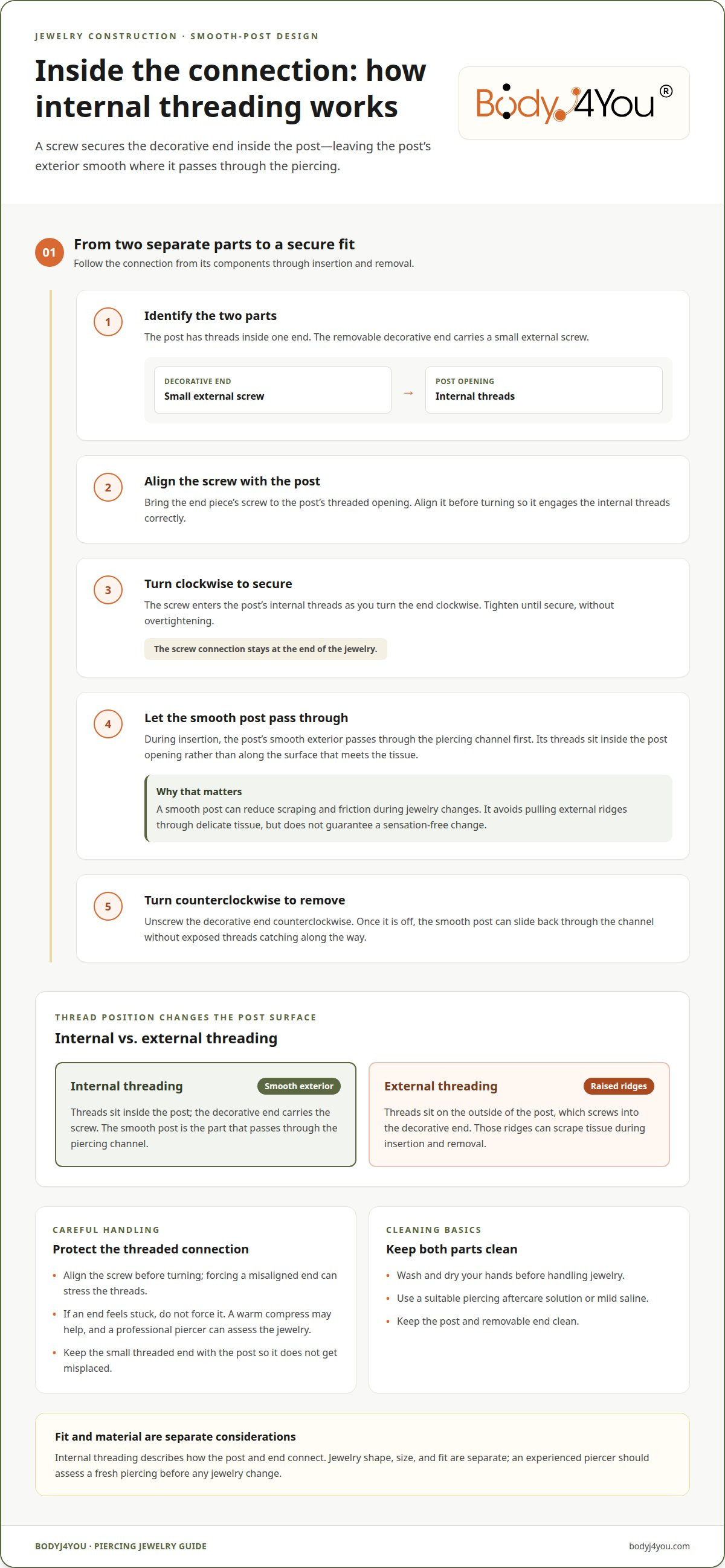
Internally threaded jewelry has a post with threads inside one end. The removable decorative end carries a small external screw that fits into the post. Turn the end to secure it, and turn it the other way to remove it. The threads sit inside the jewelry, rather than along the part that passes through the piercing.
With externally threaded jewelry, the arrangement is reversed: the post has raised threads on the outside, which screw into the decorative end. For example, when inserting a labret stud, the smooth post of an internally threaded design passes through the piercing channel first. An externally threaded post presents its ridges to the channel during insertion and removal.
The difference is where the threads sit, not whether the jewelry uses a screw connection. Internal threading joins a screw on the end to threads inside the post. External threading joins a threaded post to the end. The exterior of an internally threaded post is smooth, while an externally threaded post has ridges. These details can affect how the jewelry moves against tissue.
To clean and maintain internally threaded jewelry, use a suitable piercing aftercare solution or mild saline, and keep the post and removable end clean. Wash and dry your hands before handling the jewelry. Store the threaded parts together so the small end doesn’t get lost.
The main drawbacks are that the small threaded end can be misplaced and overtightening can make removal harder or stress the threads. If an end feels stuck, don’t force it. A warm compress may help, and a professional piercer can assess the jewelry.
Thread position is separate from material: implant-grade describes a material option, not a threading style. Jewelry comes in different shapes and sizes, so both a straight labret and a curved barbell can use internal threads. For a fresh piercing, have an experienced piercer assess it before changing the jewelry.
Reducing tissue damage during insertion and removal
Internal threading leaves the post’s outer surface smooth as it passes through a piercing. This design can reduce scraping and help protect tissue during jewelry changes.
Gentler Insertion and Removal
With internally threaded jewelry, the screw is on the removable end, not along the post. The post can therefore pass through the piercing channel without external ridges dragging across its surface. By contrast, ridges on externally threaded jewelry can scrape tissue and cause tiny tears during insertion.
This difference matters during removal, too. Once the end is unscrewed, the smooth post can slide back through the channel without exposed threads catching along the way. Less friction can mean less mechanical irritation, especially when changing jewelry. It doesn’t make every change effortless, but it avoids pulling ridges through delicate tissue.
Professional piercers consider jewelry construction when choosing pieces for a new piercing. A smooth post can be a more tissue-conscious design for insertion, while the right size and shape matter as well. Don’t change jewelry in a fresh piercing at home. An experienced piercer should assess whether a change is appropriate.
Comfort and Tissue Protection
Comfort partly comes from reducing unnecessary contact between raised edges and the piercing channel. With internal threading, the post’s smooth exterior moves through the tissue. This can limit rubbing during insertion and removal, making for a gentler change, though it doesn’t guarantee a sensation-free one.
Less scraping also means fewer opportunities for small tears caused by threading. Keeping tissue intact matters because irritation can make a piercing feel tender and disrupt healing. Internal threading can reduce this source of mechanical damage, but it doesn’t replace careful handling, clean hands, or a suitable fit.
Material and threading address different concerns. Implant-grade titanium is an option for people concerned about nickel sensitivity, while internal threading describes how the post and end connect. For a labret, a smooth-post design can reduce friction; material choice is a separate consideration.
Explore Internal Threaded Labret Studs as an example of this smooth-post construction. The threaded end secures to the post, while the piercing channel meets the smooth exterior during insertion and removal.
How internally threaded jewelry is constructed
An internally threaded piece has two connected parts: a post and a removable decorative end. One end of the post contains internal threads, while the end piece carries a small external screw. The screw fits into the post’s threaded opening to join the components. A labret stud is one example of jewelry made this way.
The parts meet at the post’s opening. To attach the end, align its screw with the internal threads, then turn it clockwise until secure. To remove it, turn the end counterclockwise. The threads guide the screw into or out of the post, without requiring the entire post to rotate through the piercing.
The post’s outer surface stays smooth because its threads sit inside the opening. During insertion, the smooth portion passes through the piercing channel, while the screw and threaded connection stay at the end. This keeps the part that contacts tissue separate from the mechanism holding the decorative piece in place.
Threaded construction is used in different jewelry forms, including straight or curved barbells, circular barbells, and labrets. The suitable post length and gauge depend on the piercing and the fit needed. For example, a labret’s post passes through the channel while its removable end attaches at the opening. Construction alone doesn’t determine fit or suitability for healing tissue.
The connection needs careful handling. Align the screw before turning so it engages the post’s internal threads; forcing a misaligned end can stress the connection. Tighten until secure, without overtightening. If an end feels stuck or a gem shifts, stop handling the jewelry and have a professional piercer assess it.
Threadless jewelry uses a different connection: a slightly bent pin creates tension inside a hollow post. Internally threaded jewelry relies on a screw and matching threads. Both designs secure a decorative end, but their attachment mechanisms differ.
What materials are best for internally threaded body jewelry?
Material and threading describe different features of body jewelry. Internal threading explains how the removable end connects to the post; material identifies what the jewelry is made from. Implant-grade titanium, solid gold, and niobium each have different considerations, so suitability depends on factors such as nickel sensitivity and desired appearance.
Implant-grade titanium is lightweight and may suit people concerned about nickel sensitivity. It can also be anodized to create different colors without reducing its safety. Anodization creates a durable, corrosion-resistant oxide finish rather than adding a plated layer. This offers a color option while preserving the titanium base.
Solid gold is another material used for internally threaded jewelry. Its alloy and finish matter: body jewelry should use an appropriate gold alloy and finish, rather than relying on the word “gold” alone. A piercer can recommend implant-grade titanium or solid-gold jewelry to help avoid issues associated with lower-quality metals. That guidance takes the material, piercing, and wearer’s needs into account.
Niobium may suit someone seeking color without a plated surface. Its role differs from titanium’s anodized finish, so material choice can reflect appearance preferences as well as sensitivity concerns. People with nickel sensitivity may experience redness and oozing from lower-grade jewelry containing nickel. Choosing a suitable material addresses that concern, while internal threading remains a separate construction feature.
For a practical comparison, consider three questions: Is nickel sensitivity a concern? Do you want a colored finish? Does the material have an appropriate composition and finish for body jewelry? These factors help narrow the options without treating one material as universally best. A professional piercer can weigh them when recommending jewelry, especially for a new piercing, where both fit and material matter.
BodyJ4You: Internal Threaded Labret Studs
BodyJ4You offers Internal Threaded Labret Studs for readers considering a labret with an internally threaded connection. The removable end screws into the post, while the post’s smooth exterior passes through the piercing channel. This construction may suit someone looking for the smooth-post design described above.
Before choosing jewelry, consider the piercing’s fit and whether a change is appropriate. Fresh piercings shouldn’t be changed at home; an experienced piercer can assess timing and suitable jewelry. For care between changes, Saline Piercing Aftercare Spray is another relevant offering.
For questions about Internal Threaded Labret Studs, contact BodyJ4You.
Choose Jewelry With Your Next Step in Mind
Understanding the benefits of internal threaded jewelry can help you make an informed choice, but the right piece also depends on fit, material, and whether a change is appropriate for your piercing. Keep these factors in view as you decide what suits your needs. For a fresh piercing, follow your piercer’s aftercare plan and have them assess whether changing the jewelry is appropriate.
BodyJ4You offers options for different piercing-related needs, including an Acrylic Ear Stretching Kit and a Surgical Steel Taper and Plug Kit. For routine piercing care, its Saline Piercing Aftercare Spray offers another relevant option. Match the product to your goal rather than choosing by appearance alone.
If you’d like help considering your jewelry options, contact BodyJ4You. Take your next step with care and confidence.
Frequently Asked Questions
What is internal threaded body jewelry?
Internal threaded body jewelry connects a post to a removable end with a screw. The post contains threads inside its opening, and the end has a matching screw. This construction appears in pieces such as labrets and barbells. Check that the end aligns with the post before tightening; if the screw doesn’t engage smoothly, it may be misaligned.
What are the benefits of internal threaded jewelry compared with external threaded jewelry?
The key benefits of internal threaded jewelry include a smooth post exterior and a secure connection between the post and decorative end. This connection can reduce the chance of losing an end and support larger decorative pieces. Externally threaded jewelry has ridges on its post instead. Internal and threadless designs are both used in professional piercing settings, and neither is automatically best for every situation.
Does internal threading reduce irritation or tissue damage during piercing insertion?
Internal threading can reduce mechanical irritation because the post passes through the piercing channel without external ridges. This may lower the chance of scraping or small tissue tears during insertion. The design doesn’t prevent every source of irritation: fit and handling matter, too. If jewelry catches, hurts, or feels difficult to insert, don’t push it through the channel.
Is internally threaded jewelry safer for fresh piercings?
Internal threading can be used for initial piercing jewelry, but threading alone doesn’t determine safety. The Association of Professional Piercers includes internally threaded jewelry in its standard for initial piercings. Initial jewelry often needs extra length to accommodate swelling; a professional may recommend a downsize after the swelling subsides. Don’t change a fresh piercing at home. Have an experienced piercer assess it.
How do you put in and remove internally threaded body jewelry safely?
For healed piercings, wash and dry your hands before handling jewelry. Loosen the removable end counterclockwise, then gently guide the post out. To insert it, pass the post through the channel, align the end’s screw with the post, and tighten clockwise. Don’t overtighten or force a stuck piece. A warm compress may help; ask a professional piercer for help if needed.
How can you tell whether internal threaded jewelry is high quality and properly sized?
Look for a smooth post with internal threads and a removable end that aligns and secures without force. Quality also depends on suitable material and finish, such as implant-grade titanium or appropriate solid gold. The post’s length and gauge should fit the piercing, so have a professional piercer assess the fit.


