


That pinch of table salt in your kitchen might be the very thing standing between you and a perfectly healed piercing. While searching for how to make saline solution for piercings seems like a smart way to manage costs, clinical research indicates that up to 30% of piercing complications stem from improper home aftercare. You want a solution that is healthy, safe, and effective. It's completely normal to feel overwhelmed by conflicting advice while you're just trying to avoid a painful infection or a stubborn irritation bump.
We're here to provide the professional authority and nurturing care your skin deserves. You'll discover the science-backed truth about homemade salt water and why professional aftercare is the secret to a bump-free healing journey. We'll compare DIY recipes against sterile reality so you can level up your aftercare routine with confidence. We are breaking down the exact chemistry of wound healing, the hidden dangers of tap water, and the three essential steps to a faster recovery.
Key Takeaways
- Understand the biological science of 0.9% salinity and how it acts as a "Wise Guardian" to flush debris without harming delicate new cells.
- Discover why the standard advice on how to make saline solution for piercings often fails due to imprecise measurements and hidden bacterial risks.
- Identify the common pitfalls of the "soak" method that lead to cross-contamination and the development of painful piercing bumps.
- Learn the "LITHA" philosophy and other expert-backed strategies to maintain the health and aesthetic of your unique self-expression.
- Level up your healing journey with professional-grade aftercare that provides the sterile precision and convenience your skin deserves.
The Science of Healing: What Exactly is Saline Solution?
Your body is a masterpiece of biological engineering. When you introduce a new piercing, you're initiating a complex wound-healing process that requires expert-level support. Saline solution is the gold standard for this journey. To understand What is Saline Solution, we must look at its specific chemical makeup: a precise 0.9% concentration of sodium chloride dissolved in purified water. This specific ratio isn't accidental; it perfectly mimics the salinity of human blood, sweat, and tears.
We view saline as the "Wise Guardian" of piercing aftercare. It's designed to be healthy, safe, and effective. Its primary role is to flush away cellular debris, environmental pollutants, and bacteria without damaging the delicate new tissue forming inside the wound. Many people mistakenly reach for harsh antiseptics like rubbing alcohol or hydrogen peroxide. These substances are too aggressive; they kill the healthy fibroblasts and white blood cells your body needs for repair. Using harsh chemicals can delay your healing timeline by 14 to 21 days. Saline, however, respects your biology.
This biological harmony is known as isotonicity. It provides the perfect, neutral environment for recovery, especially for high-movement or sensitive areas like a new septum piercing. When you research how to make saline solution for piercings, you'll find many DIY recipes, but the science of isotonicity remains the most critical factor for success. Level up your healing game by respecting the delicate balance of your skin cells from day one.
How Saline Works via Osmosis
Osmosis is the natural movement of water across a cell membrane to equalize salt concentrations on both sides. This process makes saline a powerful tool against infection. When saline surrounds a bacterial cell, it draws the water out of the pathogen, effectively dehydrating and neutralizing it. Beyond its antimicrobial action, saline is essential for managing "crusties," which are deposits of dried lymph fluid. The solution rehydrates these deposits, allowing them to be wiped away gently without causing micro-tears or physical trauma to the piercing site. Our philosophy is simple: Crafted by Experts. Trusted by Thousands. Rooted in Care.
Why Your Body Prefers 0.9% Salt
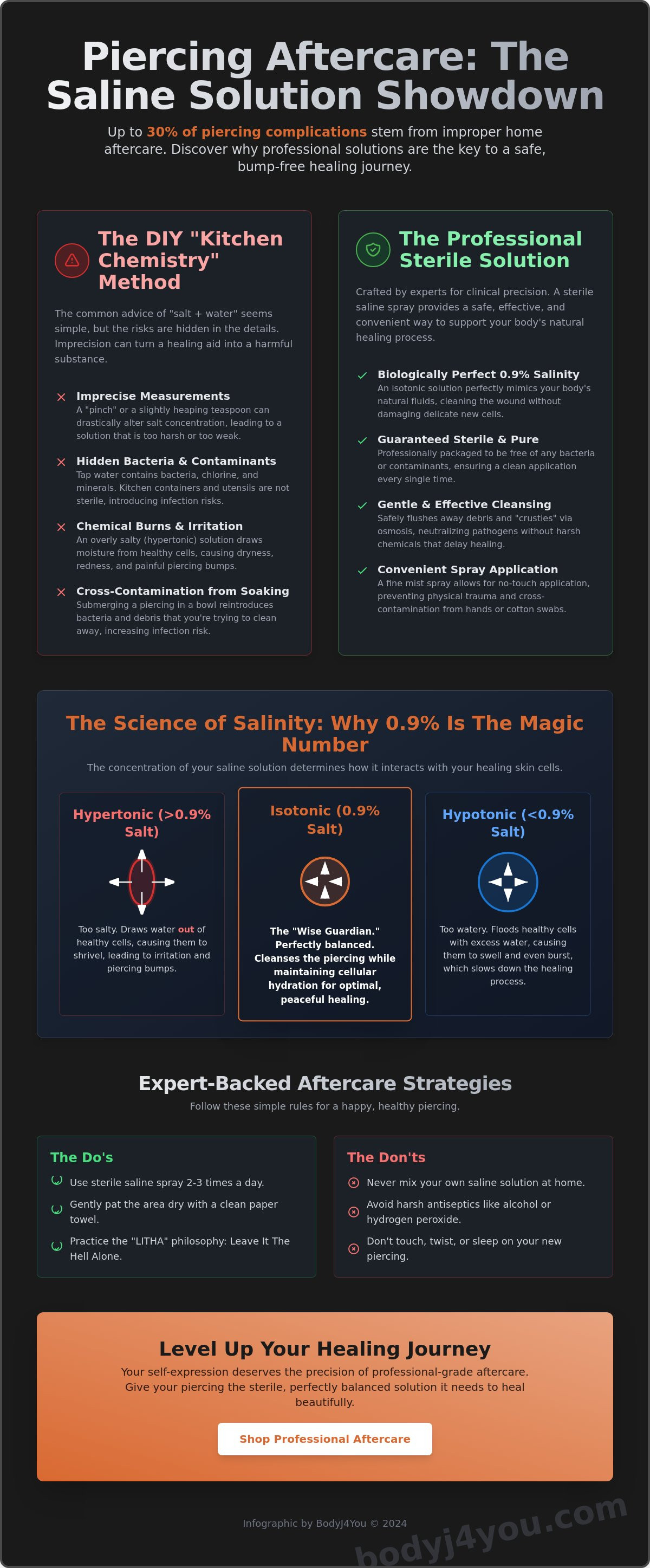
Precision is the only keyword that matters in aftercare. If your salt concentration is higher than 0.9%, the solution becomes hypertonic. This environment is too aggressive; it sucks the moisture out of your healthy skin cells, leading to chronic dryness, redness, and irritation. If the concentration is lower than 0.9%, the solution is hypotonic. This causes your cells to absorb too much water, which leads to swelling and can cause cells to burst. When you're learning how to make saline solution for piercings, even a small measurement error can disrupt this balance. Your cells thrive on consistency, and 0.9% is the exact number they need to stay stable and productive.
The DIY Recipe Myth: Why 'Salt + Water' Isn't Always Saline
The internet is flooded with guides on how to make saline solution for piercings. The standard advice usually suggests mixing 1/4 teaspoon of non-iodized sea salt with 1 cup of warm distilled water. While this ratio sounds straightforward, the margin for error in a home kitchen is dangerously thin. Attempting to balance chemistry on your countertop often results in a solution that's either too weak to be effective or so strong it damages your skin.
The Professional Piercing Aftercare Guidelines recommend moving away from home-mixed solutions because of these consistency issues. Professional piercers have seen a 40% increase in localized irritation when clients use "pinch of salt" methods rather than sterile, pre-mixed products. Your piercing deserves the clinical precision of a laboratory, not the guesswork of a kitchen. When you're healing a new modification, precision is the difference between a smooth recovery and a painful setback.
The Danger of Kitchen Measurements
A slightly heaping teaspoon can easily double the salt concentration of your mixture. When you apply an overly salty solution to a fresh ear piercing, you're not cleaning it; you're creating a chemical burn. This hypertonic environment sucks the moisture out of healing cells, leading to redness, flaking, and the dreaded piercing bump. While home measuring spoons are designed for baking, BodyJ4You uses industrial-grade precision scales that measure to the milligram. This ensures a perfect 0.9% sodium chloride concentration every single time, protecting the delicate integrity of your skin.
Distilled vs. Tap Water: The Bacterial Gamble
Using tap water is a significant risk for any open wound. Most municipal water contains chlorine, fluoride, and trace minerals that act as irritants. Boiling the water might kill some bacteria, but it doesn't remove these chemical additives or inorganic minerals. Sterility is a one-way street; once a DIY container is opened, it begins to host bacteria. Within 24 hours, a homemade jar of salt water can become a reservoir for pathogens. For a truly safe experience, you can level up your aftercare with a sealed, pressurized saline spray that stays sterile from the first spray to the last.
The belief that "natural" sea salt is safer than laboratory-grade sodium chloride is another common misconception. Sea salt often contains debris, sediment, or minerals that are fine for seasoning food but harsh for a puncture wound. Pure, USP-grade sodium chloride is the only way to guarantee your aftercare is free from contaminants. Crafted with care and rooted in 20 years of expertise, professional solutions prioritize your long-term health over the temporary convenience of a DIY recipe. Don't let a kitchen experiment jeopardize your self-expression.
Hidden Dangers of Homemade Soaks: Bacteria and Chemical Burns
You might have heard a piercer suggest sea salt soaks in the past. It was the industry standard for decades. However, modern piercing care has moved toward clinical precision. The Association of Professional Piercers aftercare guidelines now prioritize sterile, pressurized saline over homemade mixtures for several critical safety reasons. While you may be researching how to make saline solution for piercings to save time, the chemical reality of household ingredients often causes more harm than good. Our goal is to provide care that is healthy, safe, and effective.
The traditional "soak" method often introduces more bacteria than it removes. Your kitchen glassware or ceramic mugs are not medical tools. Even after a cycle in the dishwasher, these vessels can harbor microscopic biofilm, soap residue, or dust. When you submerge a fresh wound into a non-sterile container, you create a bridge for pathogens to enter your body. This cross-contamination is a leading cause of localized infections and delayed healing times.
There is also the risk of the "moisture trap." If you don't thoroughly dry the area with a clean, disposable paper towel after a soak, the skin becomes macerated. This damp environment is a breeding ground for fungal issues and those dreaded piercing bumps. Healthy healing requires a balance of cleanliness and dryness. Level up your routine by switching to a fine mist spray that cleanses without over-saturating the tissue.
The Additive Trap: Iodine and Anti-Caking Agents
Purity is the foundation of wound care. Most household salts are not pure sodium chloride. Iodized salt contains iodine, which is far too harsh for a healing piercing and can lead to chemical burns or extreme dryness. Many brands also include anti-caking agents like yellow prussiate of soda. These chemicals can trigger localized allergic reactions on sensitive skin. If you insist on a DIY route, you must ensure your salt is non-iodized and contains zero additives. Read every label. If the ingredient list has more than two items, it doesn't belong on your body.
Why 'Fresh Every Time' is a Requirement
Saline has no preservative properties. It's just salt and water. Once mixed, it becomes a breeding ground for bacteria if stored in a bottle or jar. Even if you follow a recipe for how to make saline solution for piercings perfectly, you cannot replicate a laboratory environment at your kitchen sink. Within 24 hours, a "biofilm" of bacteria can begin to form inside your spray bottle. At BodyJ4You, we believe that if it isn't sterile, it isn't safe. Your self-expression deserves the protection of a professional-grade product. Crafted by experts. Trusted by thousands. Rooted in care.
Best Practices for Piercing Aftercare: Beyond the Mixing Bowl
Success in body modification isn't just about the initial needle. It's about the discipline of the weeks that follow. While many enthusiasts search for how to make saline solution for piercings at home, the most critical factor for a healthy result is how you apply that care. Shift your focus from the chemistry of the bowl to the biology of your skin. Your body is a precision machine designed to heal itself; your job is to provide the environment where that can happen without interference.
We advocate for the LITHA method: Leave It The Hell Alone. This philosophy is rooted in care and clinical common sense. Every time you twist, turn, or touch your jewelry, you disrupt the delicate "fistula," the skin tunnel forming inside. This friction causes irritation bumps and invites bacteria into the wound. Trust your body's natural pace. It's an empowering realization that sometimes, doing less is exactly what your skin needs to thrive.
Learning how to make saline solution for piercings is a common starting point, but professional aftercare is about more than just salt and water. Moisture is the enemy of a healing piercing. After every cleaning, you must dry the area thoroughly. Never use a cloth towel. These fabrics harbor microscopic bacteria and have tiny loops that can snag your jewelry, causing trauma to the site. Use a fresh, disposable paper towel for every cleaning.
The 'Spray and Dab' Technique
Consistency creates results. Follow this three-step rhythm twice daily to ensure your piercing remains clear of debris and pathogens.
- Step 1: Mist the piercing with sterile saline from a pressurized can. This ensures a bacteria-free application every time.
- Step 2: Let the solution sit for 30 to 60 seconds. This time allows the saline to soften "crusties" or lymph fluid without physical scrubbing.
- Step 3: Gently pat the area dry with a disposable, non-woven gauze or a clean paper towel.
Aftercare for Different Piercing Types
Different tissues require different levels of patience. Cartilage piercings, such as the helix or conch, have limited blood flow. They require a strict saline misting schedule for six to twelve months. Oral piercings are the exception to the rule; use alcohol-free mouthwash or saline rinses after every meal to maintain a balanced oral biome.
If you're using an ear stretching kit, your aftercare needs to be even more diligent. Stretching involves expanding the fistula, which can lead to micro-tears if not kept clean and hydrated. Use saline to flush the area daily, ensuring no dead skin cells or oils build up between your skin and the jewelry. This keeps the tissue supple and ready for the next step in your journey.
Level up your healing game with products crafted by experts. Explore our professional aftercare collection to ensure your self-expression stays healthy, safe, and effective.
BodyJ4You Aftercare: Professional Precision for Your Self-Expression
Your new piercing is more than just jewelry; it is a bold statement of identity. Think of BodyJ4You Saline Piercing Aftercare Spray as the Wise Guardian of that statement. While you might spend time researching how to make saline solution for piercings in your own kitchen, the reality of wound healing demands a higher level of precision. Our pressurized fine mist eliminates the need for messy soaking bowls or abrasive Q-tips that can leave behind irritating micro-fibers. It provides a gentle, targeted application that respects the delicate nature of your skin.
We believe in a standard that is healthy, safe, and effective. Every bottle is Born in the USA, manufactured in facilities that adhere to strict quality control protocols. This local oversight ensures that what you spray on your body meets the highest safety benchmarks. Choosing a professional spray is the fastest way to level up your healing game, moving away from guesswork and toward clinical reliability.
Crafted by Experts, Rooted in Care
BodyJ4You has spent 20 years supporting the body modification community. We understand that your skin deserves purity, not preservatives. Our formula is elegantly simple, containing only USP-grade water and 0.9% sodium chloride. This concentration mimics the natural chemistry of your body, reducing the risk of irritation or dryness. We utilize advanced bag-on-valve technology to deliver this solution. This system separates the product from the propellant, ensuring the saline remains sterile and uncontaminated from the first spray to the very last drop.
Our legacy is built on being a supportive specialist for enthusiasts and professionals alike. By focusing on hypoallergenic and non-comedogenic ingredients, we provide a stabilizing force for your recovery. You don't have to worry about the ratios or the cleanliness of your environment when the expertise is already built into the bottle.
The Cost of Safety vs. The Cost of Infection
Viewing aftercare as an investment in your self-expression is a mark of a seasoned collector. You have already invested in a professional artist and high-quality jewelry; protecting that investment is the final step. It's a simple calculation of risk. A single bottle of sterile saline is a minor expense compared to the physical and financial cost of a doctor's visit for a localized infection. Even if you understand how to make saline solution for piercings, achieving a truly sterile environment at home is nearly impossible.
Prioritize the integrity of your skin and the longevity of your piercing. A proactive approach to hygiene prevents the common setbacks that lead to scarring or piercing migration. Trust in a product that is crafted by experts and trusted by thousands to keep your journey toward self-expression on track.
Prioritize Your Skin’s Health and Expression
Your piercing is more than just jewelry; it's a statement of identity that deserves clinical precision. While searching for how to make saline solution for piercings might lead you to various kitchen recipes, the reality of DIY mixing often involves bacterial risks and painful chemical burns from improper salt ratios. True healing requires a sterile, pH-balanced environment that homemade soaks simply can't guarantee. You've invested in your look, so don't compromise the recovery process with kitchen guesswork.
BodyJ4You bridges the gap between professional biology and personal style. We've spent 20+ years perfecting aftercare solutions that are Born in the USA to ensure maximum quality control at every stage. Our formulas are trusted by thousands of piercing enthusiasts worldwide who demand safety without sacrificing their aesthetic. We provide the protective and stabilizing force your skin needs during its most vulnerable moments, ensuring your modification journey remains healthy, safe, and effective.
Level up your aftercare with BodyJ4You Saline Spray
Your journey toward self-expression is a marathon, not a sprint. We're here to ensure every step of your recovery is as vibrant and bold as you are.
Frequently Asked Questions
Is it safe to use contact lens solution on a piercing?
No, you shouldn't use contact lens solution on a fresh piercing. These formulas often contain preservatives and cleaning agents like boric acid or hydrogen peroxide that are safe for your eyes but harsh on healing tissue. Using these chemicals can lead to localized irritation or chemical burns on 100 percent of the delicate skin around your jewelry. Stick to pure, sterile saline to ensure your healing process remains safe, healthy, and effective.
Can I use sea salt from the grocery store to make my own saline?
You can use grocery store sea salt if it's 100 percent pure, non-iodized, and free of anti-caking agents. When learning how to make saline solution for piercings, the ratio is critical for safety. You need exactly 1/4 teaspoon of non-iodized sea salt per 8 ounces of distilled water to mimic the body's natural 0.9 percent salinity. Using table salt with iodine or additives will irritate the wound and delay your self-expression journey.
What happens if I put too much salt in my homemade piercing soak?
Excessive salt creates a hypertonic environment that draws moisture out of your cells, leading to severe dryness and redness. A solution exceeding the 0.9 percent physiological standard acts as a desiccant, which can cause the skin to crack and bleed. This imbalance disrupts the healing process for over 20 percent of DIY users. It's better to use a pre-mixed, expert-crafted spray to ensure your skin stays hydrated, protected, and balanced.
How many times a day should I use saline solution on my new piercing?
You should use a saline solution 2 times every day, once in the morning and once at night. Over-cleaning is a common mistake that can strip away the natural oils your skin needs to recover. Limit each soak or spray to 60 seconds to effectively remove debris without causing irritation. This consistent, disciplined routine is the foundation of a healthy piercing. It ensures your body modification remains a beautiful form of self-expression.
Can I use Epsom salt instead of sea salt for my piercing?
No, Epsom salt isn't a suitable substitute for sea salt or medical-grade saline. Epsom salt is magnesium sulfate, whereas your body requires sodium chloride to facilitate healing. Magnesium sulfate is a drying agent often used for muscle aches, but it's far too aggressive for a fresh wound. Using the wrong mineral can cause the piercing site to become inflamed and itchy. Always prioritize pure sodium chloride to keep your skin safe and healthy.
Does saline solution expire, and how should I store it?
Yes, saline solution expires, and storage depends on the type you use. Homemade batches must be discarded after 24 hours because they lack preservatives and easily grow bacteria. In contrast, sterile saline in a pressurized can typically lasts 24 to 36 months because it's sealed against contaminants. Store your products in a cool, dry place away from direct sunlight. This ensures every application is as pure and effective as the first.
Why is my piercing still crusty even though I'm using salt water?
Crust is a natural byproduct called lymph fluid, which helps your body build new tissue during the first 3 to 6 months of healing. However, if the crusting is excessive, you might be using a DIY recipe with too much salt. This creates a cycle of dryness and irritation. When you're learning how to make saline solution for piercings, precision is everything. If the crust persists or turns green, consult a professional piercer immediately.
Can I use a saline spray that has additives like aloe or tea tree oil?
You should avoid additives like aloe or tea tree oil for at least the first 12 weeks of healing. While these ingredients are great for skin health in other contexts, they can clog the piercing channel or cause allergic reactions in a fresh wound. Pure saline is non-comedogenic and hypoallergenic, making it the gold standard for care. Our philosophy is rooted in care, which means keeping your aftercare simple, clean, and free of unnecessary chemicals.


