


What if the constant throbbing in your ear isn't a normal part of the healing phase, but a sign that your jewelry is exactly 1.5 millimeters too short? You already know that your piercing is a vital part of your self-expression, but the struggle with poor-quality metals and painful pinching is a common hurdle. Finding the right industrial barbells often feels like a difficult choice between style and skin health, especially when nearly 25% of individuals experience sensitivity to low-grade nickel alloys.
It's time to level up and stop settling for jewelry that irritates your anatomy. We've spent over 20 years perfecting the balance between clinical safety and high-end aesthetics to ensure your long-term comfort. In this guide, you'll master the art of measuring the distance between your piercing holes and choosing 100% hypoallergenic materials that last. We'll walk you through the technical specifications required to avoid piercing bumps, the most durable styles for 2026, and the secrets to a perfect, pinch-free fit.
Key Takeaways
- Master the anatomical requirements of the helix and scapha to ensure your ear is perfectly suited for a dual-point connection.
- Acquire the essential measurement techniques needed to achieve a custom fit, protecting your skin from the risks of rejection or migration.
- Compare the biocompatibility of surgical steel, titanium, and Bioflex to select industrial barbells that prioritize your long-term skin integrity.
- Level up your aesthetic by transitioning from standard bars to modern, decorative centerpieces that reflect your unique style.
- Rely on twenty years of expert craftsmanship to guide your journey toward safe, high-end self-expression.
Understanding the Industrial Barbell: More Than Just a Bar
An industrial barbell is a single, striking piece of jewelry that connects two distinct cartilage piercings with one solid bar. This isn't a simple modification; it's a bold statement of self-expression. Unlike a standard lobe piercing, this dual-point entry requires a higher level of respect and clinical precision. At BodyJ4You, we approach this through the lens of a Wise Guardian. We prioritize the long-term health of your skin over fleeting trends. Our philosophy is built on the Rule of Three. Every piece of jewelry must be healthy, safe, and effective for your body.
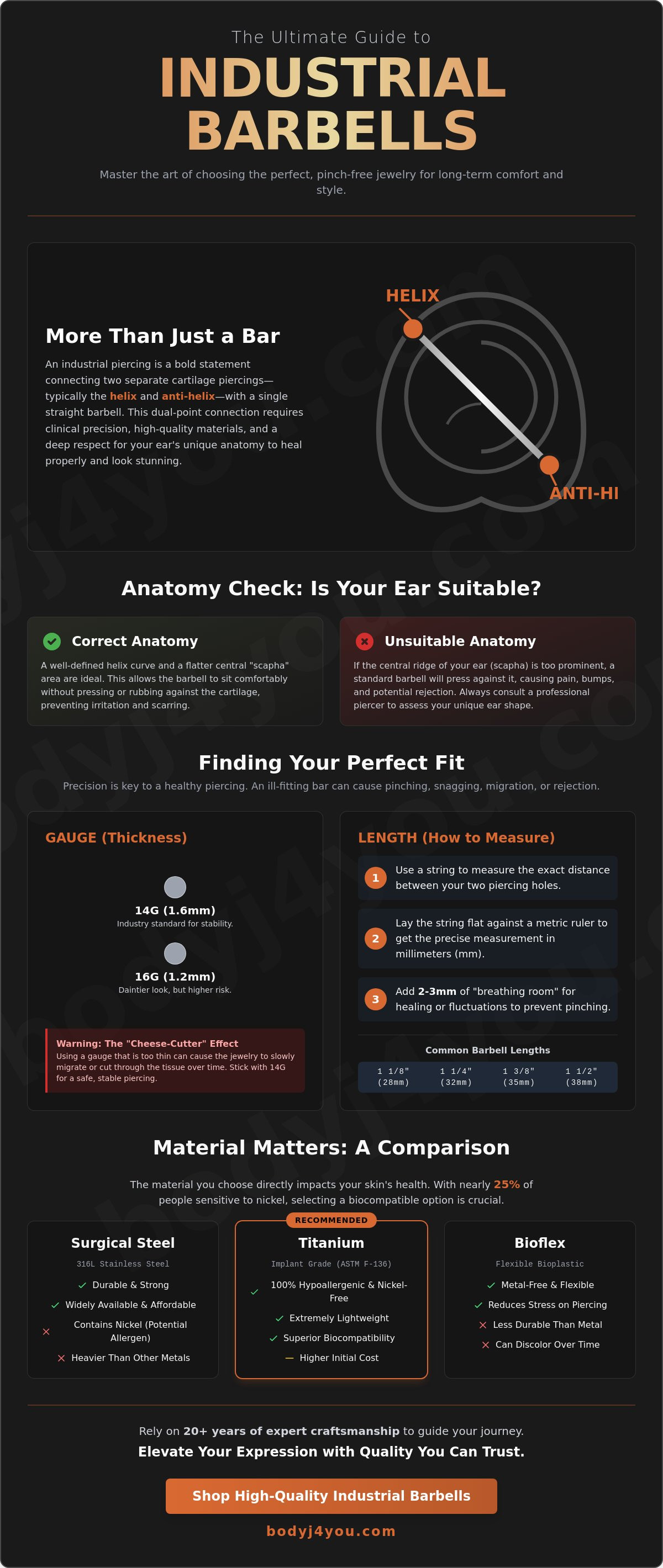
Before purchasing your first bar, it is vital to understand the technical foundation. What is an Industrial Piercing? technically? It is a dual-point perforation of the upper ear cartilage, usually the helix and anti-helix, joined by a single straight bar. Because this jewelry bridges two separate wounds, the tension and alignment are critical. It represents a physical vulnerability that demands high-quality materials and expert placement. Level up your aesthetic with the confidence that comes from twenty years of industry expertise. Crafted by Experts. Trusted by Thousands. Rooted in Care.
The Anatomy of an Industrial Piercing
Success depends entirely on your ear's unique architecture. A professional piercer must align the two points of entry perfectly to ensure the bar sits flat without putting pressure on the cartilage. Not everyone possesses the necessary scapha depth for a traditional straight bar. If your ear's center "flat" area is too prominent, the bar will rub against the skin. This leads to irritation or permanent scarring. Always confirm your anatomy is suitable before investing in new industrial barbells. Proper placement is the difference between a lifetime of style and a month of discomfort.
Standard Gauges and Lengths
The 14G (1.6mm) is the industry standard for industrial barbells. This thickness provides the stability needed to keep the two piercings aligned during the long healing process. Using a thinner gauge can lead to the "cheese-cutter effect," where the jewelry slowly migrates through the tissue. Length is equally personal. While common lengths range from 28mm to 50mm (1 1/8" to 2"), "one size fits all" is a dangerous myth. A bar that is too short will pinch the ear, while one that is too long will snag on hair and clothing. Most initial piercings require a longer bar to accommodate swelling, while healed piercings can be "downsized" for a flush, high-end look.
Finding Your Perfect Fit: How to Measure Your Ear
Precision protects your anatomy. When you select industrial barbells, the fit must be exact to ensure long-term health. An ill-fitting bar isn't just a style error; it's a physical stressor. If a bar is too short, it pinches the skin. If it's too long, it snags on hair or clothing. This constant tension often leads to migration, where the jewelry shifts out of place, or total rejection. To maintain the integrity of your cartilage, consult Body Piercing Safety Regulations to understand how professional standards prioritize anatomical safety.
You only need three simple tools: a metric ruler, a piece of string, and a mirror. Never measure while your ear is swollen, red, or inflamed. Cartilage can expand by 1.5mm to 2.2mm during a flare-up, which leads to inaccurate sizing. If you currently wear a bar that feels comfortable, measure that piece of jewelry instead of your ear. It's the most reliable way to guarantee a perfect match for your next upgrade. Our team has seen thousands of successful fits over 20 years, and the secret is always rooted in patient, accurate measurement.
Step-by-Step Measurement Guide
- Step 1: Stand before a mirror and use a piece of string to find the distance between the outside edges of your two piercing holes. Mark the string clearly, then lay it flat against a metric ruler to get the millimeter count.
- Step 2: Add 2mm to 3mm of "breathing room" if your piercing is still maturing or is less than 12 months old. This extra space prevents the balls from pressing into your skin during natural fluctuations.
- Step 3: Convert your millimeter measurement to inches to match standard retail sizes. Most industrial barbells are sold in lengths like 1 1/4" (32mm), 1 3/8" (35mm), or 1 1/2" (38mm).
The Importance of Barbell Diameter
Choosing the correct thickness is vital for the stability of your piercing. Most industrial piercings are performed with a 14G (1.6mm) needle, though some people prefer a 16G (1.2mm) for a daintier look. Gauge is the thickness of the wire used in the jewelry. Don't "size down" to a thinner wire without a specific reason. Thinner bars can cause the "cheese-cutter effect," where the jewelry slowly slices through the cartilage due to high tension and a narrow surface area. BodyJ4You provides expert-crafted jewelry designed to distribute pressure evenly. Once you have your exact numbers, you can level up your style with a bar that feels as good as it looks.
Material Science: Surgical Steel vs. Titanium vs. Bioflex
Skin health isn't a trend; it's a foundation. At BodyJ4You, we prioritize skin integrity over fleeting fashion movements. While aesthetics drive the choice of industrial barbells, the biological compatibility of the metal determines the longevity of the piercing. We believe in jewelry that is healthy, safe, and effective. Selecting the wrong material often leads to the number one cause of piercing irritation: nickel sensitivity. Statistics from the Journal of Clinical and Aesthetic Dermatology indicate that approximately 10% to 15% of the population suffers from a nickel allergy. Choosing the right material ensures your self-expression remains a source of pride, not a medical complication. Crafted by Experts. Trusted by Thousands. Rooted in Care.
Surgical grade is our baseline, not our ceiling. We look beyond basic standards to ensure every piece supports your body’s natural healing process. Whether you are in the initial healing phase or have a decade-old piercing, the material science remains vital. High-quality materials prevent bacterial buildup and minimize the risk of rejection. It's time to level up your jewelry standards.
316L Surgical Stainless Steel
This is the industry workhorse. It is durable, affordable, and capable of achieving a mirror-like finish. We recommend 316L steel for fully healed piercings in individuals who do not have extreme metal sensitivities. The high-polish finish is essential. A smooth surface prevents microscopic pits where bacteria can colonize. If your skin is resilient, this material offers the perfect balance of strength and style for daily wear.
G23 Titanium: The Gold Standard
Titanium is the ultimate choice for those seeking maximum safety. It is 100% nickel-free and highly biocompatible, making it the preferred metal for medical implants. When choosing jewelry for a fresh industrial, the APP Safe Jewelry Materials guidelines emphasize biocompatibility to ensure the healing process remains undisturbed. Titanium is 45% lighter than steel, which reduces the "pull" on industrial barbells during the healing phase. We utilize internal threading for our titanium pieces. This design ensures the smooth part of the bar passes through the tissue, preventing the "cheese-cutter" effect caused by external threads.
Bioflex and PTFE: The Flexible Alternatives
Metal isn't always the answer. Bioflex and PTFE serve as supportive specialists for difficult-to-heal ears or specific lifestyle needs. These medical-grade plastics offer several advantages:
- Flexibility: Ideal for sports or active lifestyles where a rigid metal bar might cause trauma.
- Hospital Safety: Non-conductive and non-magnetic, making them safe for MRI scans or surgeries.
- Adjustability: These bars can be trimmed to a custom length, providing a bespoke fit for unique ear shapes.
While non-metal options are excellent for temporary transitions or pregnancy, they require more frequent replacement than metal as the material can become porous over long periods. They remain a vital tool for those who prioritize comfort and adaptability.
Beyond the Bar: Choosing Your Aesthetic Style
Your ear is a canvas; the industrial piercing is its boldest stroke. While the classic straight bar remains a staple, the landscape of body jewelry has shifted toward high-end, decorative centerpieces. Approximately 35% of piercing enthusiasts now prioritize "curated ear" aesthetics, where every piece works in harmony. Your choice of industrial barbells should reflect this synergy. It's about balance, beauty, and biology. Since 2024, the trend has moved away from simple "industrial" looks toward complex, multi-layered stories told through metal and stone.
Decorative Ends and Charms
The ends of your bar are no longer just functional fasteners. We see a rising demand for synthetic opals, minimalist arrows, and sharp geometric shapes. These accents draw the eye and define your look. Center-fixed charms are another popular choice. These sit flush against the flat of your ear, creating a focal point without the bulk. When selecting your hardware, consider the closure system. Threadless (push-fit) ends are sleek and convenient for quick changes. Threaded ends provide a mechanical security that's often superior for active lifestyles. Both are healthy, safe, and effective when crafted from implant-grade materials.
Chain Industrials and Modified Bars
Anatomy varies significantly from person to person. Statistics from professional piercers suggest that nearly 20% of clients lack the specific ear fold required for a traditional straight bar. Chain industrials solve this. By connecting two separate piercings with a delicate chain, you achieve the look without the structural pressure. Twisted bars and "heartbeat" designs offer a textured, modern vibe. However, these intricate shapes require more diligent care. Debris can settle in the grooves, making your daily saline rinse essential. If you enjoy experimenting with different piercing styles, you might also find our Septum Piercing: The Complete Guide helpful for understanding how to coordinate your facial and ear jewelry.
Safety remains the priority even as you level up your style. Heavy or oversized dangly charms can cause migration if worn too early or for too long. Limit heavy decorative pieces to short durations. For daily wear, stick to lightweight titanium or surgical steel. This approach ensures your piercing stays rooted in health while looking spectacular. Our philosophy is simple: Crafted by Experts. Trusted by Thousands. Rooted in Care.
Ready to transform your look? Shop our signature collection of industrial barbells to find a piece that fits your unique style.
Elevate Your Expression with BodyJ4You Quality
Choosing the right jewelry is a commitment to your body's health and your personal style. BodyJ4You has spent 20 years at the intersection of clinical safety and creative expression. We don't just manufacture jewelry; we curate experiences for the body modification community. Our industrial barbells represent two decades of refinement, ensuring that every piece meets the rigorous standards of professional piercers and enthusiasts alike. Crafted by Experts. Trusted by Thousands. Rooted in Care.
The BodyJ4You Difference
Quality control is the heartbeat of our operation. We maintain strict oversight on every batch of 316L surgical steel and G23 titanium that enters our collection. This ensures your jewelry is hypoallergenic, durable, and polished to a mirror finish. While many brands outsource their entire process, we take pride in our "Born in the USA" branding for our specialized aftercare solutions. Our Miami-based facility produces skincare that is non-comedogenic and USDA Certified Organic where possible. You can level up your jewelry game knowing your industrial barbells are backed by a brand that prioritizes biological compatibility as much as aesthetic appeal.
Aftercare Integration for Success
Your jewelry is only as good as the skin that holds it. An industrial piercing is a complex modification that requires a dedicated cleaning routine to prevent irritation bumps or migration. We've developed a synergy between our hardware and our Saline Piercing Aftercare Spray to ensure your healing process is seamless. This pH-balanced, sterile solution removes debris without drying out the delicate tissue of the ear. If you're looking to expand your journey beyond the ear scaffold, check out The Ultimate Guide to Choosing and Using an Ear Stretching Kit to learn how to safely transition into larger gauges with the same expert-led care.
- Material Integrity: Verify the use of implant-grade titanium or 316L surgical steel to prevent allergic reactions.
- Precise Sizing: Ensure the gauge (typically 14G) and length (usually 32mm to 38mm) match your specific anatomy.
- Thread Type: Choose internally threaded or threadless options to protect the piercing tract during insertion.
- Aftercare Readiness: Have a bottle of sterile saline spray ready before you swap your jewelry.
- Style Alignment: Select a design that reflects your identity, from minimalist bars to ornate, stone-set centerpieces.
BodyJ4You remains a wise guardian for your self-expression journey. By combining high-end materials with locally manufactured care products, we provide the stability you need to express yourself with confidence. Your body is a canvas; treat it with the expert craftsmanship it deserves.
Level Up Your Piercing Journey with Expert Care
Choosing your next piece of jewelry is a vital commitment to your body's wellness and self-expression. You've seen how precise measurements prevent migration and why selecting biocompatible materials like titanium or Bioflex is essential for long-term skin health. Your style deserves the stability of professional craftsmanship. At BodyJ4You, we've spent 20 years refining our process to ensure every product is healthy, safe, and effective. We maintain local manufacturing operations in Miami to provide a level of oversight that ensures your industrial barbells meet the highest clinical standards. Our dedication to your recovery includes aftercare formulated with USDA Certified ingredients, protecting the integrity of your skin from day one. You don't have to choose between a high-end aesthetic and medical-grade safety. Trust your journey to a team that prioritizes your healing as much as your look.
Shop our Expert-Curated Industrial Barbell Collection
Step forward with confidence and let your unique style shine through safely.
Frequently Asked Questions
What is the standard size for an industrial barbell?
The standard size for an industrial barbell is 14 gauge (1.6mm) in thickness and 38mm (1.5 inches) in length. This specific gauge provides the necessary stability to connect two separate cartilage piercings with a single piece of jewelry. While some individuals require a 32mm or 44mm bar depending on their ear anatomy, the 38mm length fits approximately 75% of adults comfortably. Choosing the correct fit ensures your self-expression remains healthy, safe, and effective.
How long does an industrial piercing take to heal before I can change the bar?
You should wait between 6 and 9 months before changing your industrial barbell for the first time. Full maturation of the skin inside the piercing channel often takes up to 12 months for 85% of individuals. Changing jewelry prematurely can cause the holes to close within minutes or introduce harmful bacteria to the site. Wait until you've experienced zero redness or crusting for 21 consecutive days before you level up your style with new jewelry.
Can I use a 16G bar in a 14G industrial piercing?
You can physically insert a 16G bar into a 14G piercing, but the tissue will likely shrink to the smaller size within 24 to 48 hours. This makes returning to your original 14G industrial barbells difficult and often requires a painful tapering process. Maintaining the 1.6mm thickness is vital for the structural integrity of the long piercing channel. We recommend sticking to the gauge your professional piercer originally selected to ensure your piercing remains stable and secure.
What should I do if my industrial barbell is too tight?
Visit a professional piercer immediately to have the jewelry swapped for a longer bar if you notice the ends are indenting your skin. Swelling is a standard biological response during the first 14 days of healing, and a bar that lacks 2mm to 3mm of extra space can restrict blood flow. This pressure may lead to tissue necrosis or permanent scarring in the cartilage. Expert care is rooted in safety, so never attempt to force a tight bar to stay in place.
Is titanium better than surgical steel for an industrial piercing?
Grade 23 titanium is superior to 316L surgical steel for initial industrial piercings because it is 100% nickel-free and highly biocompatible. While surgical steel is safe for approximately 90% of the population, titanium is the gold standard for anyone with sensitive skin or known metal allergies. Our jewelry is crafted by experts to meet these high medical standards. Choosing titanium helps you level up your safety and ensures a smoother recovery process for your new piercing.
How do I clean my industrial barbell without taking it out?
Clean your jewelry by misting both ends of the bar with a sterile 0.9% sodium chloride saline spray twice every day. Do not rotate or slide the bar, as this movement tears the fragile new skin cells forming inside the channel. Gently pat the area dry with a clean paper towel to prevent moisture from sitting against the wound. This simple routine is trusted by thousands to keep the area free from debris and bacteria without disrupting the healing process.
Why does my industrial piercing have a bump near the bar?
Piercing bumps are typically irritation reactions or hypertrophic scars caused by friction, improper angles, or moisture. Statistics indicate that 60% of industrial piercings experience some form of irritation during the first 180 days of healing. Using a dedicated piercing bump oil with natural ingredients can help soothe the tissue and reduce inflammation. Our supportive specialists recommend identifying the source of the irritation, such as snagging on hair, to resolve the issue permanently.
Can I sleep on my side with an industrial barbell?
You should not sleep directly on your industrial barbell for at least 6 months to avoid shifting the angle of the piercing. Constant pressure from your head can cause the bar to migrate by several degrees, which often results in permanent bumps or rejection. If you must sleep on that side, use a travel pillow with a hole in the center to keep your ear suspended and pressure-free. This protective habit is essential for maintaining the long-term health and aesthetics of your ear.


