

Most belly piercings that feel closed are actually just waiting for professional-grade lubrication, not a second needle. Discovering that your jewelry no longer slides into place can be a moment of genuine panic for anyone who values their aesthetic journey. Learning how to reinsert a belly ring that closed, or simply narrowed, requires a delicate balance of patience, precision, and the right tools. You shouldn't have to choose between a lost piercing and the risk of painful scarring or irritation.
We understand the frustration of a piercing that seems to have vanished overnight. It's a common concern, especially as the 2026 resurgence of Y2K fashion puts the spotlight back on navel aesthetics. This guide provides a clear, clinical, and nurturing path to reclaiming your look. You'll learn how to identify the difference between a permanent closure and a temporary shrinkage, ensuring you never cause trauma to delicate tissue. We will explore the essential roles of sterile saline, high-quality surgical steel, and natural lubricants like jojoba oil to restore your piercing's integrity safely and successfully.
Key Takeaways
- Distinguish between a fully closed fistula and a narrowed channel by identifying specific signs of tissue shrinkage versus permanent healing.
- Master the clinical steps of how to reinsert a belly ring that closed to ensure jewelry slides in smoothly without causing micro-tears or trauma.
- Utilize professional-grade lubricants like Jojoba oil and sterile saline sprays to create a frictionless environment that protects your skin’s integrity.
- Implement a 48-hour recovery protocol that treats your reinserted jewelry with the same clinical care as a fresh piercing to prevent bumps and irritation.
- Recognize the "15-Minute Rule" to know exactly when to pause your DIY efforts and seek the expertise of a professional piercer for a safe insertion taper.
Is Your Belly Piercing Actually Closed or Just Shrunk?
Panic is a common first reaction when a favorite piece of jewelry meets resistance. You might assume the hole has vanished forever, but biology tells a different story. For many individuals researching how to reinsert a belly ring that closed, the reality is usually a narrowed fistula rather than a complete closure. A fistula is the structural foundation of your piercing. It is a tube of scar tissue and mature skin that forms around the jewelry during the healing process. This channel is resilient, established, and surprisingly persistent.
The Navel piercing is uniquely susceptible to rapid shrinkage. Because the abdomen is a high-motion area, the skin is subject to constant tension, compression, and stretching. When jewelry is removed, the skin’s natural elasticity causes the channel to contract. This isn't a permanent seal; it’s a biological tightening. While internet rumors suggest a piercing can close in just one night, a well-established fistula usually takes weeks or months to truly disappear. Understanding this distinction is the first step toward a successful reinsertion.
The Anatomy of a Navel Fistula
Your body maintains the piercing channel through a process of epithelialization. This creates a tunnel of skin that is separate from the surrounding tissue. The entrance and exit holes often shrink faster than the internal channel because they are exposed to air and surface friction. Skin elasticity allows these openings to tighten significantly, creating a "plug" effect that feels like a solid wall. However, the internal tube of the fistula often remains intact even when the surface appears sealed. This structural memory is what makes professional reinsertion possible without a new needle.
Telltale Signs It Is Still Open
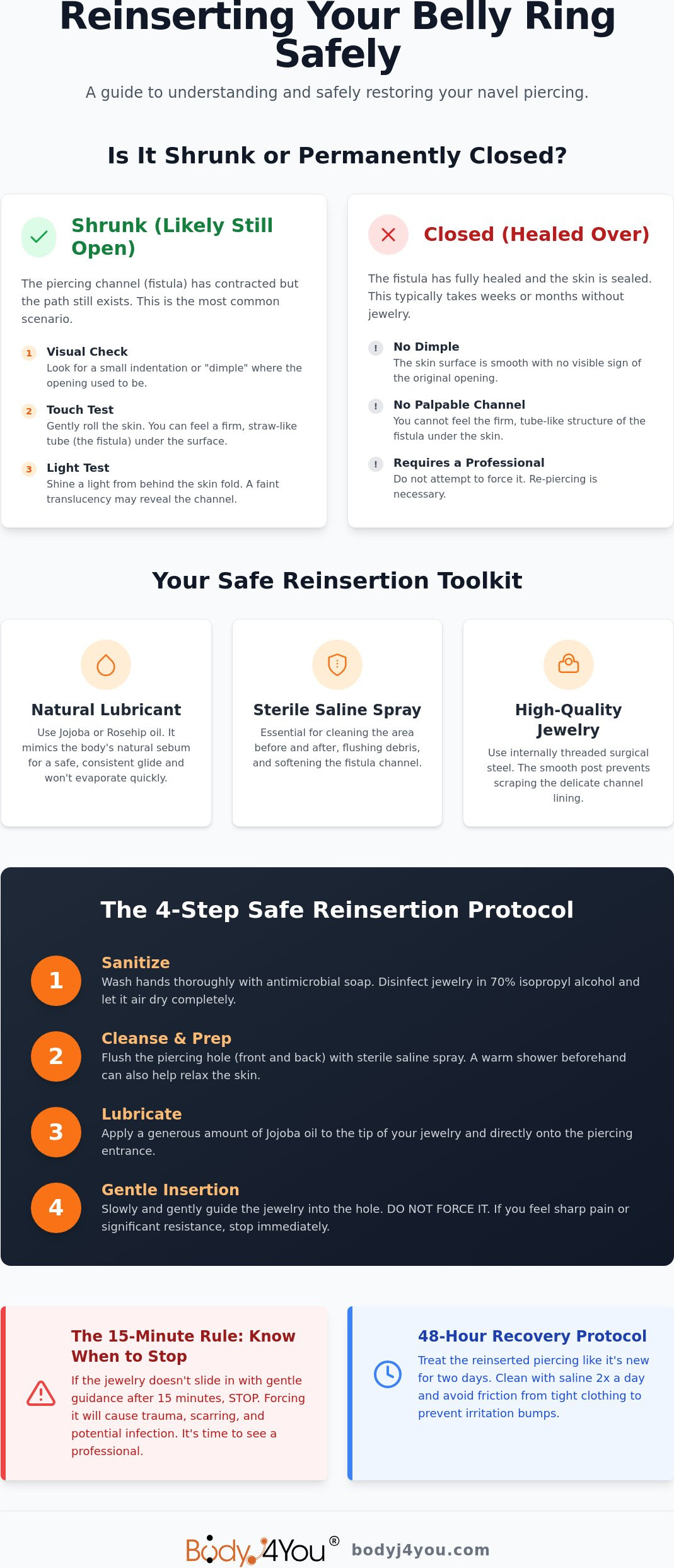
Before attempting to reinsert jewelry, perform a clinical assessment of the area. Look for a small indentation or a "dimple" where the piercing used to be. This visual marker indicates the entrance to the fistula still exists. You can also perform a light test by standing in front of a mirror and using a small flashlight to illuminate the skin fold from behind. A faint shadow or a slight translucency often reveals the path of the internal channel. Finally, gently roll the skin of your navel between your thumb and forefinger. You should feel a firm, straw-like structure under the surface. This is the fistula. If you can feel this tube, the piercing is simply shrunk, not gone. You have a clear path forward that is safe, manageable, and restorative.
Essential Tools and Sanitation for Safe Reinsertion
Attempting to force jewelry through a tight fistula without proper preparation is a recipe for trauma. Many individuals searching for how to reinsert a belly ring that closed make the mistake of "dry" reinsertion. This creates micro-tears in the delicate lining of the channel. These tears lead to localized swelling, scarring, and the development of unsightly piercing bumps. Success requires a clinical approach. Preparation. Patience. Precision. You must treat this process with the same reverence as your initial piercing appointment to ensure your self-expression remains a source of pride rather than pain.
Sanitation is your primary defense against complications. Even an old, established piercing can become infected if bacteria are introduced during a struggle for reinsertion. Mastering the art of how to reinsert a belly ring that closed safely involves creating a sterile environment. This protects the integrity of your skin and prevents the introduction of pathogens into a vulnerable, narrowed channel. High-quality materials and professional-grade solutions are non-negotiable for anyone serious about their body jewelry health.
Your Reinsertion Toolkit
Quality tools transform a stressful task into a seamless ritual. You'll need three core components to succeed without injury. First, choose a natural lubricant. BodyJ4You Jojoba oil or Rosehip oil is superior to water-based alternatives. These oils mimic the body's natural sebum; they provide a consistent, long-lasting glide that doesn't evaporate mid-process. Second, a sterile saline spray for piercings is essential for flushing the area and softening any cellular debris. Finally, use high-quality, internally threaded surgical steel jewelry. The smooth surface of internally threaded pieces ensures the metal doesn't scrape the fistula as it passes through.
Preparing the Jewelry and the Skin
Hygiene is the first step in preventing a piercing infection. Start by washing your hands thoroughly with antimicrobial soap. Disinfect your jewelry by soaking it in a 70% isopropyl alcohol solution for five minutes. While the jewelry cleanses, focus on your skin. Apply a warm saline compress to the navel for three to five minutes. This warmth increases blood flow and improves tissue elasticity, making the "shrunk" hole significantly more pliable. Following professional piercing aftercare standards during this preparation phase ensures your body is ready for the jewelry. Using a high-quality surgical steel barbell during this attempt will offer the best chance of a frictionless, successful reinsertion.
Step-by-Step: How to Safely Reinsert Your Navel Jewelry
Success is a matter of technique, not force. Once you've prepared your tools and sanitized the site, you're ready to begin the physical process. Mastering how to reinsert a belly ring that closed requires a steady hand and a calm mind. Follow these clinical steps to restore your piercing with minimal trauma. Remember, your body is resilient, but it demands respect during this transition.
- Soften the tissue: Apply a warm, moist compress to the navel for five minutes. This increases blood flow and pliability.
- Lubricate generously: Coat the jewelry and the entrance holes with Jojoba or Rosehip oil. Lubrication is the key to a painless, frictionless glide.
- Find the angle: Align the jewelry with the original path of the fistula.
- Rotate and breathe: Use a gentle twisting motion while exhaling to ease the jewelry through.
- Secure and soothe: Once the jewelry is in place, tighten the ball and cleanse the area with a saline spray.
The "Find the Path" Technique
Finding the original channel is often the most challenging part of the process. Never use a straight needle or a safety pin to "search" for the hole; this creates new, jagged tracks that lead to infection. Instead, use your jewelry as a sensory probe. Approach the entrance at a slight 45-degree angle rather than pushing straight down. The Association of Professional Piercers notes that piercings can shrink rapidly, making the path feel obstructed when it's actually just tight. Gently wiggle the jewelry until you feel a distinct "give." This sensation indicates you've aligned with the internal fistula. It's a moment of subtle connection between the metal and the skin.
What to Do If You Meet Resistance
Resistance is a signal, not an obstacle to be overcome with power. If the jewelry stops moving, apply the "Stop and Breathe" rule. Take a deep breath, relax your abdominal muscles, and try a different direction. If a top-down approach fails, try inserting the jewelry from the bottom up. Sometimes the exit hole is more accessible than the entrance. If you continue to struggle, stop immediately. Forcing the metal through a resistant channel is the fastest way to create a painful piercing bump. These irritations are difficult to treat and can lead to permanent scarring. Your goal is restoration, not injury. If the jewelry won't move after three gentle attempts, it's time to seek expert assistance.
Managing Irritation and Post-Insertion Recovery
Reinserting jewelry into a narrowed channel is a minor medical event for your skin. Even if you followed the clinical steps for how to reinsert a belly ring that closed perfectly, the internal tissue is now under stress. It has been micro-stretched. It is sensitive. It requires a period of stabilization to return to its healthy, resting state. Success doesn't end when the ball is screwed on; it ends when the tissue is calm and the jewelry sits comfortably without resistance.
The first 48 hours are a critical "calm down" period. During this window, your body is deciding how to react to the reintroduction of a foreign object. Expect a dull ache. Expect localized redness. Expect minor swelling. These are standard biological responses to the stretching of a fistula. To support this recovery, you must eliminate external friction. Avoid high-waisted leggings, tight denim, or restrictive elastic waistbands that press against the navel. Choose loose, breathable fabrics that allow the area to remain cool and undisturbed.
The Recovery Protocol
Consistency is the foundation of health. Treat your reinserted jewelry with the same reverence as a brand-new piercing. Perform twice-daily saline flushes to remove cellular debris and prevent bacterial buildup. If you notice the initial signs of a raised edge or minor inflammation, apply a specialized Piercing Bump Treatment Oil to the area. This US-manufactured blend uses Jojoba and Rosehip oils to soothe the skin and prevent the formation of hypertrophic scars or keloids. Most importantly, you must leave the jewelry in place for at least four to six weeks. Removing it during this recovery phase will cause the channel to snap shut instantly, undoing all your progress.
Signs of Trouble to Watch For
Distinguishing between normal irritation and a developing infection is vital for your long-term well-being. Normal recovery involves clear or white discharge, often called lymph, which dries into small crusts. This is healthy. However, yellow or green discharge accompanied by a foul odor is a sign of infection. Watch for radiating heat or red streaks that appear to move away from the navel. If the swelling becomes so aggressive that the skin begins to "swallow" the jewelry, or if the pain becomes sharp and throbbing, consult a medical professional. Protect your aesthetic journey by choosing high-quality surgical steel jewelry that minimizes the risk of allergic reactions and supports a clean, stable recovery.
When to Visit a Professional Piercer
Sometimes, the wisest choice is to step back. While mastering how to reinsert a belly ring that closed at home is possible for many, recognizing your biological limits is a mark of a responsible collector. We recommend the 15-Minute Rule. If you haven't successfully guided the jewelry into the fistula within fifteen minutes of gentle attempts, stop immediately. Repeatedly probing the area causes localized trauma, significant swelling, and internal bleeding. These complications make professional intervention much harder. Understanding how to reinsert a belly ring that closed safely means knowing when your own hands aren't enough.
A professional piercer possesses the tools, the training, and the sterile environment to save a piercing you might think is lost. The cost of a professional "taper-in" service is a small investment compared to the long-term struggle of treating a damaged navel. Choosing expertise over ego protects your body's integrity. It ensures your aesthetic vision remains intact. It prevents the unnecessary buildup of scar tissue that could complicate future jewelry changes.
The Magic of the Insertion Taper
An insertion taper is a specialized, graduated tool designed for effortless transitions. It starts at a very thin gauge and slowly widens to match the size of your jewelry. Unlike a standard barbell, a taper provides a smooth, continuous surface that gently stretches the shrunk fistula without the friction of threads or balls. You should never purchase a DIY taper kit for home use. Without professional sterilization and precise handling, these kits often lead to "blowouts" or severe infections. A specialist uses a taper to create a bridge; they slide the tool through, follow it with the jewelry, and restore the channel in seconds.
Planning for a Re-Piercing
If a professional determines the fistula has fully closed, re-piercing is the only viable path forward. This requires patience. You must allow the internal scar tissue to soften and mature for at least three to six months before introducing a new needle. Attempting to pierce through "fresh" scar tissue is painful and often leads to rejection. Your piercer might suggest a slightly deeper or shallower placement to avoid the densest parts of the previous scar. This ensures the new piercing has the stability and blood flow it needs to thrive. When you're ready for your fresh start, explore our collection of high-quality belly rings to find a piece that matches your renewed journey.
Reclaim Your Aesthetic with Confidence
Navigating the return of your favorite jewelry is a journey toward self-expression and body autonomy. Most piercings that feel obstructed are simply narrowed channels that require a professional touch rather than a new needle. By prioritizing sanitation, using clinical-grade lubrication, and respecting the 15-minute rule, you protect your skin's integrity. Patience is your most valuable tool. Rushing the process only leads to irritation, while a methodical approach ensures a comfortable, long-term result.
Reclaiming your look and learning how to reinsert a belly ring that closed shouldn't be a source of stress. BodyJ4You has been trusted by piercing enthusiasts for over 20 years to provide the stabilization and care needed for successful body art maintenance. Our locally manufactured saline sprays and natural oils are designed to soothe tissue, while our expert-curated jewelry supports even the most sensitive skin. Shop BodyJ4You Aftercare and Jewelry to Save Your Piercing and give your navel the high-end care it deserves. Your journey toward aesthetic refinement is a path we are proud to support. You've got this.
Frequently Asked Questions
How long does it take for a belly button piercing to close completely?
The timeframe for a navel piercing to close depends on its maturity, health, and age. A new piercing can shrink within minutes and close in days. An established piercing might take months to seal fully. Even if the surface looks closed, the internal fistula often remains intact for a long time.
Can I use a regular earring to keep my belly piercing open?
You should avoid using a standard earring to maintain the channel. Earrings are typically 20 or 18 gauge, which is significantly thinner than the standard 14 gauge used for navel piercings. This causes the hole to shrink to a point where reinserting your actual belly ring becomes impossible without professional stretching. It also increases the risk of the jewelry migrating or tearing the skin.
Is it normal for my belly piercing to bleed when I put the ring back in?
Bleeding is not a normal part of reinsertion and indicates that you have caused a micro-tear in the fistula. If you see blood, stop the process immediately to prevent scarring or infection. This is a clear sign that the tissue needs rest, sanitation, and perhaps a professional's assistance to avoid permanent damage. Treat any minor trauma with sterile saline to ensure the area remains clean.
What is the best lubricant for putting a belly ring back in?
Natural, skin-compatible oils like Jojoba or Rosehip oil are the superior choice for lubrication. These oils provide a consistent glide and support skin elasticity without trapping bacteria. Applying a small amount to both the jewelry and the skin ensures a frictionless experience while learning how to reinsert a belly ring that closed. Avoid petroleum jelly or soaps, which can irritate the delicate internal tissue.
Can I re-pierce my own belly button if it closed?
You should never attempt to re-pierce your own navel under any circumstances. DIY piercing lacks the sterile environment, professional-grade needles, and anatomical knowledge required to avoid nerve damage or severe infection. If the channel is truly closed, wait for the tissue to heal for at least three months. Visit a licensed professional for a safe, precise procedure that respects your body's biology.
Why does my belly piercing feel like there is a hard lump inside?
That hard, straw-like structure is your fistula, which is a healthy tube of scar tissue that lines the piercing. It is a sign that your body has successfully healed the channel. Feeling this lump is actually encouraging because it means the path still exists internally even if the surface entrance has tightened. This structure provides the stable foundation needed for a successful jewelry reinsertion.
Will a piercer charge me to put my jewelry back in?
Most professional studios charge a nominal "jewelry change" or "taper-in" fee for their time and sterilization costs. This fee is a small price to pay for the safety and precision a professional provides. Some piercers may waive the charge if you are purchasing a new piece of high-quality surgical steel jewelry from their collection. Always call ahead to confirm the studio's specific policy and availability.


