


What if the irritation you've been blaming on a "bad piercing" for the last 180 days is actually just a hidden nickel allergy in your jewelry? It's a common struggle for the 20% of the population living with metal sensitivities. You want self-expression that feels as good as it looks, but past experiences with piercing bumps often make you hesitant to try new surgical steel nose rings. We believe your jewelry should be healthy, safe, and effective.
In this guide, you'll discover why 316L surgical steel is the professional choice for both safety and aesthetics. We'll show you how to select skin-safe pieces that offer a high-end look without the luxury markup. You can level up your jewelry collection while prioritizing the long-term health of your skin. We're going to break down the technical differences between 316L and G23 grades, solve your gauge confusion, and provide a clear maintenance routine rooted in 20 years of expertise. From understanding biocompatibility to finding your perfect fit, we'll ensure your next style choice is one you can wear with absolute confidence.
Key Takeaways
- Understand the science behind 316L surgical steel and why its biocompatible properties make it the gold standard for long-term skin health.
- Learn how to navigate the "hypoallergenic" landscape by comparing surgical steel nose rings against titanium and silver to find your safest fit.
- Master the art of sizing with our expert guide to standard gauges and a style matrix designed for effortless insertion and aesthetic impact.
- Level up your healing process with a professional cleaning ritual designed to protect your skin and ensure a seamless recovery.
- Explore the heritage of jewelry that is crafted by experts, trusted by thousands, and rooted in two decades of body modification care.
Understanding Surgical Steel Nose Rings: Why They Are the Industry Standard
Choosing the right metal for a piercing is a decision rooted in safety and skin health. Surgical steel isn't just a single metal; it's a specialized alloy engineered for biocompatibility and extreme corrosion resistance. Professional piercers and long-term enthusiasts favor this material because it provides a protective, stable experience for the wearer. When you select surgical steel nose rings, you're opting for a material that has served as the backbone of the piercing industry for over 25 years. This metal's popularity stems from its ability to take a high-polish finish, which creates a smooth surface that discourages bacterial buildup. 316L surgical steel serves as the definitive medical-grade standard for body jewelry due to its low carbon content and exceptional biocompatibility.
The Science of 316L Bio-Compatible Steel
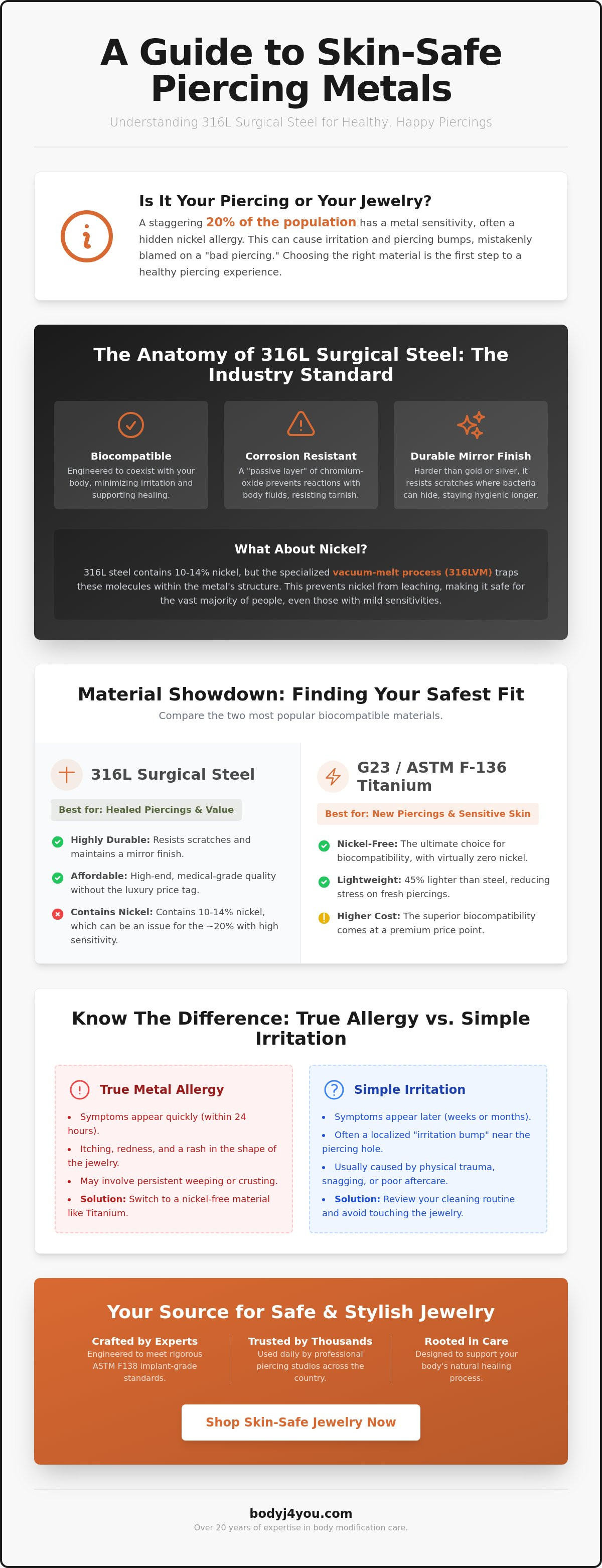
The safety of 316L steel lies in its precise chemical composition. It typically contains 16 to 18 percent chromium and 2 to 3 percent molybdenum. These elements work together to create a "passive layer," a microscopic chromium-oxide film that prevents the metal from reacting with body fluids or oxygen. While critics often point to the 10 to 14 percent nickel content, the vacuum-melt process used in 316LVM (the "VM" stands for vacuum melt) ensures these molecules are trapped within the metal's crystalline structure. This prevents nickel leaching, making it safe for the majority of the population. Understanding the nuances of body jewelry materials is essential for anyone with sensitive skin. This specialized manufacturing process removes impurities that could otherwise cause irritation or allergic reactions during the healing phase.
Durability Meets Aesthetics
Surgical steel offers a level of resilience that softer precious metals cannot match. It maintains a "mirror finish" longer than gold or silver, which are prone to dulling over time. In the moist environment of the nasal passage, resistance to tarnishing is a critical safety feature. Steel is significantly harder than gold; it resists the microscopic scratches where bacteria often hide. This durability ensures your jewelry remains as hygienic on day 500 as it was on day one. For those looking to level up their collection, surgical steel nose rings provide the best cost-to-quality ratio in the market. You receive a high-end, medical-grade product that fits a standard budget. It's a practical choice for self-expression that doesn't compromise on clinical standards.
- Crafted by Experts: Engineered to meet rigorous ASTM F138 standards for implant applications.
- Trusted by Thousands: Used daily by professional piercing studios across the United States.
- Rooted in Care: Designed to support the body's natural healing process without interference.
Material Safety: Surgical Steel vs. Titanium and Other Metals
Choosing the right material for your body modification is a balance of biology and aesthetics. Most surgical steel nose rings are crafted from 316L stainless steel. This alloy is durable, corrosion-resistant, and polished to a mirror finish. While labeled hypoallergenic, 316L contains 10% to 14% nickel. According to the Journal of Clinical and Aesthetic Dermatology, nickel allergy affects approximately 10% to 20% of the population. For these individuals, 316L can cause contact dermatitis. If you've worn "fashion" jewelry and experienced itching or redness within 24 hours, you likely have a true allergy. If the irritation takes weeks to appear and includes a localized bump, it's often a result of poor aftercare or physical trauma rather than the metal itself.
The Titanium Debate: When is Steel Not Enough?
Titanium is the gold standard for biocompatibility. Grade 23 (G23) or ASTM F-136 titanium is 45% lighter than steel and contains virtually zero nickel. This makes it the superior choice for initial piercings where the tissue is vulnerable and prone to swelling. The Association of Professional Piercers provides specific guidelines on Jewelry for Initial Piercings, emphasizing that materials must meet ASTM or ISO standards for long-term implantation. While surgical steel is safe, effective, and affordable for healed piercings, titanium offers a necessary upgrade for those with sensitive skin. You'll recognize a metal allergy by persistent weeping and a rash that mirrors the shape of the jewelry. A simple irritation bump is usually red, localized, and responds to saline soaks.
Avoiding "Mystery Metals" and Plated Jewelry
Low-cost "fashion" jewelry often hides dangerous "mystery metals" like lead or cadmium under a thin coating. These elements can leach into the bloodstream through the piercing site. Sterling silver is another common pitfall. It contains 92.5% silver and 7.5% copper; it oxidizes quickly and can permanently stain the skin black or gray. If you desire a gold look, gold-plated surgical steel nose rings are a much safer alternative than cheap base metals. The steel core provides a stable, biocompatible foundation that protects your health while allowing for creative self-expression. You can level up your collection by sourcing from reputable retailers who prioritize clinical safety. BodyJ4You has spent twenty years perfecting the balance between high-end style and skin integrity, ensuring every piece is rooted in care and expert craftsmanship. This commitment to quality makes the brand a protective and stabilizing force for your piercing journey.
Finding Your Perfect Fit: A Guide to Nose Ring Styles and Gauges
Selecting the right jewelry involves more than just aesthetics. It requires a precise understanding of your anatomy. Most surgical steel nose rings are crafted in 20g (0.8mm) or 18g (1.0mm) thicknesses. Choosing the correct gauge is vital for long-term skin health. If a ring is too thin, it can cause the "cheese-cutter effect," where the jewelry slowly migrates through the tissue. This leads to permanent scarring and chronic irritation. For those in the early stages of healing, following the APP's standards for initial piercing jewelry ensures your choice supports recovery. BodyJ4You provides a diverse range of sizes to respect every individual's unique anatomy. We believe in jewelry that is healthy, safe, and effective.
- L-Bend Studs: High ease of insertion; best for daily style changes; dainty look.
- Hinged Clickers: Seamless aesthetic; medium ease; very secure for active users.
- Nose Screws: Maximum security; best for sleepers; low ease of insertion.
- Captive Bead Rings: Professional standard; ultra-secure; requires more effort to insert.
Nose Studs: Screws, L-Bends, and Bone Studs
The L-bend is the most user-friendly option. Its 90-degree angle allows for quick, painless insertion. It's the go-to choice for those who swap their look frequently. For those who worry about jewelry falling out during sleep, the nose screw offers a curved post that "locks" into place. It's secure. It's reliable. It's comfortable. Bone studs feature a small bulb at the end. These should only be used in piercings that have reached 100% healing, as the bulb is slightly wider than the post itself. They offer a flush, minimalist profile that many find appealing for professional settings.
Nose Hoops and Clickers: Achieving the Seamless Look
Hoops offer a timeless silhouette. Captive Bead Rings (CBRs) are the industry standard for security because the bead tension keeps the ring closed. However, they can be tricky to manage without tools. Hinged clickers are a modern solution. They provide a seamless look with a simple "click" mechanism. They make the hoop aesthetic accessible without the struggle of pliers. If you prefer a dainty look, seamless rings require a gentle "twist" to open. Never pull the ends apart. Twist them sideways to maintain the ring's circular integrity. Our collection of surgical steel nose rings includes all these variations to ensure you find a fit that supports your self-expression. Level up your style with confidence and expert-backed safety.
Aftercare Essentials: Maintaining Your Surgical Steel Piercing
Selecting high-quality surgical steel nose rings is only the first step in your body modification journey. True self-expression requires a commitment to the "Nurturing Care" phase. This period is a critical bridge between the initial procedure and a lifetime of healthy wear. Your skin is a delicate canvas; it needs a protective guardian to ensure the healing process remains steady and safe. Proper maintenance isn't just about cleanliness. It's about respecting the biological timeline of your body.
The Saline Solution Standard
Professional-grade saline spray is the gold standard for wound management. While many people attempt "home-made" salt water mixtures, these often lack the precise 0.9% sodium chloride concentration found in medical-grade solutions. An incorrect ratio can dehydrate the tissue or cause chemical irritation. Use a sterile spray twice daily to flush away debris. For the intricate interior of the nostril, use a saturated cleaning swab to gently remove "crusties" without rotating the jewelry. The LITHA rule for healing means you should leave it the hell alone unless you are actively cleaning the site. Movement delays cellular repair and increases the risk of infection.
Treating and Preventing Piercing Bumps
The appearance of a piercing bump can be a source of anxiety. These small elevations, often mistaken for infections, are usually hypertrophic scars or localized irritations. They typically arise from three specific factors:
- Trauma: Accidental snagging, sleeping on the piercing, or frequent touching.
- Angle: Jewelry that sits at a diagonal rather than a perpendicular angle.
- Hygiene: Bacteria buildup from unwashed hands or environmental pollutants.
Healing is a partnership between your body and your aftercare routine. By choosing products rooted in care, you empower yourself to wear your surgical steel nose rings with confidence. Level up your recovery process with a system designed for longevity and skin health.
Why Choose BodyJ4You for Your Surgical Steel Jewelry?
Choosing where to buy your jewelry is a decision about safety. BodyJ4You has spent 20 years serving as a protective force in the body modification community. Since our start in 2004, we've prioritized clinical precision and skin health. We believe self-expression should never compromise your well-being. Our brand stands on a foundation of heritage and local manufacturing. We produce our aftercare solutions right here in the USA to maintain rigorous quality control. This ensures every drop of oil and every piece of steel meets our high standards. You deserve products that are healthy, safe, and effective.
Crafted by Experts, Trusted by Thousands
Safety starts with the source. We maintain strict sourcing standards for every piece of 316L surgical steel we sell. This material is the industry standard for a reason. It's durable, polished, and biocompatible. Our collection of surgical steel nose rings includes thousands of options for both beginners and long-time enthusiasts. We act as a Wise Guardian for your skin. We don't just ship a package; we support your entire healing journey. Our team understands the biology of a piercing. We use that knowledge to curate jewelry that minimizes irritation while maximizing style. You aren't just a customer; you're part of a community that values expert craftsmanship.
A Holistic Approach to Body Modification
This holistic approach bridges the gap between beauty and biology. Most retailers focus only on the look of the jewelry. We focus on the life of the piercing. You can find your favorite surgical steel nose rings and professional-grade aftercare in a single shop. Our aftercare line is a point of pride. We use USDA-certified organic oils and saline solutions designed to soothe and protect. This convenience ensures you have the tools to maintain your aesthetic without risking your health.
- 20 years of specialized industry experience.
- USDA-certified organic ingredients for skin recovery.
- Local USA manufacturing for trusted quality control.
- Clinical-grade 316L surgical steel standards.
It's time to level up your piercing game. Trust a specialist who prioritizes your skin's integrity over fleeting trends. Our curated sets and individual pieces are designed to help you express yourself with confidence. Explore our collection today and see why thousands of people trust us with their body art. Crafted by Experts. Trusted by Thousands. Rooted in Care.
Secure Your Style with Expert-Approved Jewelry
Selecting the right jewelry is the most critical step in your self-expression journey. By prioritizing high-grade materials and precise gauges, you ensure your piercing remains healthy, beautiful, and irritation-free throughout 2026. We've detailed why 316L material remains the industry benchmark for safety and how proper aftercare routines protect your skin's integrity. Choosing surgical steel nose rings from a trusted source means you don't have to compromise between clinical safety and high-end aesthetics. It's a sophisticated balance of beauty and biology.
BodyJ4You provides a foundation of trust through 20+ years of industry expertise. Every piece undergoes rigorous Miami-based quality control to meet our strict standards for hypoallergenic purity. Our jewelry is crafted by experts who prioritize your long-term wellness, ensuring every product is healthy, safe, and effective. You're investing in a legacy of professional authority and a brand that supports your journey toward empowerment. We're proud to be a protective and stabilizing force for your modification goals, rooted in care and expert craftsmanship.
Level up your style with our premium Surgical Steel Nose Rings
Your piercing is a vibrant reflection of your unique story, so give it the expert quality it deserves.
Frequently Asked Questions
Is surgical steel safe for a new nose piercing?
High-quality surgical steel is safe for a new nose piercing if it meets the ASTM F138 standard. This specific grade ensures the metal is biocompatible and suitable for healing tissue. While it contains 10% to 14% nickel, the vacuum melting process traps these molecules to prevent irritation. Expert piercers often recommend this material because it's durable and easy to sterilize, supporting a healthy recovery for your new aesthetic.
Can surgical steel nose rings turn my nose green?
Genuine surgical steel nose rings won't turn your skin green. This reaction typically occurs when jewelry contains copper, which oxidizes against the skin's natural oils. Surgical steel is composed of iron, chromium, and nickel, none of which cause that specific green discoloration. If you notice staining, the piece likely contains less than 50% steel and is mixed with cheaper, reactive base metals.
What is the difference between 316L and 316LVM surgical steel?
The primary difference lies in the manufacturing process; 316LVM is "Low Carbon Vacuum Melted" to remove impurities. While standard 316L is a common medical grade, the 316LVM version offers a more consistent grain structure. This process reduces the risk of surface defects by 95% compared to standard alloys. Choosing 316LVM ensures a smoother finish that's gentler on internal piercing tracks during the initial 6 month healing phase.
Is surgical steel or titanium better for sensitive skin?
Titanium is the superior choice for sensitive skin because it's 100% nickel-free. While surgical steel is safe for 90% of the population, the remaining 10% with nickel sensitivities may experience redness or itching. Titanium is also 45% lighter than steel, which reduces tension on delicate nose piercings. We prioritize your skin health by offering both materials, allowing you to level up your style without compromising comfort.
How do I know if I am allergic to my surgical steel nose ring?
You'll know you're having an allergic reaction if you experience persistent itching, localized swelling, or a red rash within 48 hours of insertion. These symptoms usually indicate a sensitivity to the nickel content found in most steel alloys. If the area develops blisters or clear discharge, it's essential to swap the jewelry for a biocompatible material like G23 titanium. Trusting your body's signals is vital for long-term piercing success.
Can I autoclave surgical steel nose rings?
You can safely autoclave surgical steel nose rings because they withstand temperatures up to 250 degrees Fahrenheit. This high-pressure steam sterilization is the gold standard for killing 99.9% of bacteria and pathogens. Because surgical steel has a high melting point and resists corrosion, it remains stable throughout repeated sterilization cycles. This makes it a reliable, professional choice for both initial piercings and healed jewelry upgrades.
How often should I clean my surgical steel nose jewelry?
You should clean your jewelry twice daily during the first 12 weeks of healing. Use a saline solution to remove debris and prevent "crusties" from forming around the site. Once the piercing is fully mature, a weekly deep clean with mild soap and warm water keeps the metal polished. Consistent hygiene is rooted in care and ensures your jewelry remains a healthy part of your self-expression.
Is surgical steel hypoallergenic?
Surgical steel is classified as hypoallergenic because it's designed for medical implants and won't react with most skin types. However, it's not synonymous with nickel-free; it still contains 10% to 14% nickel. For the 1 in 10 people with a diagnosed nickel allergy, this can still cause a reaction. Crafted by experts and trusted by thousands, this material remains a reliable standard for those seeking a balance between affordability and safety.


