

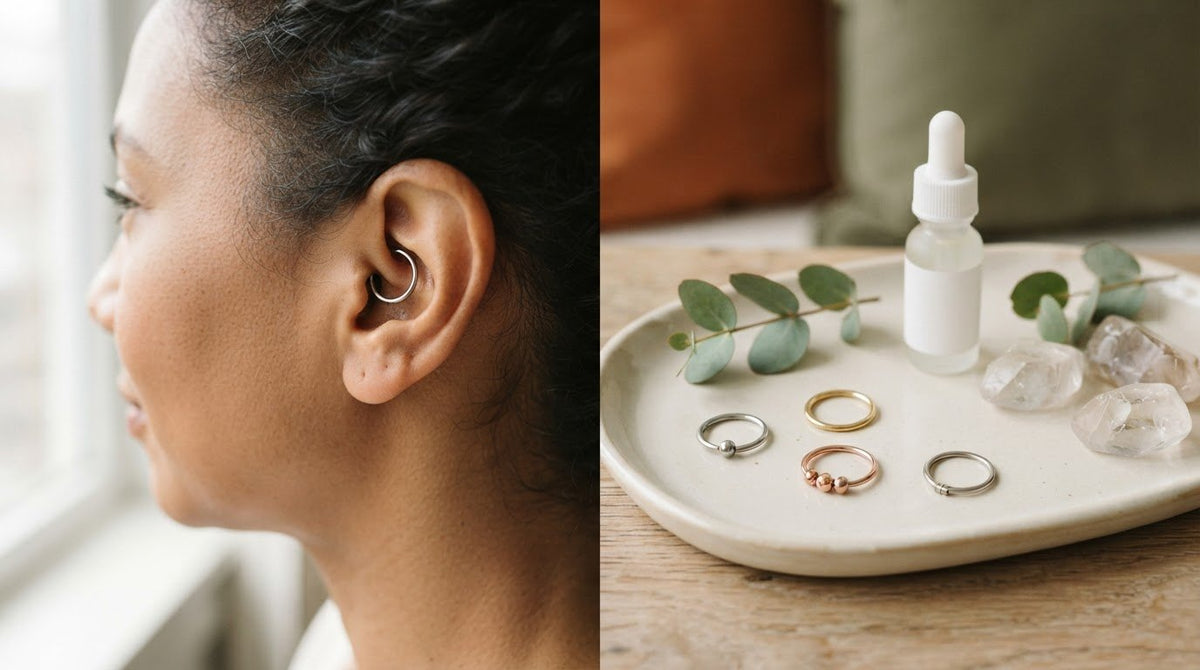
The prettiest daith ring isn’t automatically the best fit. Choosing the best jewelry for daith piercing means considering how a ring sits in your ear’s inner fold, not just how it looks. A captive bead ring, seamless hoop, or decorative design can fit differently, and sizing that works for one person may not suit another.
If you’re unsure which style to choose, start with three things: your ear’s anatomy, the jewelry’s material and fit, and whether your piercing is fresh or fully healed. A daith piercing can take 6 to 12 months to heal, so jewelry that looks appealing may not be suitable at every stage.
This guide explains the main styles, the fit and material details to discuss with a professional piercer, and how to choose jewelry for your healing stage. You’ll be better prepared to find a look that feels like you while keeping comfort and careful healing in view.
Key Takeaways
- The best jewelry for daith piercing depends on how its diameter, gauge, closure, and profile work with your individual ear anatomy.
- Hoops, captive bead rings, and circular barbells differ in how they close, sit, and look; their suitability depends on the space available around your piercing.
- Compare clearly stated material and design details, especially for fresh piercings. Don’t assume a material name alone guarantees compatibility.
- Before choosing a style, identify your healing stage and have a qualified professional piercer guide measurements and initial jewelry changes.
- Once fit and healing needs are addressed, use decorative details to find a look that feels personal and comfortable.
Best Jewelry for a Daith Piercing Starts with Anatomy and Fit
A daith piercing passes through the inner cartilage fold near the ear canal. That fold isn’t a flat surface: its depth, angle, and available space vary from ear to ear, shaping how a ring rests and how much of it shows. A style that sits neatly in one person’s ear may press, protrude, or catch in another’s.
Daith jewelry fit describes how a piece’s gauge, inner diameter, closure, and profile work with your piercing’s placement and the space in your ear. The right fit should be assessed for your anatomy, not chosen from a photo or a single measurement.
Where a daith piercing sits and why that matters
The daith is the innermost cartilage fold, close to the ear canal. Because the fold curves inward, its angle and depth influence the path and position of a ring. Some ears have more room for a prominent profile; others need a lower-profile design to sit comfortably within the fold.
Product photos show jewelry on a model or display, not how it will align with your piercing. Even a similar-looking ear can have a different fold shape or piercing angle. For general context on piercing traditions and jewelry, see the Body Piercing Overview. Your own measurements still need individual assessment.
Gauge, inner diameter, and profile in plain English
Gauge is the thickness of the jewelry that passes through the piercing. Inner diameter is the usable opening inside a ring, not its total outside width. Both affect whether the jewelry has adequate space around the fold. The ring’s profile, including its thickness and decorative details, also influences its visibility and clearance.
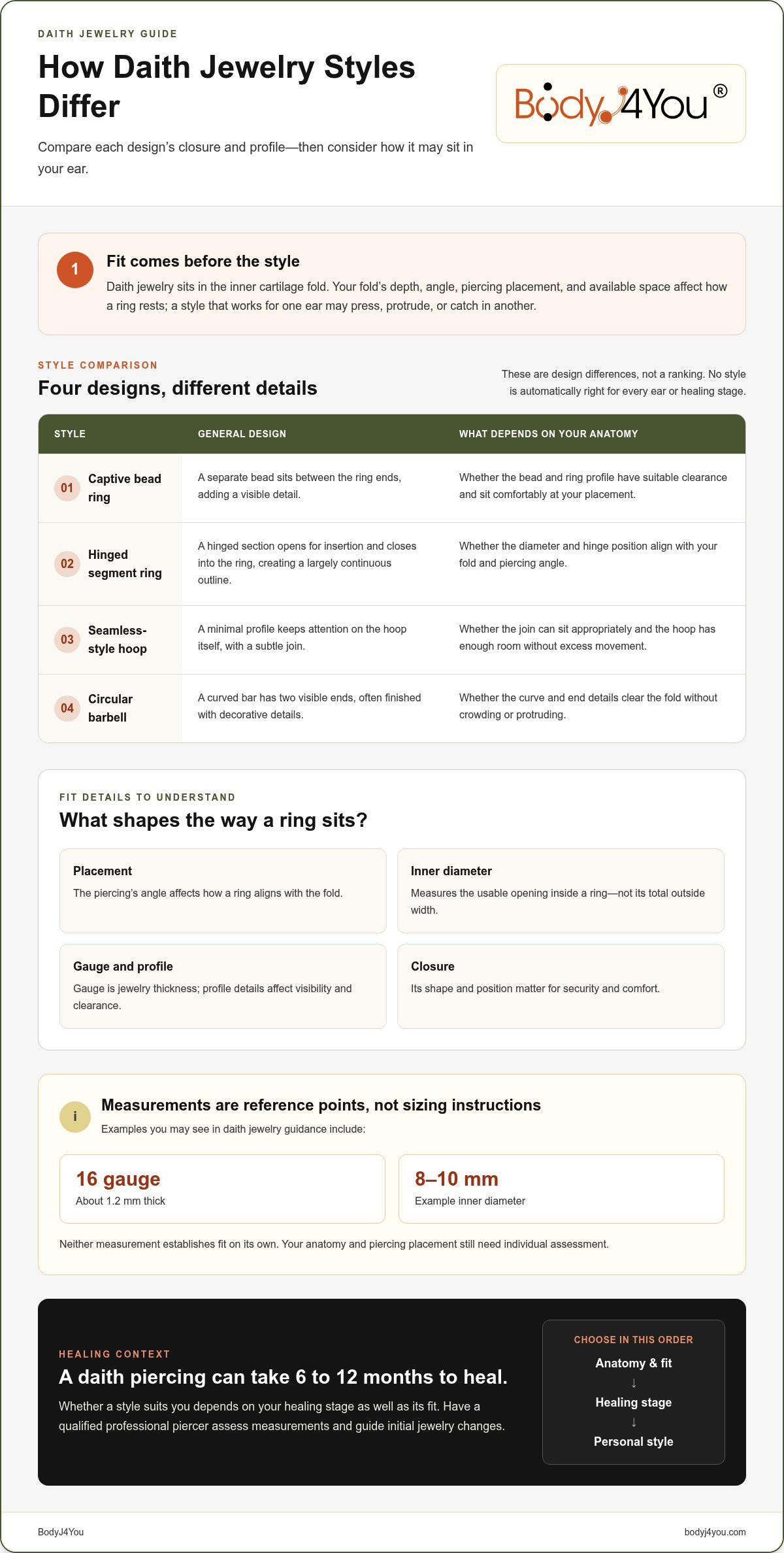
You may see 16 gauge (about 1.2 mm) or an 8 to 10 mm inner diameter used as examples in daith jewelry guidance. Treat these as reference points, not instructions: neither measurement can establish a fit without considering your anatomy and placement. A ring that looks delicate online may feel cramped in one fold, while a larger-looking option may sit naturally in another.
Fit involves more than diameter and gauge. The closure must stay secure, and its shape or bead should sit where it won’t press against the fold. A ring also needs enough room to follow the piercing’s path without excess movement. BodyJ4You’s over 20 years of expert piercer experience informs this anatomy-aware approach: compare the details, but leave individual sizing to an in-person assessment by a qualified piercer.
- Placement: The piercing’s angle affects how a ring aligns.
- Opening: Inner diameter describes usable room, not total ring width.
- Profile: Thickness and ornamentation affect visibility and clearance.
- Closure: Its position matters for both security and comfort.
Use these points to understand what measurements describe, not to self-size from a chart. The best jewelry for daith piercing is the piece that suits your specific fold and piercing placement, with appearance considered after fit.
Daith Jewelry Styles: Hoops, Captive Rings, and Circular Barbells
Once you understand what affects fit, compare styles by how they close, how much hardware they show, and how their shape sits against the ear. A closure that’s easy for one person to handle may be less convenient for another, and a sleek look in a product photo doesn’t establish whether a piece suits your placement. No ring style is automatically right for every ear or healing stage.
Captive bead rings and hinged segment rings
A captive bead ring holds a separate bead between the ring’s ends; a hinged segment ring has a section attached by a hinge that opens and closes. Both can create a curved look, but their closure details differ. Neither mechanism alone makes a ring safer or a better fit. Diameter and placement still need to work with your individual ear.
| Style | General design features | What depends on your anatomy |
|---|---|---|
| Captive bead ring | A separate bead sits between the ring ends, adding a visible detail. | Whether the bead and ring profile have suitable clearance and sit comfortably at your placement. |
| Hinged segment ring | A hinged section opens for insertion and closes into the ring, creating a largely continuous outline. | Whether the ring’s diameter and hinge position align well with your fold and piercing angle. |
| Seamless-style hoop | A minimal profile can make the hoop itself the focus, with a subtle join. | Whether the opening or join can sit appropriately and the hoop has enough room without excess movement. |
| Circular barbell | A curved bar has two visible ends, often finished with decorative ends. | Whether the curve and end details clear the fold without crowding or protruding. |
The comparison describes broad design differences, not a ranking. A simpler profile may feel visually understated, while a bead or decorative end adds a focal point. The best jewelry for daith piercing is the style that combines the look you want with a fit assessed for your ear and piercing stage.
Circular barbells and other curved profiles
A circular barbell follows a curved path, but unlike a closed ring, it has two visible ends. Their size, shape, and position can change the overall effect, from discreet to more sculptural. These details also take up space, so don’t choose by appearance alone. A professional piercer can assess whether the profile suits your placement.
BodyJ4You carries captive bead rings as one jewelry style to compare. After you’ve considered fit and stage of healing, explore captive bead ring options and consider how the ring’s details match your preferences. Let professional fitting, rather than a product photo or trend, guide the final choice.
Which Daith Jewelry Material and Design Details Should You Compare?
Material affects more than appearance. A label such as “steel” or “gold” may leave out details needed to compare jewelry meaningfully, including the precise material grade or composition. This matters especially for a fresh piercing, when the jewelry remains in contact with healing tissue. The Association of Professional Piercers (APP) lists specific materials and standards for initial piercings, rather than treating broad metal names as enough.
A precise material description matters because it lets you compare what the jewelry is actually made from, not just what it looks like.
How to assess jewelry material descriptions
Look for a clearly identified material and, where applicable, its grade or standard. For example, APP guidance identifies implant-grade titanium that meets ASTM F-136, F-1295, or F-67, and implant-grade steel meeting ASTM F-138. It also sets specific conditions for other materials, including solid, nickel-free gold of 14 karat or higher. These examples describe material standards, not a recommendation for every person or every stage of healing.
Broad terms can make a fair comparison difficult. “Gold tone,” for instance, doesn’t tell you whether a piece is solid gold, plated, or another material with a gold-colored finish. Similarly, a general “steel” label doesn’t identify a particular grade. For initial jewelry, APP advises against gold-plated, gold-filled, or vermeil pieces. A qualified piercer can help interpret material details, especially if you’ve experienced reactions to jewelry before.
People can have different sensitivities, and a material’s name alone can’t predict an individual response. A piercer can help you consider your history and the jewelry’s documented composition. BodyJ4You carries body jewelry, including captive bead rings, so you can compare styles alongside fit and material information.
Choosing a design that suits your style and routine
After reviewing material details, consider how the design looks and feels in relation to your ear. A minimal ring keeps attention on its curved outline. A bead or small decorative end adds a focal point, while a more prominent profile creates a stronger visual statement. Each detail can affect how much space the jewelry occupies around the fold, so evaluate the design together with its fit rather than in isolation.
Comfort is personal, too. Notice whether a profile feels bulky or catches your attention during ordinary wear, but don’t assume that a certain design is suitable for a particular activity. A product photo can suggest a style; it can’t show how that jewelry will sit against your cartilage or feel in your daily routine.
- Material: Find the specific composition and applicable grade or standard.
- Finish: Look for clear descriptions, not appearance-based labels alone.
- Profile: Compare minimal, decorative, and prominent designs against your fit needs.
The best jewelry for daith piercing balances material transparency, a considered design, and your healing stage. Let personal style guide the final expression, while a qualified piercer helps assess individual sensitivity and fit.
How to Choose Daith Jewelry for Your Piercing and Healing Stage
Choose in sequence, not by trend. First identify whether your piercing is still healing or fully healed. Then confirm its measurements, compare ring styles, and assess the material description. This order helps keep a decorative preference from driving a change before your piercing is ready. The best jewelry for daith piercing is a personal decision shaped by both healing stage and professional fit.
Fresh piercing or healed piercing: start with the healing stage
A fresh piercing is still healing, so changing jewelry for appearance can disturb the tissue and complicate healing. A healed piercing offers more room to consider a style change, but fit and material still matter. Don’t rely on how the piercing feels on a particular day to decide it’s ready. A qualified professional piercer should guide any initial jewelry change, especially if healing status is uncertain.
Keep care gentle and follow the guidance provided for your piercing. BodyJ4You’s sterile saline spray aftercare guide offers further information about aftercare. Do not use saline spray on open wounds. For external use only. Avoid eye contact. Discontinue if irritation occurs. Keep out of reach of children.
A practical checklist before selecting a ring
Use these steps in order. They help you narrow your options without treating an example size or a product image as a fitting prescription.
- Identify the healing stage. If the piercing is still healing, don’t make an aesthetic jewelry change on your own. Have a qualified professional piercer assess whether a change is appropriate.
- Confirm measurements. Ask the piercer to assess the current gauge and suitable inner diameter for your piercing and ear anatomy. Don’t assume an online measurement will work for you.
- Compare styles. Consider closure type, profile, and how decorative details sit in the fold. Think about what you prefer visually, while keeping comfort and clearance in view.
- Review material details. Look for a specific material description and applicable grade information. If you have a history of sensitivity, discuss it with a qualified piercer rather than relying on a broad label.
A snug feeling, pressure, persistent discomfort, or swelling isn’t a reason to keep trying different jewelry at home. Stop self-directed changes and seek professional assessment. Repeatedly switching styles can make it harder to understand what’s contributing to irritation, while a qualified piercer can assess the fit and recommend an appropriate next step. If symptoms are concerning or worsening, seek medical advice.
Once you have guidance on fit and healing, you can explore style options with more confidence. BodyJ4You carries captive bead rings as a jewelry style to consider. Browse captive bead rings as you consider your preferred look, keeping professional fitting at the center of the decision.
Daith Jewelry Next Steps: Fit First, Then Choose Your Look
Your final choice doesn’t need to start with a trend or a specific ring style. Start with fit and healing stage, then consider closure, material details, and the look you want. This order helps keep self-expression in the picture without letting a decorative detail outweigh comfort or readiness for a change.
BodyJ4You brings over 20 years of expert piercer experience to its body jewelry and aftercare retail context. That experience supports clear, anatomy-aware education, but it isn’t a medical guarantee or a substitute for an individual assessment by a qualified piercer.
When to seek help with fit or irritation
A ring that feels tight, presses into the fold, or remains uncomfortable deserves attention rather than repeated at-home adjustments. Pause self-directed jewelry changes and have a qualified piercer assess the fit. If symptoms are concerning, worsening, or accompanied by signs that worry you, seek medical attention; don’t try to diagnose the cause or treat it by swapping jewelry repeatedly.
A small bump or irritation can have different causes, so avoid assuming a single remedy will suit every situation. For related care information, consult the piercing bump aftercare guide, and seek professional advice if the area is persistent or concerning.
A calm, confident route to your final choice
Before choosing a new look, pause on four points: the healing stage, piercer-assessed fit, closure and profile, and clearly described material. Those details work together. A ring can match your aesthetic and still be the wrong choice if its fit isn’t appropriate or your piercing isn’t ready for a change. Let a qualified piercer guide initial jewelry changes and individual measurements.
- Fit: Base measurements on your piercing and ear, not a generic chart or product photo.
- Stage: Keep healing needs ahead of a style change.
- Design: Compare closure and profile for the look and feel you prefer.
- Material: Choose using specific composition information, not a vague label.
With those points in view, you can make a more informed choice about the best jewelry for daith piercing and explore body jewelry styles such as captive bead rings. Consider your preferences, then use professional guidance to keep the selection grounded in your individual needs.
For body jewelry and care products, Explore BodyJ4You body jewelry and care.
Make Your Next Choice With Confidence
Before you settle on a new look, make a short note of what matters to you: how you want the jewelry to sit, which closure you prefer, and any material sensitivities you’ve experienced. Bring those preferences to a qualified piercer, who can help you make a choice that suits your piercing rather than relying on a photo or general size guide.
The best jewelry for daith piercing is ultimately a personal choice, guided by individual fit and the right time to change jewelry. BodyJ4You’s over 20 years of expert piercer experience informs its body jewelry and piercing aftercare categories, including captive bead rings.
When you’re ready to explore options, Explore BodyJ4You body jewelry and care. Take your time, put comfort first, and choose a style that feels true to you.
Frequently Asked Questions
Is a hoop or a curved barbell better for a daith piercing?
Neither is automatically better for every daith piercing. A hoop forms a continuous curve, while a circular barbell has two visible ends, so they create different looks and occupy space differently. For a fresh piercing, leave jewelry decisions to a qualified piercer. If yours is healed, compare styles based on the way they sit in your ear, not just their appearance online, and choose a secure fit that doesn’t press uncomfortably.
What size ring do I need for a daith piercing?
There’s no universal ring size for a daith piercing. Gauge refers to jewelry thickness, and inner diameter is the opening inside the ring; both need to suit your piercing and ear. A size chart or online recommendation can help you understand product descriptions, but it can’t measure your anatomy. Before buying or changing a ring, have a qualified piercer assess your piercing and help determine appropriate measurements.
Can I change my daith jewelry myself?
Whether you can change it depends on healing, comfort, and fit. Don’t change jewelry in a healing piercing without guidance from a qualified piercer, and have a professional guide the first change. For a healed piercing, wash your hands and handle the jewelry gently. If it doesn’t move easily, stop rather than forcing it through resistance. A piercer can help with a change that feels difficult or uncomfortable.
Does a daith piercing help with migraines or anxiety?
A daith piercing shouldn’t be relied on as a proven treatment for migraines or anxiety. Personal stories and online claims don’t establish that a piercing can treat either condition. If you like the piercing for its appearance, make decisions based on fit, healing, and aftercare. For migraine symptoms or anxiety, speak with a healthcare professional about appropriate support rather than delaying care or changing treatment because of a piercing.
How long does a daith piercing take to heal?
Healing time varies, and a piercing can seem comfortable before it’s ready for a jewelry change. Don’t use a general timeline or a single symptom-free day as proof that healing is complete. A qualified piercer can assess progress and advise whether a change is appropriate. Seek medical advice if symptoms are severe, getting worse, or concerning. Patience helps you avoid rushing a change based on appearance alone.
Can earbuds or headphones irritate a daith piercing?
They can cause discomfort if they press on or repeatedly rub the piercing, though the effect depends on the ear, device, and jewelry. Don’t force an earbud into a painful area or keep wearing headphones that repeatedly aggravate it. Reduce pressure and ask a qualified piercer to assess jewelry fit if contact remains uncomfortable. Seek medical advice for significant or worsening symptoms rather than assuming the device is the only cause.
What should I do if my daith jewelry feels too tight?
Stop adjusting it and arrange a fit assessment with a qualified piercer. Tightness can signal pressure, but it doesn’t identify the cause; don’t twist, force, or repeatedly swap the jewelry yourself, especially if the piercing is irritated. Seek medical care promptly for severe pain, spreading redness, or other worrying symptoms. If symptoms worsen or you’re unsure what to do, professional guidance is a safer next step than experimenting with different jewelry.


