

A “cruelty-free” label on body jewelry doesn’t tell the whole story. If you’re searching for cruelty-free body jewelry brands that align with your values, you may find unclear claims about animal testing, materials, or manufacturing. The distinction matters: a brand may avoid animal testing yet sell products made with animal-derived materials, such as pearls or leather.
It’s reasonable to want more than a reassuring label. Unlike some cosmetics, body jewelry doesn’t have a widely recognized, jewelry-specific cruelty-free certification, so claims can be hard to compare at a glance. Start by looking for clear information about materials, sourcing, and manufacturing.
This guide explains what cruelty-free and vegan can mean for body jewelry and aftercare, how to assess a brand’s claims, and what to check before buying. You’ll also learn how to weigh transparency alongside practical details, including material suitability and fit, so your choice supports both your values and your piercing’s needs.
Key Takeaways
- Compare cruelty-free body jewelry brands by checking both animal-testing policies and animal-derived materials, not just broad ethical labels.
- Check what each claim covers and look for supporting evidence. Confirm any certification with the organization that issued it.
- Review the exact piece’s disclosed materials, product details, and fit before deciding whether it suits your piercing.
- Compare brands using the same criteria: policies, materials, transparency, and available product information.
- BodyJ4You offers body jewelry and aftercare, but the available business information doesn’t verify cruelty-free or vegan status.
What Does Cruelty-Free Mean for Body Jewelry?
For body jewelry, “cruelty-free” usually refers to whether animals were used in testing, while “vegan” describes whether a product contains animal-derived materials. The terms aren’t interchangeable, and brands may define cruelty-free differently. A clear claim should explain whether it covers the company, a particular item, its ingredients, or the production process.
That distinction matters when shopping for piercings. A jewelry piece may raise questions about decorative materials or manufacturing aids, while an aftercare product calls for a review of its ingredients and testing policy. Neither an ethical label nor an appealing product description answers every question about materials, fit, or suitability.
Cruelty-free versus vegan: what is the difference?
Cruelty-free generally signals that a product or brand doesn’t test on animals, though the precise scope can vary. Vegan materials aren’t derived from animals. For more on the definition of cruelty-free and how it differs from vegan, check how the terms are used and defined.
Some jewelry may use animal-derived decorative materials, such as pearls, leather, silk, bone, or horn. These are possibilities to check, not materials to assume. A brand could avoid animal testing yet sell pieces containing them. Conversely, a piece made without animal-derived materials doesn’t establish the brand’s testing policy. Neither claim automatically means a product is sustainable, hypoallergenic, or suitable for every piercing.
Why body jewelry needs a product-specific check
Start with the exact item. Check what its visible and less obvious components are made from, and ask whether any materials or manufacturing aids are animal-derived. Assess aftercare separately by reviewing its ingredient list and asking about the brand’s animal-testing policy. Jewelry materials and skincare ingredients require different checks.
A company-wide statement may describe one part of a business without confirming the composition of every item. For example, BodyJ4You offers internal threaded labret studs, industrial barbells, captive bead rings, and aftercare. The available business information doesn’t establish cruelty-free or vegan status for those products. Its locally manufactured skincare line is not, by itself, evidence of either claim.
Read the product description closely. If a detail is missing, contact the brand and ask about that specific item. Before buying, check both the animal-testing policy and the exact product’s materials. This two-part check gives you a more useful basis for comparing cruelty-free body jewelry brands than a broad label alone.
How to Verify Cruelty-Free Claims Before You Buy
A label is a starting point, not proof. The FDA explains that there’s no legal definition for “cruelty-free” in cosmetics labeling. That guidance concerns cosmetics, not body jewelry, but it illustrates why shoppers should look for a brand’s definition and supporting details instead of treating a phrase or logo as a complete answer.
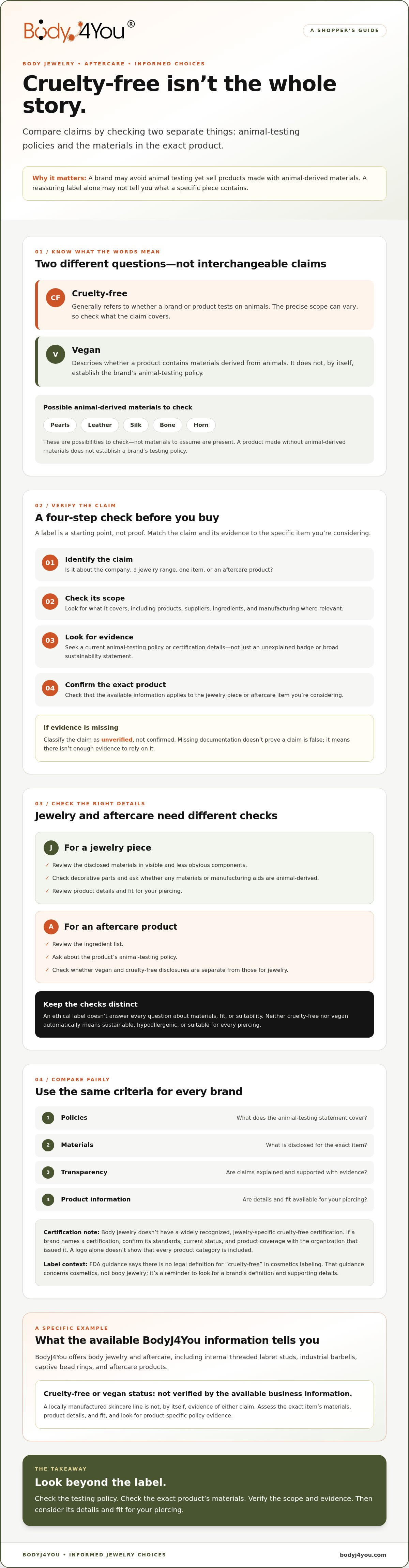
Use this four-step check to assess a claim:
- Identify the claim. Is the brand describing itself, a jewelry range, one item, or an aftercare product?
- Check its scope. Look for what the claim covers, including products, suppliers, ingredients, and manufacturing where relevant.
- Seek evidence. Look for a current animal-testing policy or certification details, not just a sustainability statement or unexplained badge.
- Confirm the product. Match the evidence to the exact jewelry piece or aftercare item you’re considering.
What evidence should a credible brand provide?
Look for a clear, current animal-testing policy that explains which products and business activities it covers. If a brand names a certification, check the issuing organization’s official directory or standards. Confirm whether the certification is current and whether it applies to jewelry, aftercare, or another part of the business. A logo alone doesn’t establish that every product category is included.
If accessible documentation is missing, classify the claim as unverified, not confirmed. That doesn’t prove the claim is false; it means there isn’t enough evidence to rely on it.
Questions to ask about jewelry and aftercare
Ask specific questions about the exact piece: what materials make up its components, including decorative parts, and whether any are animal-derived. For aftercare, request the ingredient information and ask whether the product’s animal-testing and vegan disclosures are separate from those for jewelry.
Keep the categories distinct. A certification or company policy may cover some activities without covering every item or product type. Confirm certification names and standards directly with the organization that issued them.
A certification logo matters only as much as its scope. Apply the same checks across cruelty-free body jewelry brands so you’re comparing evidence, not just marketing language. You can review BodyJ4You’s body jewelry and aftercare categories as products to assess, but the available business information doesn’t verify cruelty-free or vegan status. Check the current policy and details for any specific item before drawing a conclusion.
Cruelty-Free Body Jewelry Brands: Compare Claims, Materials, and Transparency
A useful comparison separates what a brand reportedly does from what’s independently verified. The profiles below summarize available brand information as of October 2026. They aren’t proof of jewelry-specific cruelty-free certification. Confirm current policies, materials, and certification scope with each brand or issuing organization before buying.
| Brand | Body jewelry range | Animal-welfare evidence | Materials and sourcing | Claim status |
|---|---|---|---|---|
| Anatometal | Body jewelry; specific range details not established here | Brand-reported green manufacturing includes plant-based lubricants. No specific animal-testing policy or jewelry certification confirmed. | Reported use of implant-grade materials, metals from U.S. mills, and conflict-free certified gold. | Ethical and manufacturing details reported; cruelty-free status unverified. |
| Body Vision Los Angeles (BVLA) | Handmade body jewelry | Available information reports ethical sourcing, but doesn’t establish an animal-testing policy or cruelty-free certification. | Reported use of recycled metals and ethically sourced, conflict-free diamonds. | Sourcing claims reported; cruelty-free status unverified. |
| Industrial Strength | Body jewelry | No specific animal-welfare policy or certification confirmed. | Reported materials include implant-grade titanium, stainless steel, and gold. | Material information reported; cruelty-free status unverified. |
| NeoMetal | Titanium and gold body jewelry | No specific animal-welfare policy or certification confirmed. | Titanium and gold are reported materials; further sourcing details aren’t established here. | Material information reported; cruelty-free status unverified. |
| BodyJ4You | Internal threaded labret studs, industrial barbells, captive bead rings, and aftercare | Available business information doesn’t confirm an animal-testing policy or certification. | Product-specific compositions aren’t established here. The business says its skincare line is manufactured locally and cites quality control and ethical production standards. | Relevant retailer; cruelty-free and vegan status unverified. |
How to assess body jewelry brand profiles fairly
Apply the same four checks to each profile: animal-testing policy, certification and its scope, product-level material disclosure, and relevant body jewelry range. Treat environmental or ethical sourcing claims as separate evidence, not proof of cruelty-free status. Before relying on a certification, confirm its current listing and coverage with the issuing organization.
Where BodyJ4You fits in the comparison
BodyJ4You is a U.S.-based online retailer with more than two decades of industry experience, offering body jewelry and aftercare. Its locally manufactured skincare line and stated production standards provide context, but don’t establish cruelty-free or vegan status for skincare or jewelry. Check the exact product and current policy before drawing a conclusion.
These profiles can help narrow your research, but they don’t replace it. A material detail may matter to piercing suitability, but it doesn’t verify animal-welfare practices. Compare cruelty-free body jewelry brands by checking the exact item’s composition alongside the evidence for the brand’s claims.
A Practical Checklist for Choosing Ethical Piercing Jewelry
Ethical claims are only one part of a good purchase decision. Assess the specific piece you’re considering, then check its fit and suitability separately. This five-point checklist keeps animal-welfare evidence, product details, and piercing needs distinct.
A five-point check before adding jewelry to your cart
- Policy: Find the brand’s current animal-testing statement. Check whether it covers the exact item, its suppliers, and relevant parts of production.
- Materials: Review the full material description, including decorative components. If anything is missing, ask whether the piece contains animal-derived materials.
- Certification: Look up any named certification with its issuing organization. Confirm that it’s current and check which products or business activities are included.
- Product details: Review the piece’s sizing, closure, and stated piercing compatibility. Ethical credentials don’t establish that jewelry will fit your anatomy or meet your piercing’s needs.
- Support: See whether the brand can answer product-specific questions clearly. Keep written replies with your notes so you can compare brands consistently.
For aftercare, check the product’s own ingredient information and animal-welfare disclosures rather than assuming jewelry claims apply. For related aftercare context, consult the guide Sterile Saline Spray for Piercings: The 2026 Expert Aftercare Guide.
How to handle unclear or conflicting claims
Ask precise questions, such as “Does this policy cover this specific item?” or “What materials are used in its decorative components?” If an answer conflicts with the product page, ask the brand to clarify in writing. Missing information means the claim is unknown, not that the brand has met or failed your criteria.
If the response still leaves a gap that matters to your values, consider an option with clearer documentation. This is a practical way to compare cruelty-free body jewelry brands without letting a broad label outweigh the facts about the piece.
To review available products, explore body jewelry and aftercare and check the details for each item.
Choosing a Body Jewelry Brand That Matches Your Values
There isn’t one ethical standard that fits every shopper. Decide which issues matter most to you: animal testing, animal-derived materials, or both. Then compare the available evidence with those priorities and assess the exact piece you’re considering. Ethical positioning is only one part of the decision; review materials, sizing, closure, and piercing compatibility separately.
Match your priorities to the evidence available
If avoiding animal testing is essential, look for a current policy that clearly explains what it covers. If you also avoid animal-derived materials, check the item’s components and ask about anything the product description doesn’t explain. If both issues matter to you, verify both rather than assuming one claim includes the other.
Clear, specific answers help you assess a brand’s transparency. If a brand can’t explain whether a policy applies to a particular piece, record that as unknown and decide whether the gap is acceptable to you. Use the same standard for every option you compare. Without comparable, current evidence, it wouldn’t be fair to rank one of the cruelty-free body jewelry brands as “best” for everyone.
Next steps for exploring BodyJ4You
BodyJ4You is a U.S.-based online retailer offering internal threaded labret studs, industrial barbells, and captive bead rings, as well as piercing aftercare. Its available business information also describes a locally manufactured skincare line and cites quality control and ethical production standards. Those details don’t verify that its jewelry or skincare is cruelty-free or vegan, so check current product disclosures and animal-welfare information before making that judgment.
For the piece you’re considering, review its listed materials and product details. If a component or claim is unclear, ask the retailer a specific question before purchasing. A thoughtful decision can account for both personal values and the practical needs of your piercing.
Product details are available at BodyJ4You body jewelry.
Choose with Confidence and Care
To compare cruelty-free body jewelry brands, separate animal-testing policies from animal-derived materials, then verify each claim against the specific item you’re considering. Check ethical evidence alongside practical details such as materials, sizing, and piercing compatibility. A broad brand label can’t answer every product-level question.
BodyJ4You is a U.S.-based online retailer founded circa 2001, with more than two decades of industry experience and a broad selection of body jewelry and piercing aftercare. Its skincare line is manufactured locally, but that fact doesn’t verify cruelty-free or vegan status. Review current product disclosures and ask about unclear details before deciding whether an item fits your priorities.
Use the same checks for every product you compare. Review the current information for the specific piece and decide whether the available evidence meets your standards.
Frequently Asked Questions
Is body jewelry cruelty-free?
Not automatically. “Cruelty-free” may refer to a brand’s animal-testing policy, but jewelry can also raise questions about animal-derived materials and manufacturing. There isn’t a widely recognized, jewelry-specific cruelty-free certification, so a label alone may not explain what’s covered. Check the brand’s current policy and the materials in the exact piece. Ethical sourcing claims, such as recycled metals, don’t by themselves confirm an animal-testing policy.
What is the difference between cruelty-free and vegan jewelry?
Cruelty-free generally refers to animal testing, while vegan describes materials that aren’t derived from animals. A piece could be made without animal-derived materials, but the brand’s testing policy still needs to be checked. Conversely, a brand may avoid animal testing while offering jewelry with animal-derived components. Review the product details and the brand’s definitions rather than assuming one claim includes the other.
How can I tell if a body jewelry brand is genuinely cruelty-free?
Look for a clear, current animal-testing policy and check whether it covers the specific product, suppliers, and relevant production activities. If a brand names a certification, verify its status and scope with the issuing organization. Assess the item’s materials separately. If the brand doesn’t provide enough evidence to confirm a claim, treat its status as unverified rather than assuming it’s true or false.
Can body jewelry contain animal-derived materials?
Yes, some jewelry may contain animal-derived decorative materials, including pearls, leather, silk, bone, or horn. These are possibilities to check, not ingredients to assume. A product description may not cover every component, so ask the brand about materials if details are missing. If you avoid animal-derived materials, verify the exact piece rather than relying only on a broad brand-level vegan statement.
Does cruelty-free mean jewelry is sustainable or hypoallergenic?
No. Cruelty-free claims concern animal testing, while sustainability involves separate considerations such as material sourcing and production. Neither claim confirms that jewelry is hypoallergenic or suitable for your piercing. Check the product’s stated materials and details, and consider your piercing needs independently. If you have concerns about a material or how jewelry may suit you, seek guidance from an appropriate healthcare professional.
Is BodyJ4You a cruelty-free body jewelry brand?
The available business information doesn’t verify that BodyJ4You or its products are cruelty-free or vegan. BodyJ4You is a U.S.-based online retailer, founded circa 2001, with body jewelry and piercing aftercare. Its skincare line is manufactured locally, and the business cites quality control and ethical production standards. Those details aren’t evidence of an animal-testing policy. Check current disclosures and ask about the specific item before making a decision.
What should I check before buying cruelty-free piercing jewelry?
Review the brand’s current animal-testing policy, any certification and its scope, and the exact item’s materials, including decorative components. Then check product information for sizing, closure, and piercing compatibility. Keep ethical credentials separate from practical fit and material considerations. If details are missing or conflicting, contact the brand with specific questions. Use its written response to decide whether the available evidence meets your priorities.
Explore BodyJ4You body jewelry and aftercare and review the current details for the specific product you’re considering.


