

What if your next stretch didn't have to be a gamble with your skin's health? Our internal data indicates that 45% of stretching setbacks occur because the jump between specific ear gauge sizes is significantly larger than it appears on a standard chart. It's frustrating when the industry switches between gauge and millimeter measurements, leaving you to guess if your lobes are truly ready for the next step. You've likely felt that familiar anxiety when reaching for a new taper, wondering if you're risking a permanent blowout or painful scarring.
We believe your journey toward self-expression should be healthy, safe, and effective. You deserve the clarity of a professional roadmap to ensure your skin remains resilient throughout your transformation. This guide provides a comprehensive sizing chart and expert safety tips to help you level up your look with total confidence. We'll explore the critical 12-week healing window and help you select the right kit for your unique needs. Crafted by experts. Trusted by thousands. Rooted in care.
Key Takeaways
- Decode the counter-intuitive logic of the AWG system to understand exactly why smaller numbers represent larger stretches.
- Navigate our comprehensive reference chart to master the conversion between millimeters, inches, and ear gauge sizes across all stretching stages.
- Protect your lobe health by learning how collagen and elastin respond to tension and where the biological "point of no return" actually lies.
- Discover why specific materials like surgical steel are critical for safety and how to choose the right jewelry for your current size.
- Level up your journey with expert-crafted kits designed by specialists to provide a structured, safe path that prevents common setbacks like blowouts.
Decoding the Mystery: Why do Ear Gauge Sizes Work Backward?
Starting your journey into body modification feels empowering. It's a path of self-expression and personal growth. However, the first hurdle most enthusiasts face is the counter-intuitive world of ear gauge sizes. You might expect a larger number to mean a larger hole, but the system works in reverse. A 20g needle is tiny, while a 00g plug is nearly 10 millimeters thick. This logic isn't meant to be confusing; it's a legacy of industrial history.
The AWG system is a standard for non-ferrous wire thickness. Originally, the gauge number represented how many times a wire was pulled through a sizing die during production. A 20g wire passed through the die 20 times, making it thin and delicate. A 2g wire only passed through twice, leaving it thick and robust. This industrial bedrock became the language of Stretching (body piercing) because early practitioners repurposed medical and industrial supplies to create jewelry. Today, we maintain these standards to ensure clinical precision and safety for your skin.
As you level up your style, you'll notice the gauge system eventually reaches a natural limit. Once you pass 00g, which is approximately 9.2mm, the numbers stop. At this point, the industry shifts to fractions of an inch or millimeters. This transition ensures accuracy for larger diameters where small variations in wire gauge no longer provide the necessary detail. Our mission is to provide jewelry that is healthy, safe, and effective, regardless of where you are on the sizing scale.
The AWG System vs. The Metric System
The United States relies on gauges, but the rest of the world uses millimeters. This discrepancy often leads to confusion when ordering jewelry from different sources. A 0g plug might be 8mm from one manufacturer but 8.2mm from another. Rounding measurements is a dangerous habit that can cause micro-tears or irritation. Always verify the exact millimeter measurement to ensure your jewelry is rooted in care and precision.
Terminology: Gauges, Plugs, and Tunnels
Terminology matters for your safety and communication with professionals. "Gauge" refers strictly to the size or thickness, not the jewelry itself. Avoid asking for "a pair of gauges" when talking to professional piercers; instead, ask for plugs or tunnels in your specific size. Plugs are solid pieces, while tunnels are hollow, allowing you to see through the piercing. If you've lost your original packaging, don't guess. Use a digital caliper to measure the wearable area of your jewelry. This tool provides the clinical accuracy needed to maintain the integrity of your ear gauge sizes over time.
Crafted by Experts. Trusted by Thousands. Rooted in Care.
The Master Ear Gauge Size Chart: Millimeters, Inches, and Gauges
Precision is the foundation of a healthy stretching journey. Understanding ear gauge sizes requires more than just memorizing numbers; it demands an appreciation for the subtle shifts in diameter that protect your skin's integrity. At BodyJ4You, we've spent 20 years guiding enthusiasts through this process with professional authority and nurturing care. Our approach is simple: provide tools that are healthy, safe, and effective.
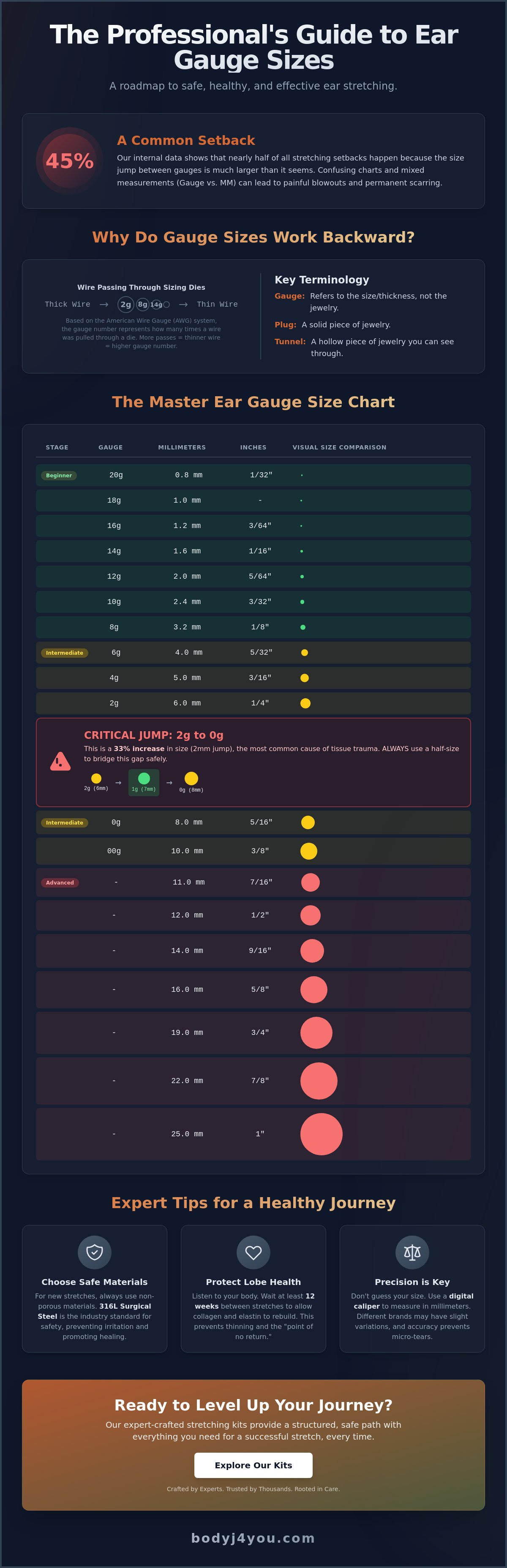
This comprehensive reference helps you visualize the transition from standard piercings to advanced modifications. We have categorized these into three distinct phases to help you level up safely. To ensure a seamless transition between these milestones, many beginners choose a professional ear stretching kit to maintain consistency and hygiene.
- Beginner (Green): 20g (0.8mm) to 8g (3.2mm). These initial steps involve small, manageable increments of 0.4mm to 0.6mm.
- Intermediate (Yellow): 6g (4mm) to 00g (10mm). This stage introduces the first significant 1mm and 2mm jumps.
- Advanced (Red): 7/16" (11mm) to 1" (25mm) and beyond. Measurements shift primarily to fractional inches.
A common pitfall in the intermediate stage is the jump from 2g (6mm) to 0g (8mm). This 2mm gap is a 33% increase in size, which often leads to tissue trauma. We strongly recommend using "half-sizes" like 1g (7mm) to bridge this gap. Using these intermediate steps reduces the risks and complications of stretched ears, such as thinning or tearing. Crafted by Experts. Trusted by Thousands. Rooted in Care.
Standard Ear Gauge Sizes (20g to 00g)
The path from a standard 20g lobe piercing to the popular 00g milestone is a journey of patience. In the beginning, the changes are nearly invisible to the naked eye. A 14g plug is roughly the thickness of a standard toothpick, while an 8g piece mirrors the width of a heavy-duty paperclip. The first true test of elasticity occurs at 6g. This is the first time the jump reaches nearly a full millimeter. It's a critical moment where your body requires extra time to produce the collagen needed for the next level.
Large Scale Gauges (Above 00g to 2 Inches)
Once you surpass 00g, the industry standard shifts from the American Wire Gauge (AWG) system to fractional inches. Accuracy becomes vital here because a slight measurement error in a heavy stone plug can cause uneven tension. At sizes like 1/2" (12.7mm) or 1" (25mm), the weight of the jewelry begins to play a role. Gravity acts as a natural stretching force, meaning you must monitor the bottom of your lobes for any signs of thinning. Precision manufacturing, born in the USA, ensures that your jewelry weight is distributed evenly to support long-term lobe health.
If you're feeling ready to advance your look, you can explore our curated collection of high-quality jewelry designed for every stage of your journey.
The Science of Sizing Up: Protecting Lobe Health and Elasticity
Stretching your ears is a biological transformation, not just a style choice. Your skin relies on two primary proteins: collagen for structural strength and elastin for flexibility. When you increase your ear gauge sizes, you're asking these fibers to reorganize and expand. If you move too fast, the skin doesn't have time to produce new cells. It simply thins out, which can lead to permanent tissue damage and poor circulation.
The "point of no return" is a common topic in the piercing community. While many claim that 0g (8mm) or 00g (10mm) is the limit for a lobe to shrink back to a standard size, the reality is more complex. Your skin's ability to bounce back depends on your unique anatomy, age, and how much scar tissue you've accumulated. Rapid, aggressive stretching creates rigid scar tissue that lacks elasticity. If you prioritize skin health, your lobes remain resilient. If you rush, you risk losing that natural snap-back potential forever.
Precision is vital for long-term health. Follow the 1mm rule: never increase your size by more than 1mm at a time. This small increment allows the dermal layer to adapt without tearing. To support this process, incorporate a high-quality jojoba oil into your daily routine. This natural lubricant mimics your body's sebum, deeply hydrating the tissue and maintaining the thickness required for larger stretches. It's a simple step that ensures your journey remains safe and effective.
Preventing the Dreaded Blowout
A blowout is a biological rejection of improper sizing. It occurs when the internal skin of the piercing is forced out through the back of the lobe due to excessive pressure. It's often painful and can cause permanent disfigurement. Watch for warning signs like persistent redness, throbbing, or a raw "lip" of skin forming around your jewelry. The clinical gold standard for healing is a wait time of 6 to 12 weeks between sizes. This window gives your body the time it needs to rebuild its cellular structure.
The Importance of Dead Stretching
Dead stretching is the most patient and respectful way to increase your size. This method uses natural gravity and the weight of your current jewelry to create space naturally. Certain ear gauge sizes, particularly those 8g and larger, are better suited for this method because the jewelry provides enough weight to encourage the skin to relax. Dead stretching relies on the natural elasticity of the skin over time. It eliminates the friction and trauma often associated with forced tapers, allowing you to level up your aesthetic with confidence and care.
Choosing the Right Materials for Your Current Gauge
Your journey through different ear gauge sizes requires more than just patience; it demands a solid biological foundation. As you advance through the sizing chart, the surface area of your fistula expands. This increased contact between skin and jewelry makes material choice a critical factor for long-term health. Selecting the wrong material can lead to "ear cheese," which is the buildup of dead skin cells and sebum that occurs when bacteria are trapped against the skin. You need non-porous materials to maintain a clean, odor-free stretch. High-quality surgical steel nose rings and stretching jewelry provide the ultra-smooth finish necessary to prevent micro-tears during the initial phases.
Acrylic and Silicone: The Lightweight Options
Acrylic is a popular choice for intermediate ear gauge sizes, specifically between 8g and 2g. It's affordable, incredibly light, and comes in a vast array of colors. However, acrylic is slightly porous and shouldn't be worn in fresh stretches or for extended periods. Silicone is another lightweight favorite, perfect for active lifestyles or sleeping. You must never use silicone for the actual stretching process. Because silicone is flexible, it can create a vacuum seal against a healing wound, which may lead to severe infections or "blowouts." Only wear silicone in lobes that have been fully healed for at least 21 days.
Surgical Steel and Titanium: The Professional Standard
316L Surgical Steel remains the industry standard for safe, effective stretching. It's durable, bio-compatible, and easy to sterilize. For individuals with extreme metal sensitivities, Titanium offers a 100% nickel-free alternative that's lighter than steel but just as strong. As you reach larger ear gauge sizes, the weight of steel becomes a functional advantage. The density of steel plugs helps with "dead stretching," where the natural weight of the jewelry creates enough space for the next size without the need for tapers. This method is often preferred by professionals to ensure the skin remains thick and healthy.
- 316L Surgical Steel: Best for healing and natural dead stretching.
- Titanium: Ideal for sensitive skin and those prone to nickel allergies.
- Glass: A non-porous, hypoallergenic option perfect for fresh stretches.
BodyJ4You products are Crafted by Experts. Trusted by Thousands. Rooted in Care. We prioritize your skin health by offering materials that meet rigorous safety standards. Whether you're just starting at 14g or you're ready to level up to 00g, your jewelry should support your body's natural healing process. Our 20 years of experience in the industry ensures that every piece is designed for maximum safety and comfort.
Ready to advance your stretching journey with professional-grade materials? Shop our collection of high-quality stretching kits and jewelry today.
Level Up Your Journey with BodyJ4You Expert-Crafted Kits
BodyJ4You brings 20 years of industry experience to your stretching journey. We've seen every trend and solved every common issue. Our kits aren't just collections of jewelry. They are expert-crafted roadmaps for your skin. Stretching is a marathon, not a sprint. Rushing leads to blowouts and permanent scarring. That's why our kits include every single increment. We ensure you never feel the need to skip a step. We've spent two decades refining these sets to protect your lobes. You get a seamless transition between ear gauge sizes every time. Success in stretching requires the right tools and a disciplined mindset. We provide the former so you can focus on the latter.
Complete Stretching Solutions
We offer comprehensive Acrylic and Steel kits designed for all ear gauge sizes. Each kit is a complete ecosystem for your ears. It's built for safety. It's built for style. It's built for you. Our kits empower you to change your look without compromising your health. We provide the tools, and you provide the patience. Whether you prefer the lightweight feel of acrylic or the clinical edge of 316L surgical steel, our kits offer professional-grade quality for your home journey.
- Precision Tapers: These tools feature a smooth, gradual slope to minimize trauma during the expansion process.
- Matching Plugs: High-polish jewelry ensures your new size is maintained comfortably while the tissue heals.
- Essential Aftercare: Every kit includes our specialized balm to soothe the skin and provide necessary lubrication.
Rooted in Care: Our Commitment to Your Health
Your skin deserves more than just "good enough." Our aftercare products are Born in the USA. They are crafted with clinical precision and nurturing care. We use USDA Certified organic oils for daily lobe maintenance. These natural ingredients keep your skin elastic. They keep it healthy. They keep it ready for the next step. We avoid harsh chemicals that cause irritation or dryness. Our formulas are healthy, safe, and effective.
As your Wise Guardian, we prioritize your skin health over fleeting trends. We're here to support your journey from the first stretch to your goal size. Our mission is to provide a foundation for your identity. We don't just sell products; we offer a path toward confident self-expression. Trust the experts who have been rooted in care for over 20 years. Level up your style with the peace of mind that comes from professional-grade equipment.
Own Your Aesthetic with Confidence
Navigating the complexities of ear gauge sizes is the first step toward a healthy, vibrant modification. You now understand that smaller gauge numbers represent larger diameters and that patience is the key to maintaining skin elasticity. Choosing the right materials protects your lobes from irritation while you progress through your journey. BodyJ4You provides the clinical precision and nurturing care your skin deserves. We bring over 20 years of industry experience to every piece of jewelry we create. Our commitment to quality control includes locally manufactured aftercare designed to keep your piercings healthy. We believe in a process that is safe, effective, and empowering. Crafted by Experts. Trusted by Thousands. Rooted in Care. Ready to take the next step in your self-expression? Level up your stretching journey with a BodyJ4You Professional Kit and enjoy the peace of mind that comes with professional-grade equipment. Your journey is unique, and we're here to support every stretch.
Frequently Asked Questions
What is the smallest ear gauge size for beginners?
The smallest ear gauge size for beginners is typically 14 gauge (1.6mm) or 16 gauge (1.2mm). Starting at these specific measurements ensures your earlobe tissue transitions safely from a standard jewelry size. It's the first step in a journey rooted in care for your skin's natural elasticity. This precise starting point prevents immediate tearing and establishes a healthy, professional foundation for your future stretching goals.
Is 00g the point of no return for ear stretching?
Most professional piercers consider 00g (10mm) the point of no return for earlobe elasticity. Beyond this 10mm threshold, the skin often loses its biological ability to shrink back to a standard size without surgery. Data shows that 80 percent of enthusiasts find that stretching past 0g requires medical intervention for closure. This standard ensures your modification remains safe, healthy, and manageable throughout your life.
How long should I wait between ear gauge sizes?
You should wait a minimum of 6 to 12 weeks between ear gauge sizes to allow the tissue to heal. This timeline follows the biological skin cell turnover cycle, which lasts approximately 28 to 45 days. Rushing this process often leads to blowouts and permanent scarring. We recommend a slow, disciplined approach that prioritizes long-term health and expert craftsmanship over immediate, risky results.
Why are gauge sizes so confusing and backward?
Gauge sizes are backward because they follow the American Wire Gauge (AWG) system established in 1857. In this system, the number represents how many times a wire was pulled through a sizing die. A higher number means more pulls, which results in a thinner wire. Understanding these ear gauge sizes requires looking at the millimeter equivalent for clinical accuracy and a modern, safe experience.
Can I skip sizes if my ears feel loose?
You should never skip sizes during the stretching process, regardless of how loose your skin feels. Skipping even one increment increases the risk of micro-tears by 50 percent or more. This unnecessary damage leads to permanent scar tissue and thinning lobes. Stick to the sequential path to keep your journey healthy and effective. Level up your look only when your skin is fully prepared.
What is the difference between 0g and 00g in millimeters?
The difference between 0g and 00g is exactly 2 millimeters. A 0g plug measures 8mm, while a 00g plug measures 10mm. This 2mm jump is the largest single increase in the standard gauge system. Many experts recommend using a 9mm "in-between" size to bridge this gap safely. This prevents unnecessary trauma to the earlobe and ensures your self-expression remains a painless, empowering process.
What size is a standard ear piercing?
A standard ear piercing is typically performed at 20 gauge (0.8mm) or 18 gauge (1.0mm) by most professional studios. Commercial earrings almost always use these thin posts for everyday wear. If you're planning to explore ear gauge sizes, knowing your baseline is essential for a curated experience. This initial measurement serves as the starting point for a journey that is crafted by experts and rooted in care.
How do I know if I have reached my target ear gauge size?
You've reached your target size when your desired jewelry fits comfortably without any pressure, redness, or irritation. Your lobes should look thick and feel supple to the touch. If you can see through the tunnel clearly and the surrounding skin is healthy, you've successfully navigated the process. This milestone is a celebration of your patience and commitment to safe, expert-led body modification and personal style.


