

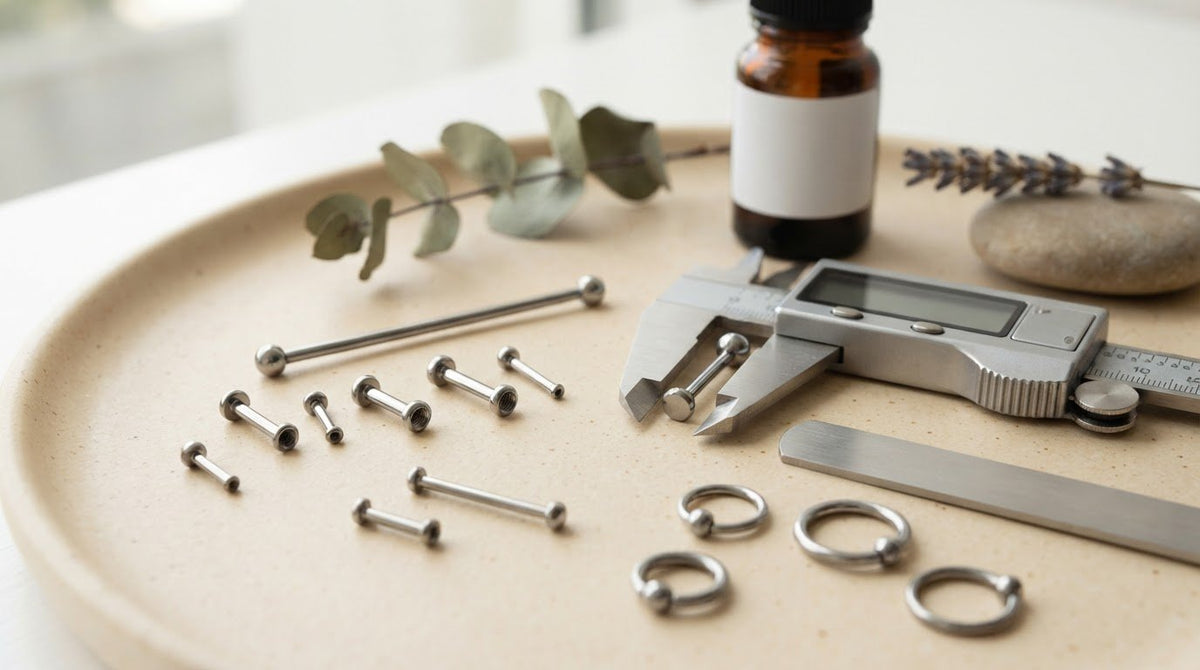
The smaller the gauge number, the thicker the jewelry. That reversal can make a gauge piercing listing feel like a sizing puzzle, especially when measurements use different units or don’t explain the whole fit. Looking beyond the number helps: jewelry thickness matters, but so do the piercing’s placement and the piece’s other measurements.
This guide explains what gauge measures and how to compare jewelry details. You’ll learn why gauge numbers work in reverse, which measurements to check alongside thickness, and how fit considerations differ by jewelry type. Use the steps here to narrow your options without relying on guesswork.
We’ll also look at how construction and placement relate to options such as internal threaded labret studs, industrial barbells, and captive bead rings. BodyJ4You offers these jewelry categories, and this guide can help you understand the measurements before you choose a style.
Key Takeaways
- A gauge piercing measurement describes jewelry thickness, and the numbering runs in reverse: a smaller gauge number means thicker jewelry.
- Use your piercing’s established size as a reference; a gauge label alone can’t tell you whether a piece will fit.
- Compare gauge, wearable length, and ring diameter as separate measurements when reading jewelry listings.
- Choose in sequence: identify the piercing placement, establish its current gauge, compare dimensions, then consider construction.
- Explore labret studs, industrial barbells, and captive bead rings as distinct jewelry categories, matching the style and construction to the piercing.
What Does Gauge Mean for a Piercing?
For piercing jewelry, gauge measures the jewelry’s thickness, or how wide the part passing through the piercing is. It describes one dimension, not the full size of a piece. The numbering can seem backward at first: a smaller gauge number generally means thicker jewelry, while a larger number means thinner jewelry.
That distinction matters when comparing pieces. Gauge helps you match jewelry thickness to a piercing’s established size, but it doesn’t tell you how long a stud is or how wide a ring is. The body jewelry sizes and gauge system reference explains how gauge relates to thickness alongside other sizing conventions. Keep those measurements separate as you browse.
Why Do Smaller Gauge Numbers Mean Thicker Jewelry?
Think of gauge numbers as a scale that runs in reverse: moving to a smaller number means moving to a thicker piece. It’s a convention, not a visual ranking, so don’t assume a higher number means larger jewelry. For an exact comparison, use a dedicated size reference rather than relying on memory or an incomplete conversion chart.
Gauge, Length, and Diameter: Three Different Measurements
Jewelry fit involves more than thickness. A labret stud and a ring show why: a stud passes through the piercing and sits against the tissue, while a ring curves around it. Their shapes and placements make different dimensions relevant. Read each measurement as a separate detail:
- Gauge: the thickness of the jewelry section passing through the piercing.
- Wearable length: the length of a straight piece that sits within the piercing, measured between its ends or decorative components as specified in the listing.
- Ring diameter: the width across a ring, which helps describe the space its curve provides.
These measurements answer different questions. Gauge indicates thickness; wearable length helps you assess how a straight piece may sit; ring diameter describes the ring’s overall span. A matching gauge alone doesn’t establish that a labret stud’s length or a ring’s diameter will suit the placement. Likewise, a suitable ring diameter doesn’t ensure that its thickness matches the piercing.
Before choosing, identify which dimensions the listing provides and compare them with the established size of your piercing. A product photo can show the design, but it can’t reliably communicate scale or fit. Treat the measurements as a set, not as a single number. This makes listings easier to understand and helps you compare options more confidently.
How Piercing Gauge and Jewelry Fit Work Together
Gauge is a starting point, not a fit guarantee. Gauge is necessary for matching jewelry thickness, but fit also depends on the piercing’s placement, your anatomy, and the jewelry’s shape and dimensions. A gauge label is useful when compared with the established size of your piercing, rather than treated as a complete description of the piece.
Placement affects how jewelry sits and which measurements matter most. A straight labret stud in a flat area of the ear, for example, needs a wearable length that suits the tissue and the way the ends rest. A ring through a curved area needs a diameter that follows the placement without sitting too tightly or extending farther than intended. The same gauge can appear across different jewelry shapes, but that doesn’t make those pieces interchangeable.
What Else Determines Whether Piercing Jewelry Fits?
Compare dimensions that match the construction. For a straight piece, check wearable length; for a ring, consider its diameter. Then account for shape and placement, since a curved ring and a straight post meet the body differently. Anatomy also matters: two piercings in the same named location may not sit identically. Use measurements from a known, well-fitting piece or reliable sizing information, rather than estimating from a product photo, which can distort scale and perspective.
Construction is part of the decision, too. A labret stud, industrial barbell, and captive bead ring each have a distinct form and arrangement. Confirm that the jewelry’s shape corresponds to the piercing before comparing details. If a listing gives a gauge but not enough information to compare other dimensions, don’t assume the gauge alone settles the question.
Gauge Jewelry Versus Stretching to a Larger Size
Replacing jewelry in an established piercing is different from deliberately stretching it. For a replacement, the goal is to select a piece that corresponds to the piercing’s current size and suits its placement. Stretching changes the piercing to accommodate thicker jewelry, so choosing a larger gauge is not simply an ordinary size swap.
Keep the distinction clear: don’t size up just because a different gauge number looks like a better fit on a listing. If you’re comparing ear-stretching sizes, use the ear gauge size chart for detailed conversions. This section focuses on matching jewelry to an established piercing, not stretching technique or healing timelines.
A practical check is to identify the placement, establish the piercing’s current gauge, and then compare the relevant length or diameter and the jewelry’s shape. That gives you a fuller picture than any single label. To explore options by construction, browse piercing jewelry styles and categories, including labret studs, industrial barbells, and captive bead rings.
How to Compare Gauge Piercing Jewelry Before Choosing
A product listing can show several measurements, each describing a different part of the piece. Compare them separately, then consider the jewelry’s shape and how it relates to your piercing’s placement. This helps you tell whether two similar-looking pieces are actually comparable. In gauge piercing shopping, appearance is a starting point, not a sizing method.
| Measurement | What it describes | What to compare |
|---|---|---|
| Gauge | The thickness of the jewelry section that passes through the piercing. | Match the listing’s gauge with the piercing’s established size. Remember that gauge numbers generally run in reverse. |
| Wearable length | The usable length of a straight piece, such as a labret stud. | Compare it with the length that suits the piercing’s placement and how the jewelry is intended to sit. |
| Ring diameter | The width across a ring. | Compare it with the space and positioning needed for that specific piercing. |
Two pieces may look almost identical in a photo yet differ in length or diameter. A small change in either dimension can alter how a piece sits, even when its gauge is the same. Product images can obscure scale, so use the written measurements rather than estimating from a picture. If a listing uses different units or unfamiliar terms, identify what each number refers to before comparing it with another item.
How to Read a Jewelry Listing’s Measurements
Start by locating the gauge, then find any listed wearable length or ring diameter as a separate detail. Units and terminology can vary between listings, so don’t compare numbers until you know they describe the same dimension. For stretched-ear jewelry, such as plugs or tunnels, consult an ear stretching kit guide for context on that category.
Which Jewelry Construction Should You Compare?
BodyJ4You offers distinct categories, including internal threaded labret studs, industrial barbells, and captive bead rings. Their construction affects how each piece is assembled and handled: a threaded stud has a component that screws into place, while a captive bead ring uses a bead to close the ring. Shape matters, too. Compare like with like when assessing measurements, and consider material details from the product description without assuming a grade that isn’t specified.
A reliable comparison follows a simple order: identify the jewelry type, match the gauge to the piercing’s established size, then compare its listed length or diameter. For stretched-ear jewelry, keep the question of current fit separate from decisions about stretching. Explore piercing jewelry categories with these measurements in mind, focusing on construction and placement as well as appearance.
A Practical Checklist for Choosing the Right Gauge Jewelry
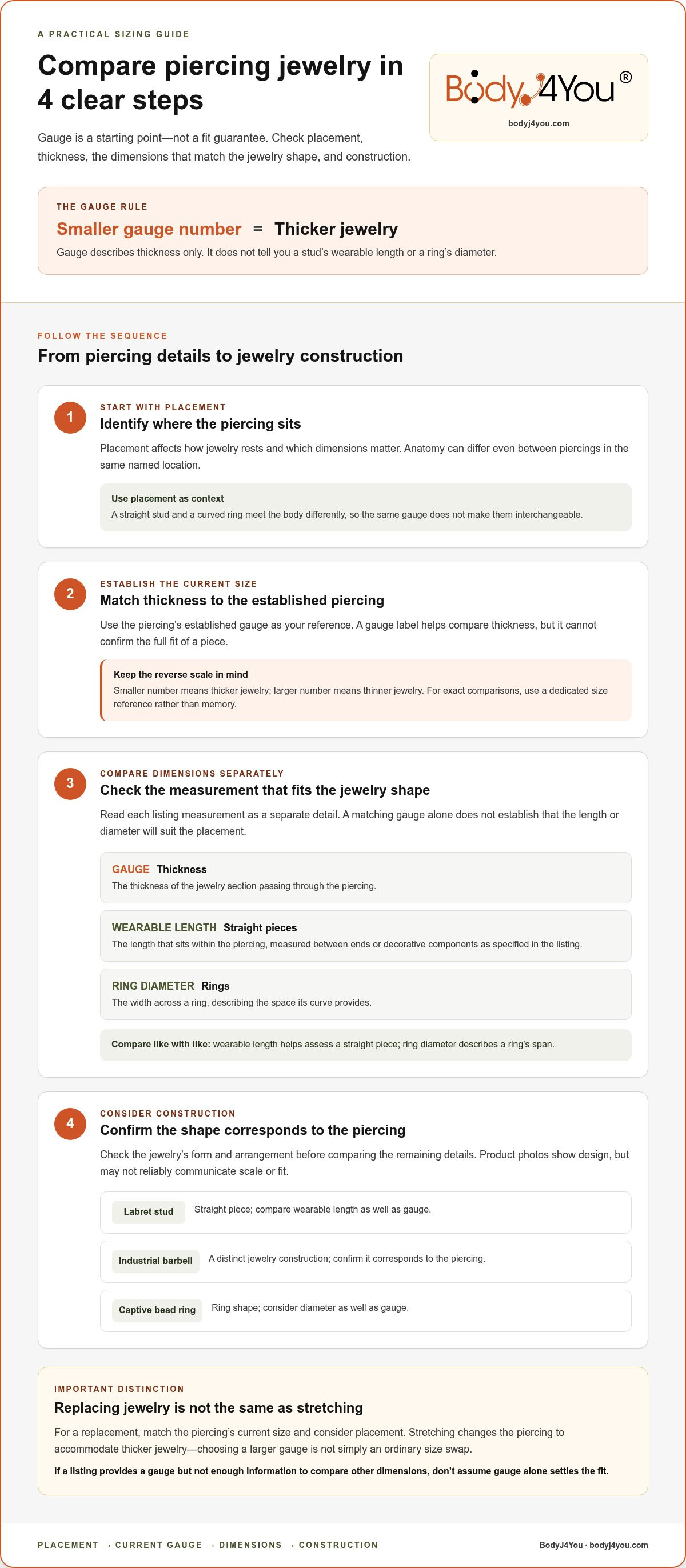
A careful choice starts with the piercing, not the product photo. Use this sequence to compare options without letting a single number make the decision for you:
- Identify the placement. Note where the piercing sits and whether its position affects the jewelry shape you need.
- Establish the current gauge. Use a reliable record or compare with jewelry that fits appropriately. Don’t assume a different gauge is suitable because its number seems close.
- Compare the other dimensions. Check wearable length for straight jewelry or ring diameter for a ring, when those measurements are provided.
- Assess construction. Consider the jewelry’s shape and closure, and whether that design matches the placement.
This process makes a gauge piercing choice more considered. Don’t size up based only on a product photo or the gauge number. Images can make pieces look larger or smaller than they are, and gauge doesn’t tell you whether the length, diameter, or shape will suit your piercing.
Check Your Existing Piercing and Jewelry
Start with a well-fitting piece or a reliable record of your current measurements. Compare only like dimensions: a straight piece’s wearable length isn’t interchangeable with a ring’s diameter. Small differences can be hard to judge by eye, especially in close-up product images, so visual estimation may lead you astray. A suitable measuring tool can help you understand a listed dimension, but using one doesn’t replace professional assessment if you’re unsure about the piercing or its size.
If the measurements are unclear, pause rather than guessing. Recheck which number refers to gauge, length, or diameter, and confirm that you’re comparing the same units. A listing’s appearance may help you assess style, but it can’t establish your piercing’s current size or guarantee a match.
Know When Fit Concerns Need Attention
Uncertainty about a measurement is a reason to slow down; pain, swelling, or visible skin damage calls for more caution. Don’t force jewelry through a piercing if it meets resistance, feels unusually painful, or seems to be causing irritation. Stop wearing a piece that appears to mismatch or is worsening discomfort, and seek medical advice promptly for possible signs of infection or a worsening injury. These symptoms need assessment, not a guess based on jewelry size.
Fit is both a sizing decision and a matter of paying attention to how your body responds. Check the measurements before choosing, and take discomfort seriously rather than trying to push through it. Once you’ve identified the placement and dimensions, explore labret studs, barbells, and captive bead rings to compare jewelry construction with your piercing’s needs.
Find Gauge Piercing Jewelry That Matches Your Style and Fit
A well-chosen piece brings together four considerations: gauge, other dimensions, construction, and placement. First match the jewelry thickness to the piercing’s established size. Then check the wearable length or ring diameter that applies to the piece, and consider how its shape and closure relate to the piercing. Style matters, but it works best alongside these practical checks.
BodyJ4You offers internal threaded labret studs, industrial barbells, and captive bead rings. These are distinct jewelry categories, not interchangeable versions of one design. BodyJ4You’s selection includes these different constructions, but no single piece fits every piercing. The measurements and placement still matter.
Choose Jewelry by Placement and Construction
A labret stud has a straight post with an end that attaches to it. An industrial barbell is a straight barbell design, while a captive bead ring is a circular piece closed with a bead. Their different shapes and construction affect how each is positioned and handled. Compare the jewelry type with your piercing’s placement, then check its listed dimensions against your established measurements.
Don’t choose a category just because its appearance appeals to you. A ring and a straight stud can have different fit considerations even if their gauge matches. Likewise, two straight pieces may differ in length or construction. Use the product description to understand the design, and treat gauge as one part of the comparison rather than a complete sizing answer.
Make Your Next Jewelry Choice With Confidence
Before settling on a piece, run through a few checks:
- Gauge: Does the thickness correspond to your piercing’s established size?
- Other dimensions: Have you compared wearable length for a straight piece or diameter for a ring?
- Construction: Does the jewelry’s shape and closure match the type of piece you’re considering?
- Placement: Have you considered how the design relates to where the piercing sits?
Keep the measurements in view as you browse. If details are unclear or a piece seems like a mismatch, pause rather than relying on a photo or choosing a different gauge by guesswork. A confident gauge piercing choice comes from checking the fit details first, then deciding which design feels right for your style.
Once you’ve reviewed your measurements and the jewelry’s construction, browse labret studs, industrial barbells, and captive bead rings. Let the numbers guide your shortlist, then choose a design that aligns with your established fit and personal style.
Let Your Next Jewelry Choice Feel Like You
Choosing jewelry can be a small act of self-expression. The right piece should feel intentional, reflecting your style while respecting the needs of your piercing. Let fit guide your options, then choose a design that feels personal. There’s no need to rush toward a trend or select a piece based on appearance alone.
As you browse, keep your established measurements close and use them to narrow your choices. A thoughtful gauge piercing decision gives you a more confident starting point than guessing from photos. BodyJ4You offers a range of piercing jewelry, including internal threaded labret studs, industrial barbells, and captive bead rings.
Ready to explore styles with fit in mind? Explore BodyJ4You piercing jewelry and find a piece that feels true to you.
Frequently Asked Questions
What does gauge mean in a piercing?
Gauge in a piercing describes the thickness of the jewelry section that passes through the opening. It doesn’t tell you the post length, ring width, or how prominent the design looks once worn. Two pieces can share a gauge but have different lengths or shapes. Check the listing’s measurements individually and compare them with the established size of your piercing before choosing a replacement.
Is a higher gauge number thicker or thinner?
A higher gauge number generally indicates thinner jewelry; a lower number indicates thicker jewelry. This reverse numbering can be easy to misread while comparing listings, so don’t assume that a larger number means a larger piece. Check what each listing means by its measurements and use a dedicated size reference for exact conversions rather than estimating from the numbers alone.
How do I know what gauge my piercing is?
Use the measurements for jewelry that fits appropriately or a reliable record of the size previously selected for the piercing. A close-up photo or visual comparison can’t reliably distinguish small thickness differences. Also make sure you’re looking at gauge, not the length of a straight piece or the diameter of a ring. If you can’t establish the size confidently, don’t test it by forcing jewelry into the piercing.
Can I wear a different gauge in my piercing?
Possibly, but it depends on the piercing’s current size and whether the new jewelry matches it. A thicker piece may not pass through an established opening, and forcing it can cause injury. Replacing a piece with another design is different from intentionally changing the piercing’s size. If insertion hurts or you notice tissue damage, stop rather than trying again, and seek medical advice if symptoms are concerning or worsening.
What is the difference between gauge and diameter?
Gauge describes jewelry thickness, while diameter usually describes the distance across a circular piece, such as a ring. A straight stud is more often compared by its wearable length, which describes the usable post section. The gauge and diameter of a ring answer separate sizing questions. Check each measurement on its own; one matching number can’t confirm that every part of a piece will suit your piercing.
Does piercing jewelry gauge vary by piercing location?
Jewelry requirements can vary with placement, anatomy, and the design of the piece, so don’t assume one gauge suits every location. A piece intended for one piercing may have a shape or dimensions that don’t correspond to another. Use measurements associated with your specific piercing and compare them with the listing. A general rule or product image isn’t a reliable substitute for checking the actual dimensions.
Can I use a taper to change my piercing gauge?
A taper is associated with stretching, which is different from choosing replacement jewelry for an established piercing. It shouldn’t be treated as a tool for pushing jewelry through an opening that isn’t ready for it. Stretching requires its own guidance and shouldn’t be rushed or forced. If you’re considering stretched-ear sizing, consult a dedicated conversion reference, and stop if you experience pain or injury.


