

Stretched ears can shrink, but they may not return completely to their original appearance. Earlobes stretched to 10G (2.4 mm) or smaller usually close fully or nearly fully for most people, while those stretched to 00G (10 mm) or beyond typically won’t close without surgery. How to shrink stretched ears depends on the size you reached, how long you wore it, and your skin’s elasticity.
It’s natural to hope that removing jewelry will restore your earlobes, but the amount of shrinkage varies. BBC News notes that how long a piercing was stretched and skin elasticity can affect whether it shrinks toward its original size. This guide explains how to remove jewelry and downsize gradually, what to expect at different diameters, and why time spent at a size matters. You’ll also learn when natural shrinkage may leave a visible opening, so you can set realistic expectations and choose a thoughtful next step.
Key Takeaways
- To encourage natural shrinkage, remove the jewelry completely and observe how the lobe changes before choosing your next step.
- Compare your current gauge and diameter with the expected closure patterns to set a realistic goal.
- Consider how long you’ve kept the piercing at its current size, since longer stretching can affect the lobe’s ability to contract.
- Allow time for gradual changes, and learn when a persistent opening may call for a different approach.
Can Stretched Gauges Go Back to Normal?
Stretched earlobes can shrink naturally after jewelry removal, but the amount varies. Use these steps to encourage gradual contraction and understand what may remain.
-
Remove Plugs to Encourage Closure
Remove plugs completely if your goal is natural shrinkage. Smaller jewelry still occupies the opening. Some earlobes may begin shrinking noticeably overnight, but early visible change doesn’t mean the piercing has fully closed. Keep the tissue clean, avoid harsh soaps or chemicals, and watch for irritation. Don’t force jewelry back into a tightening piercing.
-
Compare Downsizing With Jewelry Removal
Choose full removal to encourage closure, or downsize gradually if you still want to wear jewelry. Reduce the plug by one size at a time, allowing the lobe to adjust before changing again. Jewelry shouldn’t feel snug or cause pressure. Stop if it causes pain, since tight jewelry can irritate tissue rather than safely guide it to a smaller size.
-
Assess Natural Shrinkage and Its Timeline
Give the lobe time to contract, then assess the opening and your preferred earring size. Earlobes stretched to 10G (2.4 mm) or smaller usually close fully or nearly fully for most people; some stretched to 2g may shrink enough for normal earrings. After plug removal, shrinkage may start overnight, while fuller closure can take weeks to months. Duration at size and skin elasticity also matter.
-
Consider Oils, Massage, and Saline Soaks
Use gentle massage with jojoba oil if the skin feels dry; it may support care, but doesn’t itself close the opening. Saline soaks can support basic hygiene, not shrinkage. Avoid harsh products and stop massage if the tissue feels sore. Larger openings that remain may need medical assessment. Loboplasty removes stretched tissue and stitches the lobe; stitches may need removal after 1 week. Re-piercing is usually possible after healing, typically in 3-6 months.
Expected closure outcomes by gauge and diameter
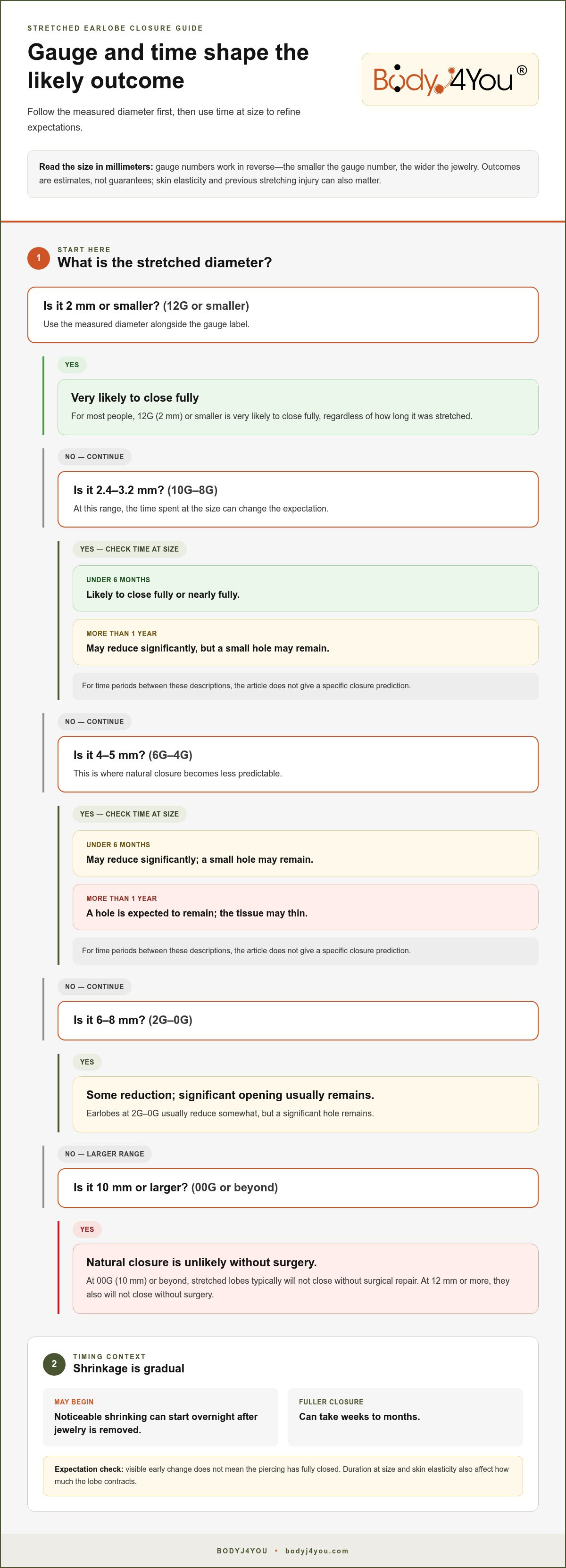
- Start with the measured diameter. Gauge labels can be confusing because the number gets smaller as the jewelry gets wider. Earlobes stretched to 12G (2 mm) or smaller are very likely to close fully for most people, regardless of how long they were stretched. At 10G (2.4 mm) or smaller, they usually close fully or nearly fully. Use millimeters alongside the gauge when estimating your likely outcome.
- Compare your size with the next range. At 10G-8G (2.4-3.2 mm), closure depends partly on duration. Under 6 months at that size, lobes are likely to close fully or nearly fully. After more than 1 year, they may reduce significantly but retain a small hole. Smaller openings generally have better odds of natural closure than larger gauges.
- Set a cautious goal at 6G-4G. This 4-5 mm range is where outcomes become less predictable. If the lobes were stretched for less than 6 months, they may reduce significantly, though a small hole may remain. After more than 1 year, a hole is expected to remain, and the tissue may thin. Allow for differences in elasticity and previous stretching injury.
- Plan for residual openings at larger diameters. Earlobes stretched to 2G-0G (6-8 mm) usually reduce somewhat, but a significant hole remains. At 00G (10 mm) or beyond, they typically won’t close without surgical repair; lobes stretched to 12 mm or more also won’t close without surgery. These ranges describe likely outcomes, not a promise of identical healing. Use your current diameter, time at size, and tissue condition to guide expectations.
The page lists 00g at 9.26 mm and 000g at 10.4 mm. A community answer says half an inch may shrink to about 12 gauge if stretched correctly.
How duration at a size affects elasticity
- Record how long each size has been worn. Note the gauge, diameter, and time spent at that size before changing your routine. BBC News reports that a stretched piercing may shrink toward its original size, depending partly on stretching duration and skin elasticity. The longer the tissue has adapted to a larger opening, the less predictable its return may be. Keep the record simple and update it as your earlobe changes.
- Downsize in measured stages. If you still want to wear jewelry, move to one smaller plug rather than jumping between sizes. Keep each smaller plug in for at least 3 to 4 days, or up to a week, before considering another reduction. Watch how the earlobe sits around it. Don’t force a plug into a tight opening; pressure doesn’t make tissue regain elasticity safely.
- Use the fit as feedback. After each downsizing stage, note whether the opening feels looser or tighter and whether the earlobe looks irritated. A shorter time at a size may leave more flexibility, while prolonged stretching can make tissue less responsive. Previous injury and scar tissue can also affect how the lobe contracts. Use these observations to set your pace, rather than relying on a calendar alone.
- Keep massage gentle and consistent. Daily massage with vitamin E oil is suggested during the closing process. Massage may support blood flow and help break down scar tissue, but it won’t erase the opening or restore elasticity. Use light pressure and stop if the skin becomes sore. Compare your notes over time to see whether the tissue is changing.
How completely stretched ears may shrink
Natural shrinkage is gradual, and a smaller opening doesn’t always mean the lobe has returned to its original shape. Learning how to shrink stretched ears safely means tracking changes without forcing a particular result.
- Track the opening, not just the jewelry size. After removing jewelry, note whether the piercing looks smaller and whether the earlobe’s edge appears even. Stretches under 6 mm tend to shrink faster, but the opening and surrounding tissue can change at different rates. Take occasional photos in consistent lighting to compare its appearance without repeatedly handling the lobe.
- Allow time for the lobe to settle. Shrinking can take months rather than weeks, and larger stretches can take a year or more to reach their final resting state. Don’t mistake an early change for the finished result. Keep the area clean, avoid snags and bumps, and leave time between assessments. A gradual approach to how to shrink stretched ears also makes changes easier to notice.
- Factor in your stretching history. Shrinkage depends on anatomy, skin type, aftercare, the extent of stretching, and whether stretching caused blowouts. For example, someone who stretched to an inch over a decade may not regain small lobes without surgery. These factors help explain why piercings at the same diameter can settle differently.
- Consider repair when an opening remains. A persistent hole after substantial shrinkage may require loboplasty, a surgical repair that removes stretched tissue and stitches the earlobe closed. Natural contraction alone cannot remove excess tissue. A medical professional can assess the remaining tissue and discuss repair once the piercing has stopped shrinking. Set your goal around the final shape you want, not simply a smaller gauge.
BodyJ4You: Acrylic Ear Stretching Kit
BodyJ4You’s Acrylic Ear Stretching Kit is for readers beginning or continuing an ear-stretching routine, not for shrinking an existing opening. If your priority is allowing an earlobe to contract, leave jewelry out rather than using a stretching kit. For a future decision to stretch again, the kit offers a relevant product option; the Surgical Steel Taper and Plug Kit is another listed choice. Saline Piercing Aftercare Spray supports piercing aftercare, but it doesn’t close stretched tissue or replace medical care for an injury.
Choose products based on your goal: gradual stretching, aftercare, or natural shrinkage are different needs. For more information, visit BodyJ4You online.
Choose the next step that fits your goal
Before changing your routine, decide what matters most: a smaller opening, room for conventional earrings, or a repaired lobe. That goal can guide whether you continue observing natural shrinkage or seek medical advice about a lasting opening. A steady, gentle approach to how to shrink stretched ears keeps the focus on your tissue’s response rather than forcing a particular result.
Keep a brief record of changes and note any discomfort or irritation. If your question is about jewelry or piercing aftercare, BodyJ4You can help you explore its relevant product options. Contact BodyJ4You for help with your next step. Take your time, protect your comfort, and choose the path that feels right for you.
Frequently Asked Questions
Do stretched ears ever fully close?
Yes, smaller stretched earlobes can close fully after jewelry is removed. Earlobes stretched to 12G (2 mm) or smaller are very likely to close fully for most people, while 10G (2.4 mm) or smaller usually close fully or nearly fully. “Nearly fully” means the opening has reduced substantially, though it may not look exactly like an untouched lobe.
Can I Shrink My Stretched Earlobes?
Yes. Remove the jewelry completely to encourage natural contraction, then observe the opening instead of repeatedly inserting jewelry to test its size. Shrinkage depends partly on how long the piercing stayed stretched and your skin’s elasticity. A smaller target opening and a larger one call for different expectations, so track the lobe’s appearance as it changes.
Can I get my stretched ears surgically repaired?
Yes. Loboplasty repairs stretched earlobes by removing stretched tissue and stitching the lobe closed. An ENT surgeon performs earlobe repair surgery. After repair, a new piercing can usually be done once the lobe has healed, typically in 3-6 months. The healed tissue’s condition matters when planning a new piercing, so allow it to recover before considering placement.
Can You Fix a Stretched Earring Hole?
Yes. A small earlobe split can be treated with tissue glue, but glue isn’t a permanent fix. For lasting repair of a stretched opening, loboplasty removes stretched tissue and closes the lobe with stitches. The right approach depends on whether the issue is a small split or an enlarged piercing channel, since these involve different amounts of tissue.
How Do I Start Shrinking My Ears?
Begin by removing your plugs and leaving jewelry out for a week, then observe how the opening changes. If you want to keep wearing jewelry while reducing the size, downsize by one size at a time instead. Don’t force a smaller plug into a tight piercing. This gives you a simple way to compare full removal with gradual downsizing.
What is the smallest gauge that will not close?
There isn’t a single gauge that defines when an opening won’t close. Gauge numbers work in reverse: a smaller number means a larger diameter. Earlobes stretched to 00G (10 mm) or beyond typically won’t close without surgery, while 20g (0.812 mm) is identified as the smallest gauge and fits a standard wire earring.


