

Is the "surgical" label on your jewelry actually a guarantee of safety, or is it just clever marketing? Many enthusiasts assume that anything labeled for surgery must be the gold standard for a new piercing, but the reality is often more complex. You deserve a piercing experience that is safe, beautiful, and effortless. It's frustrating to deal with the persistent itching, redness, and slow healing that often come from mystery metals.
Choosing between implant grade titanium vs surgical steel piercing materials is the most important decision you'll make for your skin's health. We promise to clarify the technical confusion surrounding ASTM labels so you can invest in jewelry that stays irritation-free. This guide examines the updated 2026 ASTM F136 biocompatibility standards, the 10 to 14 percent nickel levels hidden in common surgical alloys, and the essential steps to ensure your self-expression remains a source of pride rather than a medical concern. By understanding the science of what you put in your body, you can focus on your aesthetic journey with absolute confidence.
Key Takeaways
- Understand that "surgical steel" is often a marketing term rather than a regulated safety standard. Look for specific ASTM F136 certifications to ensure your jewelry meets clinical biocompatibility requirements.
- Protect your skin from chronic irritation by identifying the nickel content in 316L surgical steel. Titanium provides a nickel-free alternative with a stable oxide layer that promotes faster, cleaner healing.
- Experience greater comfort during the healing process by choosing materials that are 45 percent lighter than traditional stainless steel. This reduced weight minimizes pressure on fresh cartilage and sensitive industrial piercings.
- Discover why the implant grade titanium vs surgical steel piercing debate favors titanium for all initial piercings. It remains the non-negotiable choice for new wounds to prevent the development of long-term metal sensitivities.
- Prioritize your wellness with jewelry that bridges the gap between high-end aesthetics and dermatological safety. Our commitment to domestic quality control ensures your self-expression stays safe, ethical, and affordable.
The Material Mystery: Defining Implant Grade Titanium and Surgical Steel
The term "surgical steel" is often more about marketing than medicine. While it evokes images of sterile operating rooms and clinical precision, it's actually a broad category that includes many different stainless steel alloys. Not all of these are suitable for long-term wear inside a human body. Choosing between implant grade titanium vs surgical steel piercing options requires looking past the labels to find true biocompatibility. This is the material's ability to exist in contact with your tissue without causing an adverse immune response. It's about safety, purity, and peace of mind.
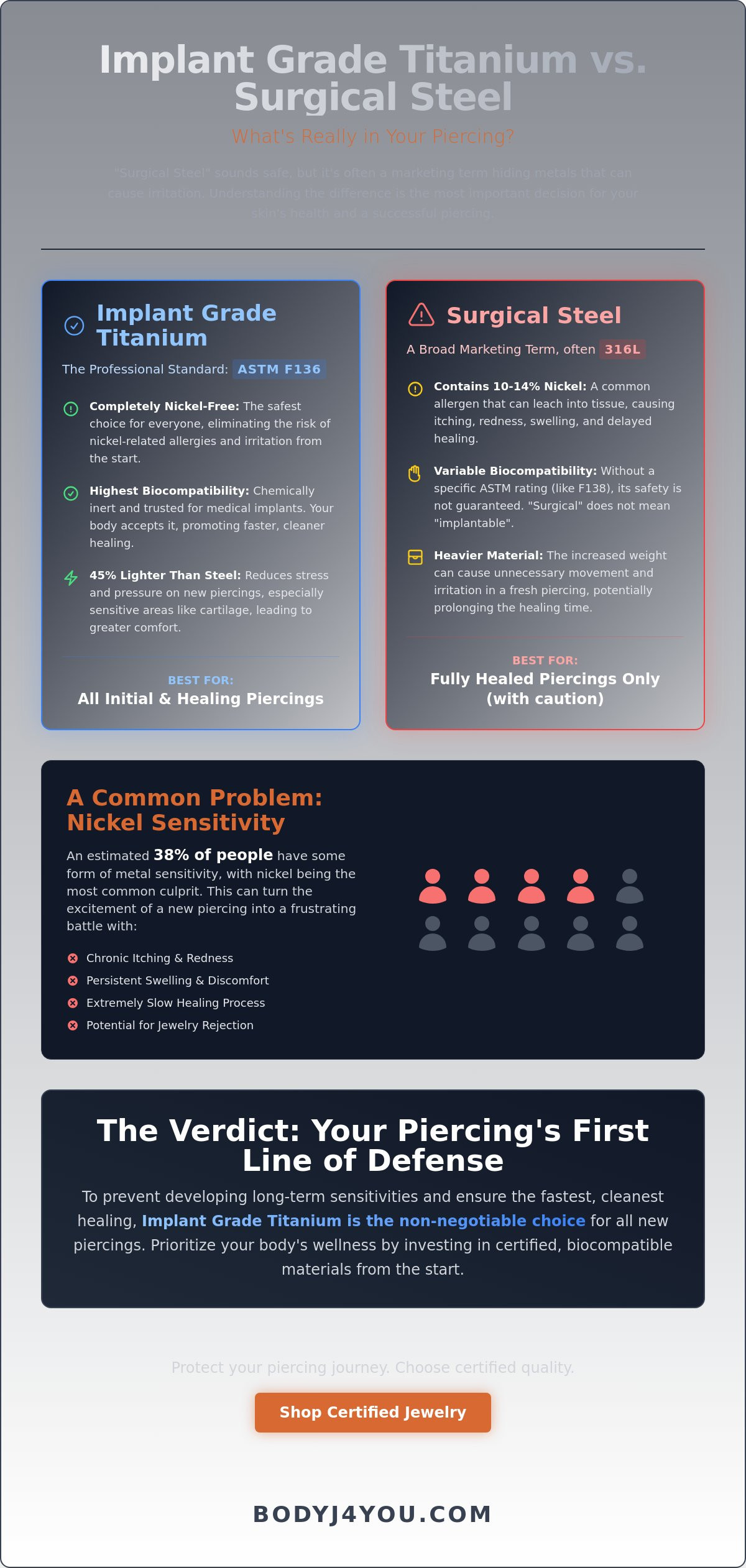
Most commercial jewelry is made from 316L stainless steel. While often called "medical grade," it still contains 10 to 14 percent nickel. For the 38 percent of consumers seeking hypoallergenic options, this can lead to chronic redness and irritation. Industry terms like "nickel-free" and "hypoallergenic" are often unregulated buzzwords that mask the presence of sensitizing metals. True safety lies in the ASTM designations. Understanding Body jewelry materials is the first step toward a successful, pain-free healing journey. You deserve jewelry that supports your body, respects your skin, and honors your personal style.
Decoding the ASTM Standards
The "F" in an ASTM designation stands for "F-series," which indicates the material is approved for medical and bio-medical applications. These standards are rigorous and uncompromising. For example, implant-grade steel (ASTM F138) undergoes vacuum-melting (VM). This process removes gaseous impurities and non-metallic inclusions that could otherwise irritate a fresh wound. ASTM F136 is the primary requirement for initial piercings because it ensures the metal is chemically inert and structurally sound. A revised version of the ASTM F136 standard for implant-grade titanium was published on February 9, 2026, solidifying its place as the industry benchmark for safety.
Why Material Choice is Your Piercing’s First Line of Defense
Your body treats a new piercing as an intruder. This "foreign body response" is a natural part of healing, but the wrong metal can turn it into a prolonged battle. Low-quality alloys can leach toxins directly into the open wound, causing the fistula to become inflamed or even reject the jewelry entirely. High-purity metals promote a stable environment. They allow the skin to knit together properly, ensuring the long-term health of your piercing. By prioritizing material integrity, you are choosing a path of:
- Rapid, irritation-free healing
- Long-term tissue stability
- Uninterrupted self-expression
Biocompatibility Breakdown: Why Your Body Reacts Differently to Each Metal
Your body is a vigilant guardian. When you introduce jewelry into a fresh wound, your immune system immediately begins a complex scanning process to identify the foreign material. This biological encounter determines whether your piercing will thrive or enter a state of chronic rebellion. The fundamental tension in the implant grade titanium vs surgical steel piercing debate lies in how these metals interact with your living tissue. While both may look identical on a display tray, their molecular behavior inside your skin is vastly different. Metal ions can actually migrate from the jewelry into your bloodstream, triggering a systemic or localized response that dictates your healing timeline.
For many, the first sign of trouble is a subtle itch that quickly escalates into persistent swelling. This isn't just "part of the process." It's often your body's reaction to the specific chemical composition of the alloy. While 316L surgical steel is a common industry standard, its 10 to 14 percent nickel content can be a significant hurdle for the 38 percent of consumers actively seeking hypoallergenic options. Choosing the right material is an act of self-care that protects your physical vulnerability and supports your journey toward aesthetic refinement.
The Science of Nickel Sensitivity
Nickel is a notorious sensitizer. Even "low nickel" alloys like 316L steel can trigger a localized immune response known as contact dermatitis. According to a North American Contact Dermatitis Group study, metal sensitivities are increasingly common among individuals with multiple piercings. Symptoms typically include persistent redness, weeping, and localized itching that refuses to subside. It's essential to differentiate these allergic markers from a standard how to get rid of piercing bump protocol, as an allergy requires a material change, whereas a bump might simply need better aftercare. Using a dedicated Saline Piercing Aftercare Spray can help soothe standard irritation, but it cannot override a biological rejection of the metal itself.
Titanium: The Biocompatible Powerhouse
Titanium is the medical industry's most trusted ally. Because it is an inert metal, it does not corrode or react with body fluids, which is why G23 and ASTM F136 titanium are the primary choices for hip replacements and dental implants. Its secret weapon is a naturally occurring, stable oxide layer that forms instantly on the surface. This layer acts as a protective shield, preventing any metal ions from leaching into your tissue. For those with sensitive skin, titanium offers a level of purity that steel simply cannot match. It is a protective and stabilizing force that allows your body to focus entirely on healing the fistula rather than fighting the jewelry. By choosing a material that mirrors the standards of clinical medicine, you ensure your self-expression remains safe, ethical, and entirely irritation-free.
Performance Comparison: Durability, Weight, and Aesthetic Longevity
Beyond the biological safety discussed in previous sections, the physical performance of your jewelry determines its daily comfort and aesthetic endurance. When evaluating implant grade titanium vs surgical steel piercing options, weight is the most immediate factor you will notice. Titanium is approximately 45 percent lighter than stainless steel. While a few grams might seem negligible, this weight difference exerts a constant physical influence on your healing tissue. A lighter material reduces the mechanical stress on a fresh wound, allowing your body to focus on repair rather than supporting a heavy load.
Durability is another pillar of the Wise Guardian's approach to jewelry. Both metals are exceptionally strong, but they handle environmental stressors differently. Titanium is naturally impervious to corrosion from salt water, chlorine, and sweat. This makes it the superior choice for active individuals or those who enjoy the ocean. Surgical steel is also resilient, but lower-quality 316L alloys can eventually suffer from microscopic pitting if exposed to harsh chemicals over long periods. Investing in high-purity materials ensures your jewelry remains:
- Structurally sound
- Visually pristine
- Physically effortless
Weight and Piercing Migration
Gravity is a constant force on your healing skin. Heavy jewelry can "drag" a healing piercing downward, a process known as migration. This is particularly dangerous for cartilage placements where the tissue is less flexible. Using lightweight titanium for industrial barbells or heavy-gauge jewelry prevents the jewelry from slowly cutting through the ear like a wire through cheese. For those exploring larger gauges with plugs and tapers, titanium’s density ratio provides the necessary size without the fatiguing weight of steel.
Color and Customization
Self-expression often demands a splash of color. Titanium offers a unique advantage through a process called anodization. By using electricity to change the thickness of the metal's natural oxide layer, we can create vibrant hues like gold, rose gold, purple, and blue. This process involves no plating or paints, so the color won't chip or irritate your skin. Surgical steel cannot be anodized; it relies on PVD (Physical Vapor Deposition) coatings for color. While PVD is durable, it is a separate layer that can eventually wear down. To maintain the high-polish finish on either metal, simply use a gentle saline solution and a soft cloth to remove daily buildup.
Making the Choice: How to Match Metal to Your Piercing Stage
Healing is a journey through distinct biological stages. Your choice in the implant grade titanium vs surgical steel piercing debate should evolve as your tissue matures. For a fresh wound, the priority is absolute stability. This is why titanium is the non-negotiable standard for initial piercings. It's inert, lightweight, and incredibly pure. Beyond the metal itself, the thread type matters. Internal threading ensures the smooth part of the post passes through the wound, preventing the microscopic tearing often caused by external threads. It's a choice that is safe, stable, and seamless.
Once a piercing is fully healed and the fistula has matured, your options expand. This is the stage where high-quality surgical steel becomes a viable and aesthetic choice. It offers a classic, high-polish shine and a reassuring weight that many enthusiasts prefer for established placements. Matching the metal to your specific anatomy ensures your self-expression remains comfortable and your skin stays healthy. Transitioning between materials should always be a deliberate, informed process that respects your body's unique healing timeline.
The Healing Phase Framework
A fresh piercing is a vulnerable opening that requires the highest level of bio-stability to prevent rejection. Combining high-purity titanium jewelry with a sterile saline spray for piercings can lead to a recovery that is 2x faster than using improper materials or harsh home remedies. This synergy between material and maintenance is the secret to a flawless heal. When it's time to "downsize" your jewelry, typically after the initial swelling subsides, you can choose to stay with titanium or transition to steel if your skin has shown no signs of sensitivity during the first few months.
Location-Specific Recommendations
Different areas of the body have unique environmental demands. For septums and daith piercings, titanium is superior because it prevents the "funk" or odor often associated with metal breakdown and sebum buildup in enclosed areas. If you're stretching your lobes, consult an ear gauge size chart to find the precise fit for your next step. For these larger placements, a Surgical Steel Taper and Plug Kit provides the extreme smoothness and structural integrity needed for a safe stretching journey. Oral piercings also benefit from the dense, ultra-smooth surface of steel, which feels comfortable against the tongue and resists the unique pH levels of the mouth.
The BodyJ4You Standard: Quality Jewelry for Every Journey
Our mission is to simplify the complex choice between implant grade titanium vs surgical steel piercing jewelry by providing clear standards and accessible quality. We believe that physical vulnerability shouldn't be a barrier to beautiful self-expression. By maintaining a rigorous commitment to ASTM-certified materials and domestic quality control, we act as a protective force for your skin. Our heritage in the industry allows us to bridge the gap between clinical-grade purity and aesthetic refinement. We prioritize your long-term wellness over fleeting trends, ensuring every piece we offer is safe, ethical, and meticulously crafted.
High-quality materials are often associated with prohibitive costs, but we've worked to make implant-grade titanium an affordable reality for everyone. We believe that safety is a right, not a luxury. By overseeing our production and sourcing with transparent ethics, we provide the stabilizing foundation your body needs to heal without compromise. Your journey toward a fully healed, irritation-free piercing is supported by our deep industry knowledge and our passion for the community we serve. Purity. Precision. Protection. This is our promise to you.
Why We Prioritize Internal Threading
Precision manufacturing is the hallmark of a supportive specialist. We focus heavily on internal threading because it represents the highest standard of safety for your fistula. Unlike external threading, which can act like a saw-blade against delicate healing tissue, our Internal Threaded Labret Studs feature a smooth post that glides effortlessly through the piercing. This design prevents microscopic snagging and tearing, significantly reducing the risk of localized trauma and infection. It's a clinical solution for a creative world, ensuring your jewelry feels as good as it looks.
Your Journey, Our Expertise
With over two decades of experience in the body jewelry industry, we understand that jewelry is only one part of the ecosystem. True success requires a holistic approach that includes professional-grade aftercare. Our locally manufactured solutions, such as our Saline Piercing Aftercare Spray and Piercing Bump Treatment Oil, are designed to work in harmony with our metals. This synergy creates a predictable and reliable healing environment. We're here to act as your expert mentor, providing the tools and the proof of efficacy you need to express yourself with absolute confidence. Healing is a process of growth, and we're proud to be part of yours.
Shop our curated collection of Implant Grade Titanium Jewelry
Prioritize Your Skin’s Health and Aesthetic Future
Choosing the right material is more than a technical decision; it's a commitment to your body's long-term well-being. By understanding the nuances of implant grade titanium vs surgical steel piercing safety, you've taken the first step toward a successful healing journey. Titanium offers the inert purity required for fresh wounds, while high-quality steel remains a durable choice for established piercings. Your self-expression should always be a source of pride, not irritation. Trust in materials that respect your biology and support your personal growth.
At BodyJ4You, we combine ASTM F136 certified titanium with US-based quality control to ensure every piece meets the highest dermatological standards. With over 20 years of industry experience, we act as a supportive specialist in your journey toward aesthetic refinement. We believe in providing clinical precision for a creative world. It's time to invest in jewelry that is safe, ethical, and beautiful. Your skin deserves the stability of a professional guardian.
Upgrade to Bio-Stable Jewelry: Shop BodyJ4You Titanium Collection
Embrace your new look with the confidence that comes from expert care. You're ready to shine.
Frequently Asked Questions
Is surgical steel okay for a first piercing?
Titanium is the superior choice for your first piercing journey because it offers the highest level of biocompatibility. While implant-grade steel (ASTM F138) is clinically safe, many generic "surgical steel" alloys contain high nickel levels that can irritate a fresh wound. Choosing titanium ensures a stable, inert environment for your skin to heal. It's about starting your self-expression on a foundation of safety, purity, and comfort.
Can you have an allergic reaction to titanium jewelry?
Allergic reactions to titanium are extremely rare because the metal is chemically inert. It doesn't react with body fluids or corrode inside the skin, which is why it's the primary choice for medical implants. If you're experiencing redness or itching, it's usually caused by physical trauma or improper aftercare rather than the metal itself. We recommend consulting a professional to rule out other factors and ensure your healing stays on track.
How can I tell if my jewelry is real titanium or just steel?
Identifying the difference in an implant grade titanium vs surgical steel piercing comparison often comes down to physical weight. Titanium is 45 percent lighter than steel and lacks the magnetic properties found in many stainless alloys. You'll also notice a darker, more matte gray tone in titanium compared to the mirror-like shine of steel. These subtle physical markers reflect the deeper biological benefits of your jewelry choice.
Why is titanium more expensive than surgical steel?
The price of titanium reflects its rarity and the complex manufacturing required to ensure purity. Unlike steel, titanium must be processed in a vacuum to prevent oxygen and nitrogen from making the metal brittle. You're investing in a material that is 45 percent lighter, entirely nickel-free, and exceptionally durable. It's a long-term investment in your body's health and the longevity of your piercing journey.
Does surgical steel contain nickel?
Most 316L surgical steel contains 10 to 14 percent nickel by weight. While this metal is common in the industry, it's the primary reason many enthusiasts prefer the implant grade titanium vs surgical steel piercing alternative. Titanium is entirely nickel-free, making it the safest option for the 38 percent of people who struggle with metal sensitivities. Your skin deserves jewelry that is protective and stabilizing during every stage of healing.
Can I use saline spray on both titanium and steel jewelry?
You can safely use sterile saline spray on both titanium and surgical steel jewelry without fear of corrosion. Both materials are designed for long-term wear and resist the salt content found in professional aftercare solutions. Regular cleaning with a saline spray helps remove debris and bacteria, ensuring your jewelry stays pristine. It's a simple, effective way to support your body's natural healing process every day.
What happens if I wear low-quality 'mystery metal' in a new piercing?
Wearing low-quality 'mystery metals' can lead to severe irritation, chronic swelling, or even piercing rejection. These materials often contain toxic elements like lead or cadmium that leach directly into your open wound. This triggers a persistent immune response that prevents the fistula from ever fully maturing. Prioritizing certified materials is the only way to ensure your self-expression remains a source of joy rather than chronic pain.
Is G23 titanium the same as implant-grade titanium?
G23 is a common industry shorthand, but you should always look for the ASTM F136 certification for true peace of mind. While G23 often refers to medical-grade titanium, the ASTM standard is the regulated benchmark that guarantees the alloy's safety for human implantation. Our commitment to these standards ensures you receive jewelry that is consistent, reliable, and clinically sound. It's the technical precision your body deserves.


