


Magnetic fake gauges create a plug-like look without stretching your ears. They attach to the earlobe with magnets instead of passing through an enlarged piercing. The style can be appealing, but listings often place magnetic earrings beside jewelry made for stretched ears, even though they fit and function differently.
When comparing options, look beyond the front-facing product photo. The attachment, dimensions, materials, and fit all affect what you can tell about a pair before buying. A dramatic appearance does not tell you how it will sit on your lobe or whether you will find it comfortable.
This guide explains how magnetic fake gauges work, how they differ from real plugs and tapers, and what to check in a product listing. You’ll also find practical ways to compare fit and comfort, so you can choose a style that suits your self-expression without assuming you need stretched piercings.
Key Takeaways
- Magnetic fake gauges create a plug-like appearance without requiring stretched earlobes. “Gauge” describes the look, not necessarily a piercing size.
- Compare stated dimensions and construction details to assess a pair’s scale and attachment, rather than relying on product photos alone.
- Check the piercing requirements and intended appearance to distinguish magnetic styles from plugs, tunnels, and tapers.
- Review closure images, material disclosures, and return terms. Specific details are more useful than broad claims such as “strong hold.”
- Choose according to the look and piercing style you want, distinguishing non-pierced accessories from jewelry designed for actual piercings.
What Are Magnetic Fake Gauges, and Do They Require Stretched Ears?
Magnetic fake gauges are decorative earrings designed to imitate plug-style jewelry without stretching the earlobe. A real plug is worn through an enlarged piercing. A magnetic fake gauge sits against the lobe, so wearing one does not mean the wearer has a stretched piercing. In a product title, “gauge” may describe the appearance rather than a piercing measurement.
This distinction matters because search results can mix non-pierced accessories with jewelry made for stretched ears. A photo might show a bold, tunnel-like shape, but it does not necessarily show how the piece attaches or whether it passes through a piercing. Read the product description and look for a view of the back before deciding what the item is designed to do.
How magnetic fake gauges create a plug-like look
Magnetic designs use attraction between decorative parts to hold around the earlobe and suggest the appearance of jewelry in a stretched opening. Construction varies by product. Some photos show pieces on opposite sides of the lobe, but don’t assume every design uses the same arrangement, magnet type, material, or dimensions. Look for clear front and back views, along with written details about the construction.
The appearance varies, too. One design may resemble a simple plug face, while another may have a more decorative shape. The product title can help identify the intended style, but it does not explain the attachment or materials. If those details are missing, the front view alone won’t answer key questions about how the piece is worn.
For context, body piercing involves jewelry worn through a piercing, while a magnetic imitation is an external accessory. That difference is central to understanding the product, not just a small wording distinction.
Magnetic fake gauges versus actual stretched-ear jewelry
Plugs and tunnels are made to sit in a stretched piercing. Their measurements relate to the opening they’re intended to fit, so shoppers need to consider the size of the piercing. Tapers are associated with the stretching process. Magnetic fake gauges don’t pass through an enlarged hole, and their product title does not establish the wearer’s gauge size.
For example, a listing might call a pair “large gauge style” because its face resembles a wide plug. Unless the listing says the jewelry is sized for a stretched piercing, treat that phrase as a description of appearance. Don’t use a fake-gauge title to decide which plug or tunnel size you need.
If you’re comparing actual stretched-ear jewelry, an ear gauge size chart can help you interpret measurements. Keep those measurements separate from the dimensions of a magnetic imitation: they describe different things. If you want a plug-like look without an enlarged piercing, focus on non-pierced designs. If you want jewelry for a stretched opening, look for listings that identify the item as a plug or tunnel and provide relevant sizing information.
How Magnetic Fake Gauges Work: Attachment, Fit, and Comfort
Magnetic fake gauges stay on the earlobe through magnetic attraction. Depending on the design, decorative parts may sit on opposite sides of the lobe or use a different arrangement to create the same general effect. There is no single universal closure, so a title or front-facing photo may not show how a particular pair fits.
Attachment and comfort depend on the specific design and the wearer. Assess the dimensions, construction, and closure together. A phrase like “strong hold” is a seller’s description, not a guarantee of how the earrings will feel or stay in place on your ear.
What to check in the magnetic closure
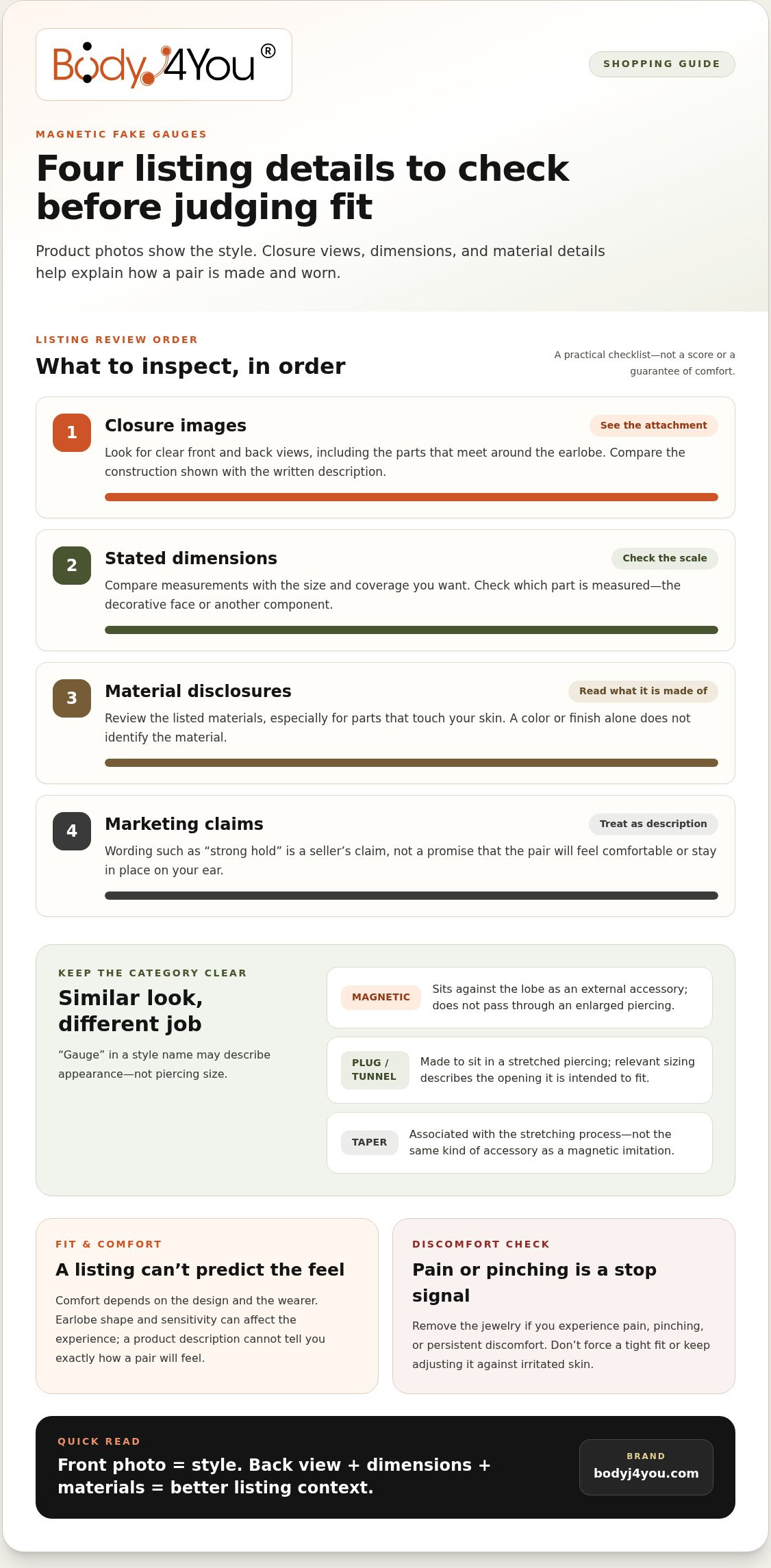
Look for clear images of the front and back of each piece, including the parts that meet at the earlobe. Compare the written details with what the photos show. If a specification is not stated, don’t assume it based on appearance or copy details from another listing.
- Closure images: Check that you can see both decorative pieces and the points that attach around the lobe.
- Dimensions: Compare the stated measurements with the scale and coverage you want. Check whether a measurement refers to the decorative face or another part.
- Material details: Read the listed materials, especially for components that touch your skin. Color and finish alone don’t identify a material.
- Marketing language: Treat phrases such as “strong hold” as descriptions, not promises of secure or comfortable wear.
These details make listings easier to compare. A close-up can show the general arrangement, while written dimensions clarify the size of the decorative face. Neither can predict exactly how the pair will feel on your earlobe, but together they give you a better basis for comparing products than a front view alone.
Recognizing discomfort and adjusting expectations
Comfort depends on the design and the wearer. Pressure that feels manageable to one person may feel distracting to another, and earlobe shape and sensitivity can affect the experience. A product description can explain the design, but it can’t predict how it will feel on your ear.
If you try a pair, pay attention to how your earlobe feels, not just whether the style stays in position. Remove the jewelry if you experience pain, pinching, or persistent discomfort. Don’t force a tight fit or keep adjusting the piece against irritated skin to achieve the look.
Consider comfort during wear as well as the appearance of the closure. If the listing does not explain the attachment, dimensions, or materials, use the details it does provide to compare alternatives rather than assuming a particular fit.
If you’re interested in jewelry for an actual piercing, BodyJ4You offers body-piercing jewelry kits as a separate option. Its piercing and jewelry products are for external use only. Avoid eye contact. Discontinue if irritation occurs. Keep out of reach of children.
Magnetic Fake Gauges vs. Real Plugs and Tapers: Which Look Fits Your Goal?
Search results can show magnetic imitation earrings alongside plugs, tunnels, and tapers, even though these items have different purposes. Start by identifying your goal: a plug-inspired look without a stretched piercing, jewelry for an existing stretched piercing, or a tool associated with stretching. You don’t need to stretch your ears to wear an imitation style.
| Jewelry type | Piercing or stretching requirement | Intended appearance | Listing details to seek |
|---|---|---|---|
| Magnetic fake gauges | Designed for external wear on the earlobe, not for a stretched opening | Imitates a plug-style look | Closure images, construction details, dimensions, and stated materials |
| Plugs or tunnels | Made to be worn in a stretched piercing | A plug face or open tunnel through the lobe | Size information relevant to the stretched piercing and clear product details |
| Tapers | Associated with the stretching process | A tapered shape, rather than a plug or tunnel look | Details that identify the item as a stretching-related tool |
When a non-pierced imitation style may suit your preference
If you like the visual impact of plug-style jewelry but don’t want stretched earlobes, magnetic fake gauges are an imitation style to consider. This is an aesthetic choice, not a step toward a particular piercing size. Designs and attachment methods vary, so check each listing’s construction, dimensions, and fit details instead of assuming every pair will look or feel the same.
When actual plugs, tunnels, or tapers are relevant
Plugs and tunnels are intended for stretched piercings, so their sizing relates to the opening they’re designed to fit. Tapers have a stretching-related purpose; they aren’t the same as decorative fake gauges or everyday plug jewelry. If you’re exploring actual stretching, an ear stretching kit guide can help you understand that separate path before comparing kit contents and jewelry options.
Match a listing to what the item physically does, not just the style words in its title. For an imitation, look for wording and images that describe external, magnetic attachment. For jewelry worn through a stretched opening, look for plug or tunnel listings with relevant sizing details. For a taper, check that the listing identifies its stretching-related purpose.
BodyJ4You offers an Acrylic Ear Stretching Kit and a Surgical Steel Taper and Plug Kit for readers considering actual stretching and stretched-ear jewelry. These are different from magnetic imitation styles. Choose according to the look and piercing style you want, without treating one option as a requirement for another.
How to Choose Magnetic Fake Gauges: A Practical Listing Checklist
A careful listing review helps separate useful details from catchy wording. For magnetic fake gauges, focus on four things: what the item is, how large it appears, what it’s made of, and how it attaches. A title can help you find a style, but specific details are more useful for comparing products.
A four-step check before choosing a pair
- Confirm the intended type. Look for an explicit description of magnetic, non-pierced jewelry. A title that only says “gauge style” may describe the appearance without explaining how the item is worn.
- Review dimensions and images. Compare stated measurements with photos from more than one angle. Check what each measurement describes, such as the decorative face, rather than assuming it refers to a piercing size.
- Compare materials and attachment details. Look for disclosed materials and images or text explaining the closure. Don’t infer details from a finish, product title, or another listing.
- Read the terms and care guidance. Review the seller’s stated care instructions, return terms, and wear guidance before deciding. Follow the details for the specific product.
Use this simple comparison to keep your review focused:
| Detail | What to compare |
|---|---|
| Stated size | Measurements and what each one refers to |
| Material | Specific disclosed materials, not inferred finishes |
| Design | Shape and appearance shown in photos and description |
| Attachment | Closure images and the seller’s explanation |
Use the table to compare options side by side. If one listing gives dimensions and another only says “large look,” you don’t have the same information to judge scale. A broad title claim cannot replace a stated measurement or a clear view of the construction.
Style, appearance, and realistic expectations
Compare finishes and silhouettes using each product’s photos and description. A design that looks bold in a close-up may appear more subtle when worn. Camera angle, lighting, styling, and individual ear shape can all affect the appearance, so treat images as a guide rather than a promise of the exact look or fit.
Keep claims about durability, comfort, or suitability tied to the information the listing actually provides. Words such as “comfortable” or “secure” don’t establish how a pair will feel for you. If an unstated detail matters to your decision, don’t treat promotional wording as proof.
If you prefer actual stretched-ear jewelry to an imitation, you can explore BodyJ4You’s ear-stretching and body-piercing jewelry kits. BodyJ4You’s piercing and jewelry products are for external use only. Avoid eye contact. Discontinue if irritation occurs. Keep out of reach of children.
Explore BodyJ4You Jewelry for Your Own Piercing Style
Choose according to the look you want and the piercing style you have, or are genuinely considering. A plug-inspired appearance doesn’t require stretched ears, and choosing body jewelry doesn’t mean you need to stretch a piercing. Identify your goal first, then browse the product category made for it.
Choose between a non-pierced look and actual piercing jewelry
Magnetic fake gauges imitate the appearance of plugs while sitting externally on the earlobe. Actual plugs are made to be worn in stretched piercings. If you want to try a plug-like silhouette without a stretched opening, focus on non-pierced imitation jewelry. If you’re choosing jewelry for a piercing you already have, look for products intended for that piercing.
There’s no need to treat one style as a step toward another. Your preference may be purely visual, or you may be choosing jewelry for an existing piercing. If you’re considering stretching, that’s a separate decision with its own process and products. Decide what you want before browsing, so similar-looking listing photos don’t blur these different purposes.
Discover BodyJ4You’s confirmed jewelry categories
BodyJ4You is a retailer of body jewelry and jewelry kits, with over 20 years of expert piercer experience. Its offerings include body-piercing jewelry kits and ear-stretching kits for people exploring actual piercing jewelry or stretching. Review each item’s details for the sizing and product information relevant to your decision.
BodyJ4You’s piercing and jewelry products are for external use only. Avoid eye contact. Discontinue if irritation occurs.
Think of the options as a choice between an imitation look for an unstretched lobe, jewelry intended for a piercing, or products related to stretching. Knowing which path fits your goal makes browsing clearer and helps you express your style without assuming that stretching is necessary. It also keeps the appearance shown in a listing separate from the product’s intended use.
If actual body jewelry or stretching kits fit your plans, explore BodyJ4You’s body jewelry. Compare the category with the style you want and choose what suits your piercing journey.
Choose the Look That Feels Like You
Decide whether you’re drawn to the visual effect of magnetic fake gauges or want to explore jewelry for a piercing you already have. Let your style and goals guide the choice rather than feeling that one look has to lead to another.
BodyJ4You describes its products as Made in USA. Its piercing and jewelry products are for external use only. Avoid eye contact. Discontinue if irritation occurs.
Explore the body jewelry range and focus on the categories that fit your piercing style. Explore BodyJ4You’s body jewelry and choose a look that feels true to you.
Frequently Asked Questions
Do magnetic fake gauges require pierced ears?
Usually, no. Magnetic fake gauges are designed to attach externally, so the earlobe doesn’t need a piercing for the style to work. Check the product description because similar search terms can bring up different earring types. Look for an explicit explanation of how the item attaches rather than relying only on its title or a photo of someone wearing it.
Can magnetic fake gauges fall off?
Yes. They can shift or come off, and how securely a pair sits depends on the design and how it fits your lobe. When trying a pair for the first time, wear it where you can notice if it moves. Avoid relying on it in a situation where losing an earring would be a concern, and follow the seller’s instructions for putting it on and taking it off.
Are magnetic fake gauges comfortable to wear?
Comfort varies by person and design. A pair may press on a sensitive spot or become uncomfortable during wear. Start with a brief wear and notice how your lobe feels. Remove the jewelry if you experience pain, pinching, or ongoing discomfort, and don’t continue wearing it on irritated skin.
How do magnetic fake gauges differ from plugs?
Magnetic fake gauges attach externally to create a plug-inspired appearance. Plugs are made to sit in a stretched piercing, so they’re selected for the opening they need to fit. A listing that uses “gauge” to describe a magnetic style doesn’t tell you the size of anyone’s piercing. Check whether the product is described as external magnetic jewelry or as a plug for a stretched lobe.
Can you sleep in magnetic fake gauges?
Remove them before sleeping. Pressure against a pillow may make an earring uncomfortable or dislodge it, and a loose piece could be misplaced. Store the pair somewhere secure and away from children after taking it off.
How should magnetic fake gauges be cleaned?
Follow the care instructions for the specific pair, since materials and construction can differ. If the instructions don’t explain cleaning, don’t guess about soaking, chemicals, or heat, which may affect some finishes or components. Keep the jewelry away from children when it’s off. If it becomes visibly dirty, use a cleaning method the seller identifies as suitable for that item.


