

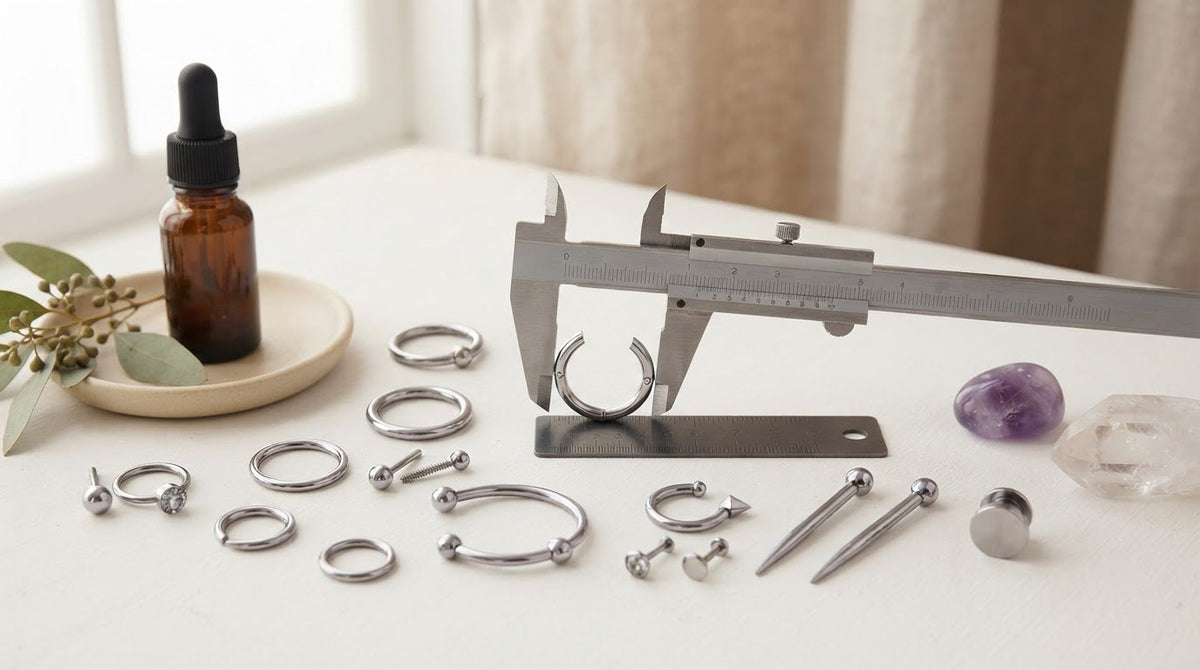
“Surgical steel” sounds like a safety guarantee. It isn’t. A surgical stainless steel piercing label, by itself, doesn’t identify a precise steel grade, prove that the material meets implant-grade standards, or tell you how much nickel may be released. If you’re comparing jewelry and considering metal sensitivity, those details matter.
It’s reasonable to want a material that feels dependable without giving up the look you love. Separate the familiar label from evidence about composition and suitability, then consider the piercing’s healing stage, jewelry fit, and product details together.
In this guide, you’ll learn what “surgical steel” can and can’t establish, how standards such as ASTM F138 and ISO 5832-1 fit into the conversation, and what nickel-related information does and doesn’t mean. BodyJ4You draws on more than 20 years of expert piercer experience in its body-jewelry and aftercare range. We’ll also cover how to compare product descriptions, spot gaps in material claims, and respond if jewelry causes irritation. This guide isn’t a substitute for personal medical advice, but it can help you make a more informed choice and know when to stop using an item and seek qualified guidance.
Key Takeaways
- “Surgical steel” is a broad label, so look beyond the category name when comparing jewelry descriptions.
- For a surgical stainless steel piercing, consider the placement and jewelry form alongside the disclosed material details.
- Gauge, length, and diameter describe different aspects of fit; compare each with the needs of the piercing.
- Use a simple checklist to assess jewelry form, fit, material information, product description, and aftercare.
- BodyJ4You’s experience informs this practical guide, which also covers its Surgical Steel Taper and Plug Kit.
What Does Surgical Stainless Steel Mean for Piercing Jewelry?
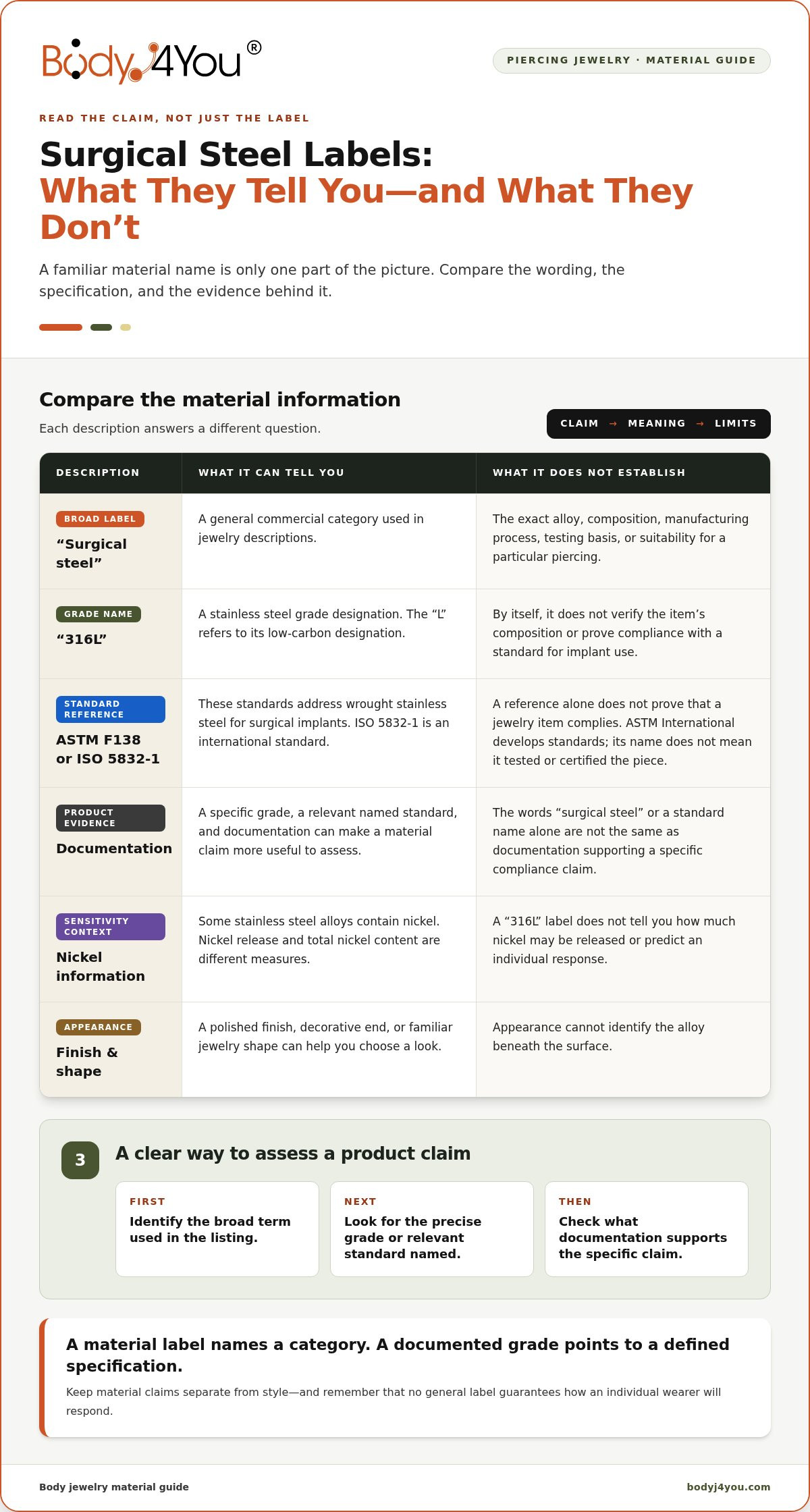
Stainless steel is an iron-based alloy whose chromium content helps it resist corrosion. Other elements and manufacturing processes vary by grade. In jewelry descriptions, “surgical steel” is a broad commercial term, not a complete material specification. The words alone don’t tell you the exact alloy, how it was made, or whether its properties suit a particular piercing.
A polished finish, decorative end, or familiar jewelry shape can help you choose a look, but appearance can’t identify the alloy beneath the surface. When comparing surgical stainless steel piercing jewelry, keep style and material information separate. One helps express your personal style; the other describes what the item is made from and what evidence supports that description.
A material label names a category; a documented grade identifies a defined specification.
Why the words surgical steel need context
“Surgical steel” doesn’t have one universal definition for consumer jewelry. On its own, the phrase may not identify a specific alloy, chemical composition, manufacturing process, or testing basis. A listing may use it as a general category, while a more detailed description may name a grade and provide documentation to support that claim. Those are different levels of information.
The term also doesn’t promise that every wearer will tolerate the jewelry. Individual responses to materials can vary, so don’t read a broad label as proof of universal skin compatibility. The general overview of Surgical stainless steel describes common types and uses, but a product-specific description is needed to understand an individual item.
What a material description can tell you
An exact grade or named standard can make a description more useful because it points to defined material requirements. For example, ASTM F138 and ISO 5832-1 address wrought stainless steel for surgical implants. ASTM International develops standards; its name appearing in a description doesn’t, by itself, mean ASTM has tested or certified that jewelry item.
Context matters. A standard has a scope, and a reference to it should be relevant to the material and intended use being discussed. Don’t assume a standard applies to every product described as surgical steel, or that mentioning it proves a particular item complies. Look for a specific claim and any documentation supporting it instead of relying on a category label.
For a careful comparison, separate three things: the broad term used in the listing, the precise grade or standard named, and the documentation supporting the claim. If a description gives only the category, you know how the seller labels the material, but not the full specification. Keeping those distinctions clear helps you assess jewelry without mistaking an attractive finish or familiar phrase for evidence about the alloy.
316L, Nickel, and Sensitivity: What Piercing Jewelry Labels Can, and Cannot, Tell You
A label such as “316L” gives more specific information than “surgical steel,” but it still needs context. 316L is a stainless steel grade designation; seeing it in a product title doesn’t prove that the item’s composition has been independently verified or that documentation supports the claim. For a surgical stainless steel piercing choice, consider both the grade name and the evidence behind it.
How to read a 316L or standard reference
316L identifies a grade of stainless steel. The “L” refers to its low-carbon designation, but the label alone doesn’t establish that jewelry meets a standard for implant use. ASTM F138 specifies requirements for wrought stainless steel used for surgical implants, while ISO 5832-1 is an international standard for wrought stainless steel for implants. A listing that says only “316L” is not the same as a documented claim of compliance with either standard.
Read the wording carefully. Does the description name a specific grade, identify a relevant standard, and state that the material complies with it? These details aren’t interchangeable. A reference to ASTM International, which develops standards, doesn’t mean the organization has certified or tested the particular piece. Standards have defined scopes, so consider whether a cited standard is relevant before treating it as evidence of suitability. Don’t infer a grade or certification from a product’s appearance or category name.
What nickel sensitivity means for a jewelry choice
Nickel deserves attention because some stainless steel alloys contain it, but the presence of nickel alone doesn’t tell you how much may be released from an item or whether you’ll react. Nickel release and total nickel content are different measures. A “316L” label also can’t predict an individual response. Sensitivities vary, and no general material description can diagnose an allergy or guarantee that a reaction won’t occur.
Read the grade name together with product documentation; neither one alone tells the whole material story.
Use general material guidance as a starting point, not personal medical advice. If jewelry causes irritation, don’t assume the cause from the label alone. Persistent or concerning symptoms warrant advice from a qualified healthcare professional, who can help assess what’s happening and what to do next.
BodyJ4You brings over 20 years of expert piercer experience to its body-jewelry and aftercare range. When comparing jewelry descriptions, explore the piercing jewelry selection with these distinctions in mind: grade, documentation, and personal suitability are related, but they aren’t the same thing.
How to Compare Surgical Stainless Steel Piercing Jewelry by Placement and Fit
A jewelry form that looks right in a photo may not suit the piercing or fit comfortably. Compare placement, shape, sizing details, and material disclosure as separate factors. A surgical stainless steel piercing label addresses the material category, not whether a particular stud, ring, or barbell matches your anatomy.
| Placement to consider | Jewelry form examples | Fit details to compare | Material disclosure |
|---|---|---|---|
| Ear lobe | Stud or ring | Gauge and post length, or ring diameter | Look for a specific material description beyond a style name |
| Cartilage | Stud or barbell | Gauge and wearable length | Check whether the alloy or a relevant standard is identified |
| Other body placements | Barbell or ring | Gauge, wearable length, or diameter, as applicable | Compare the material claim independently of the jewelry form |
Match jewelry form to the piercing
Studs, rings, and barbells describe shapes, not universal placement recommendations. Anatomy and piercing location affect how a piece sits and moves. A form that works in one placement may not work in another, even if the pieces look similar. For a new or healing piercing, don’t choose jewelry based on style alone; use qualified, placement-specific guidance instead of assuming a general example applies to you.
Compare fit details before choosing
Gauge describes the thickness of the post or bar. Wearable length measures the part that passes through the piercing, while a ring’s diameter describes its size across. These are different measurements, and one can’t substitute for another. Compare the relevant details in the product information with the fit needed for your piercing. No single measurement suits every person or placement.
Fit matters in practice. Jewelry that presses against surrounding tissue may create avoidable pressure; a piece that moves excessively may be uncomfortable or catch more easily. Neither a tight fit nor a loose fit should be treated as a style choice without considering the placement and your anatomy. If you’re unsure about sizing, seek guidance from a qualified professional familiar with your piercing rather than guessing from a photo or relying on a universal chart.
Keep tool and jewelry functions distinct, too. A taper is a tool associated with stretching, while a plug is jewelry. A tapered tool isn’t interchangeable with jewelry intended for ongoing wear, so don’t treat its shape as evidence that it should remain in a piercing as everyday jewelry.
Finally, compare material claims separately from design. A curved barbell, polished finish, or decorative end doesn’t establish an alloy grade or prove personal skin suitability. A useful comparison considers four things together: placement, form, fit measurements, and what the product description actually says about its material. That lets you assess the look you want without asking style details to answer questions they can’t resolve.
A Practical Checklist for Choosing Surgical Stainless Steel Piercing Jewelry
A product page should help you assess more than appearance. Use this checklist to compare jewelry details systematically, and treat material, fit, and care instructions as related but separate parts of your decision.
- Match the placement and form. Identify where the jewelry will sit, then consider whether a stud, ring, or barbell is appropriate for that piercing and your anatomy. For a new or healing piercing, rely on qualified, placement-specific guidance rather than choosing by style alone.
- Compare the fit information. Check the gauge and the relevant wearable length or diameter against your piercing’s needs. These measurements describe different things. Don’t assume one size works for everyone or guess based only on a product photo.
- Read the material details. Look for a specific material description beyond a broad “surgical steel” category label. If a grade or standard is named, read the exact claim and supporting product information. Don’t infer a specification that the description doesn’t state.
- Assess the product description. Clear product information helps you understand the claim. Compare the exact wording across items, and separate material statements from style names, finishes, and images. Treat unstated details as unknown rather than filling the gap with an assumption.
- Consider aftercare separately. Jewelry choice and piercing care are different decisions. Follow reliable, placement-appropriate aftercare guidance, handle the area gently, and don’t twist or turn jewelry while cleaning. For practical care information, consult a dedicated sterile saline spray guide for piercings alongside guidance from a qualified professional.
Care without adding avoidable irritation
Keep care simple and consistent with reputable piercing-aftercare guidance. Avoid unnecessary handling, and don’t use a product or routine simply because it is marketed for jewelry or skin. If irritation occurs, stop using the item. For symptoms that persist, worsen, or concern you, seek advice from a qualified healthcare professional.
This checklist makes a surgical stainless steel piercing purchase easier to assess without treating one label as a complete answer. Placement, dimensions, material wording, and aftercare each deserve attention. Together, they give you a clearer basis for comparing products and choosing with care.
Ready to compare options? Explore BodyJ4You’s piercing jewelry and aftercare with these details in mind.
BodyJ4You’s Surgical Steel Taper and Plug Kit: A Grounded Next Step
Material labels are only one part of an informed jewelry choice. Placement, fit, and clear product information matter too. BodyJ4You is a body-jewelry and aftercare retailer with over 20 years of expert piercer experience, bringing practical perspective to questions about jewelry descriptions and selection.
What BodyJ4You’s confirmed offering supports
The Surgical Steel Taper and Plug Kit is part of BodyJ4You’s product range. Its name identifies it as a taper and plug kit. When assessing it, use the product description for the details it provides, and keep the distinction between a stretching tool and jewelry intended for ongoing wear in mind.
A taper and jewelry intended for ongoing wear are not interchangeable. A taper is a tool associated with stretching, not a piece to treat as everyday jewelry. If you’re learning about taper purpose and limitations, an ear tapers article can provide useful background alongside the material and fit guidance in this guide. Choose jewelry with the piercing’s placement and fit in mind, rather than treating a tool as a substitute for a wearable piece.
Make the next choice with care
Bring the checklist from this article to any product page you’re comparing. Consider the piercing placement and jewelry form, look for relevant sizing information, and read the material description closely. A broad category phrase doesn’t answer every question about composition or suitability, and a style name can’t fill in missing material details.
BodyJ4You’s experience is a useful starting point for careful product reading, not a promise of comfort, healing, or a particular outcome. Match the jewelry to the piercing, interpret the description accurately, and seek qualified guidance if you’re unsure about fit or personal sensitivity.
Explore BodyJ4You’s jewelry range at your own pace, using the details you’ve learned to make an informed comparison. For the Surgical Steel Taper and Plug Kit, use its product description to guide your decision.
For external use only. Avoid eye contact. Discontinue if irritation occurs. Keep out of reach of children.
Choose Your Next Piece with Confidence
Your next jewelry choice can be both personal and considered. Treat material information as one part of the decision, alongside fit, placement, and how the piece will be worn. If you’re comparing a surgical stainless steel piercing option, revisit the product description and distinguish clearly stated details from assumptions. A confident choice comes from knowing what information matters to you.
BodyJ4You brings over 20 years of expert piercer experience to its body-jewelry and aftercare range, including the Surgical Steel Taper and Plug Kit. Explore the available options with your checklist in mind, and choose what aligns with your needs and preferences.
Explore BodyJ4You piercing jewelry and take your next step with care. Your style is yours to shape, and informed choices can help you express it with greater confidence.
Frequently Asked Questions
Is surgical stainless steel safe for a new piercing?
Not automatically. A label alone can’t establish whether a particular item is appropriate for a fresh piercing, so don’t use a general product description as a substitute for professional guidance. Before choosing jewelry, consider whether the recommendation is specifically for initial wear, not just healed piercings. If you have a known metal sensitivity, or notice worsening pain, redness, swelling, or discharge, seek advice from a qualified healthcare professional.
Can surgical stainless steel contain nickel?
Yes, some stainless-steel alloys contain nickel, so “surgical steel” shouldn’t be interpreted as “nickel-free.” If you’re comparing options because of a past reaction, note the exact material wording for each item rather than assuming similar-looking pieces have the same composition. A qualified piercer or healthcare professional can help you consider your circumstances. General material information can guide questions, but it can’t predict your individual response.
What does 316L mean in piercing jewelry?
316L is a stainless-steel grade designation, not proof that a particular jewelry item has verified composition or supporting documentation. A product title that includes “316L” gives you a more specific claim to evaluate, but it doesn’t establish that the item meets a separate standard. Read the full description and check what evidence, if any, supports the stated material. Don’t assume every surgical-steel item is 316L.
Is surgical stainless steel the same as implant-grade steel?
No, the terms aren’t interchangeable. “Surgical steel” is a broad description, while implant-grade claims refer to specific material requirements. If a product page names a standard, check what material and use it covers instead of assuming the category name proves compliance. This distinction is especially useful when comparing jewelry intended for different situations. If the distinction affects your choice, discuss the product details with a qualified piercer.
Can I wear surgical steel jewelry if I have a metal allergy?
A general label can’t tell you whether a particular item will be suitable for your allergy. Some stainless-steel alloys may contain nickel, and personal sensitivity varies. Avoid relying on broad terms such as “surgical” or “hypoallergenic” as a personal guarantee. Review the item’s material details and discuss your known allergy with a qualified healthcare professional before deciding. They can offer guidance based on your history rather than a general category description.
What should I do if piercing jewelry causes irritation?
Stop using the item if irritation or a negative reaction occurs, and don’t twist or turn jewelry during care. Avoid trying several new products or changing your routine at once, since that can make it harder to identify what may be contributing to the irritation. Don’t diagnose the cause from the jewelry label alone. If symptoms persist, worsen, or concern you, seek advice from a qualified healthcare professional or experienced piercer.
Are tapers meant to be worn as everyday piercing jewelry?
No, don’t treat a taper as interchangeable with jewelry intended for ongoing wear. A taper is associated with stretching, while a plug is a jewelry form; follow reliable, specific guidance for each item rather than assuming a kit name explains its use. BodyJ4You offers the Surgical Steel Taper and Plug Kit. For external use only. Avoid eye contact. Discontinue if irritation occurs. Keep out of reach of children. Consult an ear-taper guide for more context.


