

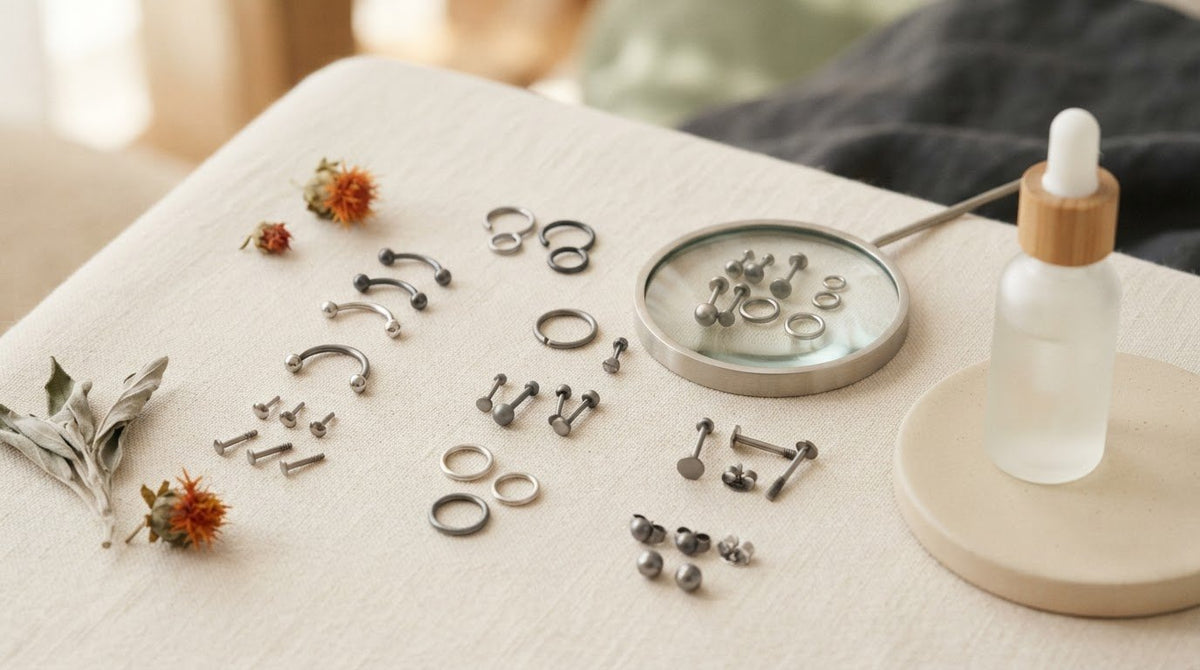
A reassuring label can tell you less than a clear material specification. When comparing nickel-free body jewelry options, look beyond the headline claim: “hypoallergenic” and “nickel-free” aren’t interchangeable, and neither label alone explains what every part of a piece is made of.
You can choose jewelry that reflects your style while taking skin sensitivity and fit into account. In the United States, these terms don’t have standardized legal definitions, so composition details can help you compare products more thoughtfully. Titanium and niobium are materials to learn about, while surgical steel contains nickel and may not suit everyone with a sensitivity.
This guide explains how to read material claims, compare common jewelry materials, and assess posts, backs, clasps, and fit alongside style. BodyJ4You has more than two decades of experience in the body-jewelry industry. You’ll also find guidance on when possible allergy symptoms are a reason to seek advice from a medical professional.
Key Takeaways
- Learn why “hypoallergenic” and “nickel-free” don’t mean the same thing, and why material details matter.
- Compare nickel-free body jewelry options by stated composition and intended use, rather than relying on broad labels.
- Use a practical checklist to assess material information, finish, sizing, and care guidance before buying.
- Consider every jewelry component, including posts, backs, and clasps, when reviewing material claims.
- Balance material information with fit, care, and personal style to make a considered choice.
Nickel-Free Body Jewelry Options: What the Label Should, and Should Not, Tell You
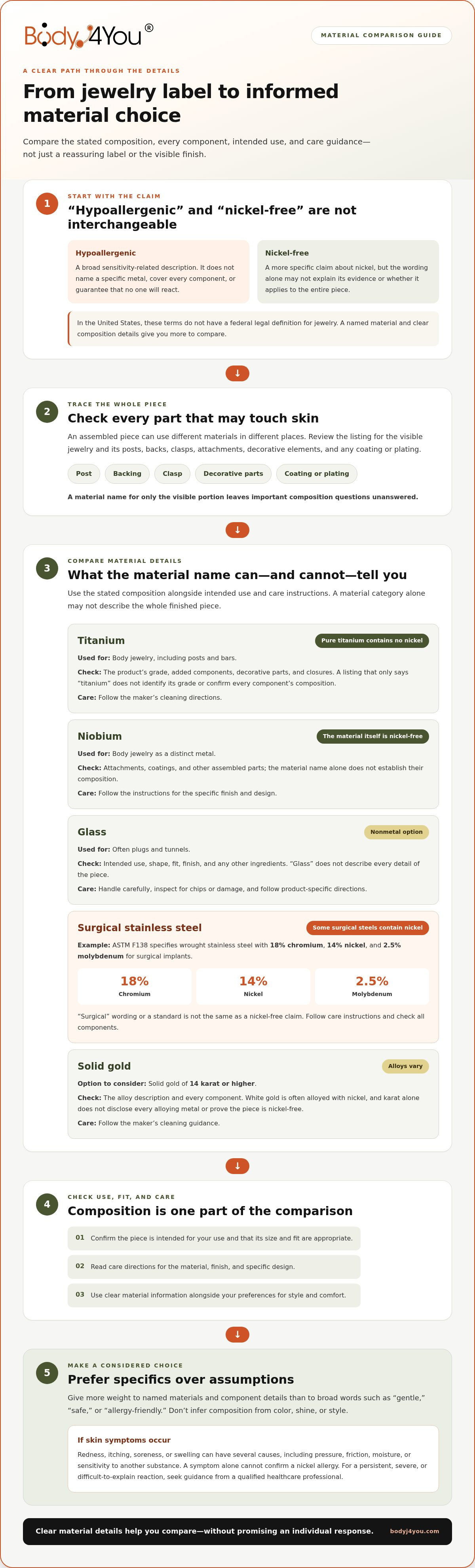
Two pieces of jewelry can look almost identical and still have different compositions. When comparing nickel-free body jewelry options, treat a product-page claim as a starting point, not as proof based on color, shine, or style. “Nickel-free” is a product claim about composition that should be assessed through clear material details, not inferred from appearance. A listing that names the material and specifies which parts the claim covers gives you more to work with when comparing products.
“Hypoallergenic” is broader. It suggests a lower likelihood of triggering an allergic response, but it doesn’t identify a specific metal or alloy, explain whether the claim applies to every component, or guarantee that a particular person won’t react. In the United States, these terms don’t have a federal legal definition for jewelry, so their use may vary between sellers and markets. Specific composition information is more useful than a reassuring adjective.
Nickel allergy, irritation, and jewelry contact
A nickel allergy is an immune response to nickel after skin contact, and it may cause allergic contact dermatitis. The Nickel allergy overview describes nickel-related reactions and their context. Redness, itching, soreness, or swelling around a piercing can have several possible causes, including pressure, friction, moisture, or sensitivity to another substance. A symptom alone can’t confirm a nickel allergy, and this section isn’t a way to diagnose one.
If a reaction is persistent, severe, or difficult to explain, seek guidance from a qualified healthcare professional. They can assess the skin and help determine whether allergy testing or other care is appropriate. Don’t rely on a product label or an online symptom comparison to identify the cause.
What nickel-free and hypoallergenic wording means
These labels aren’t interchangeable. “Hypoallergenic” is a general sensitivity-related description; “nickel-free” makes a more specific claim about nickel, but the phrase alone may not tell you what evidence supports it or whether every part is covered. Rules and terminology can differ by market, so don’t assume a label means the same thing everywhere.
Look for the named material and relevant composition details. For assembled jewelry, consider the entire piece: a post, backing, clasp, or decorative element may use a different material from the visible portion. A listing that names only a broad material category leaves more unanswered than one that specifies the components.
- Give more weight to named materials than to words such as “gentle,” “safe,” or “allergy-friendly.”
- Check whether the claim covers the full piece, including parts that touch the skin.
- Don’t treat appearance or a broad sensitivity label as evidence of composition.
Clearer information helps you compare jewelry, but it can’t predict every individual response. Use material details to guide your selection, and involve a healthcare professional when skin reactions raise questions.
Compare Nickel-Free Body Jewelry Materials Without Assuming Every Item Is the Same
Material names are useful, but they’re only part of the picture. An alloy, coating, plating, or mixed-material construction can affect what the finished piece contains. Compare jewelry by its stated composition, intended use, and care guidance, not by material category alone.
| Material | Composition and typical use | Care considerations | Limits to keep in mind |
|---|---|---|---|
| Titanium | Titanium is a metal used in body jewelry, including posts and bars. Pure titanium contains no nickel, but a product’s grade and any added components still matter. | Follow the maker’s cleaning directions and review the full piece, including decorative parts and closures. | A listing that says only “titanium” doesn’t identify its grade or confirm the composition of every component. |
| Niobium | Niobium is a distinct metal used for body jewelry. The material itself is nickel-free. | Use the care instructions for the specific finish and jewelry design. | A material name alone doesn’t establish the composition of attachments, coatings, or other assembled parts. |
| Glass | Glass jewelry is a nonmetal option often used for plugs and tunnels. | Handle carefully and inspect for chips or damage; follow product-specific care directions. | “Glass” doesn’t describe every ingredient, finish, shape, or fit. Confirm the intended use of the piece. |
| Surgical stainless steel | Some surgical steels contain nickel. ASTM F138, for example, specifies wrought stainless steel with 18% chromium, 14% nickel, and 2.5% molybdenum for surgical implants. | Follow product care instructions and don’t assume the steel’s name identifies every component. | ASTM F138 describes a nickel-containing steel; a standard or “surgical” wording is not the same as a nickel-free claim. |
| Solid gold | Gold alloys vary. Solid gold of 14 karat or higher is an option to consider, while white gold is often alloyed with nickel. | Check the alloy description and follow the maker’s cleaning guidance. | Karat alone doesn’t disclose every alloying metal or prove all components are nickel-free. |
How to assess titanium and niobium claims
Look beyond the headline material name. A specific grade or composition gives more useful information than “titanium jewelry,” especially if the piece combines metals or has a finish. Don’t infer a certification, grade, or nickel-free guarantee from a material category alone. The composition of the finished item matters, not just its main visible section.
When glass or other nonmetal options may fit
Glass can offer a nonmetal choice, particularly for plugs and tunnels, but the jewelry still needs to suit the piercing, fit comfortably, and be intended for the way it will be worn. Check the maker’s care information and inspect the surface. “Nonmetal” is not a complete composition description, so don’t assume all materials in that broad category are identical.
Use this comparison as a starting point, then weigh composition, fit, finish, and care together. BodyJ4You has more than two decades of experience in body jewelry. Explore its body jewelry selection and review the material details for each specific item.
How to Compare Nickel-Free Body Jewelry Options Before You Buy
Use the same questions for every listing. A consistent checklist makes it easier to compare nickel-free body jewelry options without letting polished photos or reassuring marketing phrases fill in missing details. Separate the facts a listing states from the details it leaves unanswered.
- Material: Is a specific material named, or does the listing rely on a broad term such as “metal”?
- Composition: Does it identify the alloy, grade, or material of each part, where relevant?
- Finish: Is a coating or plating described separately from the base material?
- Sizing: Are the gauge, length, diameter, or other measurements relevant to the jewelry style provided?
- Care: Are there clear instructions for cleaning and handling the item?
Product-listing details that help shoppers compare
Prioritize composition and any stated grade over color, polish, and phrases such as “gentle,” “safe,” or “allergy-friendly.” These descriptions don’t tell you what the jewelry is made of. Check that the product style and relevant measurements are clear, too. If a detail is missing, record it as unknown rather than assuming the item is suitable for sensitive skin.
Assess the surface finish separately. Plating or a coating describes the exterior, not necessarily the underlying material. A nickel-free finish claim alone may not explain the base metal or other components. Look for information about both layers, and note whether the statement applies to the whole piece.
Copy details from each product page into a simple comparison template. Use “not stated” rather than guessing when information is absent:
Listing A: Style: [stated or not stated]. Material and composition: [details]. Finish or coating: [details]. Size: [measurements]. Care: [instructions]. Unanswered details: [list].
Listing B: Style: [stated or not stated]. Material and composition: [details]. Finish or coating: [details]. Size: [measurements]. Care: [instructions]. Unanswered details: [list].
This format keeps product facts separate from impressions. If one listing names the material and gives measurements while another says only “hypoallergenic,” you can see which provides more useful information without assuming either description guarantees a particular result.
Match material research to jewelry style and placement
Composition is only one part of a considered choice. Shape, gauge, length, and placement affect how jewelry sits and whether it suits the piercing. For septum-specific context, see the complete septum piercing guide. For a barbell, compare its measurements with the fit considerations in the industrial piercing guide.
Read sizing alongside material details, not as an afterthought. A clearly described material can still be the wrong shape or size for your needs. When a listing leaves a key measurement or care detail unclear, keep that gap visible in your comparison rather than treating a broad label as a substitute.
Avoid Common Nickel-Free Jewelry Buying Mistakes and Make a Confident Choice
A careful purchase starts with a clear question: what are you trying to avoid, and what does the product information actually tell you? Labels and appearance can narrow your search, but neither replaces checking composition, fit, and care. Use this four-step process to compare nickel-free body jewelry options more thoughtfully.
- Identify your concern. If you have a diagnosed nickel allergy, use that information to guide your search. If you’re reacting to jewelry but don’t know why, don’t treat the symptoms as proof of nickel sensitivity.
- Compare stated composition. Look for a named material and any available alloy or grade details. Check whether the description covers the full piece, not just its visible surface.
- Assess fit and placement. Review the jewelry style and relevant measurements, such as gauge, length, or diameter. A material claim doesn’t establish that a piece is the right size or shape for your piercing.
- Review care guidance. Read the cleaning and handling instructions for the specific item. Don’t assume care advice for one material or finish applies to another.
Common assumptions that can mislead shoppers
Color isn’t a material specification. A silver-toned piece could be made from different metals or have a surface coating, while a gold-toned finish doesn’t identify the base material. Plating describes an outer layer, not necessarily what lies beneath it, and wear can affect that surface over time.
“Stainless steel” covers different alloys, so the category name alone doesn’t establish an exact composition. Some stainless steel used in jewelry contains nickel. “Hypoallergenic” is similarly broad, while “nickel-free” is a specific claim that still needs to be considered alongside available material details. Neither a category label nor a finish automatically tells you what every component contains.
A practical checklist for your next purchase
Before choosing based on appearance or price, compare the same facts across your shortlist. A side-by-side review can show where information is clear and where it’s missing.
- Is the material named, and are alloy or grade details provided?
- Does the information cover the base material, finish, and other components?
- Are the jewelry style, measurements, and intended placement clear?
- Are care instructions provided for the specific item?
- Which details remain unanswered rather than supported by a vague reassurance?
Keep “not stated” distinct from “nickel-free.” Missing information doesn’t prove a product contains nickel, but it also doesn’t establish that it doesn’t. That distinction helps you make a considered choice without guessing.
If you have a known allergy, or skin symptoms that persist, are severe, or have an uncertain cause, seek advice from a qualified healthcare professional. Switching jewelry through trial and error isn’t a way to diagnose or treat an allergic reaction. If you’re comparing jewelry styles alongside material information, explore BodyJ4You’s body jewelry selection.
Explore Body Jewelry Options with Material Information in Mind
Choosing jewelry for sensitive skin takes more than spotting a reassuring label. Keep your priorities in order: composition first, then fit, finish, care, and personal style. This framework helps you assess product information without letting a preferred shape or color distract from the details that matter to you.
Choose jewelry by material information and intended use
Apply the same composition checklist to every style you consider. An internal threaded labret stud, an industrial barbell, and a captive bead ring have different forms and uses, but the product name alone doesn’t tell you what materials make up the piece. Review stated composition for each item, including any finish or components described separately.
Then consider whether the jewelry’s measurements and shape suit your piercing and intended placement. A clear material description can’t make an unsuitable fit comfortable, just as a favorite design can’t fill in missing composition details. Treat these as separate decisions: material information helps you assess what the jewelry is made from, while sizing and style help you assess whether its form is right for your needs.
Finish and care guidance also deserve a place in your decision. A polished appearance or colored surface doesn’t identify the underlying material. Read how the seller describes the finish, and follow the care instructions for the specific piece rather than assuming they apply to every jewelry type. If product details leave a question unanswered, keep it separate from the facts the listing does provide.
Make a thoughtful next step
BodyJ4You is an online body-jewelry retailer with more than two decades of industry experience. Its jewelry selection includes internal threaded labret studs, industrial barbells, and captive bead rings. That experience provides context for a range of jewelry categories, but it isn’t medical evidence and doesn’t replace the product-specific information you need to evaluate a material claim. Consider each listing on its own details rather than assuming every piece in a category has the same composition.
As you browse, use a simple order of review: first find the stated material and composition; next compare the style and measurements with your placement needs; then read the finish and care information; finally, decide whether the design suits your personal style. This keeps practical considerations in view while leaving room for self-expression. Thoughtful material research and jewelry that feels like you can go together.
Browse the BodyJ4You body jewelry selection with your material priorities in mind. Compare the product details for each specific piece and choose based on the information available.
Make Your Next Jewelry Choice With Confidence
Let your next choice reflect both your personal style and what you know about your needs. A product page can be one part of the decision; if you have a diagnosed allergy or ongoing skin concerns, bring those questions to a qualified healthcare professional rather than relying on trial and error. Their guidance can help you decide what information matters as you compare jewelry.
Keep a short list of the details you want to see, then use it as you browse. If a listing leaves an important question unanswered, weigh that uncertainty alongside the design, fit, and care instructions. Thoughtful shopping doesn’t limit self-expression. It gives you a clearer basis for choosing among nickel-free body jewelry options and finding a style that feels right for you.
Ready to explore? Browse BodyJ4You body jewelry and compare styles at your own pace.
Frequently Asked Questions
What does nickel-free mean for body jewelry?
Nickel-free is a claim that an item contains no nickel or has limited nickel release, but its precise meaning may depend on the product and applicable rules. A listing might describe a surface treatment rather than the complete piece. Look for information about the jewelry’s main body and, where relevant, its post, decorative end, and backing. If you have a diagnosed allergy, a healthcare professional can help interpret product details for your situation.
Is titanium body jewelry nickel-free?
Titanium itself contains no nickel, but the word “titanium” alone may not describe every part of an assembled piece. For example, a decorative end or attachment could use a different material, and a listing may not specify a grade or full composition. Review the product details for the complete item. If you have a known allergy, discuss your individual needs with a qualified healthcare professional rather than treating a material name as a personal safety guarantee.
Can stainless steel body jewelry contain nickel?
Yes. Some stainless-steel alloys contain nickel, and composition can differ by grade and product. “Stainless steel” by itself doesn’t tell you which alloy is used or how the complete piece is constructed. For example, a steel post may be paired with a component made from another material. Look for specific composition details, and don’t assume a steel label means every item has the same nickel content or release characteristics.
Is hypoallergenic the same as nickel-free?
No. “Hypoallergenic” is a broad description and doesn’t name a jewelry material or establish that the item contains no nickel. A product described that way could still leave important details unanswered, such as its alloy or the materials used in smaller components. Treat the term as a reason to look for more specific information, not as a composition statement. If you have a diagnosed allergy, seek guidance tailored to your circumstances.
How can I tell whether body jewelry is nickel-free?
Start with the product’s material description and look for composition information that applies to the full piece. When comparing nickel-free body jewelry options, don’t rely on a silver or gold color, a polished finish, or terms like “gentle.” For instance, a listing may describe a coating without identifying the base material beneath it. Note any missing details rather than filling gaps with assumptions, and seek professional advice if you have an allergy or ongoing symptoms.
Can I wear body jewelry if I have a nickel allergy?
Possibly, but a general guide can’t determine which jewelry is appropriate for you. People’s needs and reactions differ, and product labels may not provide enough detail to resolve every concern. Review the composition of the specific item and discuss your options with a qualified healthcare professional if you have a known allergy. If you’re experiencing persistent or severe symptoms, seek medical guidance rather than trying different jewelry as a way to diagnose or treat the reaction.


