

A homemade salt soak may seem like a gentle option, but the wrong mixture can leave a healing piercing dry or irritated. If you’ve found conflicting advice about non-iodized sea salt for piercings, you’re not alone. Older aftercare tips don’t always reflect current professional guidance.
The safer starting point is sterile saline. The Association of Professional Piercers recommends sterile saline wound wash rather than homemade salt solutions, which can be difficult to mix correctly and keep free from contamination. That doesn’t mean sea salt has no place, but it does need careful qualification.
In this guide, you’ll learn how sea salt differs from sterile saline, what to check on a saline product’s label, and what to ask your piercer if they recommend a salt soak. You’ll also learn which salt additives and cleaning habits may irritate healing skin, and when to contact a piercer or healthcare professional. The aim is gentle care without unnecessary steps.
Key Takeaways
- Non-iodized sea salt for piercings means salt without added iodine. It does not mean sterile salt, so keep the distinction in mind when comparing aftercare options.
- Check saline labels for sterile wound wash with 0.9% sodium chloride and no added ingredients. Don’t substitute contact lens saline, nasal spray, or eye drops.
- The Association of Professional Piercers recommends sterile saline wound wash instead of homemade salt solutions. If your piercer specifically recommends a soak, ask for instructions rather than guessing at a recipe.
- Keep care simple: wash your hands, clean gently, and avoid repeated handling or harsh products that may aggravate the area.
- Irritation can have different causes. Seek advice from a professional piercer or healthcare professional if symptoms concern you or worsen.
Non-Iodized Sea Salt for Piercings: Facts and Myths
Advice about piercing soaks can be confusing. Some sources recommend homemade sea-salt mixtures, while current professional guidance favors sterile saline. The key difference isn’t simply the type of salt. It’s whether the finished solution is prepared and sterile, which matters when caring for a healing piercing.
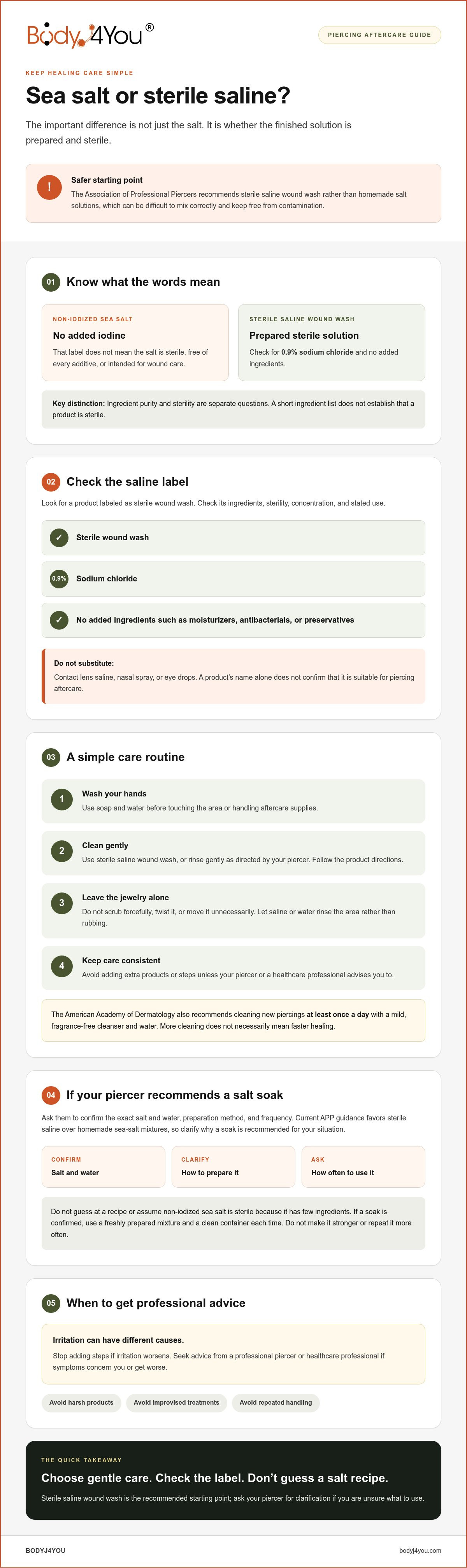
Non-iodized sea salt is salt without added iodine. That label doesn’t mean the salt is sterile, free of every additive, or suitable for wound care. Ingredient purity and sterility are separate questions. A product may have a short ingredient list and still not be made or packaged as a sterile solution.
Quotable distinction: Sterile saline is a prepared, sterile solution; homemade salt water is a mixture whose ingredients and preparation may not be sterile. A piercing is healing tissue, so gentle aftercare helps avoid unnecessary irritation. For a broader overview of the body piercing healing process, remember that healing takes time and aftercare is only one part of it.
What does non-iodized mean on a sea-salt label?
Iodine is sometimes added to salt. “Non-iodized” means it hasn’t been added, but iodine isn’t the only ingredient to consider. Some salts may also contain anti-caking agents or other additives. Read the ingredient list rather than relying on front-label terms such as “natural” or “pure.” Even a list naming only salt doesn’t establish that the product is sterile or intended for wound care.
Is sea salt the same as sterile saline?
Saline is sodium chloride dissolved in water. The name alone doesn’t tell you how it was mixed, what else may be in it, or whether it’s sterile. Homemade salt water depends on the salt, water, measuring, and handling, so it differs from a prepared sterile product.
The Association of Professional Piercers recommends sterile saline wound wash for piercing aftercare, with 0.9% sodium chloride and no added ingredients such as moisturizers, antibacterials, or preservatives. This avoids guessing at a recipe or handling ingredients at home. If you’re considering a saline aftercare spray, check its label for ingredients, sterility, concentration, and stated use. Don’t assume that a product marketed for contact lenses, the nose, or eyes is suitable for a piercing.
Safe Piercing Care: Avoid Guessing Salt Recipes
A new piercing doesn’t need an elaborate routine. The Association of Professional Piercers (APP) recommends sterile saline wound wash and advises against mixing your own sea-salt solution. Its professional piercing aftercare guidelines offer a clear baseline, while your piercer can clarify instructions for your specific piercing.
Try this simple routine:
- Wash your hands with soap and water before touching the area or handling aftercare supplies.
- Clean gently with sterile saline wound wash, or rinse gently as directed by your piercer. Choose a product labeled for wound wash and follow its directions.
- Leave the jewelry alone while you clean. Don’t scrub forcefully, twist it, or move it unnecessarily.
- Keep care consistent without adding extra products or steps unless your piercer or a healthcare professional advises you to.
The American Academy of Dermatology also recommends cleaning new piercings at least once a day with a mild, fragrance-free cleanser and water. Avoid harsh or improvised treatments, and don’t assume that more cleaning means faster healing. If you’re comparing options, read about saline piercing aftercare spray and check the product’s label and directions. Not every spray has the same ingredients or intended use.
What should you do during routine piercing cleaning?
Keep contact brief and gentle. Let saline or water rinse the area rather than rubbing it, and avoid repeatedly checking or handling the jewelry. Follow the directions on your chosen product, along with any individualized instructions from your piercer. If you’re unsure how often to clean, ask the piercer to clarify before adding steps.
What if your piercer specifically recommends a salt soak?
Ask your piercer to confirm the exact salt and water, preparation method, and frequency. Current APP guidance favors sterile saline over homemade sea-salt mixtures, so clarify why a soak is being recommended for your situation. Don’t guess at a recipe or assume non-iodized sea salt for piercings is sterile because it has few ingredients.
If your piercer confirms a soak, use a freshly prepared mixture and a clean container each time. Don’t make it stronger, repeat it more often, or keep soaking if irritation worsens. Stop and contact your piercer for guidance. Seek advice from a healthcare professional if symptoms concern you. A salt soak isn’t required for every piercing and shouldn’t replace individualized professional advice.
Sea Salt, Table Salt, and Sterile Saline: Which Option Fits Aftercare?
Salt labels can help you compare ingredients, but they don’t tell the whole story. For a healing piercing, also consider whether a solution is sterile, how it was prepared, and whether it’s intended for wound care.
| Option | Added ingredients | Sterility and preparation | Aftercare considerations |
|---|---|---|---|
| Non-iodized sea salt | No iodine added; other ingredients vary by product. | The salt itself isn’t sterile, and a homemade mixture has preparation and measurement variables. | Non-iodized doesn’t mean sterile, balanced, or automatically appropriate for a piercing. |
| Table salt | May contain added iodine or anti-caking agents. Check the label. | It isn’t a prepared sterile saline solution. Mixing it at home introduces the same preparation variables. | Not the recommended substitute for sterile wound wash. |
| Sterile saline wound wash | For piercing aftercare, look for 0.9% sodium chloride with no added ingredients. | A prepared product labeled sterile avoids mixing a solution at home. | The Association of Professional Piercers recommends sterile saline wound wash for routine piercing aftercare. |
Quotable distinction: A professionally prepared sterile product has controlled preparation and sterility; a home mixture depends on the ingredients, measurements, water, and handling used each time.
Does non-iodized sea salt make a piercing soak safer?
It rules out one possible ingredient, added iodine, but doesn’t establish whether the salt or water is sterile or whether the final mixture has the right concentration. Sea-salt products can differ, so don’t assume every variety has the same additives or properties. If your professional aftercare instructions recommend sterile saline, don’t replace it with a stronger homemade mixture or experiment with different recipes.
When is sterile saline the simpler choice?
A sterile wound wash labeled as 0.9% sodium chloride, with no added ingredients, is ready to use as directed. That avoids measuring salt and water yourself. Check the label carefully: contact-lens saline, nasal sprays, and eye drops aren’t interchangeable with piercing wound wash, and products with added ingredients don’t match the recommended formulation.
BodyJ4You offers a saline piercing aftercare spray. Before using it, verify its label for ingredients, sterility, concentration, and intended use. A product name alone can’t confirm those details, and no spray replaces advice from your piercer or a healthcare professional.
Common Salt-Soak Mistakes and Signs to Get Professional Advice
A sore or irritated piercing doesn’t automatically mean there’s an infection. Healing tissue can react to friction, pressure, handling, cleaning products, jewelry fit, or overly intensive aftercare. Consider the overall pattern and how symptoms change instead of trying to identify a cause from one sign alone.
Which aftercare habits can irritate a healing piercing?
Several well-intended habits can make care harder to assess. A salt mixture that’s too concentrated may dry or irritate tissue, while frequent soaks and repeated touching add extra contact. Over-cleaning can also disrupt delicate healing skin. Avoid twisting or moving jewelry to clean it, and don’t scrub the area.
Skip alcohol, hydrogen peroxide, and antibacterial soaps unless a healthcare professional specifically directs you to use them. These can be harsh on healing skin. Be cautious with products that don’t clearly list their ingredients or intended use. If a new product seems to make symptoms worse, stop using it and ask a piercer or healthcare professional what to do next.
If a bump or persistent irritation is your concern, a piercing bump aftercare guide may help you understand general care considerations. It can’t identify the cause of a particular change or replace individual advice.
When should you contact a piercer or healthcare professional?
For questions about jewelry fit, routine healing, or whether your cleaning technique is appropriate, contact a reputable piercer. They can assess the jewelry and talk through aftercare. A piercer can’t diagnose a medical problem, so seek clinical advice for concerning symptoms.
Arrange prompt medical assessment if symptoms are severe or worsening, or if you feel generally unwell. Increasing pain or swelling, spreading redness, unusual warmth, or discharge deserve individualized assessment, especially if they’re progressing. Fever or chills are reasons to seek prompt medical care. No single symptom confirms an infection, so don’t rely on a photo or online checklist to diagnose yourself.
If symptoms escalate quickly or you feel seriously unwell, seek urgent medical care. Don’t try to manage significant changes by making a stronger soak or adding more products. For general aftercare supplies, you can explore saline piercing aftercare products, then verify the specific product’s ingredients, sterility, concentration, and intended use on its label. Product information isn’t a substitute for medical advice.
A Simple Aftercare Plan: Choose Gentle Care and Follow Through
Good aftercare doesn’t need a complicated routine. Choose one clear set of instructions, use gentle care consistently, and pay attention to changes without repeatedly touching or checking the piercing. If professional guidance recommends a particular approach, follow it instead of combining it with conflicting tips you’ve found online. That includes avoiding an improvised recipe for non-iodized sea salt for piercings when your piercer has advised another method.
How can you keep your routine consistent?
Save your piercer’s instructions somewhere easy to find, and ask questions if any step or frequency is unclear. Keep your hands clean before care, handle jewelry as little as possible, and use products only as their directions specify. Don’t add extra soaks or treatments just because the area looks different from one day to the next.
Monitor changes over time. If the piercing becomes more uncomfortable, looks increasingly irritated, or you’re unsure whether a change is part of routine healing, check in with your piercer. For symptoms that are severe, worsening, or make you feel unwell, seek assessment from a healthcare professional.
What should you check before choosing an aftercare spray?
Start with the label, not just the product name. Review the ingredient list, intended use, and directions. If you’re seeking sterile saline wound wash, verify that the label confirms sterility and the recommended formulation: 0.9% sodium chloride without added ingredients. Don’t assume an aftercare spray meets those criteria unless its product information says so.
A spray can be a convenient way to apply aftercare, but it doesn’t replace your piercer’s instructions or medical advice. BodyJ4You offers a saline piercing aftercare spray. Check the specific label to confirm its ingredients, intended use, sterility, and concentration before deciding whether it fits your routine.
Keep the plan simple: verify your instructions, choose gentle care, and seek help if changes concern you. Explore BodyJ4You piercing aftercare.
Choose a Gentle Routine You Can Trust
The clearest takeaway is that non-iodized sea salt for piercings isn’t sterile simply because it lacks added iodine. Sterile saline wound wash is the professional baseline, while homemade mixtures can vary in preparation and strength. Keep care gentle, follow one reliable set of instructions, and ask a piercer or healthcare professional if symptoms concern you.
If you’re considering a spray, check its ingredient list, intended use, and label directions before using it. BodyJ4You offers saline piercing aftercare products and has more than two decades of industry experience. The business reports that its skincare line is manufactured in the United States, but check product-specific details rather than assuming that claim applies to a particular spray.
Explore BodyJ4You piercing aftercare and choose your next care step with confidence. Gentle, consistent care gives your piercing room to heal.
Frequently Asked Questions
Is non-iodized sea salt safe for piercings?
Non-iodized sea salt for piercings isn’t automatically safe for a healing piercing. “Non-iodized” only means iodine hasn’t been added; it says nothing about sterility, concentration, water quality, or suitability for wound care. The Association of Professional Piercers recommends sterile saline wound wash rather than homemade salt solutions. Check product labels and follow your piercer’s instructions instead of treating a home mixture as equivalent to sterile saline.
Can I use regular sea salt on a new piercing?
Don’t assume regular sea salt is suitable for cleaning a new piercing. Salt products can differ in ingredients, and the salt itself isn’t necessarily sterile. Mixing it at home also introduces variables, including the water, measuring, and handling. Current Association of Professional Piercers guidance favors sterile saline wound wash. Follow your piercer’s aftercare instructions, and check that any product you use is labeled for wound wash and matches the recommended ingredients.
How do you make a sea-salt solution for a piercing?
There isn’t a universal homemade recipe you should assume is sterile wound-care saline. The Association of Professional Piercers recommends sterile saline wound wash and advises against mixing your own sea-salt solution. If your piercer specifically recommends a soak, ask them to confirm the exact salt, water, preparation method, and frequency for your situation. Don’t improvise measurements or make the mixture stronger. A homemade solution isn’t the same as a prepared sterile product.
Is sterile saline better than a sea-salt soak for piercing aftercare?
Sterile saline wound wash is the preferred routine option in current Association of Professional Piercers guidance. It’s a prepared product, while a home soak depends on how the salt and water are measured and handled. This difference concerns preparation and sterility, not a promise of faster healing. Check the label for sterile wound wash with 0.9% sodium chloride and no added ingredients, and follow your piercer’s instructions.
Can sea salt irritate a healing piercing?
Yes, a sea-salt soak may irritate a healing piercing, but irritation can have several causes. A mixture that’s too concentrated, repeated soaks, friction, handling, or individual sensitivity may all be relevant. One symptom alone can’t identify the cause. If a product seems to worsen discomfort or irritation, stop using it and ask your piercer or a healthcare professional for guidance rather than trying a stronger mixture or adding more treatments.
How often should you clean a new piercing with saline?
There isn’t one saline-cleaning schedule that applies to every piercing and product. Follow your piercer’s instructions and the directions on the saline label. Don’t assume more frequent cleaning is better. The American Academy of Dermatology recommends cleaning new piercings at least once a day with a mild, fragrance-free cleanser and water. If that advice differs from your piercer’s guidance or you’re unsure what applies, ask them to clarify your routine.
What should I do if my piercing looks infected after a salt soak?
Contact a healthcare professional for assessment if the area is worsening, symptoms are severe, or you feel generally unwell. Online information can’t diagnose an infection, and one sign alone may have several explanations. Don’t rely on another salt soak to treat concerning changes, and don’t remove the jewelry unless a healthcare professional advises you to. For routine jewelry or aftercare questions, contact your piercer, but seek medical assessment for concerning symptoms.


