

What if the "hypoallergenic" label on your jewelry is actually the very thing preventing your skin from healing? Most people assume any shiny stud is safe for a fresh wound, but finding the safest metal for new piercings requires looking past the packaging. When you're dealing with an open piercing, the wrong alloy doesn't just cause a minor itch; it can lead to prolonged inflammation, unsightly bumps, or even total rejection.
You deserve a piercing experience that feels as good as it looks. We understand the frustration of watching a beautiful new addition turn red and tender because of hidden nickel or poor surface finishes. Our guide bridges the gap between aesthetic style and biological safety to ensure your healing process is fast and irritation-free. You'll learn to choose jewelry that supports your body's natural recovery while protecting your long-term health.
We'll examine the technical superiority of ASTM F-136 titanium, the dependable standards of 316L surgical steel, and the vital role of internal threading. This structured overview provides the technical justification you need to choose jewelry that acts as a protective, stabilizing force for your skin.
Key Takeaways
- Understand why a fresh piercing requires a biocompatible scaffold to prevent low-quality metals from leaching ions into your bloodstream.
- Identify why ASTM F136 Titanium and 316L Surgical Steel are considered the safest metal for new piercings due to their high-purity composition.
- Avoid the common pitfalls of sterling silver and plated metals that can cause permanent skin discoloration or localized inflammation during recovery.
- Recognize the technical necessity of internal threading and mirror-like finishes to ensure your jewelry never irritates the delicate healing fistula.
- Empower your recovery by pairing high-end jewelry with professional-grade aftercare solutions for a seamless, irritation-free healing process.
The Biology of Healing: Why Metal Choice Matters for New Piercings
A new piercing is a controlled puncture wound. It requires a stable environment to transform from an open injury into a healthy, skin-lined channel known as a fistula. During this transition, your jewelry serves as a vital scaffold. It supports the tissue, maintains the opening, and guides the skin's regrowth. If the material is unstable, your immune system views the jewelry as a threat rather than a support system. To ensure a successful result, your body demands integrity, stability, and safety.
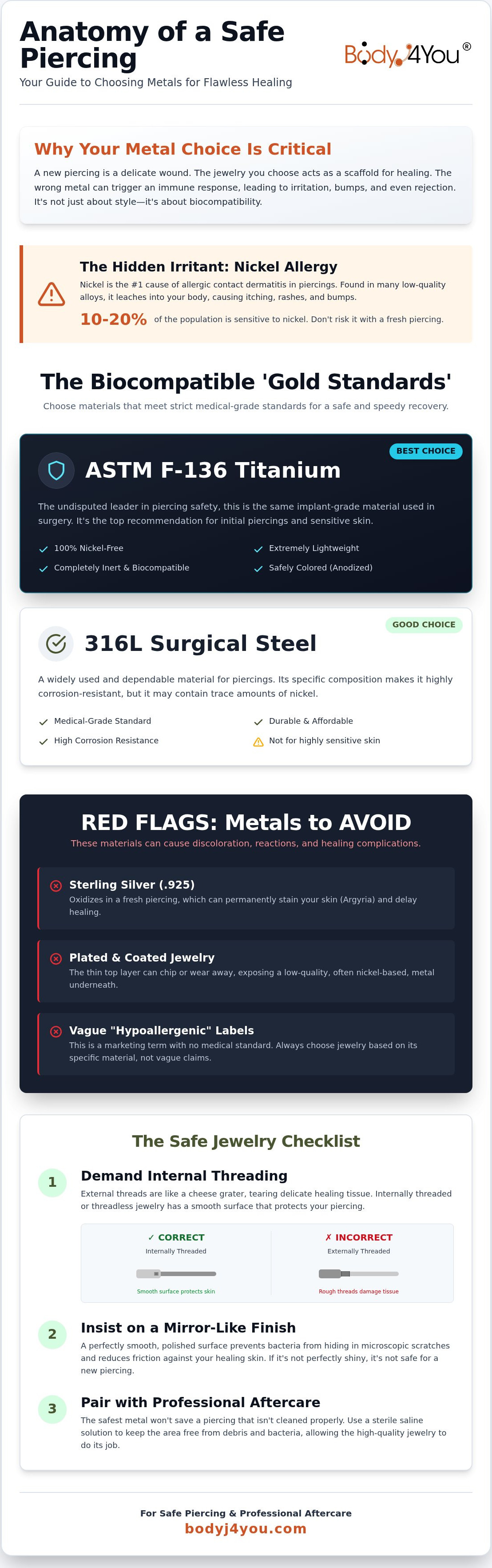
Biocompatibility is the clinical standard for any object placed inside the human body. It defines the ability of a material to coexist with living tissue without inducing an immune response or toxic reaction. While many retail brands use the term "hypoallergenic," this is often a vague marketing claim with no legal or medical definition. In contrast, choosing the safest metal for new piercings involves selecting materials that meet strict medical-grade standards. These metals remain inert, meaning they won't leach metallic ions into your bloodstream or stall the healing process. You can explore the technical differences between various biocompatible body jewelry materials to understand why medical standards outperform retail trends.
The Role of Nickel in Piercing Irritation
Nickel is the leading cause of allergic contact dermatitis in the piercing industry. It is a common alloy used to harden softer metals, but it is highly reactive when in contact with internal tissues. When jewelry sits in a fresh wound, it is constantly exposed to sweat and lymphatic fluid. These natural body fluids act as catalysts, accelerating the corrosion of low-quality alloys and releasing irritants directly into the piercing site. Nickel sensitivity is a prevalent condition that affects 10-20% of the population, often manifesting as a sudden, itchy rash that refuses to subside.
How the Body Reacts to Unsafe Metals
Your body is a wise guardian of its own health. When it detects an irritating or toxic material, it initiates a defensive rejection process. The immune system attempts to migrate the jewelry out of the tissue, which can lead to thinning skin or permanent scarring. You must be vigilant for early warning signs of metal sensitivity. Persistent redness, clear or yellow weeping, and intense localized itching are clear indicators that your body is in distress. These complications are the primary drivers behind the development of piercing bumps, which often signal that the metal choice has compromised the healing environment. Safe jewelry should feel invisible; if you can feel your piercing constantly, the metal may be the culprit.
The Safest Metals for Initial Piercings: The Biocompatible 'Gold Standards'
Safety is the foundation of beautiful self-expression. When you select the safest metal for new piercings, you're investing in a complication-free healing journey. These materials are chosen for their stability, purity, and clinical reliability. They serve as a protective barrier between your body and the environment, ensuring your new aesthetic doesn't come at the cost of your health. By prioritizing quality from day one, you establish a healing environment that is stable, predictable, and secure.
Titanium (ASTM F136): The Professional's Choice
Titanium is the undisputed leader in jewelry safety. Specifically, ASTM F136 titanium is the exact medical-grade material used for hip replacements, heart valves, and dental implants. It is strong, lightweight, and completely inert. This lightweight nature is critical for fresh cartilage or eyebrow piercings, as it reduces the gravitational pull on the wound and minimizes initial swelling. Unlike low-quality alloys, titanium contains no detectable nickel, making it the primary recommendation for anyone with metal sensitivities.
A unique benefit of this metal is the anodization process. This technique uses an electrical current to create a colorful oxide layer on the surface. It provides vibrant aesthetics without the risks associated with toxic paints or unsafe plating. By adhering to the APP standards for initial piercings, you ensure that your jewelry is manufactured to withstand the unique biological environment of a healing wound. It's a choice that prioritizes integrity, durability, and peace of mind.
Niobium and Precious Metals
Niobium is an exceptional alternative for those who react even to the most stable alloys. It is 99.9% pure and naturally elemental, meaning it doesn't require complex mixing with other metals to maintain its structure. It's soft, easy to work with, and highly resistant to corrosion from bodily fluids. For those who prefer the warmth of classic jewelry, 14K and 18K gold are safe options, provided they are verified as nickel-free. You must avoid gold-filled or gold-plated jewelry in fresh wounds; these thin layers eventually wear down or flake off, exposing your healing tissue to irritating base metals like copper or zinc.
Platinum represents the ultimate premium standard. It's dense, completely inert, and requires no alloys for strength, making it ideal for long-term healing. To provide your new piercing with the stability it deserves, consider starting with Internal Threaded Labret Studs in these biocompatible materials. This choice ensures a smooth, irritation-free transition from a fresh wound to a fully healed expression of your personal style.
Surgical Stainless Steel: Balancing Safety and Accessibility
Medical-grade steel serves as the backbone of the body jewelry world. It offers a sophisticated balance between clinical safety and aesthetic accessibility. While previous sections highlighted the inert nature of titanium, 316L and 316LVM surgical stainless steel remain the most widely utilized materials globally. For many individuals, this alloy represents the safest metal for new piercings due to its resilience and proven track record. The "L" indicates low carbon content, while "VM" signifies a vacuum melting process. This specialized manufacturing environment removes gaseous impurities and ensures a consistent, high-purity alloy that stands up to the rigors of the healing process.
When to Choose Surgical Steel
Steel is celebrated for its exceptional durability and scratch-resistance. It is resilient, affordable, and reliable. This structural integrity is why Surgical Steel Taper and Plug Kits are the preferred choice for those entering the ear stretching journey. Unlike softer precious metals, steel maintains its mirror-like surface even under the pressure of daily wear. It's an empowering choice for the fashion-forward individual who seeks a high-end look without the premium price tag of platinum. By choosing surgical-grade steel, you're opting for a material that supports your journey toward self-expression while maintaining the protective standards your body demands.
The 'Nickel-Trap' Mechanism
It's vital to address the presence of nickel with complete transparency. Surgical steel does contain nickel, but the 316L alloy structure binds these ions deep within a molecular "trap." In a high-quality piece of jewelry, the nickel remains locked inside the metal's crystalline lattice, preventing it from leaching into the bloodstream. This protective barrier is maintained through a meticulous high-polish finish. Without this mirror-like surface, the dermatological risks of piercing metals increase, as microscopic pits can harbor bacteria or release trapped ions.
If you have a known history of severe nickel sensitivity, your body may still detect these trace amounts. In such cases, the wise choice is to prioritize titanium or niobium. However, for the majority of the population without a nickel allergy, surgical steel acts as a stabilizing force. It provides a clean, wellness-oriented experience that bridges the gap between beauty and biology. Always ensure your steel jewelry is certified 316L or 316LVM to guarantee the integrity of this nickel-trap mechanism.
Red Flags: Metals You Should Never Use for New Piercings
Identifying the safest metal for new piercings is only half the battle. You must also recognize the materials that threaten your body's delicate healing process. A fresh piercing is a physical vulnerability. It requires a material that is inert, stable, and pure. Many retail options focus on fleeting trends rather than biological integrity. Using low-quality or reactive materials can lead to systemic irritation, permanent scarring, or chronic infection. Protecting your skin means knowing what to reject.
The Danger of Sterling Silver
Sterling silver is a classic choice for healed jewelry, but it is a red flag for initial piercings. It is highly reactive. When silver comes into contact with air and bodily fluids, it oxidizes and tarnishes. In an open wound, this tarnish acts as a potent chemical irritant. The most severe risk is Argyria, a condition where silver salts permanently stain the surrounding tissue a dark gray or black. This "black tattooing" is often irreversible. Keep silver for your fully healed fistula and prioritize stability during the first few months of recovery.
Porous vs. Non-Porous Materials
During the initial healing phase, your piercing releases lymphatic fluid and sebum. This is a natural part of recovery. However, porous materials like wood, bone, and acrylic are unsuitable for this environment. These materials contain microscopic pores that act as a breeding ground for bacteria. They trap discharge and skin cells, leading to "piercing funk" and localized inflammation. Non-porous metals ensure that your jewelry remains a clean, wellness-oriented scaffold for new skin. While we have focused on the safest metal for new piercings, understanding the materials that cause rejection is vital for your long-term wellness.
Avoid plated metals such as gold vermeil or gold overlay. These pieces consist of a thin layer of gold over a base metal like copper or zinc. In the moist, warm environment of a healing wound, these coatings eventually flake off. This exposes your raw tissue to mystery metals that may contain lead or cadmium. These toxins have no place in your body. They compromise your health and stall your progress toward self-expression. To ensure your safety, choose medical-grade materials from BodyJ4You that offer the purity and transparency your body deserves.
The 'Safe Jewelry' Checklist: Threading, Polish, and Aftercare
Selecting the safest metal for new piercings is a foundational step, but the mechanical design of your jewelry determines its daily performance. A medical-grade material can still fail if its surface is flawed or its threading is aggressive. You must evaluate the finish, the fit, and the function to guarantee a successful healing journey. High-quality jewelry should be smooth, stable, and sized correctly to respect your body's natural recovery process. By following a strict safety checklist, you protect your physical vulnerability while moving confidently toward your aesthetic goals.
A "mirror finish" is not a matter of vanity; it's a requirement for biology. Professional-grade jewelry undergoes a rigorous hand-polishing process to remove microscopic nicks, burrs, and scratches. These tiny imperfections can act like sandpaper against a healing fistula, causing constant micro-trauma and persistent inflammation. A perfectly smooth surface ensures that your tissue can glide over the metal without friction. Additionally, your initial jewelry must account for "the swell." We always recommend starting with a slightly longer post to accommodate the body's natural inflammatory response. This prevents the jewelry from embedding into the skin, which can cut off circulation and stall the healing process entirely.
Internal Threading: A Non-Negotiable Standard
Precision matters when your skin is in a state of repair. Internal threading means the post is a smooth, solid tube, while the screw is located on the decorative end. This design ensures that only a polished, blunt surface passes through your wound during insertion or removal. In contrast, external threads resemble a saw blade. They drag bacteria and debris directly into the center of the piercing, causing unnecessary pain and potential infection. This is why internal threaded labret studs are the gold standard for sensitive areas like the nose, lips, and ears. It's a clinical approach to beauty that prioritizes your comfort and safety.
Maintaining Your Metal with Expert Aftercare
Even the highest quality metal requires a pristine environment to function effectively. The synergy between biocompatible materials and proper hygiene is the key to faster healing. We recommend utilizing a sterile saline spray twice daily to remove "crusties" and cellular debris. This gentle irrigation cleans the jewelry without scratching the delicate mirror finish or introducing harsh, irritating chemicals. Finally, develop the habit of checking your jewelry's tightness. Use clean, freshly washed hands to ensure ends are secure. This simple act of vigilance prevents the loss of your jewelry and protects the integrity of your new piercing. It's a practice that combines discipline, care, and long-term wellness.
Empower Your Self-Expression with Biocompatible Standards
Your piercing is a powerful act of self-expression; it deserves a foundation of health and safety. By prioritizing biocompatible materials like ASTM F136 titanium or 316L surgical steel, you provide your body with the stability it needs to heal beautifully. Investing in the safest metal for new piercings is the most critical step in ensuring your journey is defined by comfort, confidence, and long-term wellness. When you choose quality, you're choosing a future free from irritation and rejection.
BodyJ4You brings over 20 years of industry expertise to your recovery process. We maintain strict quality control on all biocompatible metals and offer dermatologist-approved saline aftercare solutions to protect your skin. Our focus remains on the intersection of beauty and biology, providing you with jewelry that is as safe as it is aspirational. We act as your supportive specialist, guiding you toward a faster healing process through clinical precision and nurturing care.
Take the first step toward a healthy, vibrant piercing today. Shop BodyJ4You's Collection of Implant Grade Titanium and Surgical Steel Jewelry and experience the difference that medical-grade integrity makes. Your body is a temple; decorate it with the care, purity, and quality it deserves.
Frequently Asked Questions
Is surgical steel or titanium better for a new piercing?
Titanium is generally the superior choice for initial healing because it is completely inert and 100% nickel-free. While 316L surgical steel is a high-quality, cost-effective option for many, it still contains trace amounts of nickel trapped within its alloy. If you have any history of skin sensitivity, titanium provides the most stable environment for your body to recover without the risk of an immune response.
Can I use sterling silver for my initial ear piercing?
You should never use sterling silver for a fresh or healing piercing. Silver is highly reactive and tarnishes quickly when it comes into contact with blood and lymphatic fluid. This oxidation process can cause severe irritation and may lead to a permanent dark gray or black stain on your skin. Save your silver pieces for piercings that have been fully healed for at least six months.
What does 'implant grade' actually mean for jewelry?
The term 'implant grade' signifies that a material is certified for long-term placement inside the human body. These metals meet specific ASTM or ISO standards, ensuring they won't break down or leach toxins into your bloodstream. Selecting jewelry with this designation is the most reliable way to identify the safest metal for new piercings, as it guarantees the same quality used in medical heart valves and joint replacements.
Why is my new piercing reacting to 14K gold?
Reactions to 14K gold are typically triggered by the base metals used in the alloy rather than the gold itself. Pure gold is too soft for body jewelry, so it's mixed with metals like copper, zinc, or nickel to add strength. If these alloys aren't specifically formulated for biocompatibility, they can leach into the wound. Ensure your gold jewelry is verified as nickel-free and cadmium-free to prevent localized inflammation.
How can I tell if my jewelry is internally threaded?
You can identify internal threading by unscrewing the decorative end of the jewelry to inspect the post. In an internally threaded piece, the screw is attached to the ball or gem, leaving the post as a smooth, hollow tube. If the post itself has visible threads that look like a tiny hardware bolt, it's externally threaded. Internal threading is essential because it prevents the metal from scraping your raw tissue during insertion.
Is nickel-free jewelry the same as hypoallergenic?
These terms represent very different standards. 'Hypoallergenic' is a generic marketing term with no legal or medical definition, often used to describe jewelry that simply lacks a heavy nickel coating. 'Nickel-free' is more specific, but it still doesn't guarantee the metal is biocompatible. For a fresh wound, you shouldn't rely on vague labels; instead, look for medical-grade certifications like ASTM F136 or 316LVM to ensure total safety.
What metal is best for people with sensitive skin?
ASTM F136 titanium is the undisputed champion for individuals with sensitive skin. It is an elemental metal that doesn't rely on complex alloys, making it nearly impossible for the body to recognize it as a foreign threat. Niobium is another excellent alternative for extreme sensitivities. Both materials remain stable in the body's warm, moist environment, providing a protective and irritation-free experience for even the most reactive skin types.
Can I change my jewelry if I’m having a reaction to the metal?
Yes, you can and should change your jewelry if the current material is causing a reaction. Swapping an irritating alloy for the safest metal for new piercings, such as titanium, often calms persistent redness and itching within hours. It's best to have a professional assist with the swap to minimize trauma to the wound. Once the new jewelry is in place, continue using a sterile saline spray to soothe the agitated tissue.


