

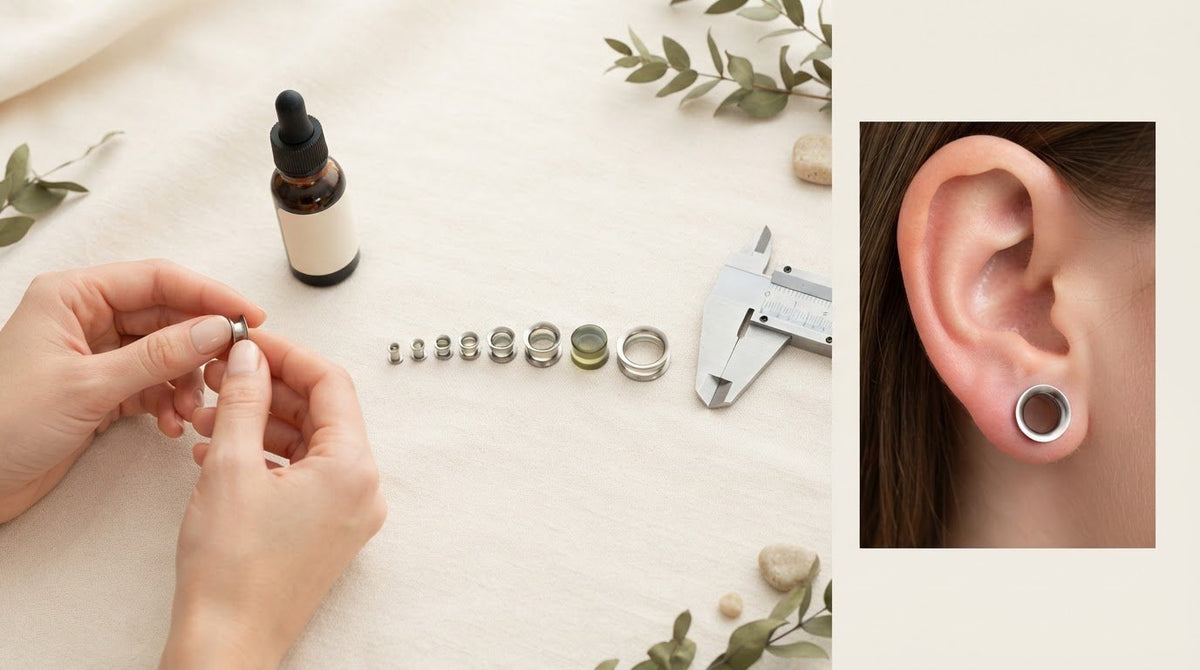
Could the safest move toward 0g be to pause, not push? If you’re looking for stretching from 2g to 0g tips, start by checking the jewelry’s diameter in millimeters. Gauge labels can hide how much larger the next size is, and forcing a stretch can leave your lobes sore or injured.
It’s reasonable to wonder whether your ears are ready, whether a taper is the right tool, or how long to wait. A comfortable fit matters more than following a schedule. Pain, resistance, or irritation are reasons to stop, not push through.
This guide explains how to compare sizes, why 1g may provide a gentler intermediate step, and what readiness and warning signs to look for. You’ll also learn how to approach jewelry and stretching tools carefully. The goal isn’t to reach 0g quickly. It’s to let your lobes set the pace.
Key Takeaways
- Gauge numbers run in reverse: a smaller gauge number means larger jewelry. Compare millimeter measurements before choosing your next size.
- Elapsed time alone can’t confirm readiness. Comfortable, easy jewelry insertion is useful to observe, but it doesn’t guarantee your lobes are ready.
- These stretching from 2g to 0g tips prioritize clean hands, gentle insertion, and stopping immediately if jewelry meets resistance.
- An intermediate size may offer a more gradual progression than sizing up directly. Let comfort and tissue condition guide your plan.
- After a stretch, handle your lobes gently and avoid unnecessary irritation. If discomfort or irritation arises, pause rather than pushing ahead.
Stretching from 2g to 0g: Understand the Size Change Before You Start
Moving from 2g to 0g can feel like a significant step because gauge numbers don’t work like ordinary measurements: as the number gets smaller, the jewelry gets larger. Before choosing a plug or taper, check its diameter in millimeters. That measurement makes the size change easier to compare and helps you judge whether the next step may be too large for your lobes.
Gauge size is the sizing label, such as 2g or 0g. Jewelry diameter is the width across the jewelry’s thickest part, usually measured in millimeters.
How big is the jump from 2g to 0g?
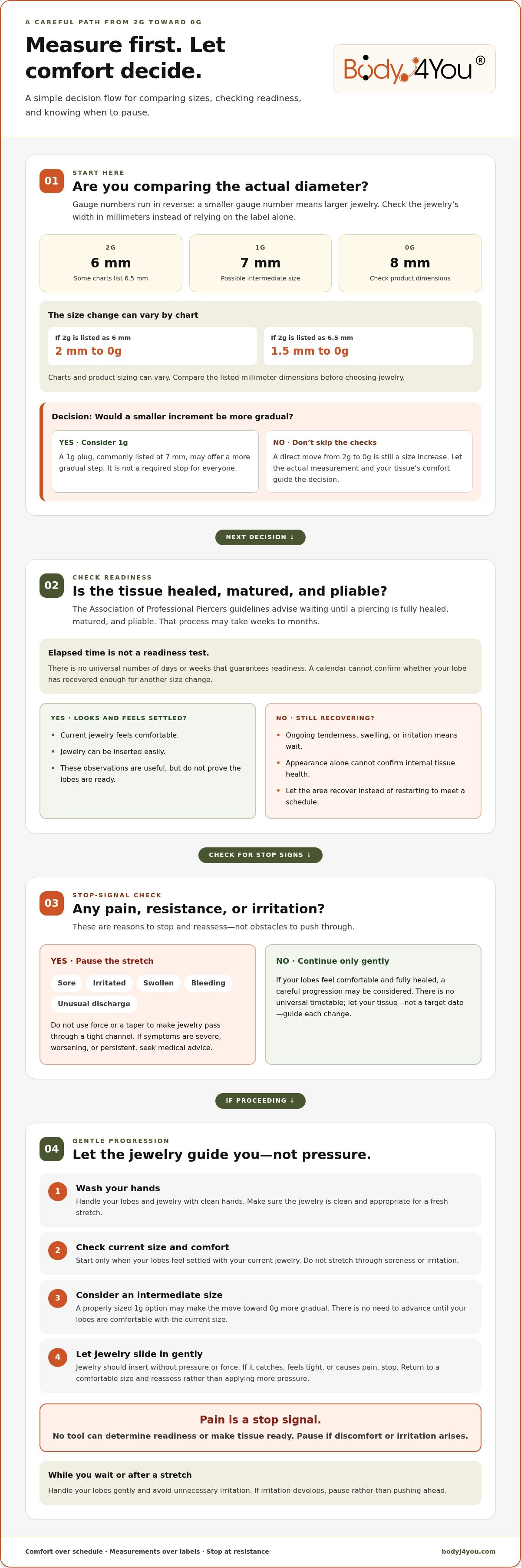
Common sizing references list 2g at 6 mm, 1g at 7 mm, and 0g at 8 mm. By those measurements, going directly from 2g to 0g is a 2 mm increase. Some charts list 2g as 6.5 mm, which would make the difference to 8 mm 1.5 mm. Charts and product sizing can vary, so check the listed millimeter dimensions instead of relying on the gauge label alone. BodyJ4You’s ear gauge size chart provides a reference for comparing sizes. For broader background on gauge systems and stretching methods, see Stretching (body piercing).
Why consider 1g before moving to 0g?
A 1g plug, commonly listed at 7 mm, can serve as an intermediate size between 2g and 0g. It isn’t a required stop for everyone, but it may make the progression more gradual. Smaller increments can reduce the temptation to push jewelry through when a larger size doesn’t fit comfortably. Resistance is a reason to pause, not to apply more pressure.
Stretching from 2g to 0g tips often focus on tools, but the size change matters just as much. A taper-and-plug kit or another stretching kit is only one part of a careful progression. No tool can determine whether your tissue is ready. Compare the jewelry’s actual measurements, consider whether an intermediate size makes sense for you, and let comfort guide the next step rather than treating 0g as a deadline.
Are Your Lobes Ready? Readiness Matters More Than a Stretching Schedule
A calendar can tell you how long it’s been since your last stretch. It can’t tell you whether the tissue in your lobes has recovered enough for another size change. Healing and tissue response vary, so there’s no universal number of days or weeks that guarantees readiness. The Association of Professional Piercers guidelines advise waiting until a piercing is fully healed, matured, and pliable. That process may take weeks to months.
Comfort is useful information, but it isn’t a green light by itself. Notice whether your current jewelry sits comfortably and can be inserted easily, but don’t treat either observation as proof that your lobes are ready to stretch. Tissue can look settled on the outside while still recovering. Consider the whole picture, not just the date or one reassuring sign.
What signs suggest you should wait?
Pause if your lobes are sore, irritated, swollen, bleeding, or producing unusual discharge. Pain and resistance aren’t obstacles to push through; they’re reasons to stop and reassess. Don’t use force or a taper to make jewelry pass through a tight channel. Trying again before irritation has settled can add stress to sensitive tissue.
If symptoms are severe, getting worse, or persistent, seek medical advice rather than attempting another stretch. This is especially important if you’re unsure whether what you’re seeing is ordinary irritation or a more serious problem.
How healed tissue differs from tissue that is still recovering
Before considering a new size, your lobes should feel settled and comfortable with your current jewelry. Ongoing tenderness, swelling, or irritation suggests the tissue needs more time. Appearance alone can’t confirm internal tissue health. A lobe that looks calm may still react poorly to added pressure, so don’t rely on a visual check as your only test.
After irritation, wait for the area to recover instead of restarting according to a preset schedule. These stretching from 2g to 0g tips support a patient decision, not a particular timeline. If your lobe doesn’t feel comfortable, pausing is a sensible next step.
Gentle handling and simple aftercare can help you avoid unnecessary irritation while you wait. For related stretching and aftercare essentials, choose products with tissue comfort in mind. Remember that no tool or aftercare product can substitute for readiness.
How to Move from 2g Toward 0g Without Forcing the Stretch
Once your lobes are comfortable and fully healed, take a calm, stepwise approach. These stretching from 2g to 0g tips focus on gentle insertion, suitable jewelry, and stopping at the first sign of resistance. There’s no universal timetable for progressing. Let your tissue, not a target date, guide each change.
A gentle progression from 2g through an intermediate size
- Wash your hands. Handle your lobes and jewelry with clean hands. Make sure the jewelry is clean and appropriate for a fresh stretch.
- Check your current size and comfort. Start only when your lobes feel settled with your current jewelry. Don’t stretch through soreness or irritation.
- Consider an intermediate size. A properly sized 1g option can make the move toward 0g more gradual. There’s no need to advance until your lobes are comfortable with the current size.
- Let the jewelry guide you. Jewelry should slide in gently, without pressure or force. If it catches, feels tight, or causes pain, stop. Return to a comfortable size and reassess instead of trying again with more pressure.
Pain is a stop signal: don’t force the jewelry through. A stretching kit may provide tools for a planned progression, but tools can’t make tissue ready. For more context on selecting and using stretching tools, read this ear stretching kit guide.
Tapers, jewelry, and what each is for
A taper is a tool intended to assist with a gradual stretch, not jewelry for everyday wear. It can make it easier to apply pressure than you realize, so don’t use it to push past resistance or pain. The Association of Professional Piercers favors gentle stretching and cautions against using tapers to force jewelry into tissue that isn’t ready.
Jewelry is what stays in the lobe after a transition. Choose a smooth, correctly sized piece that sits comfortably without pressure. For a fresh stretch, nonporous materials such as glass, titanium, or surgical steel are commonly recommended. Don’t treat an acrylic kit as suitable for newly stretched tissue. The safest progression may use no taper at all: a correctly sized plug can move in gently when the lobe is ready. Aim for a slow, comfortable, unforced transition.
What to Do After Stretching, and When to Stop
After a size change, give your lobes space to settle. Handle them gently, keep your hands clean, and avoid adding friction or products that might irritate the area. A little temporary sensitivity can happen, but pain isn’t a goal and doesn’t prove that the stretch worked. If discomfort is increasing or jewelry feels tight, pause instead of treating it as a challenge to overcome.
Simple care for stretched lobes
Keep care simple while the tissue settles. Wash your hands before touching your ears and avoid unnecessary handling. Repeatedly taking jewelry out and putting it back into irritated tissue can add friction, so don’t keep testing the fit. Follow gentle cleaning practices and don’t apply oils or other products to try to make a forced or painful stretch safe.
BodyJ4You’s saline piercing aftercare spray can be part of a gentle cleaning routine. Use aftercare only as directed. It can’t make tissue ready for a larger size or replace medical care if symptoms are concerning.
When pain or irritation changes the plan
Stop sizing up if you notice pain, bleeding, or notable swelling. Mild sensitivity that settles may be different from symptoms that persist or worsen, but don’t use discomfort as a reason to keep adjusting the jewelry. Watch for concerning changes, including worsening redness, heat, unusual discharge, or tissue that appears damaged.
- Pause: Don’t attempt another size while the lobe is irritated or uncomfortable.
- Avoid force: Don’t push in jewelry or repeatedly manipulate the area to check whether it has loosened.
- Consider a smaller size carefully: If the larger jewelry is causing pressure, returning to a comfortable smaller piece may help, but only if it slides in easily and doesn’t worsen irritation. Don’t force jewelry into tender or injured tissue.
- Seek medical care: Get medical advice for severe symptoms, suspected infection, or worsening tissue damage.
The safest stretching from 2g to 0g tips include knowing when to stop. If you’re unsure whether a symptom is minor or needs attention, pausing is the more protective choice. Let the tissue recover before considering another change rather than trying to stay on a schedule.
Choose a Patient 2g-to-0g Plan That Fits Your Lobes
There isn’t one progression that suits every pair of earlobes. A direct move from 2g to 0g means a larger size change at once, while an intermediate 1g step divides the progression into smaller increments. Your comfort and tissue condition matter more than reaching a particular size by a certain date. If either route causes pain or resistance, pause rather than pushing ahead.
Direct jump or intermediate size: how to think it through
| Option | Size increment | Readiness and reasons to pause |
|---|---|---|
| Direct to 0g | One larger change from 2g | Consider only if your lobes are settled and jewelry fits gently. Stop if you feel resistance, pain, or irritation. |
| Use 1g as an intermediate size | Two smaller steps, with time to assess between them | May suit you if a gradual progression feels more comfortable. Pause if your lobes are tender, swollen, or otherwise irritated. |
This comparison is a guide, not a guarantee that either route is right for you. Discomfort outweighs a target size or schedule. Use a simple decision path: assess how your lobes feel, choose a gradual step that fits your situation, insert jewelry gently, then watch for discomfort or irritation. If anything feels wrong, stop and give your lobes time to settle before reconsidering.
Prepare for your next step with the right tools
Tools can support a patient technique, but they can’t make a stretch safe to force. BodyJ4You offers an Acrylic Ear Stretching Kit and a Surgical Steel Taper and Plug Kit. These are different kit categories, so review the included sizes and materials and use each tool only for its intended purpose. A taper is for assisting a stretch, not everyday wear. For broader kit-selection context, see the ear stretching kit guide.
Use stretching from 2g to 0g tips as a framework, not a deadline. Readiness comes first, the next step should feel gentle, and stopping is always a valid choice. When you’re ready to explore your options, browse the ear stretching kit options and choose tools that fit your patient plan.
Make Your Next Stretch a Patient One
The best stretching from 2g to 0g tips start with your lobes, not your calendar. Check jewelry measurements in millimeters and assess whether your tissue feels settled. Remember that comfort alone doesn’t guarantee readiness. A 1g intermediate size may offer a more gradual option, while pain, irritation, or resistance means it’s time to stop and reassess.
Move only when your lobes are ready, use appropriately sized jewelry, and let it slide in gently. Afterward, handle the area with care and watch for symptoms that worsen or persist. You don’t need to reach 0g on a schedule. A pause can be the right next step.
BodyJ4You brings more than two decades of industry experience to its Acrylic Ear Stretching Kit and Surgical Steel Taper and Plug Kit offerings. Explore the BodyJ4You ear stretching kits as tools for a thoughtful progression, not a shortcut. Take your time, listen to your body, and let healthy tissue set the pace.
Frequently Asked Questions
Can you stretch from 2g to 0g in one step?
Some lobes may accommodate a direct size change, but it shouldn’t be assumed safe or comfortable for everyone. Depending on the sizing chart, 2g may be listed as 6 mm or 6.5 mm, while 0g is commonly 8 mm. That’s a substantial increase for one step. Consider your tissue’s readiness and the jewelry’s actual millimeter measurements. If there’s resistance or pain, stop rather than forcing the jump.
Is 1g a necessary step between 2g and 0g?
No, 1g isn’t a mandatory step for everyone, but it can provide an intermediate option. Commonly listed as 7 mm, it divides the move toward 0g into smaller increments. If the direct change feels too large or the jewelry doesn’t slide in gently, a 1g step may be worth considering once your lobes are ready. These stretching from 2g to 0g tips prioritize comfort over reaching a size quickly.
How long should you wait before stretching from 2g to 0g?
There’s no fixed waiting period that proves your lobes are ready. The Association of Professional Piercers advises waiting until tissue is fully healed, matured, and pliable, which can take weeks to months. Some guidance suggests waiting at least three to four months between larger stretches, with longer waits sometimes recommended. Treat timing only as a guide: soreness, irritation, or resistance means wait longer, even if a suggested interval has passed.
Should stretching from 2g to 0g hurt?
No. Stretching shouldn’t involve sharp pain, bleeding, or force. You might notice mild temporary sensitivity, but pain or resistance is a signal to stop, not proof that the stretch is working. Don’t push a taper or plug through a tight lobe. Remove pressure and reassess. If discomfort persists or symptoms worsen, let the tissue recover and seek medical advice when needed.
Can you wear a taper after stretching your ears?
A taper is a stretching tool, not jewelry intended for everyday wear. Once a stretch is complete, use appropriately sized jewelry that fits comfortably without pressure. A taper’s shape can make it easier to apply pressure unintentionally, so don’t leave it in as a plug or use it to hold a stretch open. If the jewelry you plan to wear doesn’t insert gently, stop and reassess rather than forcing it.
What should you do if your ear bleeds while stretching?
Stop immediately. Don’t keep stretching, force jewelry through, or repeatedly handle the area to check it. Bleeding can signal tissue injury; treat the lobe gently and avoid unnecessary irritation while you decide on next steps. Don’t force a smaller piece into tender or injured tissue. Seek medical care for significant or persistent bleeding, severe pain, suspected infection, or worsening tissue damage.
What size is 0g in millimeters?
0g is commonly listed as 8 mm in diameter. Gauge charts and jewelry listings can vary, so check the millimeter measurement shown for the specific piece rather than relying on the gauge label alone. Diameter means the width across the jewelry, not its length. Comparing millimeter measurements can make size changes clearer, especially when considering an intermediate size such as 1g, commonly listed as 7 mm.


