

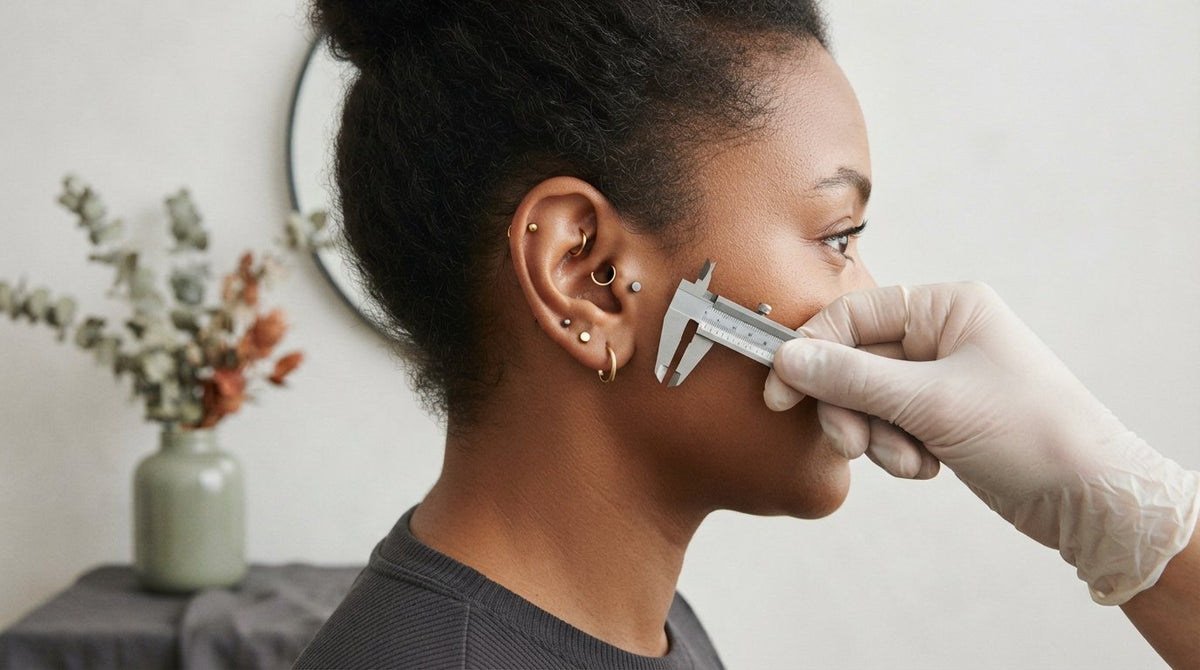
The curated ear stack you saved online might look effortless, but copying it directly is often the quickest route to migration and irritation. If you have ever stood in front of the mirror asking what piercings suit my ear shape, you already know how overwhelming the tension between aesthetics and biology can feel. You want a harmonious, expressive look, but you naturally fear the frustration of placing jewelry where your cartilage simply cannot support it.
Your ears are as distinct as a fingerprint. When you honor your natural ridges, folds, and hollows, visual harmony follows naturally. Discover how your unique ear anatomy dictates the most flattering, comfortable, and anatomically viable piercings for a balanced ear stack. Ahead, you will learn how to accurately assess your ear silhouette in the mirror, select placements tailored to your specific proportions, and choose jewelry styles designed to heal safely from day one.
Key Takeaways
- Map your ear's distinct cartilage silhouette in the mirror to identify whether your features align with round, tapered, pointed, or prominent proportions.
- Determine exactly what piercings suit my ear shape to highlight natural contours while avoiding overcrowded, visually heavy placements.
- Identify non-negotiable anatomical requirements before committing to complex projects like traditional industrials, rooks, or daiths.
- Apply the rule of thirds across cartilage zones to create an aesthetically balanced stack with fluid visual weight.
- Protect long-term tissue health by prioritizing body-safe jewelry architecture, such as internally threaded labret studs, alongside proper saline aftercare routines.
Ear Anatomy 101: Understanding Your Cartilage Landscape
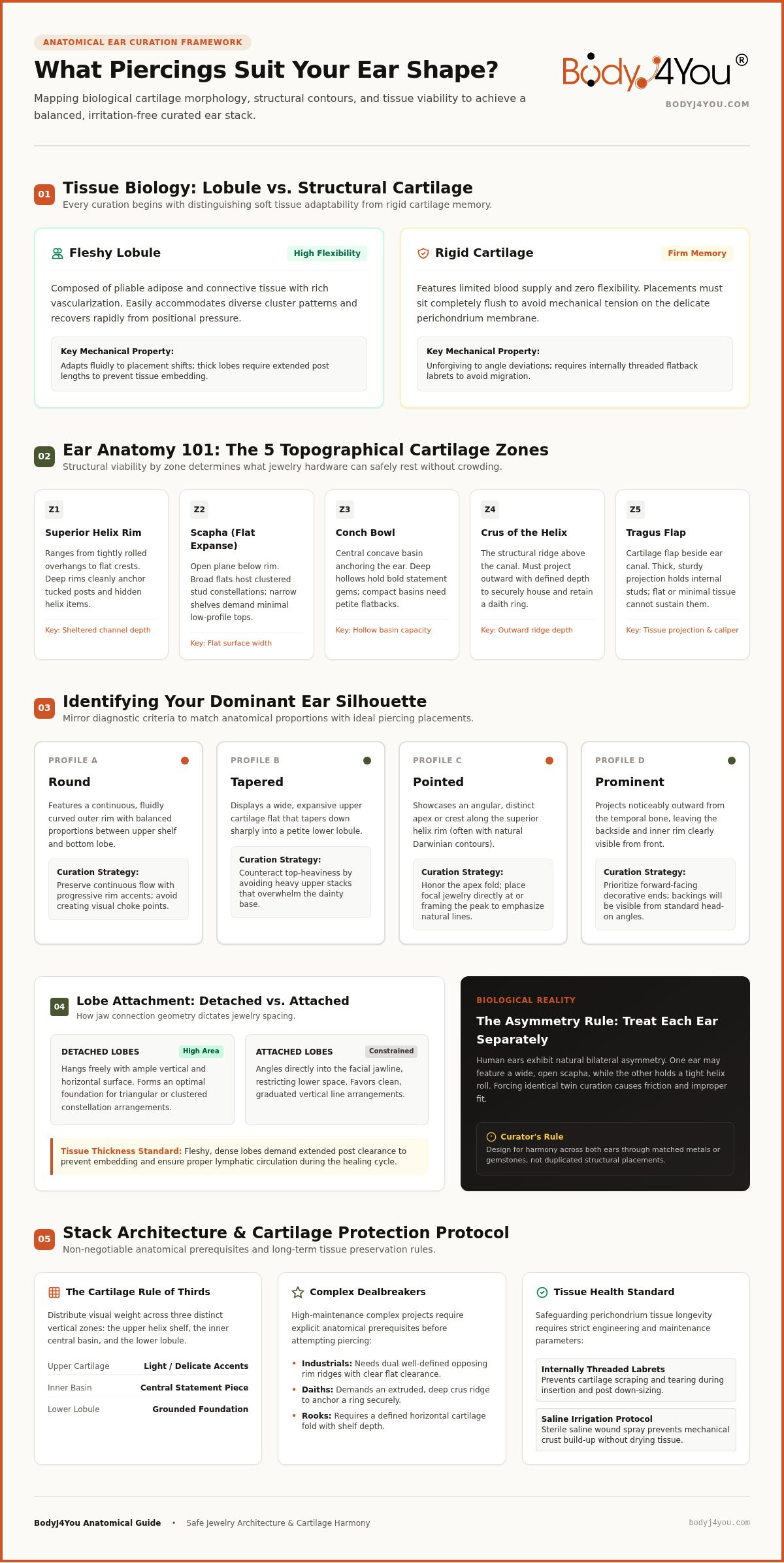
Every ear possesses a distinct biological fingerprint formed by intricate cartilage folds. While standard curation guides treat ear curation as simple jewelry layering, answering what piercings suit my ear shape requires examining structural architecture first. Your ear divides into distinct topographical zones: the outer helix rim, the antihelix ridge, the central conch bowl, the tragus, and the fleshy lobule. Ear cartilage morphology dictates piercing viability by determining tissue thickness, natural curvature, and mechanical pressure points across each zone.
Distinguishing soft tissue from structural cartilage is your starting line. The lobule consists of pliable adipose and connective tissue with rich vascularization, allowing it to adapt effortlessly to various placements. In contrast, rigid cartilage has limited blood supply, zero flexibility, and firm memory. As traditional body piercing methods have evolved into modern anatomical curation, mapping this rigid landscape ensures your jewelry rests flush against the skin rather than placing tension on delicate perichondrium tissue.
The Outer Rim and Scapha Dimensions
Start your evaluation at the top of your ear. The superior helix rim can range from a tightly rolled, protective curl to a nearly flat edge. A deep rim creates a sheltered channel with adequate overhang, making it ideal for tucking away post backs or anchoring hidden helix jewelry. Directly beneath this rim lies the scapha, the open expanse running along the upper flat of the ear. A broad, flat scapha acts as an open canvas for clustered studs, while a narrow or curved scapha requires low-profile jewelry to prevent outer rim pressure.
The Inner Basin: Conch, Daith, and Tragus Structures
Deeper within the ear sits the conch, a concave bowl that anchors the center of your silhouette. A deep, spacious conch comfortably houses larger statement pieces, whereas a compact basin requires petite flatback labrets to avoid crowding the surrounding cartilage. Directly above the ear canal lies the crus of the helix, the foundational ridge where a daith rests. This ridge must project outward with sufficient depth to hold a ring securely. Beside the canal, evaluate your tragus for projection and thickness. A pronounced, sturdy tragus securely supports an internal threaded stud, while a flat or minimal tragus may not safely sustain standard hardware.
How to Identify Your Dominant Ear Shape and Proportions
Pinning down your profile starts with a clear view. Pull your hair back completely, stand before a well-lit mirror, and observe your ear from both direct-front and profile angles. Most ears fall into one of four primary structural categories:
- Round: Features a continuous, curved outer rim with balanced proportions between the top and bottom.
- Tapered: Displays a wide upper cartilage expanse that narrows sharply into a petite lobe.
- Pointed: Showcases an angular, distinct peak along the superior helix rim.
- Prominent: Projects noticeably outward from the temporal bone, leaving the back and rim visible from the front.
Measure the visual balance between your upper cartilage third and your lower lobule. Stacking heavy jewelry across a narrow lobe while leaving a wide upper shelf empty creates visual imbalance. Equally important is accounting for natural bilateral asymmetry. Your left ear might feature an open, flat scapha while your right presents a tight curl. Answering what piercings suit my ear shape requires treating each ear as its own unique canvas rather than forcing identical twin styling.
Evaluating Lobe Proportion and Attachment
Look closely at where your earlobe connects to your facial structure. Detached lobes offer ample vertical and horizontal surface area, creating the perfect foundation for clustered constellation piercings. Attached lobes angle directly into the jaw, which restricts lower space and favors clean, vertical line arrangements. Measure tissue thickness carefully before buying posts. Dense, fleshy lobes require extended post lengths to accommodate normal movement. As highlighted in standard health protocols like the Florida body piercing regulations, adequate jewelry clearance prevents painful embedding and promotes healthy tissue healing.
Mapping Upper Cartilage Curvature
Turn sideways to assess your upper helix contour. A steep, sloping curve demands precise stud placement along the ascending rim, while a broader crest accommodates multiple hoops without pinching. Watch for natural anatomical quirks, such as a Darwinian tubercle along the rim fold; working with these natural contours yields a distinctive layout. If your ears sit flat against your head, prioritize inner-basin placements like the conch or daith to ensure your jewelry remains visible. As you map your individual anatomy, exploring body-safe essentials through BodyJ4You makes selecting properly proportioned jewelry simple and reliable.
The Curated Match: What Piercings Suit Your Specific Ear Shape
Strategic placement balances organic geometry. When evaluating what piercings suit my ear shape, the objective is never to fight your ear's silhouette, but to guide the eye purposefully across its contours. Visual balance demands distributing weight evenly between the cartilage shelf and the lower lobe. Choosing structural centerpieces, like an ornate daith ring or a central conch hoop, relies entirely on the volume of your inner cavity. To ensure comfortable, long-term wear, anchor your design with high-grade hardware like internal threaded labret studs, which eliminate external friction and sit flush against delicate cartilage.
Piercing Layouts for Round and Curved Ears
Round ears benefit from vertical visual anchors that break up circular uniformity. A vertical industrial bar or a crisp rook piercing adds linear structure, drawing the gaze upward rather than around the circumference. Placing a flatback stud at the mid-helix also disrupts continuous curved lines. Avoid stacking multiple large orbital hoops along the outer rim; heavy rings emphasize roundness and crowd the edge. Forcing oversized hoops into tight curves can also trigger irritation, as documented in clinical studies on the Complications of Body Piercing.
Best Placements for Pointed or Elongated Ears
Ears with a pronounced upper peak possess a striking, distinctive architecture. Highlight that natural apex by placing a delicate vertical helix stud right at the summit. If you prefer to soften an angular silhouette, draw attention inward with a textured conch cluster positioned centrally in the basin. Balancing elongated proportions requires grounding the base. Adding a trio of graduated lobe piercings creates horizontal fullness, establishing visual stability against a tall upper ridge.
Styling Petite Ears with Limited Surface Area
Smaller ears require discipline and restraint. When surface area is limited, overcrowded stacks look cluttered and struggle to heal properly. Focus instead on intentional micro-constellations using tiny, flat-backed studs. A single, refined tragus or forward helix gem creates a focal point without overwhelming adjacent tissue. Give every channel breathing room; generous spacing between placements minimizes persistent pressure and supports clean cartilage recovery.
Anatomy Dealbreakers: Piercings That Require Specific Structures
Aesthetic desire cannot override biological reality. When considering what piercings suit my ear shape, recognizing clear anatomical dealbreakers prevents painful complications. Cartilage relies on stability; forcing rigid metal through unaccommodating folds leads to severe tissue migration, pressure necrosis, or outright rejection. If your anatomy cannot support a classic configuration, modern styling provides inventive workarounds. For instance, pairing individual forward and outer helix studs joined by a fluid link chain delivers the look of an industrial without mechanical strain. Review our comprehensive guide on the industrial piercing for detailed structural requirements and setup options.
The Traditional Industrial Barbell Requirements
A classic industrial is uncompromising. It requires a pronounced, well-defined curl along the forward-facing upper helix and an equally pronounced rim fold on the outer opposite edge. The straight rigid bar must suspend freely through the air. If your central scapha flat protrudes outward even slightly, the bar will press directly against that tissue. That continuous friction causes painful pressure sores, tissue erosion, and permanent scarring.
The Daith and Rook Anatomical Prerequisites
Inner ear focal points demand specific cartilage shelf dimensions:
- The Daith: Sits squarely on the crus of the helix. This cartilage ridge must possess adequate thickness and outward projection to anchor a ring securely. A shallow or flat crus offers zero foundation, causing the jewelry to tilt outward, migrate forward, and reject.
- The Rook: Rests on the horizontal ridge located directly above the tragus and inner conch. This fold must be defined with clear space above and beneath it to allow a curved barbell to sit without rubbing the adjoining cartilage walls.
Tragus and Snug Piercing Limitations
The tragus flap requires sufficient thickness and projection to securely hold a straight post. If the flap is paper-thin, soft, or exceptionally narrow, standard posts tilt sideways under the weight of even modest front ends. Meanwhile, the elusive snug piercing penetrates straight through the antihelix ridge. Because this requires substantial double-sided ridge prominence, few ears can comfortably support it. If your antihelix lacks this distinct ridge, a faux-snug (combining an independent outer conch piercing with an adjacent mid-helix stud) delivers the exact same visual line safely. Browse premium titanium and steel hardware at BodyJ4You to find anatomically compatible designs built for healthy healing.
Designing a Balanced Ear Stack and Protecting Cartilage Health
Curating an ear stack is a marathon, not a sprint. While social media feeds display elaborate, fully healed constellations, discovering what piercings suit my ear shape requires patience and biological respect. Lobes heal relatively quickly in six to eight weeks, but cartilage channels require six to twelve months of dedicated recovery due to sparse blood flow. Puncturing multiple cartilage zones simultaneously overwhelms your immune system, exponentially increasing systemic swelling. Prioritize one or two placements at a time. Flush active channels twice daily with sterile saline spray for piercings to sweep away cellular debris without drying fragile regenerating skin. If nocturnal pressure or accidental snagging triggers a localized flare-up, discover how to get rid of a piercing bump before scar tissue forms.
Principles of Visual Balance and Proportions
Apply the classic rule of thirds to maintain aesthetic harmony across your ear. Ground your layout by anchoring the bottom third with your heaviest visual elements, such as bold studs or textured hoops. As the eye ascends the outer rim, transition into lighter micro-studs and delicate huggies. Leave intentional negative space between placements. Negative space gives individual gems breathing room, keeping your styling refined rather than chaotic.
Material Integrity and Post-Piercing Maintenance
Safe curation depends entirely on metal biocompatibility. Select implant-grade titanium or quality surgical steel to avoid contact dermatitis and prolonged inflammation. Initial jewelry always features extra length to accommodate acute swelling; downsize your internal threaded posts once tissue stabilizes to prevent angled migration. During recovery, maintain strict hygiene by clearing crust around post backing plates using specialized piercing cleaning swabs instead of fibrous cotton balls.
Bring Your Custom Ear Architecture to Life
Building a timeless ear curation begins with prioritizing biological harmony over fleeting trends. Determining what piercings suit my ear shape is never about copying someone else's viral aesthetic; it's about honoring your ear's unique topography, respecting non-negotiable anatomical dealbreakers, and pacing your modifications. Ground your lobe with balanced weight, accent your upper cartilage curves, and give every channel ample space to rest. When you let your natural ridges guide your layout, visual balance follows effortlessly.
Patience, strategic placement, and biocompatible materials form the foundation of long-term tissue health. Backed by over two decades of body jewelry expertise since 2001, BodyJ4You supports your styling journey with precision-engineered internal threaded titanium and surgical steel jewelry alongside gentle, US-formulated aftercare solutions. Honor your personal blueprint, celebrate your distinct silhouette, and invest in pieces built to protect your cartilage. Explore Premium Body Jewelry & Sterile Aftercare at BodyJ4You today.
Frequently Asked Questions
Can any ear shape accommodate a traditional industrial piercing?
No, a traditional industrial piercing requires very specific anatomical architecture to heal properly. The superior helix must feature a defined rim curl on both opposite connection points, and the scapha flat cannot protrude into the bar's direct pathway. If the flat pushes against the rigid bar, continuous friction causes severe pressure necrosis, tissue erosion, and eventual rejection. An anatomical check prevents irreversible cartilage damage.
How do I know if my ear cartilage is too small for a daith piercing?
You can tell your cartilage is unsuitable if your crus of helix lacks a distinct, raised ridge projecting above the ear canal opening. A viable daith requires sufficient tissue depth to anchor a curved bar or captive bead ring securely. When determining what piercings suit my ear shape, forcing a daith onto an underdeveloped ridge leads to outward jewelry tilting, chronic bumps, and rejection.
What are the most flattering piercings for completely flat earlobes?
Flat earlobes offer an exceptional, stable canvas for vertical stacked lobes and clean geometric constellation patterns. Because flat lobes lack a rounded curve, standard heavy hoops can sit awkwardly against the jaw. Flat tissue showcases low-profile internal threaded labret studs set in stacked columns, staggered triangles, or clean horizontal lines. This architecture keeps multi-gem arrangements sitting flush without tilting forward.
What should I do if my left and right ears have different shapes?
Embrace natural asymmetry by curating each ear as an individual, complementary project rather than forcing an identical match. Ear cartilage rarely mirrors itself perfectly across both sides. Answering what piercings suit my ear shape often means tailoring placements to each ear's strongest natural features. If one side has an open conch and the other features a deep helix fold, celebrate those differences with cohesive metals.
Can I get multiple cartilage piercings on the same ear at once?
You can technically receive multiple piercings in one visit, but professional standards advise limiting new cartilage placements to two per session. Cartilage heals slowly over six to twelve months due to limited blood circulation. Adding too many channels at once amplifies systemic swelling, triggers persistent irritation, and complicates daily aftercare. Staggering your projects ensures comfortable healing and protects long-term tissue health.
Which piercings look best on small ears with limited room?
Petite ears look most flattering with minimalist micro-constellations and single, intentional focal points like a petite conch or tragus stud. Crowding multiple large pieces onto a compact ear creates visual chaos and increases friction between jewelry backs. Focus on tiny, flatback studs spaced thoughtfully along the lobe and helix. A single sparkling center jewel provides sophisticated depth without overwhelming delicate cartilage.
What is an alternative to an industrial piercing if I lack the proper helix ridge?
A chain industrial is the premier anatomical alternative if your ear lacks the dual-curl rim needed for a rigid bar. This layout pairs an independent forward helix piercing with a separate outer helix stud, connecting the two with an elegant draped chain. Because there isn't a solid bar resting against the scapha, it completely eliminates pressure sores while delivering that bold, connected aesthetic.


