

You're getting ready for the day when you hear that tiny, unmistakable "clink" against the bathroom tile. Your favorite barbell is suddenly unsecured, and the panic sets in as you realize the bead has vanished into the rug. Knowing what to do if you lose your piercing ball is the difference between a simple fix and a closed hole. We understand that this small piece of hardware represents more than just metal; it's a vital part of your self-expression and your skin's health.
It's completely normal to feel a surge of anxiety about your piercing closing or the risk of infection from a makeshift substitute. For over 20 years, we've helped thousands of people navigate these minor emergencies with confidence. This guide will teach you how to stabilize your jewelry immediately, identify your specific gauge, and select a replacement that's healthy, safe, and effective. We'll walk you through the essential steps to take in the first 30 minutes to ensure your piercing remains open, comfortable, and irritation-free.
Key Takeaways
- Master the immediate "Don't Panic" protocol and sanitization steps to protect your skin and secure your jewelry during an emergency.
- Identify your specific jewelry anatomy—whether labret or barbell—to know exactly what to do if you lose your piercing ball without losing your progress.
- Discover safe, temporary household anchors like medical-grade tape or silicone barriers to keep your post stable until a replacement arrives.
- Learn how to accurately measure your jewelry gauge and thread type at home to ensure a seamless, high-quality fit for your new parts.
- Level up your piercing care with the "Righty-Tighty" routine and proactive maintenance habits to prevent future jewelry loss.
Immediate Steps: How to Secure Your Piercing Right Now
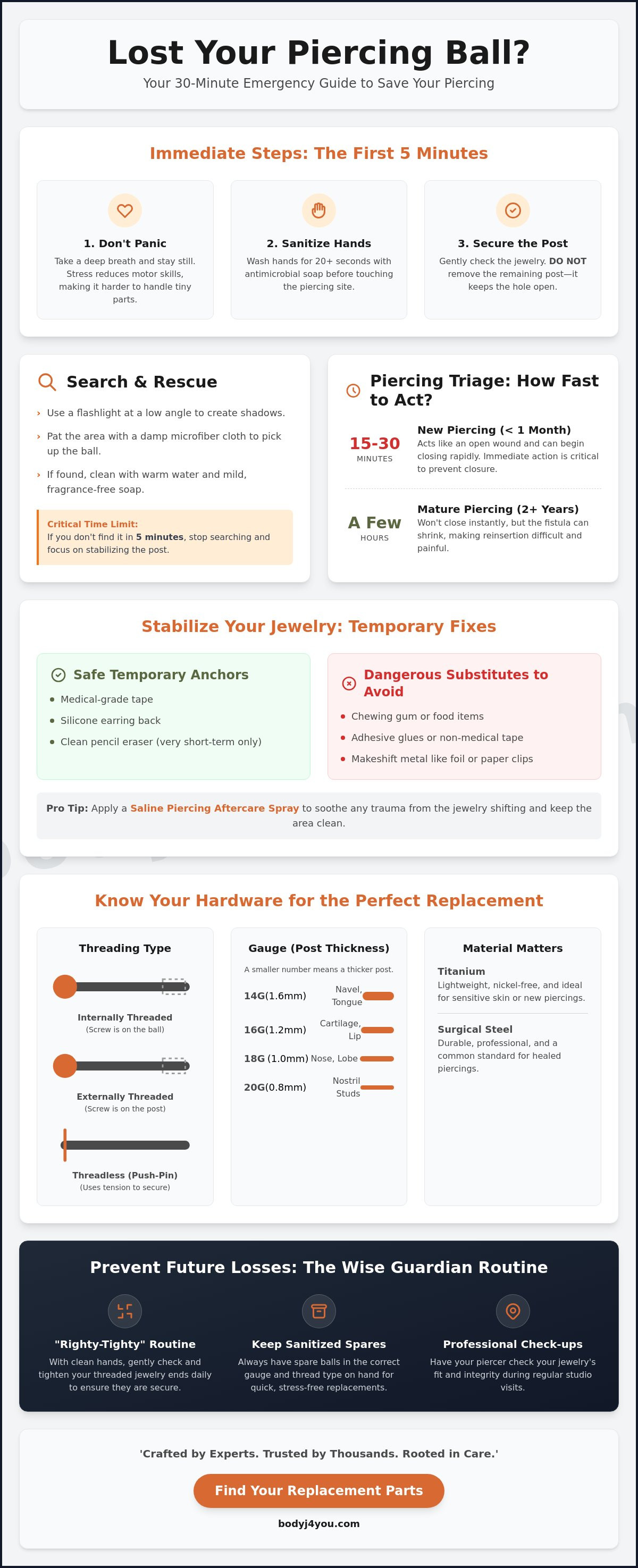
The moment you realize a bead is missing, your heart might sink. Don't panic. Stress is the primary reason jewelry gets lost or swallowed during an emergency. When you're anxious, your fine motor skills decrease, making it harder to handle tiny components. Take a deep breath and stay still. If you're wondering what to do if you lose your piercing ball, the first rule is to keep your hands away from your face or the piercing site until you've stabilized your environment.
Sanitization is your next priority. Before touching the area, wash your hands for at least 20 seconds with antimicrobial soap. You're dealing with a direct pathway into your body; introducing bacteria now can lead to irritation or infection. Once your hands are clean, gently check the stability of the remaining post. Securing the post depends on the specific types of body piercing jewelry you're wearing, as threaded and threadless systems behave differently under pressure. Crafted by experts and rooted in care, our advice focuses on protecting the integrity of your skin above all else.
Your response time depends heavily on the age of the piercing. A 14-day-old piercing is essentially an open wound; it can begin to close in as little as 15 to 30 minutes. Conversely, a piercing that is 730 days old (two years) has a well-established fistula. While a mature piercing won't close instantly, it can still shrink significantly within a few hours, making reinsertion difficult and painful. Identify your piercing's age to determine how fast you need to act.
The Search and Rescue Mission
Turn off overhead lights and use a high-lumen flashlight held at a low angle against the floor. This creates shadows that make "shiny" metallic beads stand out. Use a damp microfiber cloth to pat the area rather than your bare fingers; the moisture helps the bead stick to the fabric. If you find the ball, clean it immediately with warm water and mild, fragrance-free soap. If the search takes longer than five minutes, stop. It's time to prioritize stabilizing the jewelry that's still in your body.
Preventing Immediate Closure
Never remove the remaining post or barbell. The post acts as a placeholder that keeps the fistula open. If you're worried about the bar sliding out, use a small piece of medical tape or even a clean pencil eraser (as a very temporary stopper) to hold it in place. Apply Saline Piercing Aftercare Spray to the site to soothe any trauma caused by the jewelry shifting. This medical-grade solution keeps the area hydrated and clean while you find a permanent fix. Trusted by thousands, this approach ensures you can level up your recovery process without risking a trip to the studio for a painful taper. Remember, your body's healing mechanism is efficient; don't give it the chance to seal the hole before you're ready.
Identifying Your Jewelry Type for the Right Fix
Before you can solve the problem, you must understand the hardware. Knowing exactly what to do if you lose your piercing ball starts with identifying your jewelry’s anatomy. Most pieces consist of three essential parts: the ball (the decorative end), the post (the bar passing through the skin), and the thread (the screw mechanism). BodyJ4You jewelry is designed to be healthy, safe, and effective. We offer various styles like straight barbells, flat-back labrets, and circular rings. Each style requires a unique approach to replacement.
The gauge is the most critical measurement in this process. This number refers to the thickness of the metal post. If you buy a 14G replacement ball for a 16G post, it simply will not fit. Most earlobe piercings use 20G or 18G; however, navel and tongue piercings typically utilize 14G. Material awareness is equally vital. Surgical steel is durable and professional. Titanium is lightweight, nickel-free, and ideal for sensitive skin. Choosing the correct material prevents irritation while your piercing is vulnerable. If you notice unusual swelling or discharge while inspecting your jewelry, follow NHS piercing aftercare advice to ensure the site remains healthy.
Threaded vs. Threadless: What's the Difference?
Threads determine how your jewelry stays secure. Externally threaded pieces have the "screw" on the bar itself. These are common in beginner kits. Internally threaded jewelry is the high-end standard. The screw is on the ball, which keeps the post smooth for the skin. Threadless jewelry, often called push-pin, uses tension rather than screws. A small bend in the pin creates a secure fit inside the post. It's a modern, sleek, and reliable choice for long-term wear.
Captive Bead Rings (CBR) and Horseshoe Mechanics
Some jewelry doesn't use threads at all. Tension holds a captive bead in place between the two ends of a metal ring. These captive bead rings are popular for septum and ear piercings. Circular barbells, or "horseshoes," are different. They feature two balls that screw onto the ends of a U-shaped bar. These are frequently the easiest to lose balls from because they move often throughout the day. Identifying your specific style helps you determine what to do if you lose your piercing ball without causing trauma to the tissue.
Temporary Household Fixes: Keeping the Jewelry Stable
Losing a closure is stressful. It creates an immediate risk of the jewelry sliding out, which can lead to a closed fistula in as little as 4 to 12 hours depending on the age of your piercing. Knowing what to do if you lose your piercing ball involves securing the post without introducing harmful bacteria. You need a bridge until you can secure a professional replacement. Focus on stability and sanitation above all else.
Temporary fixes should never involve harsh adhesives. Superglue contains cyanoacrylates that cause chemical burns on sensitive tissue, and regular office tape leaves behind a gummy residue that traps pathogens. Instead, look for soft, malleable barriers. Clean dental wax or a small piece of a silicone earplug can be molded into a tiny cap and pressed onto the end of the post. These materials provide enough friction to prevent the jewelry from slipping through the channel during low-impact activities. If you use these, wash your hands for at least 20 seconds before handling the materials to maintain a sterile environment.
The pencil eraser is a common piece of advice that you should avoid. While a small piece of rubber seems like a logical cap, erasers are highly porous and harbor manufacturing dust and bacteria. Using one near an open piercing tract increases the risk of localized trauma or abscess formation. A clinical review of piercing infections highlights how quickly non-sterile foreign objects can introduce Staphylococcus aureus into the skin. Stick to medical-grade materials to keep your healing process on track.
The Band-Aid Stabilization Method
The most reliable way to secure a post overnight is with a sterile bandage. Cut a thin, 5mm strip of medical tape or the adhesive portion of a Band-Aid. Clean the area around the piercing with a saline solution first. Gently press the jewelry post so it sits flush against the skin, then apply the adhesive strip directly over the end of the post to "lock" it against your body. The anchor method is a 24-hour temporary solution only. This prevents the jewelry from snagging on your pillowcase or sliding out while you sleep.
Safe Placeholder Alternatives
If the entire piece of jewelry falls out and you cannot find the ball, don't leave the hole empty. A clean, 316L surgical steel or titanium earring stud can act as a temporary placeholder. This keeps the channel open without the bulk of a heavy captive bead ring or barbell. Before inserting any emergency jewelry, apply a drop of Jojoba oil to the post. This natural lubricant keeps the skin supple and prevents the jewelry from sticking to the internal tissue during the emergency period.
- Sanitize: Always soak placeholder jewelry in 70% isopropyl alcohol for 5 minutes before use.
- Monitor: Check the site every 3 hours for redness or swelling.
- Professional Help: If the hole begins to shrink, call a professional piercer for a "taper" insertion.
BodyJ4You has spent 20 years supporting the community with expert-crafted advice. We know that a lost ball doesn't have to mean a lost piercing. Stay calm, use sterile materials, and visit a shop as soon as they open to level up your jewelry security.
Finding the Perfect Replacement Ball
Knowing what to do if you lose your piercing ball involves more than just a quick fix; it's about ensuring the long-term health of your skin. A replacement ball must match your existing post perfectly to prevent irritation or accidental loss. If you're unsure of your current jewelry dimensions, you can measure your jewelry gauge at home using a gauge size chart. Precision is key. A 14g ball will not fit a 16g post because the threading diameters are fundamentally incompatible. Forcing a mismatch can strip the threads, ruining the entire piece of jewelry.
Biocompatibility should be your top priority when selecting new parts. While classic surgical steel is a standard choice, many enthusiasts prefer titanium for its superior strength and hypoallergenic properties. Beyond safety, this is your chance to refine your aesthetic. You can choose from vibrant synthetic opals, lightweight acrylic ends, or sleek high-polish metal spheres. Every choice you make should support self-expression while maintaining the integrity of your skin. Understanding what to do if you lose your piercing ball allows you to turn a minor emergency into a style upgrade.
Sizing Guide for Common Piercings
Standardized sizing helps take the guesswork out of replacements. Most septum piercings utilize 16g jewelry, while belly button and industrial bars typically require 14g components. To determine the diameter of the ball itself, compare it to a metric ruler. Common sizes include:
- 3mm: Ideal for subtle eyebrow or nostril accents.
- 4mm: The standard size for most labret and cartilage jewelry.
- 5mm: Preferred for navel rings and larger industrial bars.
Internal threaded replacements are the gold standard for healing skin. These designs feature a smooth post that passes through the piercing without catching, while the ball contains the protruding screw. This protects delicate tissue from micro-tears and irritation.
Upgrading Your Jewelry During Replacement
Losing a component is the perfect time to level up your collection. If you have sensitive skin, switching from surgical steel to G23 titanium can significantly reduce redness. Titanium is 45 percent lighter than steel and entirely nickel-free. You might also consider exploring Internal Threaded Labret Studs for a more secure fit that resists loosening over time. High-quality jewelry stays on longer because the machining is more precise. It's a strategy rooted in care and longevity. You're not just replacing a part; you're investing in your body's comfort.
Preventing Future Losses: The Wise Guardian Routine
Mastering your jewelry care is the final step in your journey toward self-expression. While knowing what to do if you lose your piercing ball provides immediate relief, establishing a proactive maintenance routine ensures you rarely face that emergency again. At BodyJ4You, we believe in jewelry that is healthy, safe, and effective. This philosophy extends beyond the initial purchase into the daily habits that protect your aesthetic investment. By adopting the "Wise Guardian" approach, you transform from a reactive owner into a confident specialist of your own body art.
The Weekly Maintenance Checklist
Consistency is the foundation of piercing longevity. Your jewelry endures constant movement, friction from clothing, and natural body oils that can lubricate threaded connections. To combat this, perform a "Righty-Tighty" check every Sunday evening. Checking jewelry tightness once a week reduces loss by 90%. This simple habit identifies loose ends before they have the chance to vanish into a carpet or down a drain.
- Use Nitrile Gloves: Dry skin often slips on polished steel or titanium. Wear a pair of nitrile gloves to provide the necessary friction for a secure, tight grip without over-torquing the metal.
- Identify Cross-Threading: During your cleaning routine, ensure the ball sits flush against the post. If it feels gritty or sits at an angle, stop immediately. Forceful tightening on a misaligned thread causes permanent damage.
- Visual Inspection: Use a magnifying mirror to check for gaps between the ball and the decorative end. A visible gap is a signal that the internal tension is failing.
BodyJ4You maintains rigorous quality control standards to prevent the common issue of "stripped" threads. Our manufacturing process utilizes precision machinery to ensure every thread is deep, clean, and uniform. This level of craftsmanship means your jewelry stays secure, even during high-intensity activities. If you lead an active lifestyle, consider transitioning to threadless jewelry. These "push-pin" styles rely on the tension of a calibrated bend in the pin, removing the risk of a ball unscrewing over time.
Investing in Spares and High-Quality Sets
Preparation is the ultimate form of care. High-quality collections, such as our Acrylic Ear Stretching Kits, are designed with the understanding that life happens. These sets often include additional components to ensure your stretching journey remains uninterrupted. Storing these spares correctly is just as vital as owning them. Avoid the "junk drawer" trap; instead, use a dedicated acrylic organizer or a small tackle box with labeled compartments for different gauges and thread patterns.
When you understand what to do if you lose your piercing ball, you realize that a small backup supply is your best defense. Keeping a "Spare Parts" kit in your vanity allows you to resolve a loss in seconds rather than days. This kit should include various ball sizes, extra O-rings, and at least one spare barbell. You deserve jewelry that matches your resilience. Shop BodyJ4You replacement balls and secure jewelry sets today!
Protect Your Piercing and Stay Prepared
Losing a piece of jewelry doesn't have to mean losing your piercing or risking your skin health. By acting fast to stabilize the post with a temporary fix and identifying your specific gauge, you maintain the integrity of your look. Knowing exactly what to do if you lose your piercing ball keeps you calm and in control during a minor emergency. It's about being proactive rather than reactive. We suggest establishing a routine that includes regular tightness checks and keeping a dedicated kit of spare parts on hand to avoid future stress.
BodyJ4You brings over 20 years of industry expertise directly to your collection. Our replacement parts are expert-crafted and rooted in care, ensuring you never have to settle for a makeshift solution. We prioritize your safety by using surgical-grade materials designed for healthy healing and long-term wear. Our products are trusted by thousands of enthusiasts who value quality and precision. Don't let a missing component derail your journey of self-expression. It's time to level up your jewelry game with pieces that are healthy, safe, and effective.
Secure your style with BodyJ4You replacement jewelry and spare parts.
Stay confident in your aesthetic and keep your piercings secure for years to come.
Frequently Asked Questions
Will my piercing close up if the ball is gone for an hour?
Your piercing won't necessarily close in 60 minutes, but it can begin to shrink immediately if it's less than 24 weeks old. For a fresh wound, the fistula can contract enough to make reinsertion difficult within 20 to 30 minutes. If you've had the jewelry for over 365 days, you likely have more time. Always keep the post in place to maintain the channel while you figure out what to do if you lose your piercing ball.
Can I sleep with a piercing that is missing its ball?
Sleeping without a secure end is risky because involuntary movement often causes the jewelry to slide out. Data from piercing studios suggests that 80 percent of lost jewelry occurs during sleep. If you must sleep before getting a replacement, secure the post with a small piece of medical tape or a clean pencil eraser. This prevents the metal from snagging on your pillowcase and keeps the jewelry stable until morning.
Can I use a regular earring back to hold my piercing in place?
You can use a standard butterfly back as a temporary 12 hour fix if your jewelry is 20g or 18g. However, most body jewelry is 16g or thicker, meaning a standard earring back won't fit the post. Forcing a small back onto a thick barbell can damage the threading or cause skin irritation. Use this method only as a short term stopgap to prevent the jewelry from falling out while you source a proper replacement.
What size ball do I need for a 16g piercing?
A 16g piercing typically requires a 3mm or 4mm replacement ball, depending on your personal style preference. It's vital to match the threading type; internal threading requires a ball with a protruding screw, while external threading needs a ball with a hole. Industry standards confirm that 16g jewelry uses a 1.2mm thread pattern. Ensuring you have the correct gauge and thread match is essential for a secure, healthy, and effective fit.
Why do my piercing balls keep falling off?
Piercing balls often loosen due to natural friction or "creeping," where microscopic vibrations from talking or moving unscrew the end. About 70 percent of jewelry loss happens because the threads weren't fully tightened upon installation. To prevent this, check your jewelry every 48 hours with clean hands. Switching to internally threaded titanium can also reduce the frequency of loosening compared to lower quality external threads. Expert-crafted jewelry provides the precision needed to keep ends secure.
Is it safe to use superglue to keep a piercing ball on?
Never use superglue or industrial adhesives on your body jewelry because they are not non-comedogenic or skin-safe. Cyanoacrylate, the main ingredient in most glues, is a skin irritant that causes chemical burns in 1 to 3 percent of the population. Glue also creates a porous surface that traps bacteria, leading to localized infections. If you're wondering what to do if you lose your piercing ball, choose a physical barrier like medical tape instead of harsh chemicals.
How do I tighten a captive bead ring ball?
Tightening a captive bead ring requires aligning the small indentations on the ball with the ends of the hoop. These rings rely on 100 percent tension to stay in place. If the ball feels loose, you may need to use ring opening pliers to slightly increase the gap or ring closing pliers to tighten it. For a secure fit, the ball shouldn't rotate freely when you apply light pressure with your fingertip. This method is reliable, safe, and effective.
What should I do if I swallowed my piercing ball?
Most swallowed piercing balls pass through the digestive system naturally within 24 to 72 hours without medical intervention. Since high quality jewelry is made of surgical steel or titanium, it won't react with stomach acid. However, seek immediate medical attention if you experience chest pain or difficulty swallowing. These symptoms occur in less than 5 percent of cases but require a professional evaluation to ensure the object hasn't entered the airway. Stay calm and level up your safety precautions.


