

Recent industry research reveals that 36% of consumers worry about allergic reactions every time they update their jewelry. It's a significant figure that highlights a common struggle: the search for beauty shouldn't come at the cost of your skin's health. Understanding the various types of belly button rings is essential for anyone dealing with irritation bumps or the constant frustration of jewelry snagging on high-waisted clothes. Your piercing is an investment in your self-expression, and it deserves a high-end, safe, and comfortable foundation.
We agree that finding the right fit can feel overwhelming when you're faced with endless gauges and materials. This guide provides the professional clarity you need to choose jewelry that matches your unique abdominal anatomy. You'll learn which hypoallergenic materials prevent irritation, how to measure for a perfect 14-gauge fit, and which modern styles are dominating the 2026 landscape. From classic curves to floating designs, we're here to ensure your journey is defined by purity, safety, and style.
Key Takeaways
- Identify the structural differences between classic curves and specialized J-bars to ensure your jewelry complements your unique anatomy.
- Explore the 11 essential types of belly button rings, ranging from minimalist clickers to high-impact decorative dangles.
- Prioritize your dermatological health by selecting biocompatible materials like surgical steel and titanium to eliminate irritation bumps.
- Master the professional protocol for sanitizing and switching your navel jewelry once the critical healing window is complete.
- Learn to measure for the standard 14-gauge fit to prevent snagging and maintain the long-term stability of your piercing.
Navel Jewelry Basics: Why Your Choice Matters for Comfort
Your midsection is a dynamic environment. It twists, stretches, and folds throughout the day. Because of this constant motion, standard straight jewelry isn't an option for this area. Most types of belly button rings are technically curved barbells designed to follow the natural contour of your navel. Choosing the wrong style isn't just a fashion mistake; it can lead to migration, rejection, or persistent irritation. To ensure a safe and beautiful experience, you must balance three core pillars: your unique anatomy, the jewelry material, and your daily lifestyle. When these elements align, your piercing becomes a seamless part of your self-expression rather than a source of discomfort.
Understanding Navel Anatomy and Jewelry Pressure
Your abdominal wall changes shape significantly when you move from standing to sitting. For those with a "collapsing" navel, where the skin folds over the piercing site, large bottom-heavy jewelry can cause intense pressure. This constant friction often leads to soreness or the development of unsightly bumps. Looking back at the history of navel piercings, we see how jewelry has evolved to accommodate these biological needs. When exploring different types of belly button rings, always consider how the metal interacts with your skin's elasticity. As your expert mentor in this journey, we recommend prioritizing a minimalist fit for your initial piece. A smaller bottom bead reduces the risk of the jewelry being pushed upward, which protects the delicate tissue during the critical healing phase.
The Standard 14G: Why Gauge Consistency is Key
Precision matters in body modification. While standard earlobes use thin wires, the navel requires more substance to stay stable. The 14-gauge (1.6mm) standard serves as the universal industry benchmark for stability and long-term piercing health. You should never swap your navel jewelry for thinner fashion earrings or 16-gauge pieces intended for other areas of the body. Consistency in sizing ensures that the piercing channel remains open and healthy without unnecessary stress on the entry and exit points.
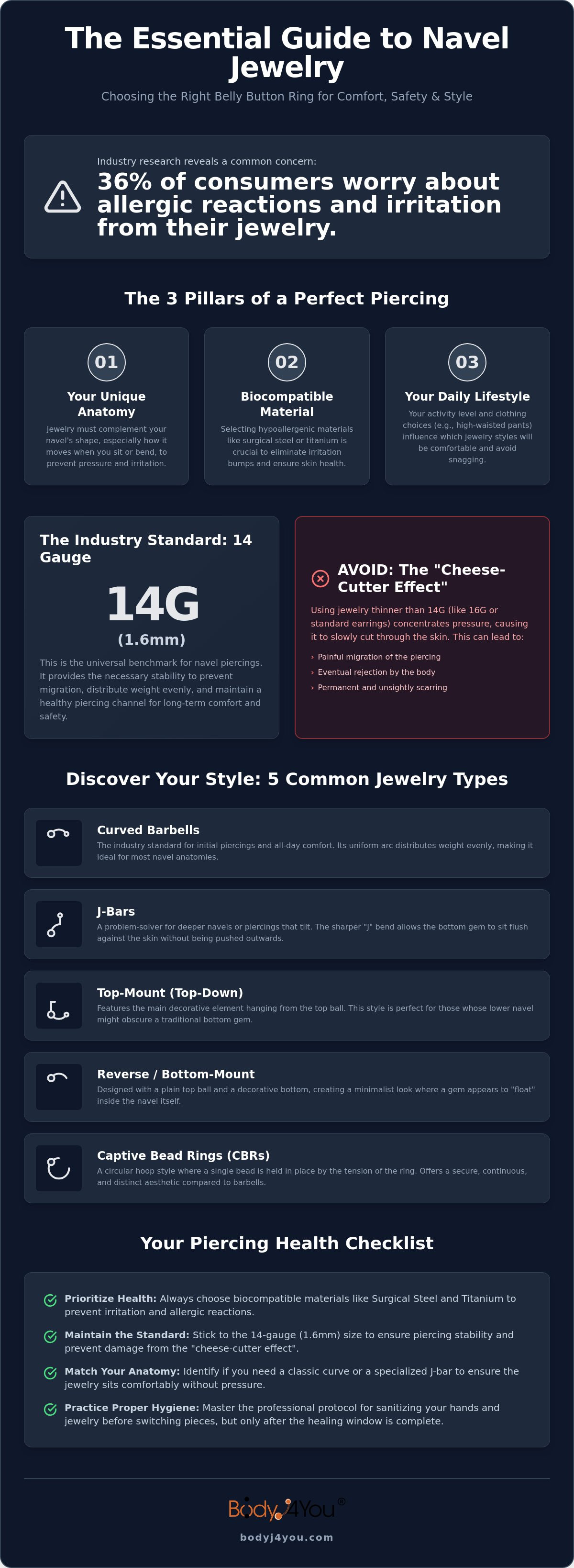
Using jewelry that is too thin creates what professionals call the "cheese-cutter effect." This occurs when the thin metal puts concentrated pressure on a small area of skin, causing the jewelry to slowly migrate toward the surface. It's a painful process that often leaves permanent scarring. By sticking to the 14G standard, you distribute the weight of the jewelry evenly across the piercing channel. This simple choice is the most effective way to prevent rejection and keep your piercing looking vibrant for years to come.
The 5 Most Common Types of Belly Button Rings
Selecting from the diverse types of belly button rings requires more than just an eye for sparkle. It's about finding the silhouette that respects your body's movement while reflecting your personal style. While we previously discussed the 14G standard, the shape of the bar itself determines how the jewelry sits against your skin. From the classic arc of a curved barbell to the architectural precision of a J-bar, each design serves a specific functional purpose. A successful choice is reliable, balanced, and essential for long-term comfort.
The five most common styles include:
- Curved Barbells: The industry standard for initial piercings and everyday comfort.
- J-Bars: A specialized "J" shape that helps the bottom gem sit further forward.
- Top-Mount (Top-Down) Rings: Designs where the primary charm hangs from the top ball.
- Reverse/Bottom-Mount Rings: Jewelry that creates the illusion of a floating gem within the navel.
- Captive Bead Rings: Circular hoops that provide a secure, continuous aesthetic.
When choosing your first piece after healing, following the Association of Professional Piercers' standards ensures you're using materials that won't compromise your skin's integrity. For those ready to upgrade, exploring our high-quality industrial barbells and navel jewelry offers a perfect blend of safety and sophistication.
Curved Barbells vs. J-Bars: Which Curve is Yours?
Standard curved barbells are the go-to for traditional anatomy. They follow a uniform arc that distributes weight evenly across the piercing channel. However, J-bars act as problem-solvers for specific anatomical needs. If your piercing tends to tilt or if your navel is deep, a J-bar provides a sharper bend at the bottom. This allows the jewelry to sit flush against the skin without being pushed by the natural fold of the abdomen. It's a technical solution for a common comfort issue.
| Bar Shape | Best Anatomy | Primary Benefit |
|---|---|---|
| Uniform Curve | Traditional or Shallow | Balanced weight distribution |
| J-Bar | Deep or Collapsing | Reduces bottom-ball pressure |
Top-Down vs. Reverse Styles: Changing the Visual Focal Point
Top-down jewelry shifts the decorative focus upward. Unlike standard rings where the charm dangles from the bottom, these pieces feature the primary ornament at the top of the navel. This is particularly effective for showing off detail when wearing lower-cut waistlines. Conversely, reverse rings, often called floating navel jewelry, position the gem inside the navel itself. This creates a clean, minimalist, and practical aesthetic that is exceptionally high-waist friendly. Because the decorative element is tucked away, it significantly reduces the risk of snagging on fabric, protecting both your clothes and your piercing from accidental trauma.
Captive bead rings offer a secure alternative for those who prefer a hoop. These circular rings stay firmly in place regardless of activity level. While they provide a bold look, they're best reserved for fully healed piercings, as the circular shape can put different pressures on a new channel than a traditional barbell.
Decorative and Specialty Styles for Personal Expression
Once you have mastered the structural basics of your piercing, the journey toward personal expression begins. This is where your aesthetic vision meets the functional reality of your daily life. While basic barbells provide the foundation, decorative types of belly button rings allow you to tailor your look to specific occasions or seasonal trends. Whether you are seeking a high-impact statement for a summer getaway or a subtle shimmer for professional settings, your choice should always reflect a balance of beauty, biology, and balance. Choosing the right decorative piece ensures your self-expression remains a source of joy rather than irritation.
Specialty styles typically fall into four distinct categories:
- Dangle Belly Rings: Features hanging charms, chains, or gems that provide movement and flair.
- Clickers and Hinged Rings: Modern, seamless hoops that snap into place for a minimalist silhouette.
- Non-Dangle Decorative Rings: Large gem clusters or intricate metalwork that sits flush against the skin.
- Multi-Gem Barbells: Dual-gem designs that offer a classic, symmetrical sparkle at both entry points.
The Dangle Dilemma: Weight and Snag Prevention
Dangle rings are the ultimate statement pieces, but they require a disciplined approach to wear. We recommend reserving these styles for fully healed piercings that are at least 12 months old. The additional weight of a dangle charm can put significant stress on the piercing channel if the internal tissue hasn't reached full maturity. For those with established piercings, identifying "snag-free" designs is essential. Look for charms with smooth, rounded edges and secure settings that won't catch on delicate lace or mesh fabrics. To prevent the "cheese-cutter effect" mentioned earlier, limit the wear of heavy dangles to short-term events rather than 24/7 use. This protective approach preserves the integrity of your piercing hole for years to come.
Seamless Looks with Clickers and Hoops
The 2026 style landscape has seen a dramatic rise in the popularity of navel clickers. These hinged rings offer a sleek, continuous aesthetic that mimics a standard hoop but with a much easier closure mechanism. For those prioritizing security, captive bead rings remain a reliable choice, often favored as initial jewelry because they lack sharp edges or exposed threads. When selecting a hoop or clicker, the diameter is your most critical measurement. A ring that is too small will pinch the rim of your navel, leading to pressure sores and potential migration. A well-fitted clicker should hang comfortably with a small amount of "daylight" between the ring and your skin, providing a modern look that is both safe and sophisticated. Integrity, Safety, Expression.
For active lifestyles, non-dangle decorative rings are the superior choice. If your day involves high-intensity gym sessions or yoga, a cluster design that sits flush against your body minimizes the risk of impact or snagging. These pieces provide the sparkle of a dangle without the mechanical risks, making them the perfect partner for your wellness routine.
Material Safety and Sizing: Preventing Irritation Bumps
Material selection is the silent guardian of your piercing's longevity. While aesthetics draw the eye, the biological compatibility of the metal determines whether your body accepts or rejects the jewelry. In the landscape of 2026, safety standards like ASTM F2999-19 ensure that adult jewelry meets strict requirements for lead and cadmium, but your individual skin chemistry remains the ultimate guide. Understanding the different types of belly button rings by their material composition is the first step toward a lifetime of comfortable wear. Purity. Integrity. Safety.
Four primary materials dominate the professional market:
- Surgical Steel: A durable, high-polish alloy that serves as the gold standard for fully healed piercings.
- Titanium: The lightweight, biocompatible choice for those with nickel sensitivities or fresh piercings.
- Bioflex and Acrylic: Flexible, non-metallic options ideal for active lifestyles or use as "pregnancy retainers."
- 14K Gold: A luxurious, nickel-free investment for matured piercings that require a touch of refinement.
Surgical Steel vs. Titanium: The Supportive Specialist’s Take
At BodyJ4You, we prioritize high-quality surgical steel because it offers an exceptional balance of dermatological safety and durability. It's a reliable choice for the vast majority of enthusiasts who have moved past the initial healing phase. However, if you notice persistent redness, intense itching, or prolonged weeping, your body may be signaling a metal sensitivity. In these cases, transitioning to implant-grade titanium is the professional solution. Titanium is entirely inert, making it the most supportive material for reactive skin. If you're curious about measurements for other areas of your collection, our ear gauge size chart provides a comprehensive reference for safe sizing across all piercing types.
Floating Navels and "Collapsing" Anatomy
A common yet often ignored factor in piercing migration is "collapsing" navel anatomy. To check your anatomy, sit down in front of a mirror and observe your belly button. If the top and bottom rims press together or the navel "closes" completely, traditional large-bottom barbells will be constantly pushed by your skin. This mechanical stress is a leading cause of irritation bumps and jewelry rejection. Selecting the right types of belly button rings for your specific anatomy is crucial for long-term stability.
The solution is "floating navel" jewelry. This style uses a standard 14G bar but replaces the large bottom gem with a small, flat disk. This allows the navel to collapse naturally without putting pressure on the jewelry. If you've already noticed a persistent bump forming due to anatomical pressure or material friction, our expert guide on how to get rid of a piercing bump fast offers the clinical steps needed to restore your skin's health.
Explore our curated collection of surgical steel and titanium jewelry to find the perfect match for your anatomy and lifestyle.
How to Switch and Maintain Your Navel Jewelry
Patience is the cornerstone of piercing success. While the desire to experiment with different types of belly button rings is understandable, timing is everything. Navel piercings are notorious for their slow metabolic rate, often requiring a full 6 to 12 months to reach complete maturity. We call this the "Golden Window." Attempting a jewelry change before this period ends can collapse the delicate internal fistula, leading to trauma and unnecessary setbacks. Your body needs time to build a stable, skin-lined tunnel that can withstand the friction of a swap.
When you're finally ready to transition, preparation is your best defense. Start by thoroughly washing your hands with antimicrobial soap to prevent the transfer of bacteria. You must also sanitize the new jewelry, even if it arrived in sealed packaging. A successful swap follows a simple, rhythmic protocol: prepare the site, guide the transition, and monitor the results. To maintain the channel, gently follow the old jewelry out with the new bar, ensuring the piercing is never left empty for more than a few seconds.
The Sanitization Ritual
Never assume that new jewelry is biologically clean just because it looks polished. Atmospheric dust and handling oils can cling to the surface of even the highest-quality pieces. We recommend using a sterile saline spray for piercings to thoroughly drench both the new bar and the piercing site itself. Isotonic saline is the only safe solution for cleaning a new jewelry swap without disrupting the skin's natural pH balance. This step eliminates surface bacteria and provides the lubrication necessary for a smooth, painless entry.
Long-Term Maintenance and Troubleshooting
Maintaining your look requires ongoing vigilance. Because the midsection is in constant motion, threaded ends can gradually loosen over time. We suggest a weekly "security check" where you gently tighten the balls or charms with clean, dry hands. If you ever feel resistance or see excessive redness during a change, stop immediately. A jewelry swap should never be a struggle or a source of pain.
As your supportive specialist, our final "Wise Guardian" tip is simple: if it hurts to change, it isn't ready yet. For complex types of belly button rings like intricate dangles or those with internal threads, don't hesitate to visit a professional piercer for your first few changes. They have the tools and experience to ensure the channel remains stable. After any swap, treat the area with extra care for 24 to 48 hours. This "mini-healing" phase allows the tissue to settle around the new shape, ensuring your self-expression remains comfortable and secure. Purity. Safety. Expression.
Elevate Your Aesthetic with Confidence and Safety
Your journey toward self-expression is deeply personal, and your jewelry should be a reflection of that unique path. By now, you understand that selecting the right types of belly button rings involves more than just picking a beautiful design. It requires a harmony between your specific anatomy and high-quality materials like surgical steel or titanium. Remember that patience during the healing window and a commitment to sanitization are the best ways to protect the integrity of your piercing for years to come. Your body is a canvas that deserves respect and precision. This commitment to a curated aesthetic can also extend to your home, where Statements by J offers chic, modern furnishings to complement your personal style.
With over two decades of industry expertise, we prioritize your long-term wellness through meticulous US-based quality control and hypoallergenic materials. Whether you're seeking a minimalist clicker or a bold decorative statement, the right fit ensures your comfort doesn't take a back seat to your style. We invite you to Explore BodyJ4You’s Curated Collection of Safe and Stylish Navel Jewelry and discover pieces designed with your safety in mind. Your piercing is an investment in your identity; treat it with the expert care it deserves. Purity. Integrity. Empowerment.
Frequently Asked Questions
What is the most comfortable type of belly button ring for daily wear?
Standard curved barbells are the most comfortable choice for daily wear because their arc mimics the natural curve of your navel. These types of belly button rings minimize internal friction and prevent the jewelry from catching on your waistband. To maximize comfort, select a piece with small, rounded beads rather than large, heavy gems. This reduces the mechanical pressure on the piercing channel and ensures a stable, irritation-free experience for your active lifestyle.
Can I wear a dangle belly ring if my piercing is only 3 months old?
You should avoid wearing dangle jewelry until your piercing is at least 6 to 12 months old. At the three-month mark, the internal tissue is still fragile and hasn't formed a stable fistula yet. The constant movement and weight of a dangle charm can pull on the healing channel, leading to migration or unsightly irritation bumps. Stick to a lightweight, fixed barbell until your mentor confirms the site is fully matured.
What is a "floating navel" belly ring and do I need one?
A floating navel ring features a small, flat disk on the bottom instead of a traditional large gem. You likely need this style if your navel "collapses" or closes when you sit down. As we discussed earlier, standard jewelry gets pushed upward by this movement, which causes chronic irritation. By using a flat disk, the jewelry sits flush against the skin without being displaced, providing a modern look that respects your unique anatomy.
How do I know what size belly button ring I need?
The standard size for a navel piercing is a 14-gauge (1.6mm) barbell with a length of 3/8-inch (10mm). To find your specific fit, you can measure the distance between the entry and exit holes of your piercing with a small ruler. If you're unsure, consult a professional piercer to determine if you need a longer bar to accommodate swelling or a shorter one for a snug finish. Precision ensures long-term comfort.
Are plastic or acrylic belly rings safe for long-term wear?
Plastic and acrylic jewelry aren't recommended for long-term wear because they're porous materials. Over time, these substances can develop microscopic cracks that harbor bacteria or degrade due to body heat. While they serve as excellent temporary retainers during pregnancy or medical procedures, you should return to high-quality metals like titanium or surgical steel for your permanent collection. These biocompatible options ensure long-term dermatological health and structural integrity for your piercing.
What should I do if my belly button ring keeps getting caught on my clothes?
If your jewelry frequently snags, you should transition to a low-profile style like a floating navel ring or a fixed bead barbell. Avoid dangles and large, prong-set gems that act as hooks for lace or knit fabrics. Choosing types of belly button rings with smooth, bezel-set stones or simple metal spheres will significantly reduce snagging. Additionally, consider wearing mid-rise clothing to keep waistbands away from the piercing site during your daily routine.
Is surgical steel or titanium better for a new navel piercing?
Implant-grade titanium is the superior choice for a new piercing because it's entirely biocompatible and nickel-free. While high-quality surgical steel is a durable and affordable standard for healed skin, titanium eliminates the risk of allergic reactions during the vulnerable healing phase. If you have sensitive skin or a history of metal allergies, titanium provides the most stabilizing environment for your new investment. It ensures your journey starts with purity, safety, and care.
How often should I clean my belly button ring once it is healed?
Once your piercing is fully healed, you should clean it daily as part of your normal shower routine. Use a mild, fragrance-free soap to gently remove any buildup of oils or dead skin cells around the jewelry. If the site feels occasionally dry or irritated, a quick rinse with a saline spray can restore balance. Consistent, gentle maintenance prevents odors and keeps the surrounding tissue looking vibrant and healthy for years to come.


