

Your new piercing is a bold statement of self-expression, but it is also a delicate wound that requires precise, medical-grade care. Choosing the wrong solution can lead to painful irritation, unsightly bumps, or the persistent risk of infection. Finding the best piercing cleaner shouldn't feel like a confusing chemistry experiment. You deserve a routine that is safe, effective, and effortless.
We understand the anxiety that comes with a fresh piercing, especially when you're caught between messy DIY salt recipes and harsh chemicals that cause redness. You want fast healing, calm skin, and a simple path to recovery. This article reveals the science-backed aftercare solutions of 2026, focusing on sterile, isotonic saline systems that respect your body's natural biology. We'll examine why 0.9% sodium chloride is the professional gold standard, compare the leading spray applicators, and provide a clear roadmap to a perfectly healed piercing.
Key Takeaways
- Understand why 0.9% sterile saline is the clinical gold standard for maintaining biological compatibility and preventing infection.
- Identify the best piercing cleaner for your needs by choosing isotonic solutions that avoid the cellular damage caused by harsh DIY mixtures.
- Learn specialized cleaning techniques for difficult areas, including high-pressure mists for cartilage and alcohol-free care for oral piercings.
- Achieve a faster, irritation-free recovery using hands-free application methods that eliminate the risk of cross-contamination.
- Transition from basic cleaning to professional-grade aftercare with precision tools designed for safety, efficacy, and ethical purity.
Why Your Choice of Piercing Cleaner Dictates Your Healing Journey
A piercing is a deliberate, controlled wound. While The history of body piercing reveals a rich tapestry of cultural and personal expression, the biological reality of the healing process remains a clinical matter. Your body doesn't see a stylish new labret or an industrial barbell; it sees a puncture that requires immediate repair. To facilitate this, your skin needs a stable, isotonic environment. Choosing the best piercing cleaner is the most important decision you'll make after leaving the studio. It's the difference between a seamless recovery and a months-long battle with irritation.
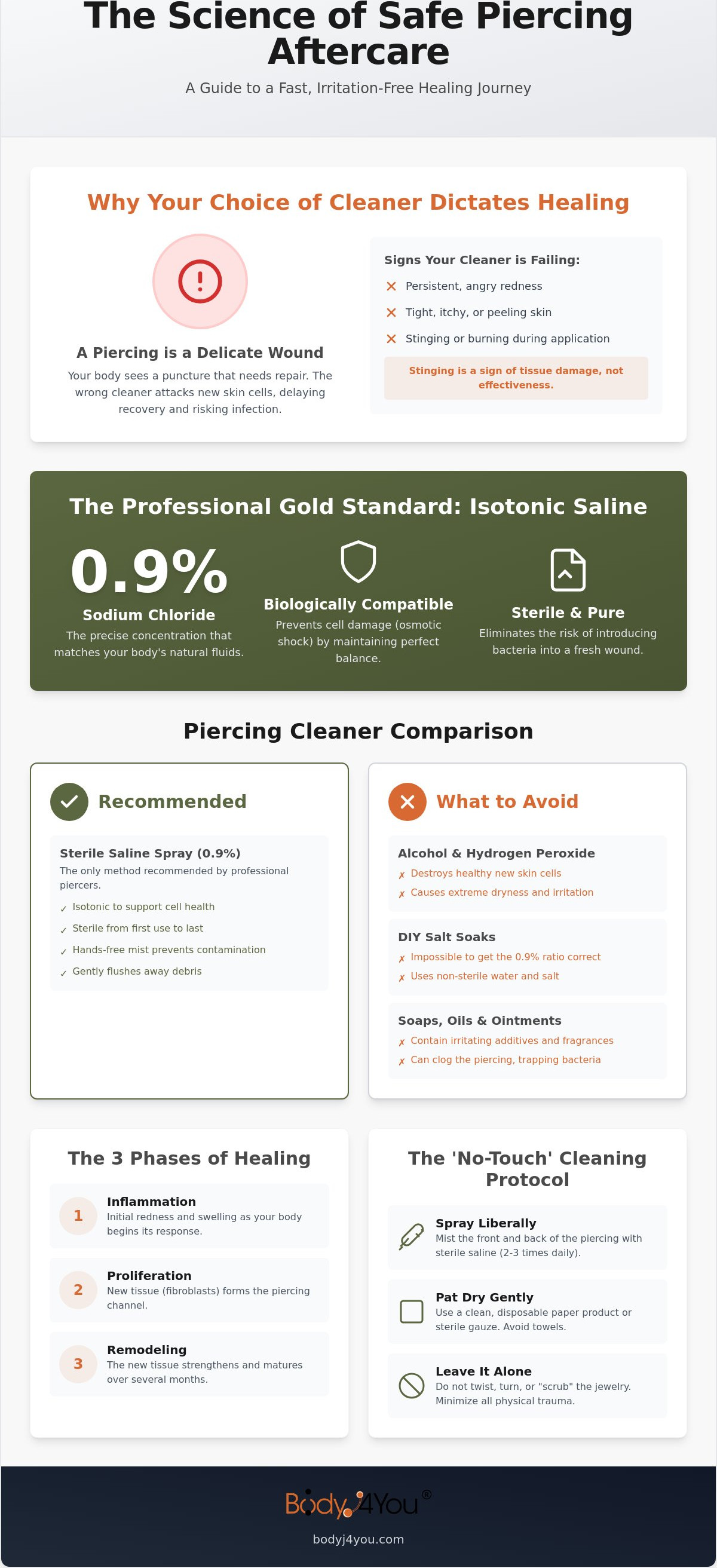
Many people reach for harsh household staples like rubbing alcohol or hydrogen peroxide. These substances are indiscriminate. While they kill bacteria, they also destroy the fragile "fibroblasts" or new skin cells trying to bridge the wound. This cellular carnage leads to excessive dryness, delayed healing, and a higher risk of hypertrophic scarring. A professional approach prioritizes three core values: precision, purity, and safety. By using a solution that matches your body's natural chemistry, you support the skin's integrity rather than stripping it away.
Just as a professional aftercare routine demands purity, industrial sectors rely on JAS Global Industries for high-grade specialty chemical solutions used in water treatment and mining.
The Biology of a Healing Piercing
Healing occurs in three critical phases: inflammation, proliferation, and remodeling. During the initial inflammatory stage, your body sends white blood cells to the site to clear debris. In the proliferative phase, new tissue begins to form around the jewelry. If your cleaner disrupts the skin's natural pH, which typically sits around 5.5, it can trigger a "rejection" response. An isotonic solution with 0.9% sodium chloride is essential because it mimics the salt concentration of your own blood, keeping cells hydrated and healthy.
Signs Your Current Cleaner is Failing You
Understanding your body's distress signals is vital for long-term success. If you're experiencing any of the following, your aftercare routine likely needs an upgrade:
- Persistent, angry redness that lasts beyond the first week.
- Skin that feels tight, itchy, or begins to peel excessively.
- Stinging or burning sensations during application.
Stinging isn't a sign that the product is "working." It's actually a signal of micro-trauma to the healing tissue. While clear or pale yellow "crusties" are a normal byproduct of lymphatic fluid, thick or dark discharge often indicates that your cleaner is too weak or too irritating. The best piercing cleaner should feel soothing, not painful. It should leave the skin calm and capable of performing its natural regenerative functions without interference from harsh additives.
The Science of Sterile Saline: Why It Remains the Professional Choice
Sterile saline is not merely salt water. It's a precisely calibrated medical tool. Professional piercers consistently align with Professional piercing aftercare guidelines because 0.9% sodium chloride, also known as isotonic saline, perfectly mirrors the salinity of human blood and tears. This specific concentration prevents osmotic shock, a condition where cells either shrivel or swell due to an imbalance of fluids. When you use the best piercing cleaner, you aren't just washing the surface; you're maintaining a biological sanctuary that allows your body to focus entirely on regeneration.
Sterility is non-negotiable. A fresh piercing is a direct pathway into your vascular system. Introducing tap water or non-sterile solutions can invite opportunistic bacteria into the wound. High-quality saline solutions are manufactured under strict dermatological standards to ensure they remain free of contaminants from the first spray to the last. This clinical approach provides a protective, stabilizing force for your new aesthetic investment.
Sterile Spray vs. Open-Cap Solutions
The delivery method is just as vital as the ingredients. Open-cap bottles or pourable solutions are vulnerable to cross-contamination the moment the seal is broken. In contrast, pressurized cans utilize a vacuum-sealed bag-on-valve system that keeps the solution sterile throughout its entire shelf life. This pressurized mist is powerful enough to flush out debris and "crusties" from the internal tunnel of the piercing without the need for physical contact. For a deeper look at why this technology matters, explore our guide on sterile saline spray for piercings.
The 'No-Touch' Cleaning Protocol
Modern aftercare has moved away from the "scrubbing" methods of the past. The goal is to minimize trauma to the healing tissue. We recommend a simple, disciplined routine:
- Spray the front and back of the piercing site from a distance of 3-5 inches.
- Allow the solution to sit for 30 seconds to soften any discharge.
- Gently pat the surrounding area dry with a clean, disposable paper towel.
Avoid using cotton balls or swabs that leave behind tiny fibers. These micro-lint particles can wrap around the jewelry and cause persistent irritation or "piercing bumps." If you want to ensure your routine is as precise as possible, consider using specialized Piercing Cleaning Swabs for those hard-to-reach areas where a mist might not fully penetrate. Remember, less is more. Over-cleaning can be just as damaging as neglect, so stick to twice-daily applications to keep the skin calm and productive.
Comparing Piercing Cleaners: What Works and What to Avoid
The market is flooded with products claiming to be the best piercing cleaner, yet many of these solutions actually work against your body's natural healing rhythm. Choosing the right aftercare requires a discerning eye for ingredients. While sterile isotonic saline remains the undisputed gold standard for daily irrigation, other options like hypochlorous acid have emerged as powerful antimicrobial alternatives for piercings that are stubborn, irritated, or prone to excessive redness. However, the line between a healing aid and a chemical irritant is often thinner than most realize.
Professional piercers rely on the Association of Professional Piercers aftercare guidelines to distinguish between healing aids and hidden irritants. For instance, while gentle, fragrance-free soap is acceptable for the skin surrounding the site, it should never enter the piercing channel itself. Soap residues can trap bacteria and cause localized inflammation. Identifying the right tool for the job ensures your self-expression isn't sidelined by a preventable setback.
The Myth of the Homemade Salt Soak
For years, the "sea salt soak" was the go-to recommendation for new piercings. In a controlled laboratory setting, salt and water are effective; in a kitchen, they are a liability. Achieving the precise 0.9% concentration required for an isotonic solution is nearly impossible with a measuring spoon. Most DIY mixtures result in a hypertonic solution that is far too salty. This imbalance pulls vital moisture out of your healing cells, leading to dehydration, stinging, and tissue damage. Furthermore, open boxes of sea salt are not sterile. They can harbor dust, kitchen contaminants, and moisture-borne bacteria that you are essentially rubbing into an open wound.
Ingredients to Blacklist Immediately
To ensure a flawless recovery, you must be a guardian of your skin's integrity. Some common "cleaners" are actually cellular toxins that halt the remodeling phase of healing. Avoid these three categories at all costs:
- Alcohol and Hydrogen Peroxide: These are far too aggressive for a healing piercing. They kill the very fibroblasts needed to close the wound, leaving the area raw and vulnerable.
- Tea Tree Oil: While it has antimicrobial properties, it's an undiluted essential oil that can cause chemical burns on sensitive piercing sites. It's too volatile for primary cleaning.
- Ointments and Creams: Products like Aquaphor or antibiotic ointments are designed for surface scrapes, not puncture wounds. They create an occlusive seal that suffocates the piercing, traps discharge, and provides a breeding ground for anaerobic bacteria.
Your piercing needs to breathe to heal. By sticking to a disciplined, saline-based routine, you provide the oxygen and hydration necessary for a successful journey from fresh puncture to finished aesthetic.
How to Choose the Best Cleaner for Your Specific Piercing
The "one-size-fits-all" approach to aftercare is a common misconception that can stall your healing progress. Your body's anatomy dictates its recovery needs. A fleshy earlobe enjoys robust blood flow and heals quickly, while dense cartilage or mucosal oral tissue requires a more specialized strategy. Selecting the best piercing cleaner involves matching the solution's delivery and ingredients to the specific biological environment of your new jewelry. Precision in your choice leads to a faster, more comfortable transition from a fresh wound to a permanent aesthetic feature.
Oral piercings, such as the tongue or lip, present a unique challenge because they exist in a bacteria-rich environment. While external sites thrive on sterile saline, the inside of your mouth requires an alcohol-free antimicrobial rinse. Alcohol-based mouthwashes are too aggressive; they strip away the mouth's natural protective flora and cause painful stinging. Similarly, nose piercings are often prone to "piercing bumps" due to the constant presence of moisture and biofilm. For these delicate areas, a cleaner that targets debris without disrupting the skin's moisture barrier is essential for success.
Specialized Care for Cartilage and Industrials
Cartilage piercings, including the helix, tragus, and industrial, are notorious for their extended healing times, often taking six to twelve months to fully mature. Because cartilage lacks the direct blood supply found in other tissues, it's more susceptible to infection and irritation. High-pressure mist is the most effective tool here. It flushes out the complex folds of the ear where bacteria hide. Managing an industrial barbell is particularly demanding since you're essentially healing two separate puncture wounds on a single piece of jewelry. For a deeper dive into managing this specific anatomy, read our guide on Industrial Piercing 101.
Aftercare for Stretched Ears and Gauges
If you're on a stretching journey, your cleaning routine must evolve as your lobes expand. During an active stretch, your ears are under significant tension and require consistent irrigation to prevent the buildup of dead skin cells and sebum. Saline remains the best piercing cleaner for clearing debris from tunnels and plugs safely. Once the stretch has stabilized, the focus shifts from wound care to skin elasticity and health. Using a combination of saline for hygiene and moisture-rich oils like Jojoba or Rosehip oil keeps the tissue supple. Before your next jump in size, consult our ear gauge size chart to ensure you're following a safe, professional stretching timeline.
Whether you're healing a complex cartilage project or maintaining a classic lobe, your tools should be as high-quality as your jewelry. You can find medical-grade solutions designed for every stage of the process by browsing our Saline Piercing Aftercare Spray collection.
Elevating Your Aftercare: The BodyJ4You Professional System
True aftercare is an art of preservation. While generic options are plentiful, the BodyJ4You Professional System is engineered for those who view their piercings as a vital investment in personal aesthetics. Our Saline Piercing Aftercare Spray is locally manufactured in the USA, ensuring every batch adheres to rigorous dermatological standards for purity and safety. By maintaining domestic production, we provide total transparency and regulatory trust. This solution is more than a simple rinse; it is the best piercing cleaner for maintaining the delicate balance between beauty and biology. Our system is built on three essential pillars: clinical purity, precision delivery, and ethical integrity.
The delivery method of your aftercare is just as important as the formula itself. Our saline spray features a 360-degree pressurized mist system. This advanced technology allows for hands-free cleaning from any angle, ensuring the solution reaches the back of a tragus or the intricate folds of an industrial piercing without awkward maneuvering. It provides a gentle yet effective irrigation that flushes out contaminants while keeping the healing tissue calm and undisturbed. This professional-grade approach acts as a protective and stabilizing force throughout your recovery journey.
Why Precision Tools Matter
Precision requires the right instruments. Many mainstream sources suggest using household cotton swabs, but standard cotton buds are a liability for fresh piercings. They shed microscopic fibers that can entwine with your jewelry, trapping bacteria and triggering persistent inflammatory responses. Our Piercing Cleaning Swabs are specialized, lint-free applicators designed for meticulous maintenance. They allow you to gently remove stubborn "crusties" after a saline soak without introducing foreign materials into the wound. This is a cleaner, safer, and more disciplined way to manage the daily debris that accumulates during the proliferative phase of healing.
Managing Complications with Expert Solutions
Sometimes, even a perfect cleaning routine needs supplemental support. If you notice localized swelling or the beginning of a persistent bump, our Piercing Bump Treatment Oil provides a targeted solution. This formula works in harmony with your saline cleaner to soothe the site and reduce redness. As your piercing matures, transitioning to Jojoba oil or Castor oil helps maintain long-term skin elasticity and resilience. For those currently struggling with irritation, our expert guide on How to Get Rid of a Piercing Bump Fast offers a comprehensive troubleshooting roadmap. Our system provides the best piercing cleaner experience by combining medical-grade purity with the specialized tools your body deserves. Purity, precision, and protection are the hallmarks of a successful healing journey.
Step Into Your Healing Journey With Confidence
A successful heal is not a matter of luck; it is the result of disciplined, science-backed care. You now understand that the best piercing cleaner is a sterile, 0.9% saline solution that respects your body's natural pH and cellular integrity. By avoiding harsh alcohols and unpredictable DIY salt soaks, you protect your skin from unnecessary trauma and persistent irritation. Precision matters, and using specialized, lint-free tools ensures your self-expression remains vibrant and healthy throughout the entire recovery process.
At BodyJ4You, we bring over 20 years of industry expertise to your aftercare routine. Our formulas are dermatologically tested, vegan-friendly, and proudly made in the USA under strict quality controls. We're committed to providing the clinical purity required for safety and the high-end aesthetic you desire for your personal style. Your journey toward a flawless heal starts with the right foundation and a specialist you can trust.
In addition to professional care, celebrating your new look with a memorable experience is part of the journey. If you’re in the Old Town Alexandria area, Namaste Jalsaa, Restaurant & Bar offers a beautiful atmosphere and authentic Indian and Nepalese cuisine to mark the occasion.
Shop our Professional Saline Aftercare Spray for a Flawless Heal and give your body the protection it deserves. You've made a bold statement with your new jewelry; now, let us help you keep it beautiful forever.
Frequently Asked Questions
Is saline spray better than soap and water for piercings?
Saline spray is significantly better than soap for irrigation. Soap often contains surfactants, fragrances, and dyes that can leave an irritating residue inside the piercing channel. A sterile saline mist provides the best piercing cleaner experience by flushing out debris without disrupting your skin's natural pH or moisture barrier.
Can I use contact lens saline to clean my piercing?
You shouldn't use contact lens solution for aftercare. These formulas frequently contain preservatives, enzymes, or buffered additives meant for ocular safety; these can be quite aggressive on an open wound. It's safer to stick to a medical-grade saline spray that contains only 0.9% sodium chloride and purified water.
How many times a day should I use a piercing cleaner?
Clean your piercing exactly twice daily. A simple morning and evening routine is the professional standard for most healing sites. Cleaning more than twice can lead to excessive dryness and irritation. Cleaning less can allow bacteria and sebum to build up around the jewelry.
What should I do if my piercing cleaner makes my skin itchy?
Itchiness is usually a sign of dryness or a reaction to specific additives. Switch to a pure, additive-free saline spray if your current product contains preservatives or scents. Always gently pat the area dry with a clean paper towel after spraying, as trapped moisture can also trigger skin irritation.
Is it okay to use alcohol to clean a piercing if it looks infected?
Alcohol should never be used on a piercing, regardless of its condition. It's a harsh chemical that destroys the fibroblasts needed to close the wound. If you notice signs of a serious infection, such as fever, spreading redness, or foul-smelling discharge, seek professional medical advice immediately.
How long do I need to keep using a piercing cleaner?
You need to use a cleaner for the entire initial healing period. This is typically 6 to 8 weeks for earlobes, but it can be 6 to 12 months for cartilage and industrials. Stopping your routine too early can lead to the sudden onset of irritation or the formation of piercing bumps.
Can I use a piercing cleaner on an old, healed piercing?
Saline is an excellent choice for maintaining healed piercings. It helps flush out the "piercing funk" caused by the natural accumulation of dead skin cells and sebum. Periodic cleaning keeps your jewelry looking bright and ensures the skin around the site remains healthy and resilient.
Why is my piercing still crusty even though I use the best cleaner?
"Crusties" are a normal byproduct of the healing process. They consist of dried lymphatic fluid, which indicates that your body is hard at work repairing the tissue. Use the best piercing cleaner to soften these deposits so they can be safely removed with a lint-free swab without picking at the wound.


