

Ear weights are high-fashion statement pieces, not stretching tools. While it's tempting to use gravity for a quick size increase, doing so risks the dreaded keyhole effect and permanent lobe thinning. You want to express your unique aesthetic, maintain your lobe health, and feel confident in your choices. It's a delicate balance between personal style and physical safety. We believe that protective care is just as vital as the jewelry you choose.
With ear piercings now accounting for 46% of the global market in 2026, the trend toward sculptural stacks and architectural looks has never been stronger. This guide will teach you how to master the art of wearing ear weights safely while protecting your lobes for the long term. You'll learn to navigate weight classes in grams and ounces, discover the security of the through-tunnel wearing method, and identify high-quality materials like surgical steel. We're here to ensure your journey toward self-expression remains safe, stylish, and sustainable.
Key Takeaways
- Distinguish between decorative art and functional stretching. Learn why ear weights should never replace a dedicated stretching kit to preserve your lobe's structural integrity.
- Master the four primary weight classes. Select pieces that align with your current gauge, comfort level, and unique aesthetic vision.
- Follow a precise, step-by-step insertion guide. Discover how the through-tunnel method provides the stability and protection your skin deserves.
- Implement the Golden Rule of Rotation. Balance your statement pieces with standard plugs to prevent thinning and maintain thick, resilient lobes.
- Maintain the purity of your collection. Use material-specific cleaning and storage protocols to ensure the long-term beauty and safety of your jewelry.
Understanding Ear Weights: Aesthetics vs. Functional Stretching
Ear weights are a celebration of personal evolution. They represent a curated choice for those who have already completed their stretching journey. Unlike standard jewelry, these pieces utilize gravity to create a distinct, hanging silhouette. However, it's vital to recognize their specific purpose. They are decorative. They are occasional. They are not a shortcut to a larger size. We view your lobes as living tissue that deserves the highest standard of care, balancing the vibrant world of aesthetics with clinical precision.
Looking back at the history of ear stretching, we see that various cultures have used weighted ornaments for centuries. Yet, modern biology teaches us that constant downward pressure requires a strategic approach. When you wear heavy jewelry, gravity pulls on the bottom of the lobe. This tension can restrict blood flow if maintained for too long. When gravity pulls the jewelry down, it compresses the capillaries in the lower lobe. Reduced circulation can lead to coldness, discoloration, or even tissue thinning. We prioritize your tissue integrity above all else. A Wise Guardian approach means understanding that your lobes are living tissue, not just a canvas for metal.
The Difference Between Weights and Plugs
Plugs and tunnels distribute weight evenly across the entire circumference of the piercing. This 360-degree support maintains a round, healthy shape. Conversely, ear weights concentrate all their mass on a single point at the bottom of the lobe. Because of this concentrated pressure, they are statement pieces rather than daily staples. You should only introduce weights to piercings that are fully healed and matured. If your skin is still recovering from a recent stretch, the added stress can lead to irritation or micro-tears. Your lobes should be supple, thick, and resilient before you experiment with weighted styles.
Why Weights Aren’t for Primary Stretching
The temptation to "naturally stretch" using only weight is a common mistake. This method often leads to the keyhole effect, where the bottom of the piercing thins out and elongates into a narrow slit. This deformation is often permanent. It makes wearing standard plugs difficult and compromises the aesthetic of your ear. To increase your ear gauge sizes safely, you need consistent, even pressure. Using a dedicated ear stretching kit ensures that the tissue expands uniformly. Weights pull down; kits expand out. This distinction is the difference between a healthy lobe and one that is dangerously thin at the base. Always choose controlled expansion over gravity-led thinning.
Choosing Your Perfect Pair: Weight Classes and Materials
Selecting the right pair of ear weights is an exercise in both artistic vision and physical awareness. You aren't just choosing a design. You're choosing a specific mass that will interact with your living tissue. We believe in providing the technical justification behind every aesthetic choice. This ensures your journey remains both beautiful and safe. Before you safely stretch your ears to accommodate these pieces, understand that material density dictates the physical experience.
Understanding Weight Categories (Grams vs. Ounces)
We categorize jewelry into four primary classes to help you manage lobe health. Accuracy matters. While some brands use vague terms, we rely on grams to provide clinical precision. Beginners should always start light to test their skin's elasticity and tolerance. Consistency is the foundation of safety.
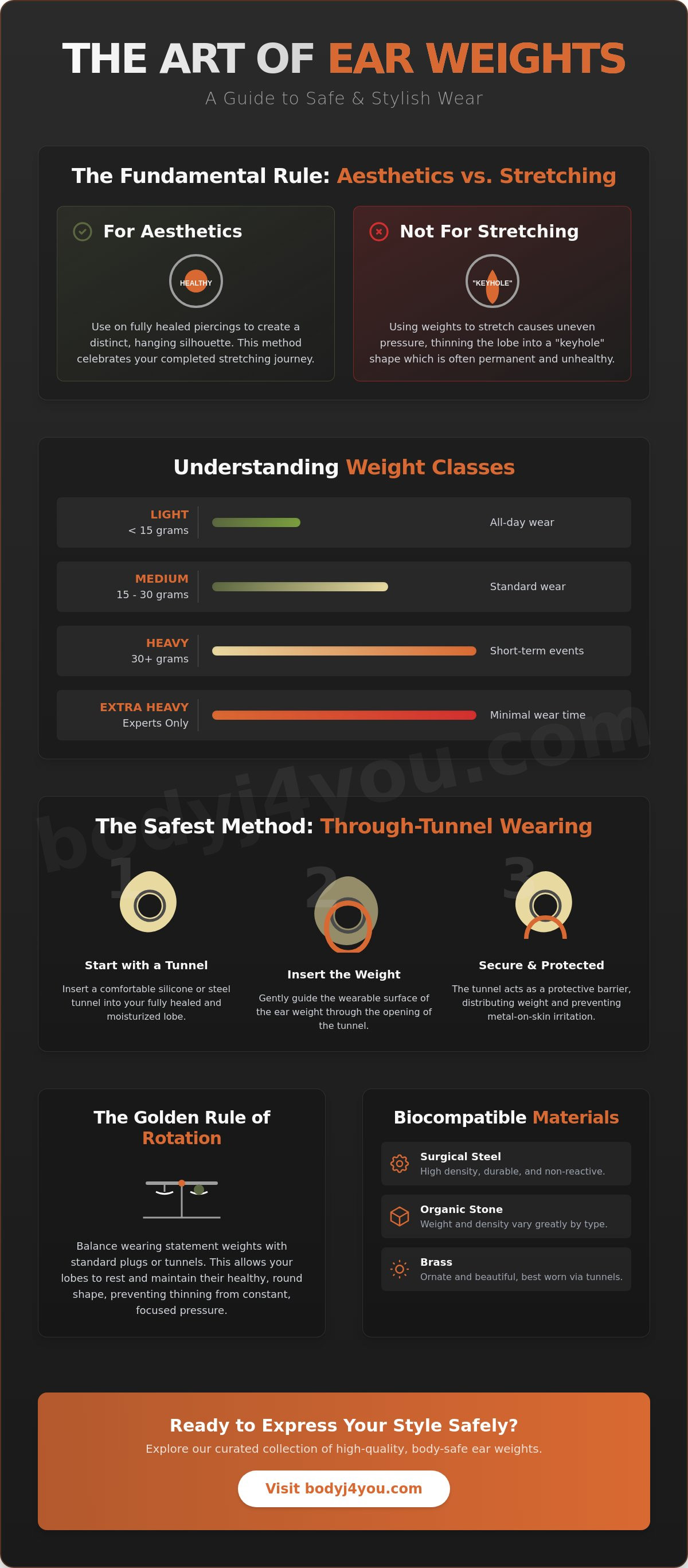
- Light (under 15g): These are ideal for all-day wear. They provide a gentle pull without compromising blood flow.
- Medium (15g to 30g): This is the standard range for established, healthy lobes. They offer a significant "swing" and presence.
- Heavy (30g+): These are reserved for short-term events. Use them for a few hours at a time to prevent tissue fatigue.
- Extra Heavy: Only for experienced collectors with very thick, resilient tissue.
Biocompatible Materials: Brass, Steel, and Organic Stone
The relationship between size and weight is often counterintuitive. A small, solid surgical steel weight will often be significantly heavier than a large, ornate wood hanger. This is due to density. We prioritize high-quality, non-reactive materials to ensure your skin remains healthy and irritation-free. Our commitment to purity means selecting materials that support your body's natural balance.
Surgical steel remains the reliable standard. It's non-porous, easy to sanitize, and bio-inert. For those seeking artistic versatility, brass and white brass offer intricate designs. However, brass requires more frequent cleaning to prevent oxidation. Organic stone and glass provide unique weight distribution. They are naturally hypoallergenic and feel cool against the skin. When you explore our curated collection of jewelry, you'll find that we prioritize purity and ethics in every piece.
- Surgical Steel: 7.8 to 8.0 g/cm³
- Brass: 8.4 to 8.7 g/cm³
- Glass: 2.4 to 2.8 g/cm³
- Organic Wood: 0.5 to 0.9 g/cm³
Understanding these values helps you predict how a piece will feel. A brass weight is nearly ten times denser than a wood one. Always check the weight in grams before purchasing to ensure it aligns with your comfort level and current lobe strength. Reliable data leads to a better styling experience.
How to Wear Ear Weights Safely: A Step-by-Step Guide
Preparation is the foundation of safety. Before you introduce the artistry of ear weights to your collection, you must ensure your lobes are prepared for the physical demand. Healthy tissue is elastic, resilient, and well-hydrated. We recommend a consistent massage routine using Jojoba oil or Rosehip oil to maintain skin suppleness. This ritual increases localized blood flow and prepares the collagen fibers for the unique pull of weighted jewelry. Never rush this process. Your lobes must be fully healed and free of irritation before you proceed with insertion.
Balance is equally vital. Always wear weights as a pair to ensure even tension on both sides of your neck and jawline. If you find a single piece captivating, resist the urge to wear it alone. Lopsided weight can lead to posture issues and uneven stretching of the ear tissue. When you first begin, limit your wear time to two hours. This allows you to monitor how your skin reacts to the new pressure. Gradually increase this duration as your tissue builds tolerance, but always listen to your body's signals of fatigue.
The "Through-the-Tunnel" Method for Even Distribution
The through-tunnel method is the gold standard for lobe preservation. By wearing your ear weights through a pair of steel or silicone tunnels, you create a protective barrier. The tunnel acts as a structural bridge. It takes the concentrated pressure of the weight and spreads it across the entire bottom surface of your piercing. This technique effectively prevents the "cheese-cutter" effect, where thin jewelry slices into the tissue over time.
When selecting tunnels for this method, precision is key. Ensure the internal diameter of the tunnel is large enough to accommodate the wearable area of the weight without pinching. If you are using silicone, ensure it is high-quality and fully cured. This method allows you to enjoy the aesthetic of heavy hangers while maintaining the round, healthy shape of your gauge.
Direct Wear vs. Hanger Styles
Different designs require different approaches to safety. Coil hangers are prized for their security. Their spiral shape wraps around the lobe, providing multiple points of contact that distribute mass more effectively than a simple hook. They are less likely to slip during movement, making them a reliable choice for active environments.
Shield weights offer a bold, architectural impact. Because they often have a broader wearable surface, they sit flush against the lobe. However, their size can sometimes mask "hot spots." Periodically check your skin for redness or deep indentations. If you notice localized throbbing or a change in skin temperature, remove the jewelry immediately. Use a Saline Piercing Aftercare Spray to soothe the area and return to standard plugs until the tissue recovers. Prioritizing these small checks ensures your self-expression never comes at the cost of your health.
Preventing Lobe Thinning and the "Keyhole" Effect
Longevity in body art requires discipline. The Golden Rule of Rotation is your most effective defense against permanent tissue damage. You should never view ear weights as a 24/7 jewelry choice. Instead, treat them like a pair of high-end heels; they're designed for impact, not for a marathon. Rotating your weights with standard plugs ensures that pressure is redistributed across the entire piercing. This prevents the tissue from becoming permanently elongated or "notched" at the base. Your lobes need variety to stay resilient. Rest, rotate, and restore.
Don't ignore the signs. Your body speaks through sensation. If your lobes feel cold, look pale, or seem noticeably thinner at the bottom rim, the tissue is under excessive stress. These are early warnings of the keyhole effect. This happens when the mass of the jewelry pulls the piercing into a narrow, vertical slit. Once this deformation occurs, it's difficult to reverse. We act as a protective force by encouraging you to prioritize tissue integrity over fleeting aesthetic trends. Healthy lobes are thick lobes.
The 8-Hour Limit: Why Duration Matters
Time is a critical factor in biological health. We recommend a strict 8-hour limit for wearing weighted jewelry. Gravity is a constant force that never rests. When you wear weights for extended periods, the skin at the bottom of the lobe is under continuous tension. This tension leads to localized thinning because blood cannot circulate freely. You should never sleep in your weights. During sleep, your ears need total freedom from pressure to allow for maximum cellular repair. A sustainable schedule often looks like two days of wearing weights followed by five days of standard plugs. This rhythm allows the tissue to bounce back and maintain its structural density.
Lobe Massage and Tissue Health
Active restoration is the secret to maintaining thick, healthy lobes. Daily massages are essential. Using Jojoba oil or Vitamin E oil helps to break up scar tissue and stimulate collagen production. These oils act as a lubricant and a nutrient source, keeping the skin supple and elastic. We also advocate for "naked time." Giving your lobes a few hours every day without any jewelry allows the skin to breathe and contract naturally. If you notice your lobes feeling paper-thin or cold to the touch, it's time to downsize. Catching thinning early is much easier than trying to repair a fully formed keyhole.
Sometimes, the stress of a weight can cause minor trauma. If you notice redness, swelling, or a small growth, you need to employ how to get rid of piercing bump techniques immediately. Switch back to lightweight, high-quality surgical steel and apply a Saline Piercing Aftercare Spray. This clinical approach calms the area and prevents secondary issues. Consistency in your care routine is what separates a long-term collector from someone who has to retire their piercings early. To maintain your lobe's resilience, shop our premium Jojoba oil and aftercare essentials to keep your tissue in peak condition.
Curating Your Look: Styling and Maintenance Tips
Self-expression is the ultimate destination of your body art journey. Once you have mastered the technical aspects of weight classes and lobe health, you can focus on the vibrant world of personal aesthetics. We believe that high-end style should never compromise biological safety. Maintaining your collection with clinical precision ensures that your pieces remain as stunning as the day you acquired them. Your jewelry is an investment in your identity. We are here to help you protect that investment through meticulous care and thoughtful curation.
Proper storage is the first step in preserving your collection's luster. You should store your ear weights in a dedicated, fabric-lined jewelry box to prevent surface scratches and unnecessary oxidation. Keeping pieces separate prevents harder materials, like surgical steel, from damaging softer organic stones or intricate brass work. A disciplined organization system reflects the respect you have for your body and your art. Clean jewelry is safe jewelry. Reliable maintenance builds a deep sense of consumer trust in the longevity of your style.
Cleaning and Aftercare for Weights
Different materials demand specific hygiene protocols. For non-porous materials like surgical steel and glass, you can use mild, fragrance-free soap and warm water for daily sanitization. Our Piercing Cleaning Swabs are excellent for reaching into the intricate crevices of ornate hangers. If you wear brass or plated designs, keep them dry to prevent premature tarnishing. A soft polishing cloth will help maintain their radiant finish without the need for abrasive chemicals.
Organic materials like stone and wood require a nurturing touch. Never soak these pieces in water or expose them to harsh disinfectants, as this can cause cracking or permanent discoloration. Instead, wipe them down with a damp cloth and apply a light coating of Jojoba oil to keep the material hydrated. This mirrors the care you give your own skin. By prioritizing the purity of your materials, you ensure a harmonious relationship between your jewelry and your biology.
Pairing Weights with Surgical Steel Nose Rings
Creating a cohesive aesthetic involves more than just your lobes. A "curated ear" often looks best when it complements your facial jewelry. You can create a sophisticated, architectural look by matching the cool, clinical tones of Surgical Steel Nose Rings with high-polish ear weights. This consistency in metal choice establishes an immediate sense of professional authority in your styling.
Don't be afraid to mix textures while keeping the base metal consistent. A hammered brass weight can pair beautifully with a smooth gold-plated labret. This contrast adds depth and energy to your appearance. We encourage you to embrace your unique style journey with confidence. Our philosophy is simple: Safety, Purity, Style. By following these guidelines, you empower yourself to express your authenticity while acting as a wise guardian of your own well-being. Your aesthetic is a reflection of your growth; wear it with pride and care.
Elevate Your Aesthetic with Confidence
Mastering the art of ear weights is a journey that balances bold self-expression with technical discipline. You now understand that these pieces are decorative statements rather than functional stretching tools. By prioritizing the 8-hour wear limit and the protective through-tunnel method, you maintain the structural integrity of your tissue. Healthy, resilient lobes are the essential foundation of any great style. We believe your personal growth and aesthetic refinement deserve the highest standards of safety, purity, and ethics.
With over 20 years of industry expertise, we remain your supportive specialist in the world of body art. Our collection features dermatologically safe, high-quality materials designed to offer affordable luxury without compromising your well-being. It's time to transition from basic jewelry to curated art that respects your biology. Your unique look is a powerful reflection of your authenticity. Wear it with the quiet pride and confidence of a well-informed collector.
Explore the BodyJ4You Ear Weight Collection for Your Next Statement Piece
Frequently Asked Questions
Can I use ear weights to stretch my ears to the next size?
No, you shouldn't use weights for primary stretching. Weights pull downward rather than expanding the tissue outward. This often leads to uneven thinning at the base of the lobe. For safe, uniform expansion, always rely on a dedicated Surgical Steel Taper and Plug Kit. We prioritize your tissue integrity over rapid sizing.
How long can I safely wear ear weights each day?
We recommend a strict limit of eight hours per day. Gravity is a relentless force. Extended wear can restrict circulation and cause tissue fatigue. It's best to treat ear weights as occasional statement pieces rather than daily staples. Always return to standard plugs for several days a week to allow your lobes to recover and breathe.
What is the "keyhole" effect and how can I avoid it?
The keyhole effect is a permanent elongation of the piercing into a narrow, vertical slit. It occurs when the mass of the jewelry pulls the tissue downward over time. You can avoid this by using the through-tunnel method and rotating your jewelry regularly. Consistency in your rest days is the most effective way to preserve your lobe's natural, round shape.
Do I need to be at a certain gauge to wear ear weights?
Most weighted designs require a minimum size of 8g (3mm) to fit comfortably through the piercing. However, the specific requirement depends on the wearable area of the piece. If you're at a smaller gauge, the concentrated pressure can be more intense. Ensure your lobes are fully healed and matured before introducing any significant mass to your jewelry collection.
Is it better to wear ear weights through tunnels or directly on the skin?
Wearing ear weights through silicone or steel tunnels is significantly safer for your tissue. Tunnels act as a protective bridge. They distribute the concentrated weight across a larger surface area of the lobe. This prevents the "cheese-cutter" effect and keeps your skin healthy. Direct wear should be reserved for very light pieces and short durations.
What materials are best for people with sensitive ears?
High-quality surgical steel and glass are the premier choices for sensitive skin. These materials are non-porous, bio-inert, and exceptionally easy to sanitize. They don't react with your body's natural chemistry. If you experience irritation, use a Saline Piercing Aftercare Spray to soothe the area and switch back to a reliable Surgical Steel Plug until the skin recovers.
Why do my ears feel sore after wearing weights for only a few hours?
Soreness typically indicates tissue fatigue or restricted blood circulation. If the jewelry is too heavy for your current lobe thickness, the nerves will signal discomfort. Your skin needs time to build tolerance. If you feel throbbing or coldness, remove the pieces immediately. Apply Jojoba oil and perform a gentle massage to restore healthy blood flow to the area.
How do I clean brass ear weights without damaging the finish?
Use a dry, soft polishing cloth to maintain the luster of brass jewelry. Avoid soaking brass in water or using harsh chemical cleaners. These can strip the finish and cause oxidation. For intricate designs, use our Piercing Cleaning Swabs to gently remove debris from small crevices. Keeping your brass dry and polished ensures it remains a vibrant part of your unique aesthetic.


