

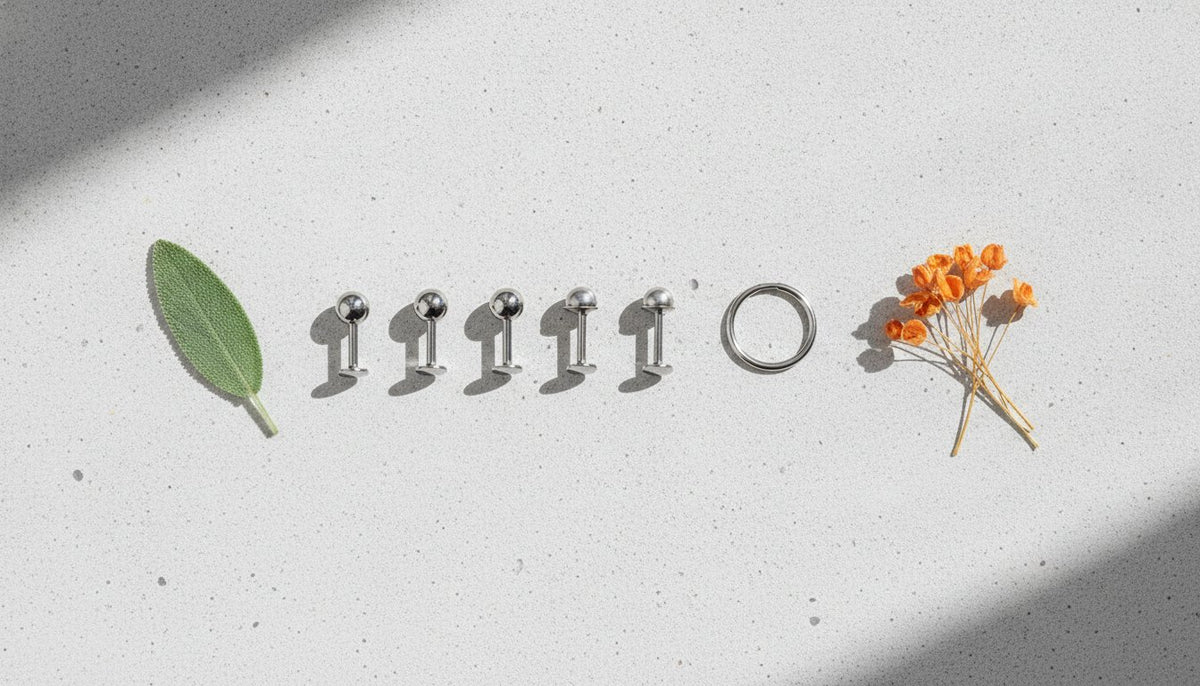
The most exquisite piece of jewelry is effectively worthless if your body rejects it. Your helix piercing is more than a canvas for self-expression; it's a delicate biological interface that requires clinical precision, aesthetic refinement, and anatomical awareness. Choosing the right helix piercing jewelry is the difference between a painful, prolonged healing process and a seamless transition to a stunning ear stack. We understand the frustration of seeing your style overshadowed by persistent irritation bumps or the constant annoyance of jewelry that snags on your hair and clothing.
In this 2026 guide, you'll learn how to select pieces that harmonize high-end style with clinical-grade safety. We'll demystify the confusing world of gauge and diameter sizing, explain why internal threaded labret studs are the gold standard for tissue health, and guide you through the transition from initial healing to a fully styled ear. Whether you're looking for surgical steel hoops or titanium studs, you'll learn to build a collection that promotes irritation-free wear for a lifetime. Let's transform your piercing journey into a seamless experience of wellness and beauty.
Key Takeaways
- Prioritize biocompatible materials like surgical steel to prevent the irritation bumps often caused by reactive or low-quality metals.
- Select the ideal helix piercing jewelry by opting for internal threaded labret studs to ensure a low-trauma experience and a secure fit.
- Understand the technical standards of cartilage sizing, specifically the differences between 16g and 18g gauges and why 6mm or 8mm posts are the industry defaults.
- Protect your healing piercing by using a sterile saline spray and waiting for full stabilization before attempting your first jewelry change.
- Balance clinical precision with personal aesthetics to build a curated collection that supports both your long-term health and your creative style.
Understanding Helix Piercing Jewelry: Anatomy and Placement
A helix piercing is any perforation of the upper ear cartilage rim. It's a versatile canvas, a structural anchor, and a commitment to long-term health. Unlike a standard lobe piercing, a Cartilage piercing involves dense, avascular tissue that demands a higher standard of care. We view this process through the lens of a Wise Guardian; the jewelry you choose acts as a stabilizing force for your body’s natural healing response. Your anatomy isn't just a backdrop for style; it's the foundation of your comfort.
Placement varies significantly based on your unique ear shape and aesthetic goals. Common locations include:
- Forward Helix: Positioned at the front of the ear, closest to the face and temple.
- Mid-Helix: Located along the center of the outer rim, providing a balanced look.
- Vertical Helix: Pierced through the top of the ear from front to back, often hosting decorative studs.
In the world of the curated ear, the helix often serves as the anchor piece. It defines the silhouette of your ear stack and provides the necessary height to balance lower lobe piercings. Choosing the right helix piercing jewelry ensures this anchor remains secure and irritation-free.
For enthusiasts looking to elevate their aesthetic with artisanal craftsmanship, you can explore Fine Jewelry to find timeless pieces that complement a modern ear stack.
The Biological Challenge of Cartilage
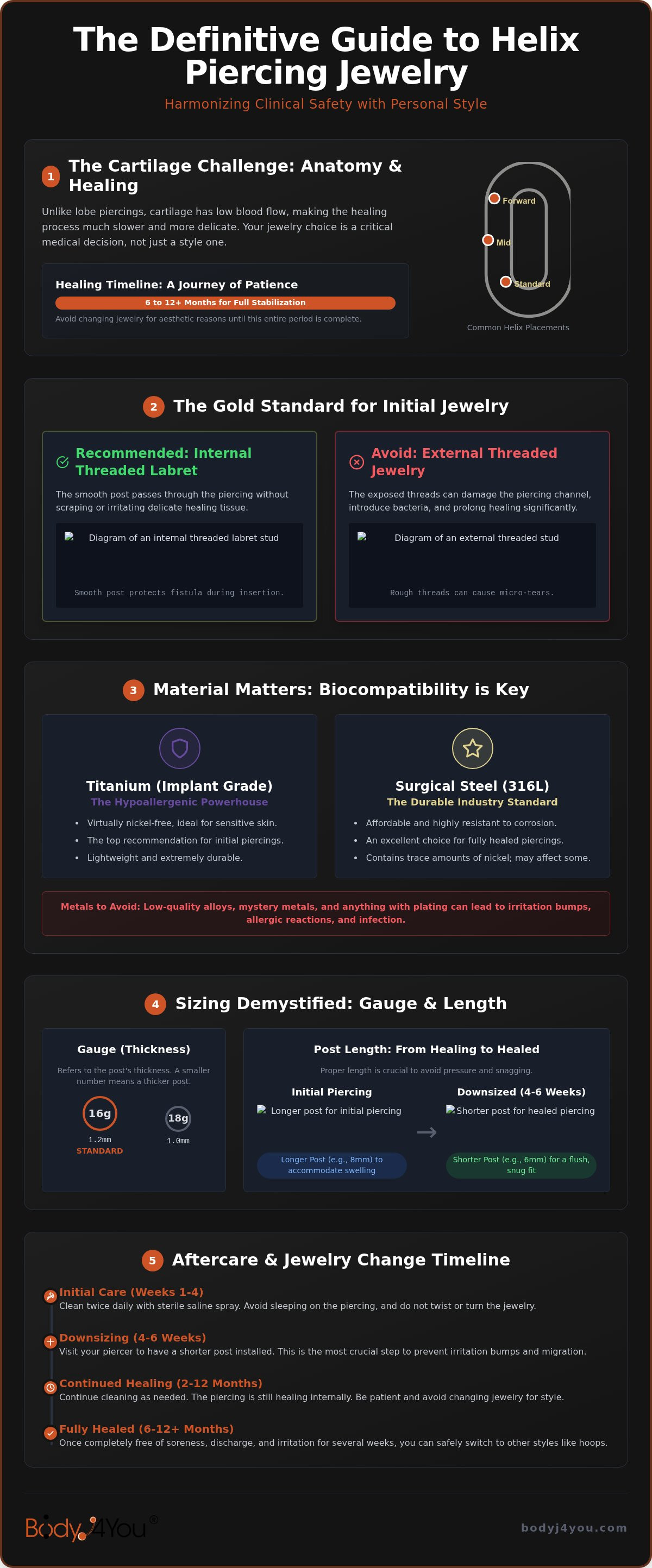
Cartilage lacks the robust blood flow found in skin or muscle. This biological reality means healing is slow, typically requiring six to twelve months for full stabilization. Because the tissue is less pliable, jewelry material is a medical necessity rather than a simple style choice. Low-quality alloys can trigger chronic inflammation that the body cannot easily resolve. Improperly fitted jewelry often leads to pressure sores, which are painful indentations in the cartilage. Cartilage pressure is the leading cause of piercing bumps.
Anatomy-Specific Jewelry Selection
Your anatomy dictates your options. If your ear has a prominent "curl" at the rim, it can comfortably host captive bead rings or hoops. However, if your helix is flatter, these styles may pull against the tissue and cause migration. In flat areas, flat-back studs are the gold standard. They sit flush against the skin, which reduces the risk of snagging on hair or clothing.
Success requires patience and precision. We recommend starting with internal threaded labret studs to minimize trauma to the delicate fistula during insertion. Once the initial swelling subsides, usually around the four to six-week mark, it's vital to downsize the post length. This prevents the jewelry from tilting and causing uneven pressure. Choosing the right helix piercing jewelry ensures your aesthetic vision doesn't come at the cost of your physical well-being.
Choosing the Right Materials for Cartilage Health
Your body is a biological gatekeeper. It identifies every foreign object as either a guest or an intruder. When selecting helix piercing jewelry, biocompatibility is the essential bridge between aesthetic desire and physical safety. Cartilage is uniquely sensitive; it lacks the vascular resilience of your earlobe. Choosing the wrong material can trigger a cascade of inflammation, migration, or permanent tissue staining from reactive metals like nickel or brass.
We advocate for a Wise Guardian approach to material selection. This means prioritizing substances that the body recognizes as inert. The Association of Professional Piercers provides rigorous standards for safe jewelry materials, emphasizing that what you wear during the first six months determines the health of your piercing for the next six years. Focus on these three core pillars of safety:
- Purity: Materials free from reactive alloys that cause irritation bumps.
- Stability: Metals that won't oxidize or corrode when exposed to body fluids.
- Integrity: Solid construction that lacks fragile surface coatings or plating.
Surgical Steel vs. Titanium
Surgical steel is the industry workhorse. We utilize 316L grade surgical steel because it offers a sophisticated balance of durability, luster, and affordability. It's an excellent choice for stabilized piercings. However, titanium remains the hypoallergenic powerhouse. It contains virtually no nickel, making it the superior option for initial healing or individuals with extreme sensitivities. For a deep dive into the technical specifications of these alloys, consult our Surgical Steel vs. Titanium: Material Safety Guide.
The Danger of Plated Metals in Cartilage
Fashion jewelry often relies on thin plating to achieve a specific look. In the context of a cartilage piercing, this is a significant risk. Sweat, friction, and cleaning solutions eventually erode these coatings, exposing reactive base metals like brass or copper underneath. This exposure often leads to localized allergic reactions. We prioritize solid-material integrity over fleeting trends.
If you desire a gold aesthetic without the risk of flaking, consider anodized titanium or high-grade steel. These methods provide vibrant color through a safe electrochemical process rather than a fragile surface layer. When you're ready to select your next piece of helix piercing jewelry, you can explore our range of biocompatible jewelry options to ensure your style remains as healthy as it is beautiful.
Helix Jewelry Styles: From Studs to Captive Bead Rings
The modern landscape of cartilage jewelry offers several distinct profiles to suit your anatomy:
- Captive Bead Rings (CBRs): These provide the classic "hoop" look with a high-tension bead that ensures the jewelry remains closed and secure.
- Circular Barbells: Often called horseshoe hoops, these add an edgy, industrial aesthetic and are incredibly easy to clean.
- Clicker Hoops: A modern solution for the fashion-forward individual, featuring a hinged closure that clicks into place without the need for professional tools.
- Internal Threaded Labret Studs: The gold standard for daily wear, offering a flat-back design that minimizes snagging and promotes a "barely-there" feel.
The Superiority of Internal Threading
Precision engineering is the hallmark of a Wise Guardian approach to piercing. Most low-end jewelry uses external threading, where the screw threads are on the post itself. This creates a "cheese-cutter" effect, scraping the delicate internal tissue during every jewelry change. Internal threading places the screw on the decorative top, leaving the post perfectly smooth. Internal threading ensures the smooth part of the post passes through the piercing, not the screw threads. This design reduces trauma, prevents bacterial buildup, and ensures a more secure connection that won't vibrate loose over time.
Hoops vs. Studs: When to Switch
Patience is the foundation of a healthy curated ear. While the allure of a sleek hoop is strong, studs are mandatory for the first 6 to 9 months of the healing process. Rings move too much, which can pull bacteria into the wound and cause the dreaded irritation bump. You'll know you've reached the "hoop milestone" when your piercing is no longer tender, shows no redness, and has zero discharge for at least 30 consecutive days.
Once you've reached this stabilization point, you can begin layering textures. Many enthusiasts find success by combining Internal Threaded Labret Studs in the mid-helix with a clicker hoop in the upper rim. This creates a structured, rhythmic look that remains comfortable even during sleep. By choosing high-quality helix piercing jewelry, you ensure your curated ear remains a source of pride rather than a source of irritation.
Sizing and Fitting: Finding Your Perfect Gauge and Diameter
Precision is the soul of safety. When you choose helix piercing jewelry, you aren't just picking a style; you're selecting a fit that respects your unique anatomy. Unlike the "one-size-fits-all" approach of generic fashion earrings, cartilage hardware requires technical accuracy to ensure longevity. Standard helix piercings utilize 16g (1.2mm) or 18g (1.0mm) posts. These are intentionally thicker than standard 20g lobe earrings. This thickness provides the structural stability necessary to prevent the jewelry from migrating through the tissue over time.
Understanding the dimensions of your ear is vital for a comfortable ear stack. Post length and hoop diameter are the two pillars of a perfect fit. For studs, 6mm (1/4") and 8mm (5/16") are the industry benchmarks. The 8mm post is typically used for initial piercings to accommodate the body's natural swelling, while the 6mm post is the goal for a healed, flush fit. If you're transitioning to hoops, diameters usually range from 6mm to 10mm. Our ear gauge size chart provides a comprehensive reference to help you navigate these technical specifications with confidence.
How to Measure Your Helix at Home
To find your ideal hoop diameter, you can use a simple paper strip. Place the edge of the paper at your piercing hole and mark where it reaches the edge of your ear. Measure that distance in millimeters. If you want a snug fit, add 1mm to that measurement. For a dangling look, add 2-3mm. A hoop that is too tight creates constant tension, which can lead to "migration" or "rejection," where the body slowly pushes the jewelry out. While home measurement is a great starting point, we always recommend consulting a professional piercer for your initial anatomical assessment.
Common Sizing Mistakes to Avoid
The most frequent error is falling into the "standard earring" trap. Using 20g jewelry in a helix piercing is risky. The thin wire lacks the surface area to support the weight of the jewelry in cartilage, potentially leading to irritation. Another critical mistake is neglecting "swelling room." A new piercing requires a longer post to allow for the body's natural inflammatory response. Once that swelling subsides, switching to Internal Threaded Labret Studs with a shorter post ensures your jewelry doesn't tilt or catch on your hair. Ready to find your perfect fit? Explore our collection of precision-sized helix hardware to start building your curated ear today.
Maintaining Your Helix Style: Aftercare and Jewelry Changes
The relationship between your body and your helix piercing jewelry is a lifelong partnership. While the creative allure of a new look is undeniable, the health of your cartilage must remain the primary priority. Patience is the foundation of a successful ear stack. We operate on a Golden Rule: never attempt to change your jewelry if the piercing site is crusty, red, or swollen. These are clear biological signals that the tissue is still in a state of repair. Forcing a change during this phase risks creating internal micro-tears, which often lead to permanent scarring or localized infections.
Safe jewelry maintenance requires a disciplined, rhythmic approach to hygiene. You aren't just cleaning a piece of metal; you're managing a biological interface. To ensure your style remains irritation-free, follow these core principles:
- Stability: Keep the jewelry stationary to allow the delicate fistula to strengthen.
- Purity: Use only isotonic solutions that mirror your body's natural chemistry.
- Observation: Monitor the site daily for subtle changes in color or texture.
The Aftercare Synergy
Effective maintenance relies on the synergy between high-quality materials and professional-grade aftercare. We recommend using Sterile Saline Spray for Piercings twice daily. This prevents the buildup of biofilm, a thin layer of bacteria that can colonize the surface of your jewelry. It is vital to debunk the harmful myth of "rotating" your jewelry. Moving the post or ring breaks the healing seal and drags external contaminants into the wound. If you experience minor irritation after a jewelry change, applying Piercing Bump Treatment Oil can help soothe the tissue and reduce redness quickly.
Signs It Is Time to Upgrade Your Jewelry
Your body often tells you when your current helix piercing jewelry is no longer serving its purpose. Persistent itching or a green/black discoloration on the skin are immediate red flags. These symptoms indicate that the metal is oxidizing or contains high levels of nickel. Jewelry that feels excessively loose or snags frequently on your clothing is also a sign that your post length is incorrect. Once your piercing has reached full stabilization, typically after six to nine months, you can confidently transition from basic healing studs to more decorative options like Captive Bead Rings. This transition marks the shift from a healing project to a fully realized aesthetic expression. By prioritizing clinical safety today, you protect the vibrancy of your style for years to come.
When you've reached the milestone of a fully healed piercing and a completed ear stack, you might also check out Gift4You for premium laser-engraved gifts to commemorate other special life occasions.
Master Your Helix Journey with Confidence
Your ear stack is a sophisticated blend of biological integrity and creative vision. By prioritizing biocompatible materials like 316L surgical steel and titanium, you ensure your body remains a healthy canvas for self-expression. Remember that technical accuracy in sizing, specifically understanding the nuances of 16g and 18g gauges, prevents long-term irritation. Choosing high-quality helix piercing jewelry is the foundation of a look that balances clinical safety, aesthetic refinement, and anatomical precision. Disciplined aftercare using saline spray remains the final pillar of a successful, irritation-free stack.
With over 20 years of industry experience, BodyJ4You provides the stabilizing force you need for a lifetime of comfortable wear. Our dermatologist-tested aftercare is proudly made in the USA to support your wellness journey from the very first day. We take pride in being the expert mentor you can trust for high-grade hardware and reliable care. It's time to transform your piercing into a masterpiece of personal style.
Shop BodyJ4You’s Curated Helix Jewelry Collection today. Your style is an evolution; embrace it with the care it deserves.
Frequently Asked Questions
What is the best jewelry for a new helix piercing?
The best jewelry for a new helix piercing is an internal threaded labret stud made from implant-grade titanium or 316L surgical steel. These materials are biocompatible and prioritize your tissue health during the long healing process. Flat-back studs minimize movement and snagging, which reduces the risk of irritation. Internal threading is essential because it prevents the screw threads from scraping the delicate fistula during insertion, ensuring a smoother recovery.
Can I sleep on my helix piercing if I have a flat-back stud?
You should avoid sleeping directly on your helix piercing, even if you're wearing a comfortable flat-back stud. Constant pressure on the cartilage can cause the piercing to migrate or shift at an angle. This physical stress often leads to the development of irritation bumps. If you must sleep on that side, use a travel pillow and place your ear in the center hole to eliminate direct contact with the jewelry and bedding.
Is 16g or 18g better for a helix piercing?
A 16g post is generally considered the industry standard for helix piercing jewelry because it provides superior stability for cartilage tissue. While 18g is sometimes used for a more delicate look, the slightly thicker 16g wire is less likely to migrate or cause the "cheese-cutter" effect. Most professional piercers prefer 16g for initial piercings to ensure the hole remains open and healthy during the six to twelve month healing period.
How long should I wait before changing my helix jewelry?
You should wait a minimum of six to twelve months before changing your helix jewelry for aesthetic reasons. While the surface might look healed after a few weeks, cartilage heals from the outside in and requires significant time to stabilize. A professional piercer should perform a downsize to a shorter post at the four to six week mark. This necessary adjustment prevents the jewelry from snagging and tilting as initial swelling subsides.
Why is my helix jewelry causing a bump on the back of my ear?
Irritation bumps on the back of the ear are usually caused by localized trauma or reactive materials. If your jewelry contains nickel or has a rough surface, your body may respond with an inflammatory bump. Poor fit is another common culprit; a post that's too short can compress the tissue. We recommend using a saline spray twice daily and switching to high-grade 316L surgical steel or titanium hardware to resolve these issues.
Can I use a regular earring in my helix piercing?
Using a regular 20g lobe earring in a helix piercing isn't recommended for long-term wear. Standard earrings are often too thin for cartilage and can lead to migration or the "cheese-cutter" effect. Additionally, butterfly backs are notorious for trapping bacteria and hair, which increases the risk of infection in the upper ear. Stick to 16g or 18g hardware specifically designed for cartilage to maintain the integrity of your piercing.
What size hoop do I need for a snug helix fit?
Finding a snug fit depends entirely on your unique ear anatomy and the distance from the piercing hole to the edge of the rim. Most individuals find that a 6mm or 8mm diameter hoop provides that desired "huggie" look. To find your size at home, measure the distance from the hole to the ear's edge in millimeters. Adding 1mm to that measurement will usually result in a comfortable and secure fit.
How do I clean my helix jewelry without taking it out?
You can effectively clean your helix piercing jewelry by using a sterile saline spray twice daily without ever removing the hardware. Simply spray the front and back of the piercing site and let it air dry. If there's stubborn buildup, use a specialized cleaning swab soaked in saline to gently wipe the area. Avoid twisting or rotating the jewelry, as this can break the healing seal and introduce bacteria into the wound.


