


The more often you soak a new piercing, the more you may irritate it. If you’re wondering how often should you do a sea salt soak, the gentlest answer may be not to make one at all: the Association of Professional Piercers advises against homemade sea salt solutions and recommends packaged sterile saline instead.
It’s understandable to reach for extra cleaning when you notice crusting or tenderness, especially when aftercare advice seems to conflict. A little dried fluid can be part of healing, and more soaking isn’t automatically better. A gentle, consistent routine matters more than frequent homemade soaks.
This guide explains how often to clean safely, why sterile wound-wash saline may be a better choice, and how to avoid overhandling your piercing. You’ll also learn what healing crusts can look like, when to check in with a reputable piercer, and which changes call for medical advice. BodyJ4You’s Saline Piercing Aftercare Spray is one ready-made option to consider, but follow its label and your piercer’s individualized guidance.
Key Takeaways
- There’s no universal answer to how often should you do a sea salt soak. Your piercing’s location, healing stage, and professional advice all matter.
- Frequent soaking, friction, and overly concentrated homemade solutions may irritate a piercing rather than help it heal.
- Compare homemade salt water, sterile saline, and plain-water rinsing to choose a gentle cleaning approach.
- Build a simple routine with clean hands, gentle rinsing, product directions, and minimal touching.
- Know which changes call for advice from a reputable piercer or healthcare professional, and when symptoms may need urgent care.
How often should you do a sea salt soak for a piercing?
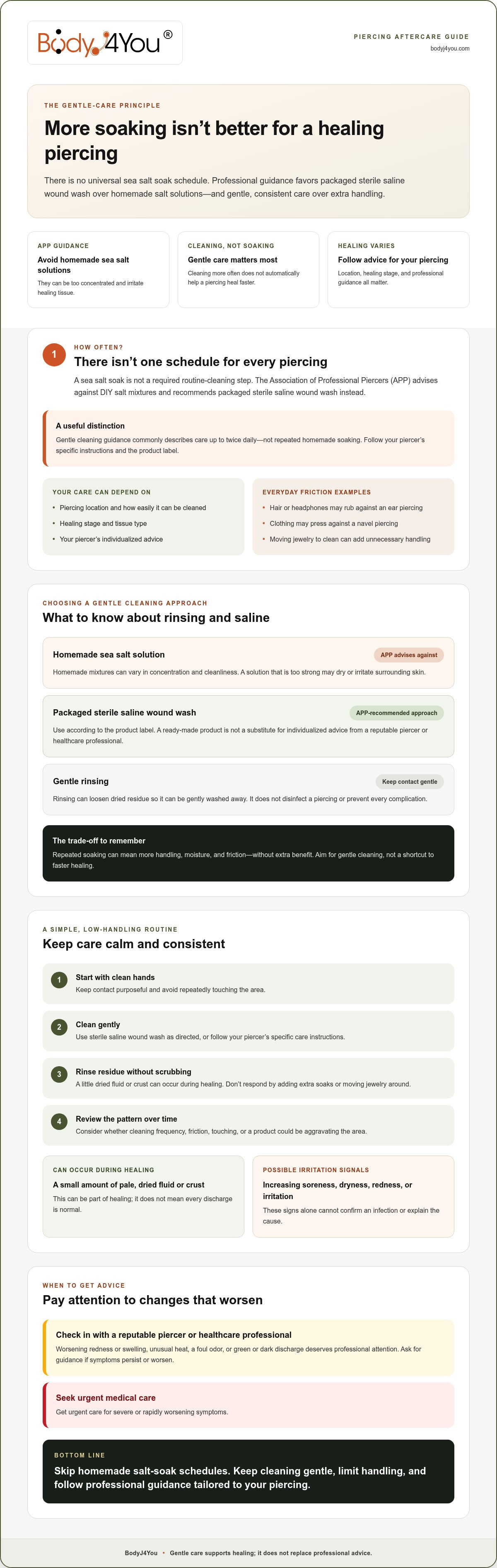
There isn’t one sea salt soak schedule that suits every piercing. In fact, the Association of Professional Piercers (APP) advises against homemade sea salt solutions because they can be too concentrated and irritate healing tissue. Its current guidance favors packaged sterile saline wound wash instead. If you’re asking how often should you do a sea salt soak, first check whether a soak is appropriate at all, then follow care instructions tailored to your piercing.
Cleaning more often isn’t automatically better. Repeatedly touching, moving, or rinsing sensitive tissue can add friction and aggravate irritation. A sea salt soak is not a required routine-cleaning step, and more soaking doesn’t mean faster healing. Gentle care supports the body’s natural process; it doesn’t replace it.
Is there one recommended sea salt soak schedule?
No universal soak frequency applies to all piercings. Schedules such as soaking once or twice daily are often repeated, but that doesn’t make homemade salt soaks the current professional standard. APP guidance recommends avoiding DIY salt mixtures and using sterile saline wound wash. Cleaning guidance commonly describes gentle care up to twice daily, rather than repeated soaking. Follow your piercer’s specific instructions, and check the product label before use.
Why piercing location and healing stage matter
Placement affects what a piercing is exposed to and how easy it is to clean. An ear piercing may rub against hair or headphones, while a navel piercing can be pressed by clothing. Tissue type and jewelry position can also affect comfort. A fresh piercing, one that’s still healing, and a fully healed piercing don’t necessarily need identical care.
Healing doesn’t follow one fixed timetable. The healing process for piercings can involve different phases, and the visible surface may feel settled before deeper tissue has finished healing. Ask your piercer for advice specific to the location, and keep care gentle as the piercing changes. A little crusting or tenderness may occur during healing, but adding extra soaks in response can create more handling than the area needs.
What a sea salt soak does: why more soaking can irritate a piercing
A soak can rinse away residue around a piercing, but it isn’t a shortcut to faster healing or a treatment for infection. The goal is gentle cleaning without unnecessary contact. Repeated soaking can mean more handling, moisture, and friction, especially if you need to hold a cup against the area or move jewelry to reach it.
A calm, consistent cleaning routine is often kinder to a piercing than repeated soaking. If you’re wondering how often should you do a sea salt soak, consider whether a homemade soak is needed at all. The Association of Professional Piercers advises against mixing your own sea salt solution, describing it as no longer a suggested practice because it may be too strong and irritate the piercing.
How salt water interacts with healing piercing tissue
Rinsing can loosen dried residue so it can be gently washed away, but salt water doesn’t disinfect a piercing or prevent every complication. Homemade mixtures can vary in salt concentration and cleanliness. A solution that’s too concentrated may dry or irritate the surrounding skin, while repeated rinsing can add handling without offering extra benefit. Follow current professional guidance and product directions.
Signs your routine may be too aggressive
Notice the pattern, not just one moment of tenderness. Increasing soreness, dryness, redness, or irritation may be a reason to review how you’re cleaning, how often you touch the area, and whether a product is suitable. These signs alone can’t confirm an infection or reveal what’s causing the irritation.
A small amount of pale, dried fluid or crust can occur during healing. That doesn’t mean every discharge is normal. Worsening redness or swelling, unusual heat, a foul odor, or green or dark discharge deserves professional attention. If symptoms persist or worsen, ask a reputable piercer or healthcare professional for guidance. Seek urgent medical care for severe or rapidly worsening symptoms.
If you’re considering a ready-made aftercare option, review BodyJ4You’s Saline Piercing Aftercare Spray. Check its current label directions, and don’t treat any product as a substitute for individualized professional advice.
Sea salt soak vs. sterile saline: which is better for piercing aftercare?
Homemade sea salt water, sterile saline, and plain-water rinsing differ in preparation and consistency. The Association of Professional Piercers (APP) advises against mixing your own salt solution and recommends sterile saline wound wash. Its aftercare guidelines explain why homemade mixtures may be too strong and irritate a piercing. Follow your piercer’s specific advice and the product label. No single method is right for every piercing or situation.
| Method | Consistency and convenience | Things to consider |
|---|---|---|
| Homemade sea salt water | Must be mixed for each use. | Measuring errors can make it too concentrated, and preparation or handling may introduce contamination. |
| Sterile saline wound wash | Ready to use, with no home mixing. | Check that the label identifies it as sterile saline wound wash, ideally 0.9% sodium chloride with no additives, and follow its directions. |
| Plain water rinse | Simple option for gently rinsing the area. | It doesn’t require salt mixing, but use it only in a way that fits your piercer’s advice and the piercing’s needs. |
What is different about sterile saline?
Sterile saline is a prepared salt-and-water solution designed to be free of living microorganisms. For piercing aftercare, APP guidance points to wound wash labeled as 0.9% sodium chloride with no additives. A packaged product removes the need to measure and mix ingredients at home, though it’s still important to read the label. Products can differ, so don’t assume every saline spray has the same ingredients or intended use.
BodyJ4You offers a Saline Piercing Aftercare Spray, but check the product details and directions on its current label before use. Don’t assume it’s interchangeable with sterile wound wash unless its labeling supports that use. A product can be convenient without replacing individualized guidance from a reputable piercer.
When should you avoid a homemade sea salt mixture?
Skip DIY mixing if you can’t measure consistently, aren’t sure your preparation is clean, or find that the solution leaves the area dry or more irritated. A mixture that looks clear isn’t necessarily the right concentration or clean enough for piercing aftercare. If you’re asking how often should you do a sea salt soak, first confirm whether a homemade soak is recommended for your piercing at all.
For more detail on sterile saline aftercare, ask a reputable piercer which cleaning approach fits your piercing and its current condition. This is especially important if irritation is ongoing or worsening.
How to care for a piercing gently without overdoing sea salt soaks
A simple routine is easier to follow and less likely to involve unnecessary handling. Current Association of Professional Piercers guidance favors sterile saline wound wash over homemade sea salt solutions. Adjust care to your piercer’s instructions and the product label rather than adding extra soaks whenever you notice a little crusting.
A simple, low-irritation cleaning routine
- Wash your hands. Use soap and water before touching the piercing or its jewelry. Clean hands help limit the transfer of dirt and germs.
- Rinse gently. Use packaged sterile saline wound wash according to its label, or rinse with clean water as advised by your piercer. Don’t mix a homemade salt solution or apply a product in a way its directions don’t recommend.
- Let residue soften. If dried discharge doesn’t rinse away easily, leave it alone and try again during your next gentle cleaning. Don’t pick, scrape, or pull crusts off attached tissue.
- Dry with care. If needed, pat the area dry with a clean disposable paper product. Avoid rubbing with a towel, which can snag jewelry or create friction.
- Leave the jewelry still. Don’t twist, rotate, or move it just to clean. Don’t remove or change jewelry during healing unless a qualified professional advises you to do so.
There’s no universal schedule that fits every piercing. If you’re asking how often should you do a sea salt soak, follow current professional guidance rather than assuming that a soak is necessary. Clean as directed, and avoid adding steps simply because the area looks a little different from day to day.
Aftercare habits that can make irritation worse
Skip alcohol, hydrogen peroxide, harsh soaps, and ointments unless a healthcare professional specifically recommends them. These products may be too harsh for healing tissue or interfere with the care routine. Also consider what’s touching the piercing: tight clothing pressing on a navel piercing, headphones rubbing an ear piercing, or makeup getting onto a facial piercing can all add avoidable contact. Follow piercing-specific advice about swimming and other activities that expose the area to friction, pressure, or water.
BodyJ4You sells Saline Piercing Aftercare Spray as a ready-made aftercare option. Check the current label for directions and intended use, and keep your piercer’s individualized guidance at the center of your routine. Explore the Saline Piercing Aftercare Spray as one option to review.
When to stop soaking and get advice about a healing piercing
A little tenderness or brief irritation can happen during healing, especially after accidental pressure or friction. If it settles and there are no other concerning changes, avoid reacting by adding extra soaks or touching the piercing repeatedly. If a homemade salt soak seems to make the area drier or more irritated, don’t keep repeating it. Ask a reputable piercer about a gentler routine. If a clinician has prescribed treatment, don’t stop or change it without their advice.
Which symptoms deserve professional attention?
Contact a healthcare professional for assessment if you notice symptoms that are worsening or spreading, such as increasing pain, expanding redness, unusual heat, or concerning discharge. A small amount of pale fluid that dries into a crust can occur during healing, but foul-smelling, green, or dark discharge merits prompt advice. These signs don’t confirm an infection on their own, and a professional can assess what may be causing them.
A reputable piercer can advise on jewelry and piercing-care practices. Symptoms affecting your health need a clinician’s assessment. If you have a fever or feel seriously unwell, seek prompt medical attention. For severe or rapidly worsening symptoms, get urgent care rather than waiting to see whether another soak helps.
Choose a consistent aftercare option
Conflicting advice can make it tempting to switch products or methods often. Instead, confirm your routine with a reputable piercer, follow the label directions for any product, and keep cleaning gentle. The question “how often should you do a sea salt soak” doesn’t have one schedule that fits every piercing, and a homemade soak isn’t the default answer. If symptoms persist or worsen, get professional advice rather than increasing cleaning frequency.
BodyJ4You’s Saline Piercing Aftercare Spray is one ready-made aftercare option to review. Check its current label for directions and intended use, and remember that a product isn’t a substitute for advice tailored to your piercing or medical care when symptoms call for it. Explore BodyJ4You piercing aftercare as you consider your routine.
Keep aftercare gentle and consistent
There’s no single soak schedule for every piercing, and more cleaning isn’t automatically better. If you’re wondering how often should you do a sea salt soak, remember that current professional guidance advises against homemade salt mixtures. A gentle routine, guided by your piercer and product directions, can help you avoid unnecessary handling and irritation.
Choose an appropriate cleaning method, leave jewelry undisturbed unless a qualified professional advises otherwise, and seek medical advice if symptoms worsen or you feel unwell. If you’re considering a ready-made aftercare option, BodyJ4You sells Saline Piercing Aftercare Spray. The company reports more than two decades of body-modification industry experience and says its skincare line is manufactured in the United States. Check the current product label and follow advice tailored to your piercing.
Explore BodyJ4You piercing aftercare and review the Saline Piercing Aftercare Spray as you build a manageable routine. Follow the label and your piercer’s advice for care specific to your piercing.
Frequently Asked Questions
How often should you do a sea salt soak for a new piercing?
There isn’t a universal soak schedule, and the Association of Professional Piercers advises against homemade sea salt solutions. If you’re asking how often should you do a sea salt soak, first check whether your piercer recommends one at all. Current guidance favors packaged sterile saline wound wash rather than a DIY mixture. Follow instructions specific to your piercing and the product label, and don’t increase cleaning just because you see a small amount of crusting.
Can you soak a piercing in sea salt water every day?
Daily soaking isn’t a default recommendation for every piercing, especially if the solution is homemade. The salt concentration and preparation can vary, and repeated soaking or handling may leave sensitive tissue dry or irritated. Follow your piercer’s directions and current professional guidance instead of assuming a daily soak is needed. If you’re using a packaged aftercare product, follow its label rather than applying it more often than directed.
Is sterile saline better than a sea salt soak for piercings?
For routine piercing aftercare, the Association of Professional Piercers recommends packaged sterile saline wound wash over homemade sea salt water. Look for wound wash labeled as 0.9% sodium chloride with no additives, and check the product label to confirm its intended use. Sterile saline avoids the home measuring and mixing involved in a DIY soak. Your piercer’s advice still matters, since care can depend on the piercing and its condition.
Can sea salt soaks irritate a piercing?
Yes. A homemade solution that’s too concentrated can dry or irritate the area, and repeated soaking may add unnecessary contact. If you notice increasing dryness, redness, or soreness after soaking, pause the DIY mixture and review your routine with a reputable piercer. Those symptoms alone can’t identify the cause or confirm infection. Seek healthcare advice if changes persist, worsen, or come with concerning discharge, unusual heat, or spreading redness.
What happens if you soak a piercing too often?
Soaking too often may contribute to dryness, irritation, or tenderness, particularly if the mixture is too salty or each soak involves moving or pressing jewelry. It doesn’t guarantee faster healing or prevent infection. Keep care gentle and avoid adding extra soaks in response to every bit of dried fluid. If discomfort is getting worse, check your technique and products with a reputable piercer, and consult a healthcare professional for concerning symptoms.
Should you rinse a piercing after a sea salt soak?
If you’ve used a homemade soak, gently rinsing away residue with clean water can help avoid leaving salt on the skin. Don’t scrub, twist the jewelry, or repeat the soak to make the area feel cleaner. Current Association of Professional Piercers guidance advises against homemade salt mixtures, so consider asking your piercer about a suitable alternative. For packaged saline, follow the label. Extra rinsing may not be necessary unless its directions or your piercer say so.
Can you use table salt instead of sea salt for a piercing soak?
No. Don’t swap in table salt or another kitchen salt to make a piercing soak. The Association of Professional Piercers advises against mixing your own salt solution because it can be difficult to get the concentration right and the mixture may irritate the piercing. Choose a cleaning approach recommended by your piercer, and check any product’s label for intended use. Avoid adding household ingredients to a healing piercing without qualified guidance.


