

That unsightly "lip" of tissue isn't just a cosmetic setback; it's your body's urgent signal for a biological reset. Seeing a blowout for the first time often triggers immediate anxiety about permanent scarring and ruined progress. If you're currently dealing with a painful, throbbing lobe, understanding how to fix a blowout in stretched ears is the first step toward restoration. We know how much your self-expression matters to you. It's frustrating to feel like you've moved two steps back, but with the right clinical care and patience, your lobes can heal.
We promise to provide the exact roadmap you need to reduce inflammation, manage the blowout lip, and protect your long-term skin integrity. You'll learn how to identify the severity of the damage, implement a sterile cleaning routine, and use organic oils to encourage healthy tissue remodeling. This guide covers the essential recovery phases: immediate downsizing, daily saline aftercare, and the gradual return to a safe stretching journey. Your path to healthy, supple, and aesthetically refined lobes starts with these professional recovery protocols.
Key Takeaways
- Recognize the characteristic "lip" of tissue as a biological signal that your lobe requires an immediate, protective reset.
- Prioritize immediate downsizing by at least two full gauge sizes to relieve pressure, restore circulation, and encourage tissue remodeling.
- Master the "Soak and Spray" protocol to learn how to fix a blowout in stretched ears using clinical saline and organic jojoba oil.
- Discern the critical signs of infection to know exactly when your healing journey requires professional, specialized intervention.
- Adopt the 1mm rule and dead stretching to ensure your future journey is safe, gradual, and aesthetically refined.
Identifying an Ear Stretching Blowout: Signs and Symptoms
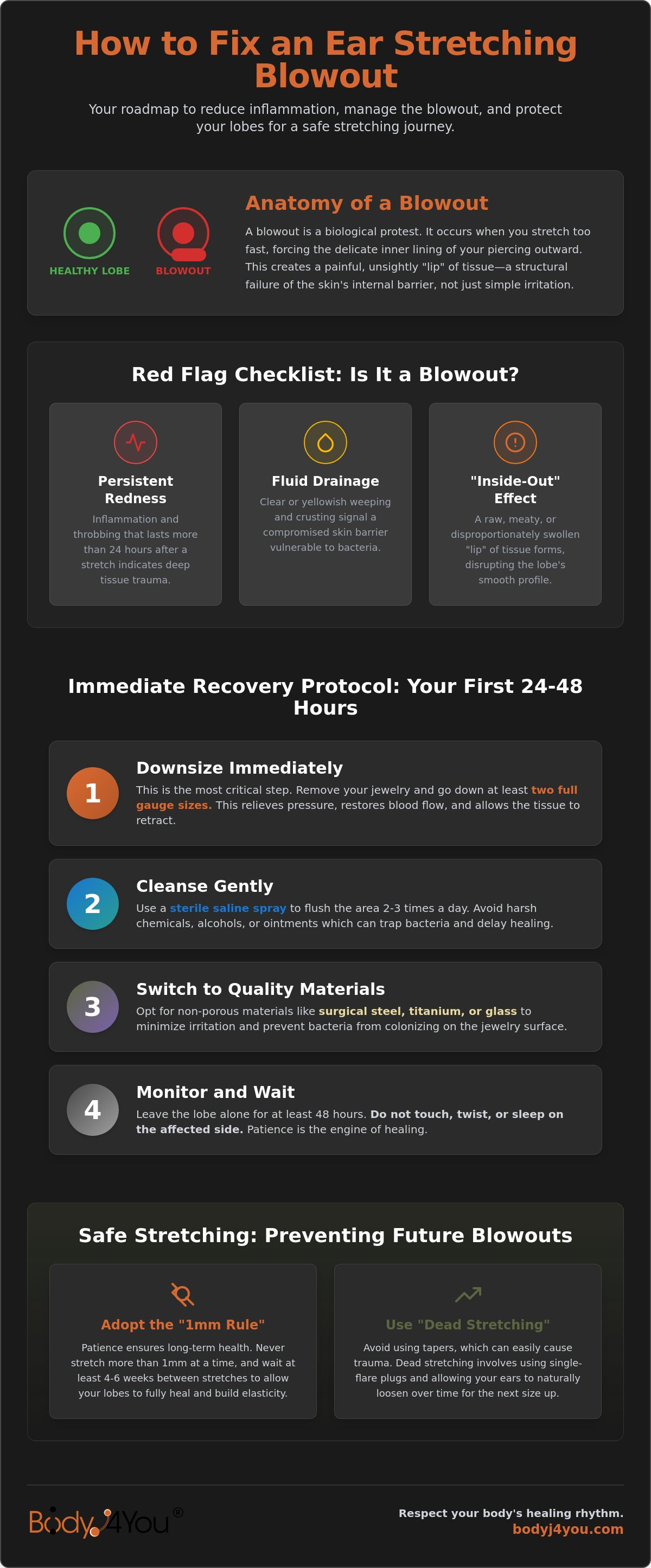
A blowout is a biological protest. It occurs when you move too fast, pushing the delicate lining of your piercing beyond its elastic limit. If you are searching for how to fix a blowout in stretched ears, you've likely noticed a fleshy protrusion or a persistent, painful "lip" around your jewelry. This isn't just standard soreness. It is a structural failure of the skin's internal barrier. Recognizing the signs early is the difference between a temporary setback and permanent aesthetic damage.
Distinguishing a blowout from simple irritation is vital for proper recovery. While minor irritation involves localized redness and a slight sting, a blowout presents as a distinct physical deformity. You will feel intense throbbing, localized heat, and a raw tenderness that doesn't subside with rest. If you see a ring of skin bunching up behind your plug, your body has effectively turned itself inside out to accommodate the sudden pressure. It's a signal to stop, assess, and prioritize your lobe's long-term health.
The Anatomy of a Blowout
The physics of Stretching (body piercing) rely on gradual cellular expansion. When you force a taper or a plug into a restricted canal, the internal fistula tissue has nowhere to go but out. A blowout is the displacement of the fistula due to excessive pressure. Most blowouts occur at the back of the lobe because the jewelry is typically inserted from the front, pushing the internal skin toward the exit point. This creates the characteristic "shelf" of tissue that disrupts the smooth profile of your ear.
The Red Flag Checklist
Identifying the damage early is the key to successful remodeling. Use this checklist to evaluate your lobe health and determine if you need to learn how to fix a blowout in stretched ears immediately:
- Persistent Redness: Inflammation that lasts beyond 24 hours after a stretch indicates deep tissue trauma rather than simple blood flow.
- Fluid Drainage: Clear or yellowish weeping and crusting signal a compromised skin barrier that is vulnerable to environmental bacteria.
- The "Inside-Out" Effect: The smooth, healed skin of the lobe looks raw, meaty, or disproportionately swollen, often resembling a small lip of tissue.
A simple tear might heal with basic hygiene, but a blowout requires a strategic reduction in size to allow the fistula to retract. Ignoring these red flags can lead to permanent scarring, loss of lobe elasticity, and a permanent deformity. We advocate for a disciplined approach to recovery that respects your body's natural healing rhythm. Your self-expression should never come at the cost of your physical integrity.
The Immediate Recovery Protocol: Your First 24 Hours
The moment you realize your lobe is compromised, panic often sets in. You might be tempted to leave the jewelry in and hope the inflammation subsides on its own. Don't. Learning how to fix a blowout in stretched ears begins with a single, decisive action: you must remove the pressure. The first 24 hours are the most critical window for tissue retraction. If you act quickly, you can significantly reduce the risk of permanent scarring. Follow this immediate recovery protocol to stabilize the area:
- Step 1: Downsize immediately. This is the most critical and often ignored rule of recovery.
- Step 2: Remove the pressure. Go down at least two full gauge sizes to allow the skin to breathe.
- Step 3: Cleanse the area. Use a sterile saline spray to flush away bacteria and prevent secondary infection.
- Step 4: Switch materials. Opt for high-quality, non-porous materials like surgical steel to minimize irritation.
- Step 5: Monitor and wait. Observe the lobe for 48 hours without touching, twisting, or sleeping on the affected side.
Why Downsizing is Non-Negotiable
Blood flow is the engine of healing. When jewelry is too large for a damaged piercing, it compresses the capillaries and starves the injured tissue of oxygen. By downsizing, you create the physical space necessary for the "lip" of skin to pull back into the canal. It's common to feel a sense of "size dysphoria" or frustration over lost progress. However, losing a few millimeters now ensures you don't lose the entire lobe to permanent deformity later. Consult our ear gauge size chart to pick a safe downsize that provides relief without leaving the piercing empty.
The Sterile Environment
Keeping the wound clean is paramount for tissue remodeling. Avoid "home brews" or DIY salt water solutions. These are often too harsh, non-sterile, and can lead to chemical burns on raw fistula tissue. Instead, use a professional Saline Piercing Aftercare Spray to maintain a clinical environment. This precision helps manage the risks and complications of stretched ears without drying out the skin. Finally, adopt a strict hands-off policy. Your fingernails carry bacteria that can turn a simple blowout into a medical emergency. If you need a fresh start with safer materials, our Surgical Steel Taper and Plug Kit offers the biocompatibility required for a smooth recovery.
Restore. Relieve. Recover.
The Healing Regimen: Saline Soaks and Oil Massages
Once the initial inflammation has stabilized, your focus shifts from damage control to active tissue remodeling. Successful recovery is a marathon, not a sprint. If you're committed to how to fix a blowout in stretched ears, you must establish a disciplined daily ritual. This phase combines clinical hygiene with biological nourishment to encourage the fistula to retract and heal. Cleanse. Nourish. Remodel.
The "Soak and Spray" method is your first line of defense. Use a Saline Piercing Aftercare Spray twice daily to maintain a sterile environment. This simple act flushes away cellular debris and prevents the accumulation of bacteria that could lead to secondary infections. According to professional clinical insights on Ear Blowout: Symptoms and Treatment, keeping the area clean is the prerequisite for any tissue repair. Only after the skin is no longer raw or weeping should you introduce organic oils into your routine.
The Power of Jojoba and Rosehip Oil
Purity matters. When the skin barrier is closed, Jojoba oil becomes your most valuable asset because it closely mimics natural human sebum. This allows for deep, non-clogging hydration that restores elasticity to the lobe. For those dealing with more significant scarring, Rosehip oil offers targeted repair by supporting collagen production and softening the appearance of thickened tissue. You can learn more about natural oils for piercings to understand how these botanical extracts support dermatological health and skin integrity.
Managing the "Blowout Lip"
The characteristic ring of skin requires physical intervention to flatten. Once the lobe is no longer tender, perform a 5-minute massage twice daily. Use a directional technique, gently pushing the displaced tissue back toward the center of the piercing. The natural vitamin E found in these oils helps break down the fibrous, tough tissue of a blowout, making it more pliable over time. This mechanical stimulation increases blood flow to the area, which is essential for cellular turnover.
To maintain this progress throughout the day, apply a thin layer of Gauges balm. This creates a protective moisture barrier that shields the healing skin from environmental stressors while keeping the tissue supple. Remember, a full 30-day commitment is required to see visible changes in the "lip" structure. Consistency is the only path to restoration. If you stay the course, you'll find that even stubborn blowouts can be significantly reversed with patience and the right nutrients.
When to Seek Professional Help for Ear Blowouts
Self-care is a powerful tool, but it has boundaries. While the protocols for how to fix a blowout in stretched ears are effective for most minor cases, severe trauma requires a specialist's eye. Your lobe's long-term health depends on your ability to recognize when home treatment is no longer sufficient. There is a fine line between manageable inflammation and a medical complication. If your recovery stalls or symptoms intensify, prioritizing professional intervention is the most empowering choice you can make for your aesthetic journey.
Differentiating between standard inflammation and a secondary infection is critical for your safety. Inflammation typically involves localized swelling and tenderness that subsides after downsizing. An infection, however, is a systemic threat. You must monitor for fever, green or foul-smelling discharge, and red streaks radiating from the piercing site. These are not signs of a simple blowout; they are indicators that bacteria have breached your defenses. Ignoring these signals can lead to permanent tissue loss or more serious health risks.
Signs of Secondary Infection
Listen to the rhythm of your body. A common sign of infection is localized heat that feels like a persistent "pulse" or throbbing in the ear that doesn't stop when you rest. You should also check the area around your jawline and neck for swollen lymph nodes. This indicates your immune system is actively fighting an invader. Finally, never ignore a foul odor. While "ear cheese" is common in healed piercings, a sharp, pungent smell from a raw blowout is a primary red flag for trapped bacteria.
The Role of the Professional Piercer
A professional piercer acts as a wise guardian for your skin's integrity. They have the specialized tools and experience to insert jewelry into a swollen, difficult lobe without causing further tearing. If you are struggling to downsize on your own, an expert can provide a steady hand and a second opinion on whether the piercing can be saved. During a professional checkup, they may use piercing cleaning swabs for precision removal of debris without irritating the raw fistula. This level of clinical care ensures your "reset" is handled with the highest standards of safety.
The "Point of No Return" occurs when the displaced tissue becomes fully epithelialized. This means the blowout "lip" has healed over with permanent skin. Once this happens, the tissue is no longer in a remodeling phase, and topical oils or massages will not move it back into the canal. At this stage, surgical sculpting or lobe reconstruction by a medical professional may be the only remaining option to restore a smooth profile. To prevent reaching this point, maintain a proactive healing environment with our Piercing Bump Treatment Oil to soothe inflammation before it hardens into permanent scar tissue.
Safe Stretching: Preventing Future Blowouts with Proper Tools
Healing a blowout is a hard-won lesson in patience. Once you've mastered how to fix a blowout in stretched ears, the priority shifts to ensuring it never recurs. Safe stretching is a discipline. It requires a balance of high-quality tools and a deep respect for your body's biological limits. If you've just finished a 30-day recovery cycle, your lobes are in a sensitive state. You must treat them with clinical precision as you return to your journey. Resilience is built through consistency, not force.
The "1mm Rule" is your most reliable safeguard. Never attempt to increase your size by more than 1 millimeter at a time. Your skin requires significant time to produce new cells and collagen to support the increased diameter. If a stretch feels tight, stings, or throbs, your tissue isn't ready. Forcing a fit is the fastest way to trigger another blowout. We advocate for a "listen to your body" philosophy. If the jewelry doesn't slide in with ease, stop immediately and wait another two weeks. Quality over speed is the only way to maintain thick, healthy lobes.
Dead Stretching vs. Tapers
Dead stretching is the gold standard for long-term lobe health. It uses gravity and the natural weight of your jewelry to create space over several months. This method is trauma-free because it relies on the ear's natural loosening rather than mechanical force. However, many beginners prefer the structure of a kit. If you use tapers, they must act as a guide, not a wedge to force tissue. You can explore our guide on choosing an ear stretching kit to ensure you are using non-porous, biocompatible materials like surgical steel. This prevents the micro-tears associated with porous acrylic or wood during an active stretch.
The Maintenance Phase
Even after your lobes are fully healed and you've learned how to fix a blowout in stretched ears, maintenance is a lifelong commitment. Establish a daily cleaning routine using a saline spray to remove sebum and debris. Once your ears are stable, begin "naked training." Removing your jewelry for a few hours each night, or eventually overnight, allows blood to circulate freely and prevents the tissue from becoming overly thin. Investing in our Surgical Steel Taper and Plug Kit ensures your transition pieces are smooth and safe. Your self-expression is an evolving art form. Honor it by choosing the highest standards of care and the most reliable tools in the industry.
Restore Your Lobe Health and Confidence
Recovering from a blowout requires a shift from frustration to focused restoration. By prioritizing immediate downsizing and a sterile cleansing routine, you've already taken the most difficult steps toward healing. Remember that tissue remodeling is a biological process that demands time, consistency, and the right nutrients. You now have the professional roadmap for how to fix a blowout in stretched ears while protecting your skin's long-term integrity. Thick lobes, healthy skin, and safe progress are within your reach.
Your journey to safe self-expression is supported by our 20+ years of industry expertise and commitment to purity. We provide locally manufactured skincare solutions that are trusted by professional piercers worldwide to ensure quality control at every stage of your recovery. This clinical precision ensures your lobes receive the stabilizing force they need to thrive. Heal your lobes with BodyJ4You Sterile Saline Spray and Jojoba Oil to provide the specialized care your body deserves. Stay patient, stay disciplined, and your lobes will return to their most supple and aesthetically refined state.
Frequently Asked Questions
Can a blowout in a stretched ear go away on its own?
No, a blowout will not spontaneously resolve without active intervention. It is a structural displacement of internal tissue that requires you to remove pressure immediately. If left untreated, the "lip" will eventually heal into a permanent skin shelf that disrupts the smooth profile of your lobe. Learning how to fix a blowout in stretched ears involves a dedicated routine of downsizing and massage to encourage the fistula to retract.
How long should I wait to stretch again after a blowout?
You should wait at least three to four months after the lobe has fully healed before attempting another stretch. This duration allows the skin's collagen structure to stabilize and regain the elasticity lost during the trauma. Rushing back into stretching too soon will almost certainly cause the weakened tissue to blow out again. Patience is the only way to ensure your long-term aesthetic goals remain viable and safe.
Is it okay to keep my jewelry in if I have a blowout?
You must downsize your jewelry by at least two full gauge sizes, but you should not necessarily leave the piercing empty. Keeping a smaller, high-quality plug in place helps maintain the shape of the canal while relieving the pressure that caused the injury. However, if the area is severely torn, bleeding, or showing signs of deep trauma, removing the jewelry entirely for 48 hours is the safest clinical choice.
What oil is best for fixing a blowout lip?
Organic Jojoba oil is the most effective choice for tissue remodeling because it closely mimics your skin's natural sebum. It provides deep, non-clogging hydration that is essential for softening the tough, fibrous tissue of a blowout. Rosehip oil is an excellent secondary option if you are specifically targeting the reduction of thickened scar tissue. These oils work most effectively when applied during a gentle, five-minute directional massage.
How do I know if my ear blowout is infected?
An infected blowout will present with systemic symptoms like fever, green or yellow discharge, and red streaks radiating from the lobe. While standard blowouts are tender and swollen, an infection feels like a persistent, hot pulse in the ear that doesn't subside with rest. If you notice these red flags, stop home treatment and seek professional medical advice immediately to prevent the infection from spreading or causing tissue loss.
Can I hide a blowout with a different style of plug?
Attempting to hide a blowout with large-flared plugs or silicone is counterproductive and potentially dangerous. While jewelry with a wide face might temporarily mask the "lip," it traps bacteria and increases pressure on the damaged tissue. This prevents the fistula from retracting and often leads to permanent scarring. Focus on healing the injury through downsizing rather than concealing it with aesthetic fixes that can worsen the condition.
Will my ear ever look normal again after a blowout?
Most ears can return to a normal appearance if the blowout is treated within the first 24 to 48 hours. When you downsize quickly and maintain a strict massage regimen, the displaced tissue can often be fully reabsorbed into the canal. However, if the tissue has become epithelialized, meaning it has healed into permanent skin, the deformity may be permanent without surgical intervention. Early action is the key to restoration.
What is the "lip" of skin on the back of my ear called?
This protrusion is known as a blowout, which represents the displacement of the internal fistula tissue. In the community, it is often referred to as the "lip" or "shelf" because of the way the internal skin bunches up around the jewelry exit point. Understanding this anatomy is the first step in learning how to fix a blowout in stretched ears through proper directional massage techniques and clinical aftercare.


