

A piercing bump is not a sign of bad luck or a failed aesthetic; it's a biological SOS from your skin that demands a precise, professional response. We understand the immediate wave of anxiety that hits when you notice that small, stubborn protrusion. You’ve likely spent hours scrolling through conflicting advice, wondering if you should reach for the tea tree oil or just hope it disappears. It’s frustrating to feel like your journey toward self-expression has hit a painful, unsightly roadblock.
You don't have to navigate this alone. This guide provides the exact steps to identify your bump, treat the underlying irritation, and restore your skin to its smooth, healthy state using 2026 professional standards. We'll bridge the gap between beauty and biology by debunking harmful home remedies and introducing you to the Three Pillars of Piercing Recovery. From selecting a sterile saline piercing aftercare spray to knowing when a keloid requires medical intervention, you'll gain the confidence to heal with clinical precision and aesthetic grace.
Key Takeaways
- Distinguish between localized irritation and genetic keloids to ensure you apply the most effective treatment for your specific skin response.
- Identify the specific environmental triggers of a piercing bump, from physical snagging to the accidental use of disruptive chemical agents.
- Adopt a clinical-grade recovery protocol that prioritizes the removal of irritants and the restoration of skin integrity through sterile saline aftercare.
- Learn why the selection of biocompatible jewelry materials is a non-negotiable step for achieving a flat, healthy, and aesthetically pleasing result.
- Gain practical strategies for long-term maintenance, including protective sleeping techniques that prevent pressure-induced inflammation.
What is a Piercing Bump? Understanding Your Body's Signal
A piercing bump is not a permanent failure of your aesthetic journey. It is a localized inflammatory response. It is a biological signal. It is a temporary hurdle. When you notice a small, raised area near your jewelry, your body isn't attacking you; it's communicating with you. Most of these protrusions are either hypertrophic scars or irritation granulomas. Both conditions are entirely reversible when addressed with clinical precision and patient care. Your skin is essentially building a protective "cushion" of collagen or vascular tissue to defend itself against persistent friction, movement, or chemical stress.
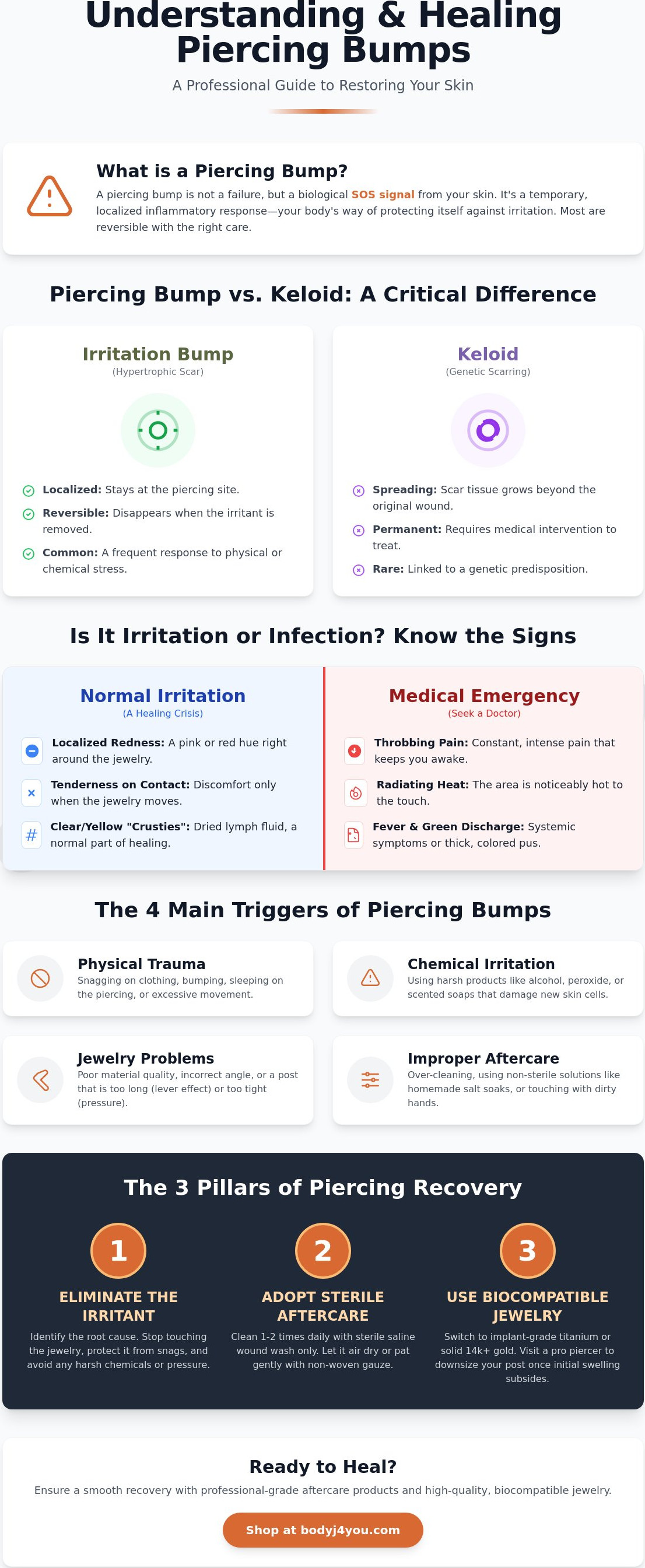
Understanding the root of the issue is the first step toward restoration. While these bumps can be frustrating, they stay localized to the entry or exit point of the wound. This is the primary way to distinguish Piercing Bumps vs. Keloids. While a standard bump is a manageable reaction to environmental stressors, a keloid is a genetic predisposition where scar tissue grows indefinitely beyond the original site. By identifying the bump as a signal rather than a permanent scar, you can transition from a state of anxiety to a proactive recovery mindset.
Common Symptoms of a Healing Crisis
Differentiating between normal healing and a developing bump requires a keen eye for detail. During a healing crisis, you might notice specific indicators that your skin is struggling to stabilize. These typically include:
- Localized Redness: A pink or red hue concentrated immediately around the jewelry.
- Physical Tenderness: A sharp or dull discomfort that occurs specifically when the jewelry shifts or is accidentally touched.
- Lymph Secretion: The presence of clear or pale yellow fluid that dries into "crusties" around the post.
When a Bump is Actually an Emergency
While most bumps are simply "angry" and irritated, you must remain vigilant for signs of a true bacterial infection. Irritation is a nuisance, but an infection is a medical priority. If you experience throbbing pain that keeps you awake, radiating heat that you can feel with your fingertips, or thick green discharge, the situation has escalated. Systemic symptoms like a sudden fever or swollen lymph nodes in the neck or jaw are clear indicators that you need professional medical attention immediately. Distinguishing between the discomfort of a piercing bump and the danger of an infection ensures you protect both your piercing and your health.
The Root Causes of Piercing Irritation: Why Bumps Form
A piercing bump doesn't manifest without a specific catalyst. It is an environmental reaction. It is a biological response. It is a sign of imbalance. To eliminate the bump permanently, you must first identify the environmental stressor that triggered your body's defense mechanism. Most people assume the bump is an infection, but it's usually the skin protesting against avoidable irritation.
Physical trauma is the most frequent culprit. Snagging your jewelry on a towel, bumping it while dressing, or the habit of "playing" with the post causes microscopic damage to the fistula. These micro-tears lead to localized inflammation. Similarly, chemical irritation occurs when you use products that are too aggressive for cellular repair. Harsh soaps, rubbing alcohol, and hydrogen peroxide destroy the new skin cells your body is trying to build. This chemical disruption often aligns with the clinical descriptions found in guides on How to Heal Your Piercing Bump.
Beyond external friction, internal forces often play a role. Common causes include:
- Pressure Necrosis: Jewelry that is too tight restricts blood flow, causing tissue distress and localized swelling.
- The Angle Issue: Piercings performed at a non-perpendicular angle exert uneven pressure on the fistula.
- Inappropriate Aftercare: Over-cleaning or using non-sterile solutions that disrupt the wound's pH.
The Downsizing Dilemma: Why Your Initial Jewelry is Too Long
Initial jewelry is intentionally long. Your piercer provides this extra room to accommodate the inevitable inflammatory swelling that follows a fresh wound. However, once that initial swelling subsides, that extra length becomes a liability. A long post creates a "lever effect" where every slight movement of the jewelry exerts massive force on the internal healing tissue. This constant rocking irritates the fistula, leading directly to the formation of irritation granulomas. Many enthusiasts miss this step, assuming their jewelry is fine because it was "professional." Downsizing is the professional practice of shortening a piercing post after 4-8 weeks to stabilize the jewelry and prevent this mechanical stress.
Material Matters: Surgical Steel vs. Titanium
Your body is sensitive to the elements you introduce to its internal environment. Nickel allergies are a leading cause of persistent piercing bumps, especially when using low-quality alloys. Plated metals or cheap acrylics can leach irritants directly into your bloodstream through the open wound. This chronic irritation prevents the skin from sealing properly. Transitioning to high-quality Internal Threaded Labret Studs is a critical step to minimize tissue trauma and eliminate the risk of nickel-induced reactions. High-quality materials like implant-grade titanium or surgical steel provide the purity your skin needs to finish the healing process without interruption. This upgrade doesn't just treat the bump; it secures the long-term health of your aesthetic investment.
Piercing Bumps vs. Keloids: Navigating the Critical Differences
Anxiety often stems from the unknown. When you first notice a protrusion near your jewelry, the mind immediately jumps to the worst-case scenario. Is it a permanent scar or a passing phase? Most often, what people fear is a keloid is actually a standard piercing bump or an irritation granuloma. These two issues are fundamentally different in their biology, their behavior, and their treatment. A standard bump is localized. It is reactive. It is reversible. It stays strictly at the site of the injury and responds predictably to a change in aftercare or jewelry quality.
In contrast, keloids are rare, invasive, and persistent. They are the result of a genetic predisposition where the body loses its ability to stop the scarring process. While an irritation bump appears within days or weeks of a trauma, a keloid often takes months to manifest. It doesn't just sit at the hole; it expands, migrates, and grows indefinitely beyond the original wound site. If your bump is flesh-colored, rubbery, and seems to be "taking over" the surrounding skin, it requires a dermatologist's intervention. However, if it's a small, red, or translucent mound that appeared after you snagged your earring, you're likely dealing with a manageable healing hurdle.
The Moisture Bump: A Hidden Culprit
Trapped water is a silent irritant that many enthusiasts overlook. When you leave your piercing damp after a shower, workout, or swim, the skin begins to macerate. This softening of the tissue creates a moisture bump. These specific bumps appear white, translucent, and slightly "soggy" compared to the firm, red appearance of a friction-based piercing bump. They are essentially small pockets of fluid trapped under a weakened skin barrier. To resolve this, professional piercers recommend a simple but effective pro tip: use a hairdryer on a cool, low setting to ensure the area is bone-dry after every cleaning. This eliminates the "greenhouse effect" that stagnant water creates around the jewelry post.
Hypertrophic Scarring: The Body's Overreaction
Sometimes the body's repair mechanism is simply too enthusiastic. During the proliferative phase of healing, your system may overproduce collagen in response to persistent movement or pressure. This results in hypertrophic scarring. These scars are firm, raised, and flesh-colored. They feel resilient to the touch and lack the "mushy" or "angry" texture of a granuloma. While they can be stubborn, they are not permanent. Consistent care with Saline Piercing Aftercare Spray and the use of specialized silicone therapy can help signal the body to flatten these overactive cells. By maintaining a stable, dry, and clean environment, you allow the skin to finish its remodeling process without further provocation.
The 2026 Recovery Protocol: How to Heal Your Piercing Bump Safely
Recovery is a deliberate process. It requires discipline. It requires the right chemistry. It requires patience. To permanently eliminate a piercing bump, you must move beyond guesswork and follow a structured, three-pillar recovery framework. This protocol is designed to stabilize the tissue, restore the skin's pH, and allow the body's natural healing mechanisms to take the lead. By treating the area as a delicate ecosystem, you transform a source of anxiety into a testament to your body's resilience.
The first step involves the total elimination of external trauma. Stop touching the jewelry. Stop sleeping on the side of the piercing. Stop allowing towels or clothing to snag the site. Even minor friction can reset the healing clock. Once the physical environment is secure, you must optimize the chemistry of the wound. Using a sterile saline spray for piercings ensures that the delicate fistula remains hydrated without the risk of bacterial contamination or chemical burns.
The Power of Sterile Saline and Healing Oils
Purity is the foundation of aesthetic recovery. A solution of 0.9% Sodium Chloride is the only external liquid that perfectly matches your body's internal chemistry. It is isotonic, which means it cleanses without dehydrating the new cells trying to bridge the wound. While saline provides the cleaning, a specialized Piercing Bump Treatment Oil provides the soothing. These formulations utilize natural anti-inflammatories to reduce redness and soften the tough, fibrous tissue of a hypertrophic scar. However, the most underrated tool in your kit is the LITHA Method: Leave It The Hell Alone. Your body is an expert at healing; your job is simply to provide the clean, stable environment it needs to work its magic.
Safe Cleaning Techniques for Delicate Tissue
Precision matters during the cleaning process. Aggressive scrubbing or rotating the jewelry only worsens the inflammation. Instead, use piercing cleaning swabs to gently lift away "crusties" or lymph buildup without disturbing the jewelry's position. This targeted approach prevents micro-tears in the healing fistula that can lead to a recurring piercing bump. 2-3 sprays of saline per day is the optimal frequency for 2026 aftercare standards. Over-cleaning is just as dangerous as neglect. It strips the skin's natural protective barrier and leaves the tissue vulnerable to further irritation. If the bump persists after fourteen days of this protocol, visit a professional for an audit of your jewelry length and piercing angle.
Restore your skin's health today by securing our Saline Piercing Aftercare Spray and starting your recovery journey.
Long-Term Prevention: Maintaining a Healthy, Bump-Free Piercing
Preventing a recurring piercing bump is an act of long-term stewardship. It requires vigilance. It requires quality. It requires consistency. Once the initial inflammation has subsided, your focus must shift from crisis management to sustainable health. Achieving a permanently flat, healthy piercing site is not a matter of luck; it is the result of intentional environmental control. Investing in high-quality materials like implant-grade titanium or biocompatible 14k gold is the most effective way to ensure your skin remains calm. These metals are biologically inert, meaning they won't trigger the inflammatory responses that lead to irritation. Additionally, using a 'donut' or travel pillow is a simple but transformative habit. By elevating the ear, you eliminate the nocturnal pressure that often causes fresh piercings to migrate or swell.
Consistency is the guardian of your aesthetic investment. Even after the visible signs of irritation have vanished, you should maintain a simplified aftercare routine. Regularly inspect your jewelry for any buildup of sebum or environmental debris. This "tarnish" or biological crust can act as a sandpaper-like irritant against the delicate internal fistula. By staying proactive, you ensure that your body remains in a state of repair rather than a state of defense.
Jewelry Hygiene and Maintenance
Maintaining the integrity of the fistula requires delicate handling. You should clean your jewelry regularly to prevent the accumulation of bacteria, but you must do so without removing the post. Withdrawing jewelry from a piercing that isn't fully matured risks immediate fistula collapse and internal trauma. For those with mature piercings, applying a small amount of Jojoba oil can keep the tissue supple and resilient against minor snags. You should never switch to 'fashion jewelry' or mystery alloys too early in the healing process. These pieces often contain nickel, which can trigger a persistent piercing bump even years after the initial procedure. Stick to the purity of professional standards to protect your skin's long-term health.
The Importance of Professional Check-ups
A six-month check-up with a specialist acts as a vital safety net. These visits allow for the early detection of migration or subtle shifts in jewelry angle that could lead to future complications. If you encounter unexpected resistance in your healing journey, consult our comprehensive how to get rid of piercing bump master guide for advanced troubleshooting. Patience is your most powerful ingredient. True healing is a slow, biological remodeling that cannot be rushed. By combining professional-grade materials with disciplined aftercare, you ensure that your piercings remain a vibrant and healthy expression of your unique identity.
Restore Your Skin’s Natural Radiance
Navigating a piercing bump requires a blend of clinical precision and unwavering patience. You now have the tools to identify environmental triggers, distinguish between irritation and scarring, and implement a sterile recovery protocol. Your skin is a delicate ecosystem that thrives on stability, purity, and protection. By choosing biocompatible materials and maintaining a disciplined aftercare routine, you ensure your journey of self-expression remains healthy. It’s about more than just healing; it’s about reclaiming your confidence and comfort.
At BodyJ4You, we bring over 20 years of industry expertise to your recovery process. Our aftercare solutions are locally manufactured in the USA using dermatologically-conscious ingredients that prioritize your long-term wellness. We stand by a philosophy that is safe, ethical, and effective. You deserve a healing experience that is as refined as your aesthetic. Shop the BodyJ4You Piercing Bump Treatment Kit today to begin your transformation. Your skin is resilient. Your style is unique. Your healthy recovery starts now.
Frequently Asked Questions
How long does it take for a piercing bump to go away?
A typical piercing bump takes two to six weeks to resolve once you remove the primary irritant. This timeline depends on the severity of the initial trauma and the consistency of your recovery protocol. If you continue to sleep on the piercing or use harsh chemicals, the inflammation will persist indefinitely. Focus on stabilization, hydration, and patience to see a visible reduction in the size of the protrusion.
Can I pop a piercing bump like a pimple?
You should never attempt to pop or squeeze a piercing bump under any circumstances. Unlike a pimple, these mounds are often composed of dense collagen or vascular tissue rather than trapped sebum. Forcing them open causes significant trauma, introduces bacteria, and can lead to permanent scarring. This physical aggression resets the healing clock and often makes the protrusion larger and more painful than before.
Does tea tree oil actually help with piercing bumps?
Pure tea tree oil is generally too aggressive for the delicate tissue of a healing wound. While it has antiseptic properties, its high concentration often causes chemical burns and extreme dehydration. This worsens the irritation rather than soothing it. Instead, prioritize isotonic solutions like a Saline Piercing Aftercare Spray to maintain the skin’s natural pH and biological integrity without risking a chemical reaction.
Should I take my jewelry out if I have a bump?
You shouldn't remove your jewelry if you discover a bump unless a medical professional instructs you to do so. Taking the jewelry out allows the fistula to collapse and close rapidly. This can trap bacteria or fluid inside the tissue, potentially leading to a localized abscess. If the jewelry is the cause of the irritation, a professional should perform a controlled swap to a higher-quality material.
What happens if a piercing bump won't go away after treatment?
If a bump persists after several weeks of proper care, you need a professional audit of your jewelry. This usually involves checking the piercing angle or downsizing the post to eliminate mechanical friction. Sometimes the body requires a change in jewelry material to implant-grade titanium or gold. Persistent issues that grow or change texture should be evaluated by a dermatologist to rule out more complex skin conditions.
Is a nose piercing bump different from an ear piercing bump?
The biological response of a nose piercing bump is identical to one on the ear, though the triggers often differ. Nose piercings are more susceptible to irritation from skincare products, makeup, and accidental snags during face washing. Ear piercings are more frequently bothered by hair products, phone use, and sleep pressure. Both require the same clinical attention to hygiene and the removal of physical stressors.
Can a piercing bump turn into a keloid?
A standard piercing bump cannot biologically transform into a keloid. These are two distinct types of tissue responses. A bump is a reactive inflammatory condition caused by external factors; a keloid is a genetic overproduction of scar tissue. While they look similar in the early stages, their causes and long-term behaviors are entirely different. Most people with irritation bumps don't have the genetic predisposition for keloids.
How do I know if my piercing bump is infected?
You can identify an infection by the presence of radiating heat, throbbing pain, and thick green or foul-smelling discharge. While a normal bump might be slightly tender or pink, an infection often presents with spreading redness and systemic symptoms like fever. If you notice these warning signs, seek medical advice immediately. True infections require professional intervention rather than just a change in your daily aftercare routine.


