


Cartilage isn’t an earlobe, and treating it like one can turn a style change into an injury. If you’re wondering how to stretch cartilage piercings safely, start by understanding that cartilage has less blood supply and tends to heal more slowly than soft earlobe tissue. That difference matters when deciding whether, and when, to change a jewelry size.
Wanting a particular look is understandable. So is feeling unsure when advice about tapers, jewelry, and timing doesn’t agree. Cartilage stretching calls for patience and attention to how your ear feels, not pressure to reach a larger size.
This guide explains how cartilage differs from earlobes, what can go wrong if tissue is stretched too quickly or forcefully, and which warning signs mean you should stop. It also covers what to consider before changing jewelry, why forcing it through resistance isn’t a safe shortcut, and when to seek assessment from a professional piercer or medical clinician. Protecting your ear matters more than reaching a target size.
Key Takeaways
- Cartilage behaves differently from earlobe tissue, so any size change calls for extra caution.
- Learning how to stretch cartilage piercings safely starts with recognizing that a taper or slow pressure doesn’t make forcing jewelry safe.
- Before changing jewelry size, consider whether the piercing is fully healed and symptom-free. A qualified piercer can assess the next step.
- Know which warning signs mean you should stop and seek professional or medical assessment.
- Gentle routine care and less pressure or handling can support ear health. Keeping the current size may be the safest choice.
How cartilage piercings differ from earlobes, and why that matters
Cartilage isn’t earlobe tissue, and forcing a larger size through it can cause harm. Stretching deliberately enlarges a piercing channel over time. That’s different from replacing jewelry with another piece that fits the already-healed channel. A routine jewelry change shouldn’t require pressure or create a larger opening.
Cartilage-piercing channels pass through firm cartilage rather than the soft tissue of the earlobe, and they generally heal more slowly. The overview of cartilage piercing types and healing offers context on piercing locations and healing. Cartilage has less blood supply than the lobe, so irritation or a small tear may take longer to settle and can lead to lasting tissue changes.
What makes cartilage different from an earlobe?
The earlobe is soft and flexible. Cartilage, found in areas such as the upper ear, is firmer and helps the ear hold its shape. Stretching puts pressure on the piercing channel and surrounding tissue. In cartilage, that pressure may cause inflammation or injury in tissue that doesn’t recover like a soft lobe. Healing and anatomy vary by person and piercing location, so don’t assume an earlobe stretching schedule suits cartilage.
Is stretching a cartilage piercing considered safe?
There’s no universally safe DIY method to recommend for deliberately stretching cartilage. Moving slowly or using a taper doesn’t remove the risk of trauma, and jewelry should never be forced through resistance. Sharp pain, bleeding, or significant swelling are reasons to stop, not push through.
A routine jewelry change is not the same as stretching. If a piercing is fully healed and symptom-free, replacing jewelry with a piece that fits its existing channel may be possible. Discomfort or resistance is a reason not to force the change. Deliberately enlarging the channel is a different decision and calls for a cautious assessment by a qualified piercer. If the area is hot, increasingly red or swollen, very painful, or has discharge, seek medical advice rather than attempting a size change. When considering how to stretch cartilage piercings safely, protecting the tissue comes before reaching a larger gauge.
Why tapers and forced size changes can injure cartilage
A taper can make a size change look controlled, but it doesn’t make cartilage stretching safe. Its gradual shape still applies pressure as it moves through the piercing channel. If the tissue isn’t ready or the jewelry doesn’t pass freely, that pressure can irritate or injure it. Guidance about stretching earlobes shouldn’t be treated as a cartilage-specific method.
Why a taper is not a safety guarantee
A taper is a tool, not jewelry. Using one to overcome resistance can cause trauma rather than gently guide a change. Cartilage’s structure helps explain why caution matters: the Cleveland Clinic describes the anatomy and function of cartilage, which differs from soft tissue in how it supports the body. A gradual-looking tool can’t remove the risks of putting pressure on a piercing channel.
Resistance is a stop signal, not a cue to apply more pressure. Pain, bleeding, or swelling during a change are also reasons to stop. Don’t push jewelry farther in or use a taper to make it fit. Leave the area alone and seek assessment from a qualified piercer. If symptoms are concerning or worsening, contact a medical professional.
Risks to understand before changing cartilage jewelry
Pressure or friction may cause tenderness, irritation, or tissue injury. A tear can take time to settle and may heal with scar tissue, which can affect the piercing’s appearance or make future jewelry changes more difficult. Discomfort alone doesn’t confirm a particular injury, but it should never be ignored or pushed through.
Infection is another risk if the skin is damaged or bacteria enter the area. Cartilage infections can need prompt medical assessment, especially if redness, warmth, pain, or swelling is increasing, or there’s discharge or fever. These signs don’t prove an infection, but they warrant medical advice rather than experimenting with jewelry or home treatment.
If you’re researching how to stretch cartilage piercings safely, the most protective choice may be not to stretch at home. A qualified piercer can assess whether the piercing appears ready for a jewelry change. A clinician should assess possible infection or significant injury. For gentle routine piercing care, explore saline piercing aftercare spray. It isn’t a treatment for injury or infection.
Cartilage versus earlobe stretching: safer choices and common methods
Stretching advice often describes earlobes, but the softer lobe and firm cartilage aren’t interchangeable. A method discussed for gradually sizing up an earlobe doesn’t prove that the same approach is safe for cartilage. The location changes the tissue involved and the risks to consider.
| Situation | Tissue | Common discussion | Key caution |
|---|---|---|---|
| Earlobe stretching | Soft, flexible tissue | Gradual stretching is commonly discussed in ear-stretching guidance. | Advice still depends on healing and should never mean forcing jewelry. |
| Cartilage stretching | Firm cartilage framework | There’s no universal DIY method to recommend. | Don’t apply earlobe routines or size charts to cartilage. |
| Routine jewelry change | The existing piercing channel | Replacing jewelry without enlarging the channel. | Stop if jewelry meets resistance or causes pain; don’t force it. |
Why earlobe stretching advice does not automatically apply
Location matters. Earlobe guidance is written for soft tissue, while a cartilage piercing passes through a firmer structure with different healing considerations. A chart can explain gauge terminology, but it can’t tell you whether cartilage is ready or safe to stretch. See the ear gauge size chart for sizing language only, not as a cartilage stretching plan. Earlobe-focused kit guidance also shouldn’t be used to justify changing cartilage size.
Stretching, dead stretching, and changing jewelry
Stretching deliberately enlarges a piercing channel. Dead stretching refers to allowing a fully healed, elastic piercing to accommodate larger jewelry without a taper. It’s discussed in lobe-stretching resources, not as a cartilage recommendation. A jewelry change replaces a piece with one that fits the channel as it is. If it doesn’t slide in comfortably, stop rather than applying pressure.
When learning how to stretch cartilage piercings safely, don’t assume a lobe method transfers simply because it’s gradual or taper-free. Leaving a cartilage piercing at its current size is a valid, protective choice. For general care after a piercing or jewelry change, the Association of Professional Piercers shares professional piercing aftercare guidelines.
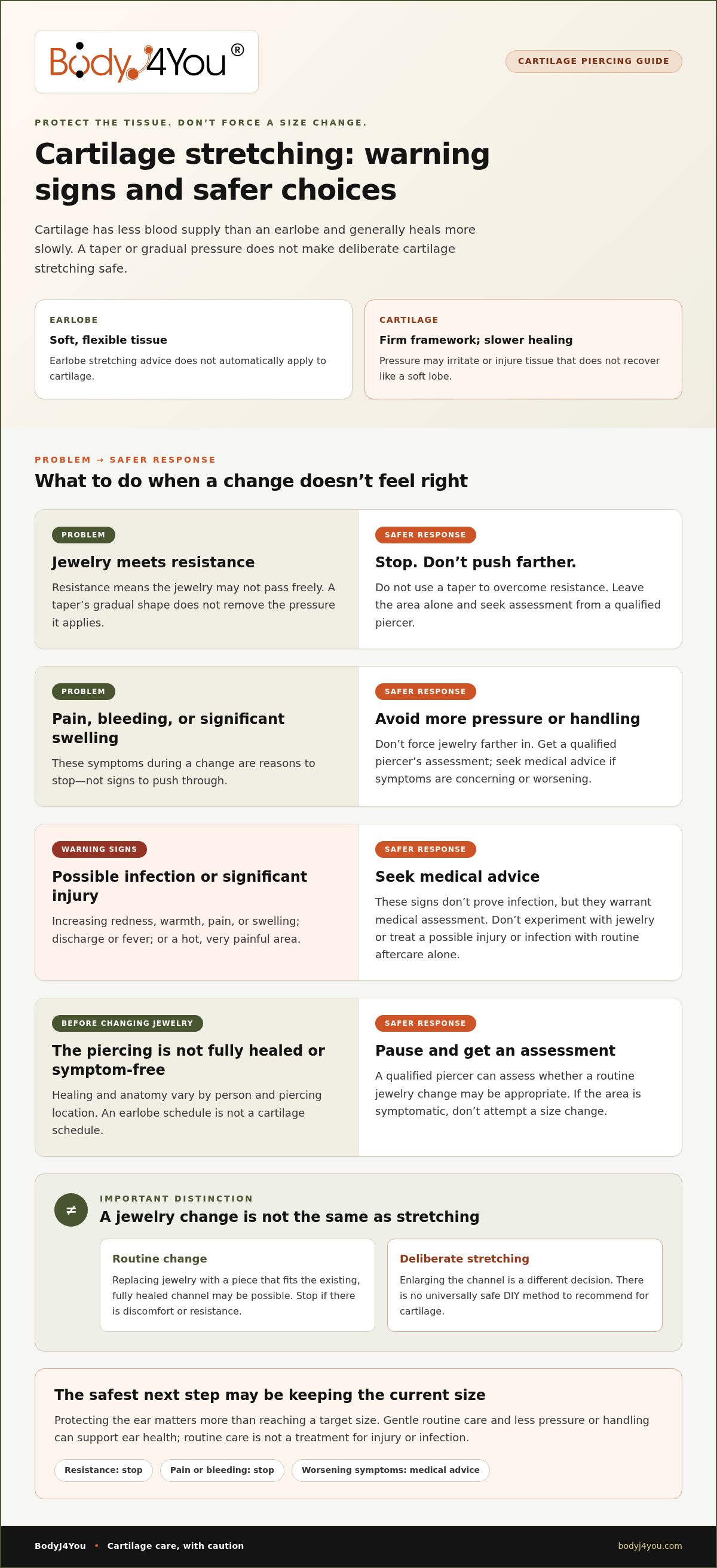
A safer step-by-step plan before changing a cartilage piercing
Before considering a larger size, pause and assess the piercing rather than testing it with new jewelry. There’s no universally safe DIY method for stretching cartilage. A qualified piercer can assess the piercing and advise whether a jewelry-size change is appropriate. Never force a change.
- Ask whether it’s fully healed and symptom-free. If it’s fresh, tender, irritated, or showing new symptoms, don’t change the jewelry or try to stretch it.
- Don’t rely on a calendar alone. Healing varies by person and piercing location. A fixed timeline can’t confirm that the tissue is ready.
- Get a professional assessment before changing size. Don’t test the channel by pushing in larger jewelry. If your goal is a larger channel, discuss the risks with a qualified piercer rather than attempting DIY stretching.
- Stop at any warning sign. Pain, pressure, resistance, bleeding, or new swelling means stop. Don’t force the jewelry or try repeatedly.
- Seek medical care for concerning symptoms. Worsening redness, warmth, swelling, discharge, severe pain, or fever calls for prompt medical assessment.
Check the piercing before considering a jewelry change
A piercing can look calm on the surface while still being unsettled. Don’t treat the absence of obvious irritation as proof that it’s ready for a larger size. A professional assessment is safer than testing the channel yourself. If your aim is simply to replace the jewelry, explain that so the assessment can focus on a change that doesn’t enlarge the piercing.
What to do if the area becomes painful or swollen
Leave it alone. Avoid twisting, pressing, repeated jewelry changes, or sleeping on the sore area. If infection is possible, don’t remove the jewelry unless a medical professional advises you to. Get medical guidance promptly, especially if symptoms are worsening or you have a fever. Piercing aftercare can support gentle routine cleaning, but it can’t diagnose or treat an infection.
If you’re researching how to stretch cartilage piercings safely, the most useful decision may be to wait for an assessment or keep the piercing at its current size. For gentle routine care, explore saline piercing aftercare spray. It isn’t a treatment for pain, injury, or infection.
Keep cartilage healthy: aftercare and the right next step
The safest choice may be to keep your cartilage piercing at its current size. Protecting the tissue matters more than reaching a target gauge. Choosing not to stretch is a considered decision, not a setback. If a jewelry change is appropriate, the new piece should fit the existing channel comfortably. Changing jewelry and deliberately enlarging a piercing are different actions.
Simple aftercare without over-cleaning
Keep routine care gentle. Clean the area as appropriate for your piercing and follow the directions for any aftercare product you use. Avoid twisting or repeatedly moving the jewelry, pressing on the piercing, and touching it unnecessarily. Over-cleaning or trying several products can add irritation rather than make the area more comfortable.
Sterile saline can support routine cleansing, but it doesn’t treat damaged tissue or cure an infection. If you’re unsure about everyday care, read this sterile saline aftercare guide. Don’t rely on saline in place of medical advice if the area is increasingly painful, hot, swollen, or producing discharge.
Avoid treating alcohol, harsh chemicals, or unverified home remedies as universal solutions. What feels soothing at first may irritate sensitive tissue, and a product meant for routine cleansing isn’t a substitute for assessment when symptoms appear. If discomfort or swelling develops, reduce handling and seek advice from an appropriate professional instead of experimenting with more products or another jewelry change.
Choose comfort and tissue health over a target size
Jewelry should feel comfortable in a healed piercing, without pressure or persistent tenderness. If it catches, feels tight, or causes irritation, don’t force it. Pause and seek assessment from a qualified piercer before trying another change. A larger size isn’t automatically a better fit or a safer choice.
When researching how to stretch cartilage piercings safely, remember that caution can mean staying where you are. Keep the piercing at its current size if stretching doesn’t feel right, and focus on gentle care and comfortable jewelry rather than a size goal.
BodyJ4You offers body jewelry and aftercare products for personal piercing routines. Browse the body jewelry and aftercare range to find options for comfortable jewelry and gentle routine cleansing. No quick size change is worth compromising your tissue health.
Put tissue health first in your next piercing decision
Cartilage isn’t an earlobe, so stretching advice for soft lobes shouldn’t be treated as a cartilage routine. There’s no universally safe DIY method to recommend. If jewelry meets resistance or causes pain, pressure, bleeding, or swelling, stop rather than push through. A qualified piercer can assess a possible jewelry change, while worsening symptoms or signs of infection call for medical advice.
Learning how to stretch cartilage piercings safely may lead to a choice that feels unexpected: keeping the piercing at its current size. That can be a thoughtful way to protect your ear, not a failure to reach a look you want. Comfort, patience, and informed decisions matter more than a target gauge.
BodyJ4You offers body jewelry and aftercare, including a U.S.-manufactured skincare line. Explore BodyJ4You body jewelry and piercing aftercare for products to support your routine. Whatever you choose next, let your ear’s comfort guide you.
Frequently Asked Questions
Can you stretch a cartilage piercing safely?
There’s no universally safe DIY method to recommend for stretching cartilage. Cartilage differs from soft earlobe tissue, and forcing a larger size can injure the piercing. If you’re considering a size change, have a qualified piercer assess the piercing first. Stop if you feel pain or pressure, or notice resistance, bleeding, or swelling. The safest option may be keeping the piercing at its current size.
Is stretching cartilage different from stretching an earlobe?
Yes. Earlobes are made of soft, flexible tissue, while cartilage piercings pass through firmer tissue with different healing and injury considerations. Advice commonly discussed for gradual earlobe stretching, including dead stretching, shouldn’t automatically be applied to cartilage. A method or timeline discussed for lobes doesn’t establish that cartilage stretching is safe. Consider the piercing location and tissue health before any jewelry-size change.
Can I use a taper to stretch a helix or conch piercing?
A taper shouldn’t be used to force a larger size into a helix or conch piercing. Even though it’s shaped to increase gradually, it can still apply pressure and injure tissue. Tapers are tools, not jewelry, and moving slowly doesn’t guarantee safety for cartilage. Don’t push past resistance or pain. If you’re considering a jewelry change, have a qualified piercer assess the piercing rather than attempting a DIY stretch.
How long should I wait before changing cartilage piercing jewelry?
Wait until the piercing is fully healed, not simply until a fixed number of weeks or months has passed. Cartilage piercings can take 6 to 12 months or longer to heal, and healing varies by person and location. A qualified piercer can assess whether a routine jewelry change may be appropriate. Changing jewelry within the existing channel is different from deliberately stretching it to a larger size.
What happens if cartilage piercing jewelry will not go in?
Stop and don’t force it. Resistance may mean the jewelry isn’t aligned, the channel has tightened, or the tissue is irritated. Forcing it can cause injury. Avoid repeated attempts, pushing harder, or using a taper to make it fit. Leave the area alone and seek advice from a qualified piercer. If there’s bleeding, significant swelling, worsening pain, or other concerning symptoms, get medical assessment.
What should I do if my cartilage piercing becomes swollen or painful?
Stop handling or changing the jewelry, and avoid pressure on the sore area. Seek prompt medical care if you notice worsening redness, heat, swelling, discharge, severe pain, or fever. These signs need assessment and don’t confirm a diagnosis on their own. If you suspect infection, don’t remove the jewelry unless a medical professional advises you to. A piercer can advise on jewelry concerns, but medical symptoms need clinical attention.
Can saline spray make an irritated cartilage piercing heal faster?
No. Saline spray can be used for gentle routine cleansing, but it isn’t a treatment that makes cartilage heal faster, and it doesn’t prevent or cure infection or tissue injury. Follow the product directions and avoid over-cleaning or unnecessary handling. If irritation persists or symptoms worsen, including increasing warmth, swelling, pain, or discharge, seek medical advice rather than relying on saline alone.


