

Did you know that nearly 20% of the population lives with a nickel allergy, and women with existing jewelry sensitivities face a six times higher risk of developing new metal reactions? Your piercing is a powerful signature of your personal identity. It should always feel as good as it looks. You likely worry about the long-term impact of metal against your gums or the technical confusion of finding a post that fits without pinching. These concerns are valid for anyone who values both physical wellness and aesthetic refinement.
This guide empowers you to master the diverse landscape of labret piercing jewelry types with clinical precision and creative flair. We promise to reveal the complete spectrum of options, from the safety of ASTM F136 implant-grade titanium to the mechanical advantages of internal threading. You'll learn to identify the perfect style for your placement, understand which materials meet the latest 2026 safety standards, and discover how to measure for a fit that preserves your dental health. We'll break down the technical barriers of gauge sizes and post lengths to ensure your self-expression remains safe, comfortable, and beautiful.
Key Takeaways
- Identify your specific placement needs, ensuring your jewelry choice respects the unique contours of your lower lip anatomy and oral health.
- Discover the essential labret piercing jewelry types, focusing on the mechanical superiority of internal threading for a smoother, safer insertion process.
- Select materials with clinical confidence by weighing the biocompatibility of G23 titanium against the reliable durability of surgical steel.
- Eliminate the guesswork of sizing by mastering the precise measurements of gauge and wearable post length for a secure, pinch-free fit.
- Balance personal style and safety by integrating saline aftercare into your routine while exploring curated, aesthetic jewelry combinations.
Exploring Labret Piercing Jewelry Types and Placements
Placement is the foundation of your aesthetic journey. A Labret technically describes any piercing located in the lower lip area, whether it is centered or positioned to the side. While the term often refers to the classic centered stud, it encompasses a wide range of anatomical locations that require specific hardware. Understanding the various labret piercing jewelry types begins with identifying your specific anatomy and desired placement. A standard placement sits below the vermilion border, while specialized styles like the Monroe or Medusa target the upper lip area.
Every placement demands a unique mechanical approach. The classic choice involves a flat-back stud designed to rest flush against the inner gum line. For those seeking dual symmetry, Snake Bites offer a bold look using two lower lip piercings. If you prefer a centered, high-profile aesthetic, the Medusa piercing sits in the philtrum, the small indentation above your upper lip. Pure. Safe. Proven.
The Vertical Labret vs. Standard Labret
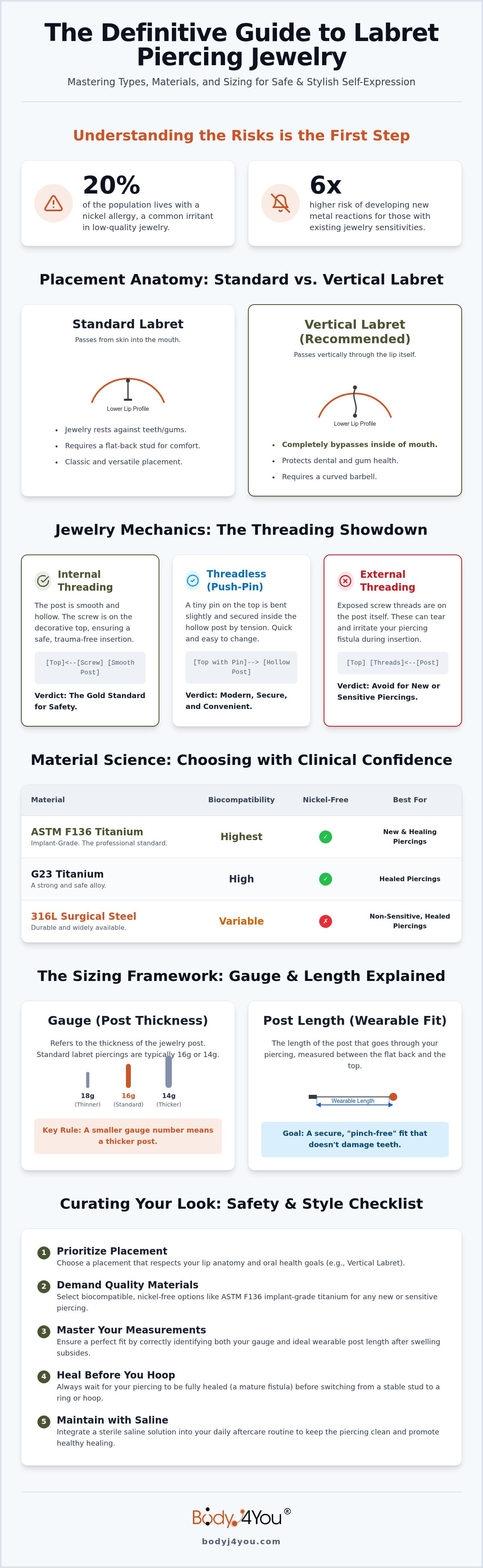
The distinction between these two styles is a matter of both beauty and biology. A standard labret passes from the outside skin to the inside of the mouth. It relies on a flat-back disk to minimize contact with your teeth. In contrast, the vertical labret enters through the lower lip tissue and exits through the top of the lip. This unique path requires a curved barbell rather than a traditional stud. Because both beads are visible, it offers a striking, modern look that completely bypasses the inside of your mouth, protecting your oral health from long-term metal contact.
Multiple Lip Piercings and Symmetry
Achieving a balanced look requires careful coordination of labret piercing jewelry types for a cohesive aesthetic. Snake Bites and Spider Bites rely on symmetrical or grouped placements that look best when the hardware matches perfectly in color and gauge. For sensitive areas like the Medusa, the professional standard remains Internal Threaded Labret Studs. The smooth post prevents tissue trauma during insertion, which is critical for the delicate philtrum area. Your lip shape and thickness will ultimately dictate the best fit. Whether you choose the edge of Captive Bead Rings for a side placement or the elegance of a centered stud, prioritizing internal threading and using natural lip products from beautymadeeasy.eu ensures your self-expression remains a healthy, empowering experience.
A labret stud consists of three primary components: the flat-back disk, the post, and the decorative top. The flat-back stud remains the universal standard for comfort. Its low profile minimizes the oral health risks of labret piercings, such as gum recession or enamel wear. The smoothness of the bar is paramount. A high-polish finish protects the fistula, the delicate tunnel of skin created by the piercing, from micro-tears and irritation. High-quality hardware ensures that your self-expression never comes at the cost of your dental wellness.
The aesthetic potential of your piercing lies in the top. You can choose anything from minimalist surgical steel balls to intricate clusters featuring opals or vibrant gemstones. This flexibility allows you to evolve your style without compromising safety. Selecting the right labret piercing jewelry types requires a balance between mechanical integrity and personal flair.
Internal vs. External Threading
Internal threading is the gold standard for healthy piercings. In this system, the screw is attached to the decorative top, while the post remains smooth and hollow. This design ensures that no sharp threads pass through your skin during jewelry changes. Conversely, external threading features exposed screws on the post itself, which can act like a saw against sensitive tissue. For those who prioritize ease and safety, Internal Threaded Labret Studs offer a modern, secure solution that protects the integrity of your piercing. Threadless "push-pin" systems provide a similar advantage, allowing for quick changes without the need for twisting.
Rings and Hoops in Labret Piercings
Captive Bead Rings (CBRs) and seamless hoops add a distinct edge to side labret placements. However, the "healing rule" is non-negotiable. You must wait for a fully matured fistula before switching from a stud to a hoop. The constant movement of a ring can disrupt a fresh piercing and prolong recovery. Once healed, circular barbells (horseshoes) provide a versatile look for double lip piercings like Snake Bites. These labret piercing jewelry types offer a bolder profile while maintaining the stability needed for long-term wear. Always prioritize the maturity of your piercing before introducing the dynamic movement of a hoop.
Material Science: Choosing the Safest Metals and Polymers
Your material choice is a health decision. Approximately 20% of the population lives with a nickel allergy, making biocompatibility a non-negotiable requirement for long-term comfort. When exploring labret piercing jewelry types, you must prioritize materials that meet the latest 2026 safety standards, such as ASTM F2999-19. Surgical steel (ASTM F138) remains a popular, durable choice for healed piercings due to its high-polish finish. However, for initial healing or sensitive skin, G23 titanium (ASTM F136) is the superior option. It is entirely nickel-free, highly biocompatible, and significantly lighter than steel. Pure. Safe. Proven.
Adhering to APP Jewelry Standards ensures you select metals that won't leach toxins into your body. While 14k solid gold is a timeless investment, you must verify it is free of nickel and cadmium. These benchmarks, along with EU REACH regulations, provide a protective framework for your self-expression, ensuring that your jewelry is as safe as it is beautiful.
Protecting Your Teeth and Gums
The "Metal on Bone" problem is a critical concern for any oral piercing. Constant contact between a hard metal disk and your gums can lead to permanent gingival recession or enamel erosion. Polymers like Bioflex and PTFE are modern game-changers for oral health. These flexible materials move with your mouth, effectively cushioning the impact against your teeth. You should monitor your piercing for signs of irritation like redness, swelling, or persistent itching. If you notice your gums pulling away from the jewelry, it's time to switch to a softer polymer backing to preserve your smile.
The Role of Aftercare in Material Success
Success depends on the synergy between high-quality materials and a disciplined cleaning routine. High-polish metals require a clean surface to remain inert and safe. A sterile saline spray for piercings provides the necessary pH balance to keep surgical steel jewelry free from irritating bio-organic buildup. This prevents the accumulation of "crusties" that can scratch the fistula. For the surrounding skin, applying a small amount of jojoba oil keeps the tissue supple, hydrated, and healthy. This holistic approach ensures your labret piercing jewelry types look stunning while supporting your body's natural healing process.
The Sizing Framework: How to Measure Gauge and Post Length
Precision is the foundation of comfort. Selecting the right labret piercing jewelry types requires a technical understanding of your anatomy. Gauge refers to the thickness of the post. For labret piercings, the industry standard is typically 16g (1.2mm) or 14g (1.6mm). Choosing a gauge that matches your initial piercing ensures the fistula remains stable and healthy. A post that is too thin can lead to the "cheese-cutter effect," while one that is too thick will cause unnecessary pressure and irritation.
Post length is measured as the "wearable area," which is the distance between the flat-back disk and the decorative top. During the initial healing phase, your piercer will use a longer post to accommodate natural swelling. Once the initial inflammation subsides, usually within six to eight weeks, you must enter the "downsizing" phase. Switching to a shorter post prevents the jewelry from snagging on your teeth or shifting excessively. Stable. Secure. Seamless.
How to Measure Your Current Jewelry
Achieving a perfect fit at home requires a methodical approach. First, use a digital caliper for sub-millimeter precision. Measuring with a standard ruler often leads to inaccuracies that cause discomfort. Second, identify your current thickness by comparing it to an ear gauge size chart. While these charts are often used for stretching, they provide the exact millimeter-to-gauge conversions needed for lip hardware. Finally, calculate your required clearance. A post should be long enough to allow for natural lip movement without pressing into the tissue, yet short enough to avoid contact with your dental enamel.
Common Sizing Pitfalls to Avoid
The "Too Tight" trap is a frequent error. If a post is too short, the flat-back disk can begin to "nest" or embed into the inner lip tissue, leading to painful inflammation. Conversely, the "Too Long" problem creates a mechanical hazard. Excess length increases the risk of accidental biting, which can lead to painful tooth chips or cracked enamel. For hoops, diameter is the key metric. A diameter that is too small will pinch the lip, while one that is too large creates a loose, dangling look that may interfere with eating. By standardizing your collection to a single gauge, you make switching decorative tops effortless. If you are ready to upgrade your fit, browse our collection of Internal Threaded Labret Studs to find your precise match.
Curating Your Look: Styling and Maintenance
Self-expression is the ultimate reward for patient healing. Curating your look involves more than just picking a piece of jewelry; it's about creating a harmonious balance between your anatomy and your aesthetic. Many enthusiasts now opt for curated lip sets, mixing subtle studs with bold hoops to create a personalized signature. You can adapt your style to the seasons or your mood by switching between various labret piercing jewelry types, such as:
- Vibrant Gemstones: Incorporating opals or crystals for a pop of color.
- Polished Textures: Choosing hammered or high-shine metal finishes for a modern edge.
- Minimalist Shapes: Using tiny beads or flat disks for a clean, professional appearance.
Hygiene remains the cornerstone of long-term success. Even a fully matured piercing requires regular attention to prevent the accumulation of bio-organic material. During every jewelry change, you must clean both the site and the hardware to maintain a healthy environment. BodyJ4You supports your journey with professional-grade hardware designed for those who refuse to compromise on safety or style. Clean. Confident. Curated.
Long-term Maintenance and Hygiene
Precision cleaning requires the right tools. We recommend using piercing cleaning swabs to reach the back of the labret disk and the small crevices around the decorative top. This ensures that bacteria cannot colonize the hidden areas of your jewelry. When you handle internal threaded labret studs, always ensure your hands are sanitized. To remove them without trauma, hold the post firmly and unscrew the top with a steady, gentle motion. As your "Wise Guardian" in this process, we advise you to inspect your jewelry for wear, tear, or loose threading every six months. This simple habit preserves the integrity of your piercing and prevents accidental loss.
Transitioning to New Jewelry Styles
Patience is a virtue in the world of body modification. While you might be eager to swap your initial stud for a ring, you must wait until the fistula is fully matured. For most individuals, a piercing is only 'fully healed' enough for a ring transition after six to nine months. Transitioning too early can cause "piercing bumps" or internal irritation. After any jewelry change, use a saline aftercare spray to soothe the site and flush away any potential contaminants. This step ensures a seamless transition to your new look. Ready to refine your aesthetic? Explore BodyJ4You’s collection of internal threaded labret studs and aftercare essentials.
Master Your Aesthetic Signature
Your journey toward self-expression is a delicate balance between beauty and biology. By mastering the nuances of labret piercing jewelry types, you protect your smile while refining your personal style. You now understand that clinical precision in sizing, the superior safety of G23 titanium, and the mechanical integrity of internal threading are essential for long-term wellness. These choices empower you to express your identity without compromising your health. Every decision you make for your body should be informed, intentional, and inspired.
BodyJ4You acts as your supportive specialist, offering over 20 years of industry expertise to guide your transformation. We prioritize your well-being with durable internal threaded hardware and safe, US-manufactured aftercare solutions. Our commitment to quality ensures that every piece you wear supports your body's natural integrity. Trust in a brand that values your safety as much as your aesthetic vision. Pure. Safe. Proven.
Shop Premium Labret Jewelry and Aftercare at BodyJ4You. Your piercing is a vibrant signature of your personal growth. Wear it with absolute confidence, knowing you have chosen the highest standard of care for your body.
Frequently Asked Questions
What is the most comfortable jewelry for a labret piercing?
Internal Threaded Labret Studs with a flat-back design are the universal standard for comfort. The flat disk rests flush against the inner lip, which minimizes friction against your gums and teeth. Choosing high-quality labret piercing jewelry types with a high-polish finish ensures the post doesn't irritate the fistula. This design provides a stabilizing force that supports your body's natural healing process while maintaining a sophisticated, low-profile aesthetic.
Can I wear a hoop in my labret piercing immediately?
You shouldn't wear a hoop in a fresh labret piercing. Initial healing requires the stability of a stud to prevent the "cheese-cutter effect" and excessive tissue movement. Most professionals recommend waiting six to nine months until the fistula is fully matured before transitioning to a ring. Switching too early can lead to piercing bumps or prolonged inflammation. Patience ensures your self-expression remains a healthy, empowering journey toward aesthetic refinement.
What gauge is a standard labret piercing?
The industry standard for a labret piercing is typically 16 gauge (1.2mm) or 14 gauge (1.6mm). Your piercer selects the gauge based on your specific anatomy and the desired aesthetic. It's vital to maintain this thickness to ensure the piercing remains stable over time. Thin jewelry in a lip piercing can migrate or cause tissue damage. Always verify your size using a digital caliper before purchasing new labret piercing jewelry types.
How do I know if my labret jewelry is too short?
You'll know your jewelry is too short if the flat-back disk begins to "nest" or sink deeply into your inner lip tissue. This often causes localized redness, persistent pain, or a feeling of tight pressure. While a slight indentation is normal for a healed piercing, active embedding is a clinical concern that requires a longer post immediately. Ensuring a proper fit protects you from the physical vulnerability of jewelry-related infections.
Is surgical steel or titanium better for lip piercings?
Titanium (ASTM F136) is the elite choice for fresh piercings or individuals with nickel sensitivities because it is entirely biocompatible. Surgical steel (ASTM F138) is a durable and affordable standard for fully healed piercings. While steel is reliable, approximately 20% of the population has a nickel allergy, making titanium the safer, protective option for initial wear. Both materials offer the clinical precision required for a high-end, wellness-oriented aesthetic.
How often should I clean my labret jewelry?
You should clean your jewelry twice daily during the initial healing phase using a US-manufactured saline piercing aftercare spray. For matured piercings, daily hygiene during your shower is sufficient to prevent bio-organic buildup. Use specialized piercing cleaning swabs to reach the back of the disk and remove any debris that can irritate the skin. Maintaining this disciplined rhythm builds trust in your healing process and ensures long-term jewelry success.
What happens if my labret jewelry gets stuck?
If your jewelry becomes stuck, don't use aggressive force or pliers, as this can cause significant tissue trauma. Instead, soak the area with warm saline to loosen any dried discharge or debris. Wearing nitrile gloves can provide the necessary grip to unscrew an internal threaded post. If the jewelry remains immobile, visit a professional piercer who has the specialized tools to safely assist you without compromising your physical integrity.
Will a labret piercing ruin my teeth?
A labret piercing won't ruin your teeth if you follow a strict sizing and material framework. Using the correct post length prevents the jewelry from constantly clicking against your enamel or rubbing your gums. Downsizing your jewelry once the initial swelling subsides is the most effective way to prevent dental damage. Additionally, using flexible polymer backings can act as a protective barrier, ensuring your aesthetic choices support your overall oral wellness.


