

Did you know that nearly 77% of all piercing complications are minor bacterial infections, often triggered by improper aftercare? It is a staggering figure that highlights just how vulnerable your skin remains during the initial healing phase. You want to protect your new investment, but the conflicting advice surrounding a saline spray vs sea salt soak can feel daunting. It is completely normal to feel overwhelmed by the pressure of mixing DIY solutions or the fear of developing irritated piercing bumps.
We believe your journey toward self-expression should be safe, empowering, and beautiful. You deserve a healing protocol that offers clinical precision, dermatological safety, and absolute purity. In this definitive 2026 guide, you will discover the critical differences between modern saline sprays and traditional salt soaks to ensure your new piercing heals perfectly without irritation. We will explore the latest industry standards from the Association of Professional Piercers, explain why sterile delivery is the gold standard, and provide a clear path to reducing redness and swelling. By the end, you will have a reliable, convenient routine that fits your busy lifestyle while keeping your skin calm, protected, and healthy.
Key Takeaways
- Understand the science of isotonicity and why a precise 0.9% salt concentration is essential for supporting your skin's natural recovery process.
- Discover why professional piercers now recommend pressurized sterile sprays as the gold standard for maintaining a pristine, irritation-free environment.
- Evaluate the practical benefits of saline spray vs sea salt soak to determine which method best supports your lifestyle and specific piercing location.
- Learn the "Clean, Dry, Protect" framework to stabilize your piercing, manage swelling, and effectively reduce the risk of minor bacterial infections.
- Master 360-degree application techniques that allow you to cleanse hard-to-reach areas without the need for manual jewelry rotation or physical irritation.
The Science of Healing: Why Salt Solutions are Essential for Piercings
Your body is a master of recovery. When you introduce a new piercing, you are creating a controlled wound that requires a stable, supportive environment to thrive. A piercing-safe saline solution is a precise mixture of pharmaceutical-grade water and sodium chloride. It is simple. It is pure. It is effective. Unlike harsh antiseptics like alcohol or hydrogen peroxide, which aggressively destroy fragile new skin cells, saline acts as a protective stabilizer. By understanding the science of saline solution, we can see why it is the only substance recommended for daily care. It flushes debris, removes cellular waste, and protects new tissue without causing trauma.
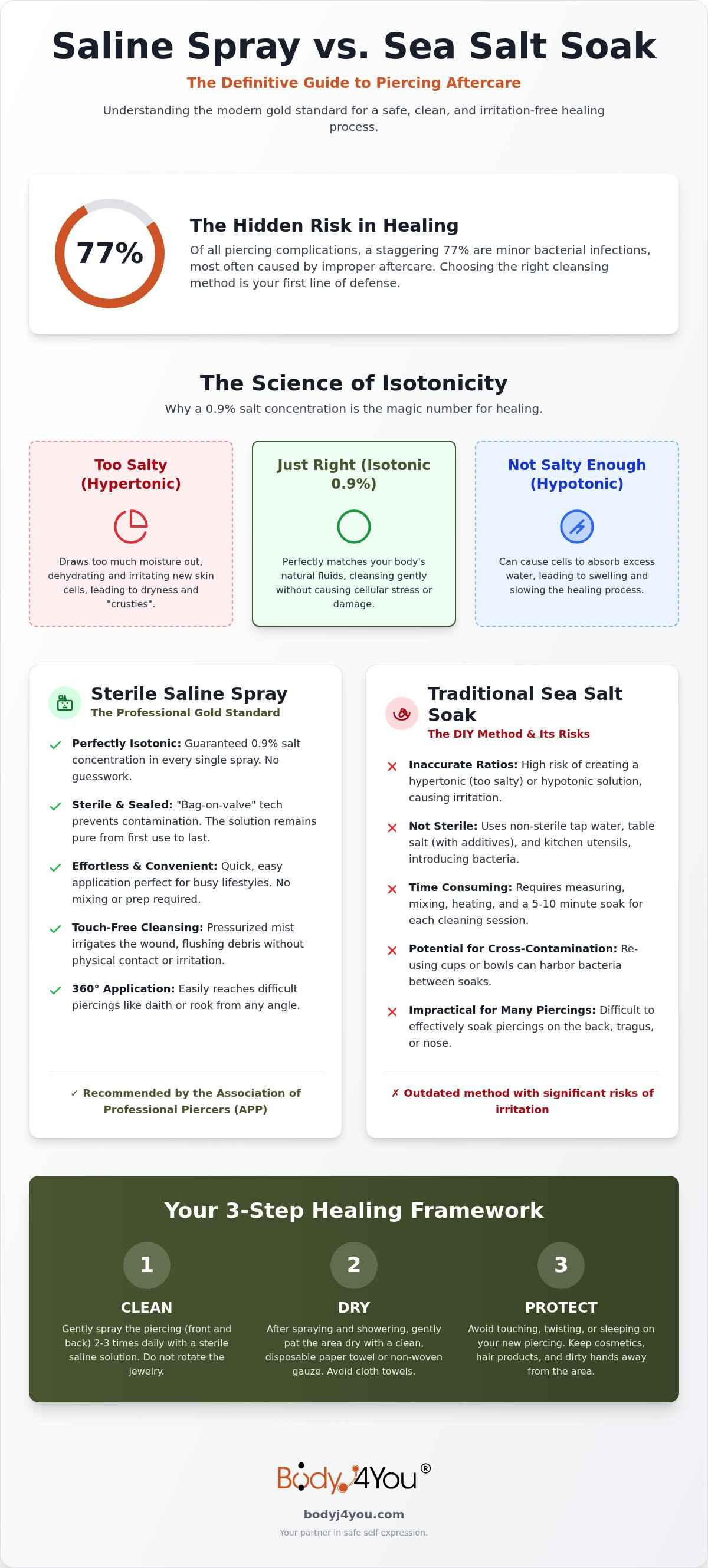
The secret to this protection lies in isotonicity. An isotonic solution contains exactly 0.9% salt concentration, which perfectly mirrors the natural chemistry of your blood and tears. This balance ensures that the solution cleanses the area without causing cellular stress; it effectively lifts away discharge while leaving the healing site undisturbed. As your mentor in this journey, we prioritize the integrity of your skin over aggressive, outdated "cleaning" methods that do more harm than good.
Osmotic Pressure: How Salt Interacts with Wound Tissue
Salt is a natural dehydrator. Through the process of osmotic pressure, a correctly balanced saline solution draws moisture out of harmful bacteria, effectively neutralizing them before they can cause trouble. However, your own skin cells remain hydrated because the concentration matches your internal environment. This is where the saline spray vs sea salt soak debate begins. If a solution is hypertonic, meaning it is too salty, it creates a hostile environment for your skin. This leads to the dreaded "piercing crusties," persistent dryness, and localized irritation. Your goal is consistent irrigation, not the total dehydration of the area.
Irrigation vs. Soaking: Two Paths to the Same Goal
Healing requires movement, but not the kind you might think. We must distinguish between the physical removal of debris and the softening of tissue. Wound irrigation is the controlled flow of liquid over a healing site. This process gently lifts away dried lymph and external pollutants without requiring you to touch or twist the jewelry. While traditional methods favored long, warm immersions, modern science suggests that targeted irrigation is often more efficient for daily maintenance. This shift in perspective has sparked the ongoing conversation regarding saline spray vs sea salt soak efficacy in modern piercing culture, moving away from stagnant water toward sterile, flowing solutions.
Sterile Saline Spray: The Modern Professional's Gold Standard
Professional piercers have reached a clear consensus. The era of guessing ratios and mixing solutions in your kitchen is over. According to the Association of Professional Piercers guidelines, sterile saline spray is now the absolute gold standard for modern aftercare. It removes the human error inherent in the saline spray vs sea salt soak debate. Every spray is precise. Every mist is isotonic. Every application is safe. This consistency is vital for stabilizing a new piercing, as it prevents the fluctuations in pH that often lead to irritation bumps and prolonged redness.
Sterility is the ultimate protector of your aesthetic journey. Modern sprays utilize "bag-on-valve" technology, a sophisticated system that keeps the saline solution in a sealed pouch inside the can. This prevents the propellant and external air from ever touching the liquid. Your aftercare remains sterile from the first mist to the very last drop, even months after you first open the bottle. It's a closed system that guards against dust, bathroom bacteria, and environmental pollutants. For those with complex ear anatomy like a daith, conch, or rook, the 360-degree nozzle offers effortless access from any angle. You don't have to contort your body or move your jewelry to ensure full coverage.
The Benefits of Pressurized Irrigation
Pressurized irrigation does the heavy lifting for you. The gentle, consistent stream physically dislodges "crusties" and discharge without the need for cotton swabs or manual picking. Touching a fresh wound is the fastest way to introduce cross-contamination. By opting for a sterile saline spray for piercings, you maintain a strict "no-touch" protocol that protects your skin's delicate new cells. It is a disciplined approach to wellness that prioritizes long-term health over quick fixes. If you're looking for a reliable way to maintain this standard, our Saline Piercing Aftercare Spray provides the clinical-grade irrigation your body needs.
Identifying Quality: What to Look for on the Label
Purity is the hallmark of professional-grade care. When you examine a label, follow the "Rule of Three": purified water, 0.9% sodium chloride, and a sterile delivery method. Anything else is an unnecessary risk. Additives like fragrances, alcohol, or chemical preservatives are major red flags that can cause localized reactions or delay healing. We take quiet pride in our US-based manufacturing, which ensures every bottle meets rigorous quality control standards. This regional production isn't just about heritage; it's about regulatory trust and the safety of your skin. Choose ingredients that align with your body's biology for a seamless transition from a new piercing to a healed masterpiece.
Traditional Sea Salt Soaks: Benefits, Risks, and Common Pitfalls
Before the convenience of modern packaging, the sea salt soak was the cornerstone of piercing care. It is a legacy method, born in an era when sterile, pressurized solutions were difficult to find. The primary benefit of this tradition isn't actually the salt itself, but the warmth of the water. Heat stimulates blood flow to the area. It encourages oxygenation. It supports the body's natural inflammatory response. However, as your supportive specialist, I must warn you that the risks of this DIY approach often outweigh the benefits in the saline spray vs sea salt soak comparison. Modern science has provided us with more reliable tools for a reason.
Think about your kitchen. Your measuring spoons, ceramic mugs, and even your countertop are teeming with invisible bacteria. Mixing a solution in a non-sterile environment introduces a high risk of cross-contamination. While the Association of Professional Piercers aftercare guidelines emphasize the need for clinical purity, most home environments simply cannot meet that standard. You are essentially introducing a non-sterile liquid into a vulnerable wound, which is a gamble your skin shouldn't have to take.
The Danger of DIY: Why Homemade Ratios Often Fail
Humans are notoriously bad at measuring small quantities accurately. A "pinch" or a "heaped" quarter-teaspoon can easily result in a solution that is too concentrated. This creates a hypertonic environment that causes chemical burns and localized dehydration. Then, there is the "tap water problem." City water often contains chlorine, fluoride, and heavy minerals that can aggravate a fresh piercing. Using iodized table salt instead of pure, non-iodized sea salt introduces unnecessary chemicals that can severely irritate a healing wound. These inconsistencies create a cycle of irritation that can stall your healing for weeks.
When a Soak is Actually Beneficial
There are rare instances where a soak remains a valuable tool. If you are dealing with stubborn drainage or localized swelling, a warm immersion can help "draw out" waste and soften heavy buildup. For specific placements like nipple or navel piercings, the "cup method" provides a way to soothe the area through total immersion. However, this should remain a targeted, temporary intervention rather than a daily habit. For your primary routine, transitioning from soaks to sprays is the safest way to maintain long-term skin integrity. It ensures you get the benefits of irrigation without the risks of a non-sterile kitchen environment.
Saline Spray vs. Sea Salt Soak: A Situational Comparison
Choosing between a saline spray vs sea salt soak often comes down to the balance between proactive protection and reactive care. While some argue that a DIY soak is more cost-effective, this perspective often ignores the "hidden cost" of complications. An infection or a prolonged irritation cycle can lead to expensive specialist visits or the loss of the piercing entirely. We view the convenience of a sterile spray not as a luxury, but as an investment in your body's long-term health. It provides a predictable, clinical standard that removes the variables of human error and environmental contamination.
Lifestyle factors play a decisive role in successful healing. Life doesn't stop for a new piercing. You travel. You work. You hit the gym. Carrying a bag of sea salt and a measuring spoon is impractical in these settings. A pressurized spray is essential for post-workout cleanup or maintaining hygiene while on the move. It offers a quick, efficient way to flush away sweat and bacteria before they can settle into the wound. From an environmental standpoint, a targeted spray also minimizes water waste compared to the full cups required for traditional immersion.
Daily Maintenance vs. Irritation Management
For your standard routine, we recommend using a saline solution for piercing as a preventative daily mist. This approach perfectly aligns with the "Leave It Alone" (LITHA) method. By misting the area and letting it air dry, you avoid the physical trauma of touching, rotating, or picking at the jewelry. However, if a stubborn piercing bump or localized swelling appears, a warm soak can act as a reactive tool to encourage drainage. Use the spray to keep the peace and the soak only to manage a conflict.
Safety and Sterility: The Deciding Factor
The stakes are higher for certain anatomical locations. Cartilage piercings and septums have limited blood flow, making them more susceptible to persistent infections if bacteria are introduced. The clinical precision of a spray is far superior for these high-risk areas because it ensures 100% sterility with every application. If you are navigating the unique challenges of a mid-line piercing, our septum piercing guide offers deeper insights into anatomy-specific care. To ensure your healing stays on track with professional-grade tools, you can order our Saline Piercing Aftercare Spray here to maintain a pristine environment for your new aesthetic.
Optimizing Your Aftercare: How to Integrate Saline Solutions Safely
Successful healing is a discipline. It requires a balance of targeted intervention and patient observation. For 2026, we have refined the standard of care into a simple, effective framework: Clean, Dry, Protect. This tripartite philosophy ensures your skin remains stabilized, your jewelry stays pristine, and your recovery stays on track. While the saline spray vs sea salt soak debate often focuses on the solution itself, the way you apply that solution is what ultimately determines your success. You are the guardian of your new aesthetic, and your daily routine is your most powerful tool.
Step-by-Step Application for Maximum Efficacy
Precision matters. To begin, mist the area with your saline spray from approximately 4 to 6 inches away. Let the solution sit undisturbed for 30 seconds. This brief window allows the isotonic mixture to soften any "crusties" or discharge without the need for physical friction. Once the debris is softened, you may use our Piercing Cleaning Swabs to gently lift away the residue. These specialized tools are far superior to cotton balls, which often leave behind microscopic fibers that can snag on your jewelry and cause irritation.
The most overlooked step in aftercare is the drying process. Moisture is the primary enemy of healing cartilage. If left damp, the skin can become macerated, leading to localized swelling and the development of moisture-related bumps. Gently pat the area dry with a disposable paper towel. Never use a cloth towel, as these harbor bacteria and can easily catch on the prongs of your jewelry. A clean, dry environment is a safe environment.
Signs Your Aftercare is Working (and When to Call Your Piercer)
Understanding your body's signals is essential for peace of mind. During the early stages, it is normal to see "lymph fluid," which is a clear or pale yellow discharge that dries into a crust. This is a sign of healthy cellular activity. However, you must be able to distinguish this from actual pus, which is typically thick, opaque, and may have a green or brown tint. If you notice the triad of infection—intense heat, spreading redness, and persistent throbbing pain—it is time to consult your professional piercer or a healthcare provider immediately.
You will know your piercing is fully healed when the skin appears relaxed, the discharge has completely ceased, and the jewelry moves freely without any discomfort. This journey requires patience, but by staying disciplined with the saline spray vs sea salt soak protocol that best fits your needs, you ensure a lifetime of beautiful self-expression. Trust the process, protect your skin, and let your body do what it does best.
Master Your Piercing Recovery
We bring over 20 years of piercing expertise to every solution we offer. Our dermatologically inspired formulas are proudly manufactured in the USA to ensure the highest standards of purity and regulatory trust. It's time to simplify your routine and stabilize your skin with a product designed for your wellness. Shop our Clinical-Grade Saline Piercing Aftercare Spray today and experience the professional standard of care. Trust your intuition, stay disciplined with your routine, and wear your new aesthetic with absolute confidence.
Frequently Asked Questions
Can I use contact lens saline instead of piercing spray?
No, you should never use contact lens saline for piercing aftercare. These solutions often contain enzyme cleaners, preservatives, or buffering agents designed for eye safety but are far too harsh for an open wound. Your piercing requires a simple, sterile mixture of 0.9% sodium chloride and purified water. Stick to products labeled as wound wash to ensure your skin remains calm and protected.
Is it okay to use table salt for a sea salt soak?
You should avoid using table salt at all costs. Most table salts are iodized and contain anti-caking agents that can cause chemical irritation or even localized burns on a fresh piercing. If you must perform a soak, use only pure, non-iodized sea salt. However, the clinical precision of a sterile spray remains the superior choice for maintaining a balanced, irritation-free environment.
How many times a day should I spray my new piercing?
We recommend spraying your piercing twice daily. A morning and evening application provides the perfect rhythm for irrigation without disrupting the body's natural healing process. Over-cleaning can be just as detrimental as under-cleaning. It can lead to unnecessary dryness or localized stress. Consistency is the key to a stable recovery, so keep your routine simple, disciplined, and effective.
What happens if I use too much salt in my DIY soak?
Using too much salt creates a hypertonic solution that aggressively dehydrates your skin cells. This imbalance often leads to chemical burns, persistent redness, and the development of "piercing crusties." It is the most common pitfall in the saline spray vs sea salt soak debate. A pressurized spray eliminates this risk by delivering a perfect, medically validated ratio every single time you use it.
Can I use saline spray on an infected piercing?
Yes, but you must understand that saline is a cleanser, not a medication. It is excellent for flushing away discharge and keeping the wound site pristine. While it supports the healing environment, a true infection requires professional medical attention. If you experience spreading redness, intense heat, or throbbing pain, consult your piercer or a doctor immediately while continuing your gentle saline irrigation.
Should I rinse off the saline spray after applying it?
No, you don't need to rinse the saline off with tap water. Tap water can introduce minerals, chlorine, and bacteria back into the vulnerable area. Instead, let the spray sit for about 30 seconds to soften any debris, then gently pat the skin dry with a clean, disposable paper towel. This ensures the area remains sterile and free from the moisture that can cause irritation bumps.
Why does my piercing feel dry after using salt solutions?
Salt is a natural desiccant that draws moisture out of tissue. If your skin feels excessively tight or flaky, you might be cleaning the area too frequently or using a DIY solution that is too concentrated. Transitioning to a professional spray can help stabilize the area. If dryness persists, reduce your applications to once a day and ensure you are patting the area completely dry after every mist.
Can I use a saline spray on a septum piercing?
Yes, sterile saline spray is actually the ideal choice for a septum piercing. The internal "sweet spot" can be difficult to reach with traditional soaks without causing unnecessary movement. A pressurized mist allows you to irrigate the internal tissue from any angle without touching or rotating the jewelry. It's a clean, effortless way to maintain hygiene in a sensitive and high-movement area of the face.


