

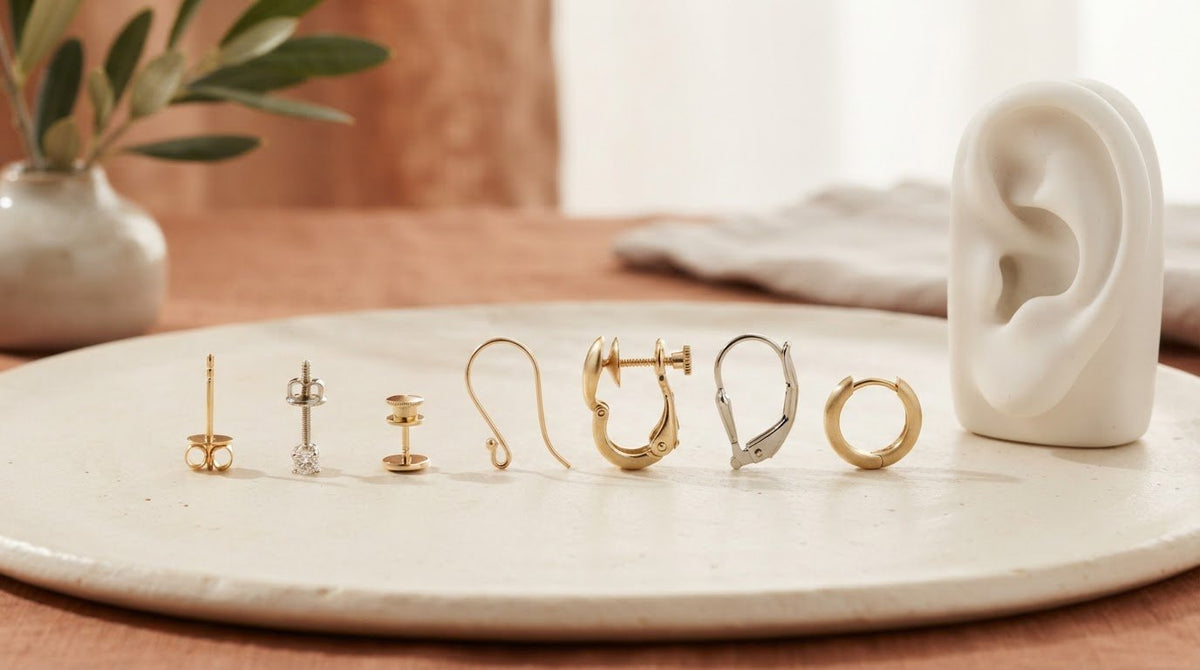
The most secure earring closure isn’t automatically the most comfortable. Common options include push-backs, screw-backs, flat-backs, French wires, French clips (also called Omega backs), lever-backs, and hinged or latch-back hoops. The types of piercing closures explained here differ in how they fasten, sit against the ear, and balance ease of use with security.
A closure that feels simple on a lightweight stud may not suit a heavier earring or a different way of wearing it. This guide compares comfort, security, and handling, including French clips and Omega backs, interchangeable closure styles, and hinged hoops. You’ll learn what sets each design apart and which features matter when choosing a closure that feels comfortable and stays in place.
Key Takeaways
- Match the closure to the earring’s weight and how you plan to wear it; a style that works for a lightweight stud may feel less secure on a heavier design.
- Compare comfort and security separately. A closure that stays firmly fastened may take longer to put on or press against the earlobe.
- French clips, also called Omega backs, use a hinged clip behind the earlobe, while French wires rely on their curved shape and gravity to stay in place.
- Interchangeable backs can change how an earring fits, but for sensitive ears, the metal in the post and closure matters more than the closure style alone.
- Hinged hoops and latch-backs fasten differently from hook styles; understanding how each mechanism closes can help you choose a design that suits your routine.
Earring Back Types Explained: Which Closure Is the Most Comfortable?
Comfort depends on the backing, the earring’s weight, and how long you wear it. If you’re searching for “types of piercing closures explained,” start by comparing how each design fastens and rests against the ear. A low-profile backing may suit a long day, while a simple fastening can make frequent changes easier.
Choosing Closures for Occasions and Earring Styles
Match the closure to the earring style and where you plan to wear it. For a workday, a flat-back stud sits close to the ear; for an event, a drop earring with a lever-back can distribute weight more evenly than a post closure. Butterfly backs suit lightweight earrings, while hinged hoops form a closed shape without a dangling wire. Consider your hair, clothing, and how often you’ll remove the earrings.
Matching Backings to Earring Weight and Use
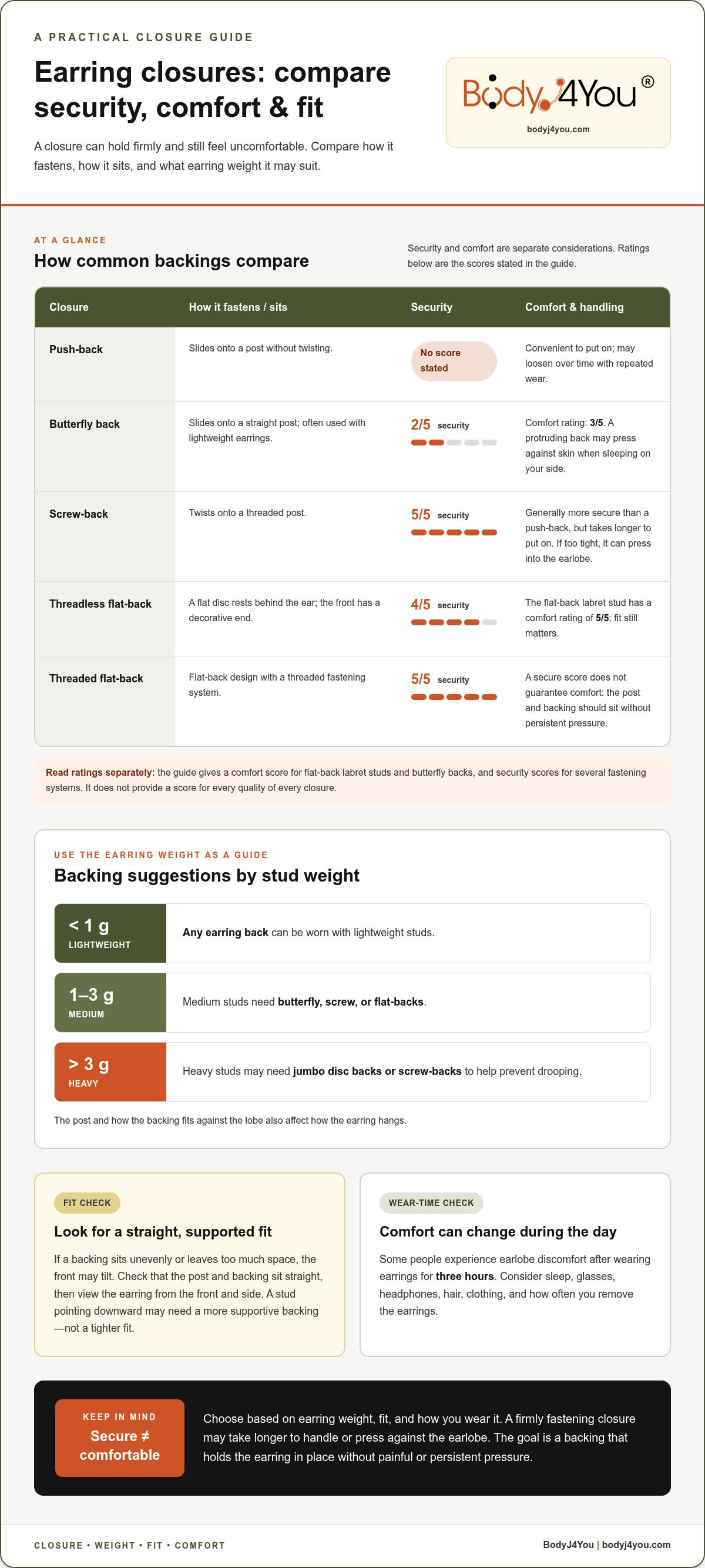
Use the earring’s weight as a practical guide to backing choice. Lightweight studs under 1 gram can be worn with any earring back. Medium studs weighing between 1 and 3 grams need butterfly, screw, or flat-backs. Heavy studs over 3 grams may need jumbo disc backs or screw backs to prevent drooping. The post and the fit against the lobe also affect how the earring hangs.
Labret, Butterfly, and Screw-On Back Differences
A labret has a flat disc behind the ear and a decorative end at the front. A butterfly back slides onto a straight post, while a screw-on back twists onto a threaded post. Flat-back labret studs have a comfort rating of 5 out of 5, compared with 3 out of 5 for butterfly backs. Tight screw-backs can press into the earlobe and take longer to put on. A types of piercing closures explained comparison is most useful when it considers both fastening and fit.
Closure Options Across Piercing Placements
For lobe piercings, post-style earrings can use butterfly, screw, or flat-back closures. Flat-back labret studs are common initial jewelry for a helix piercing. Nose, lip, and other body piercings use jewelry designed for their specific placement, not ordinary earring backs. Initial piercing jewelry should allow for swelling, so closure style alone doesn’t determine whether a piece is suitable.
For a fresh piercing, choose jewelry designed for that placement and allow room for swelling. Don’t use a standard earring backing as a substitute for suitable initial jewelry.
Jewelry costs vary with material, design, and closure mechanism. Compare the complete piece, including its post and backing, rather than estimating the cost from the closure alone.
Closure security, ease of use, and comfort
A closure has three jobs: stay fastened, feel comfortable, and remain easy to handle. Those qualities don’t always align. A screw-back may feel more secure than a push-back, but take longer to fasten. A butterfly back slides on quickly, but can loosen with repeated wear. Compare how firmly the closure holds and how much pressure it puts on your earlobe, not just how it looks.
Security ratings illustrate the differences. Butterfly backs rate 2 out of 5, while screw backs rate 5 out of 5. Threadless flat-back systems rate 4 out of 5; threaded flat-back systems rate 5 out of 5. These ratings distinguish fastening mechanisms, but comfort still depends on fit. A secure closure shouldn’t be tightened until it presses painfully against the ear.
Push-backs are convenient because they slide onto a post without twisting. However, they can loosen over time, allowing an earring to droop or fall out. Screw-backs twist onto threaded posts and are generally considered more secure than push-backs. That extra hold comes with a trade-off: they take longer to put on, and a tight backing can press into the earlobe.
Fit affects how an earring hangs. If the backing sits unevenly or leaves too much space behind the lobe, the front may tilt rather than remain centered. Check that the post and backing sit straight, then look at the earring from the front and side. For example, a stud that points downward may need a more supportive backing, not a tighter fit. Heavy studs over 3 grams may need jumbo disc backs or screw backs to help prevent drooping.
Comfort can also change with wear time. Some people experience earlobe discomfort after wearing earrings for three hours, so a closure that feels fine at first may become uncomfortable later. A flat-back design keeps the backing close to the ear, while a protruding butterfly back may press against the skin when you sleep on your side. Consider daily activities, glasses, headphones, and whether the earring might catch on hair or clothing.
Choose by balancing fastening effort with how securely the piece should sit. For frequent changes, a simple push-back may be easier to handle; for a closure that twists into place, screw-backs offer a firmer connection. If you’re comparing low-profile styles, explore piercing jewelry options and consider how the post and backing work together. A comfortable fit should hold the earring in place without creating persistent pressure.
French clip or Omega backs for pierced ears
French clips and French hooks secure earrings in different ways, despite their similar names. A French clip, also called an Omega back, uses a hinged clip that presses behind the earlobe. A French hook, often called a fish hook or French wire, passes through the piercing and relies on its curved shape and gravity to stay in place. The distinction matters if you prefer a clasp to an open wire.
An Omega back has two parts: a post that passes through the lobe and a hinged section that closes behind it. The clip presses against the back of the earlobe to help hold the earring in place. Its visible front can suit a range of earring designs, while the hinged mechanism sits behind the ear. Check where the clip rests, since a poor fit can feel uncomfortable or create pressure.
French-wire earrings have no separate closure mechanism. Their curved wire passes through the piercing, and gravity helps keep the earring in place. This open design is simple to put on and remove, but it offers less security: French hook closures rate 1 out of 5 for security. A French wire can slide out if you tilt your head or brush your hair aggressively, so consider those movements during daily wear.
For lightweight earrings, a French hook offers an airy, dangling look without a clasp behind the lobe. It may suit occasions when you can keep track of the earring and avoid catching the wire on hair or clothing. An Omega back offers a different balance: its hinged section closes behind the lobe instead of leaving an open wire. Try fastening and releasing it before choosing a style you’ll change often.
Neither design is automatically comfortable for every ear. Fit, earring weight, and pressure behind the lobe all affect how it feels as you move. If an Omega clip presses firmly, prolonged wear may cause discomfort; if a French wire swings freely, it may catch or shift. Check how the earring hangs from the front and side, and notice whether the wire or clip touches your skin.
These closures are designed for earrings worn through lobe piercings, not as general solutions for cartilage jewelry or other body placements. For example, a French hook’s curved wire needs to pass through a compatible piercing, while an Omega back’s post and hinged clip must fit correctly around the lobe. Choose based on your fastening preference, fit, and how much the earring will move while worn.
Interchangeable earrings and closure options
Interchangeable earrings let you change how a piece fastens, but the post and backing must fit together. A butterfly back won’t attach to every post, and a threaded backing needs a matching threaded post. Before switching backs, remove the earring and check the post for bends, worn threads, or damage. A straight, compatible post helps the backing sit securely instead of wobbling or tilting.
For sensitive ears, metal choice matters more than closure style alone. Both the post and backing touch the ear, so changing only the backing may not address irritation if the post material is the issue. Consider the entire earring, including its post and closure, rather than focusing on the visible front. If a backing causes discomfort, remove it gently instead of forcing it forward or tightening it against the lobe.
Locking backs add a mechanism intended to hold the earring in place. Premium locking backs are recommended for jewelry valued over $2,000, while the right option still depends on the post design and wearer’s routine. Check that the lock engages fully after fastening. A locking back that feels secure but is difficult to release may be less practical for an earring you remove often.
Hoop closures use different fastening actions. With a latch back, the post clicks into a catch on the opposite side of the hoop. A hinged hoop closes through its built-in hinge, creating a joined loop; hinged hoops have a security rating between 4 and 5 out of 5. Hinged huggies distribute weight around the earlobe instead of letting the earring dangle from one point. For example, a close-fitting huggie may feel different from a larger hoop that moves more freely.
Maintenance helps keep interchangeable backs working as intended. Inspect butterfly and silicone backs regularly, and replace them if they become loose, damaged, or no longer stay in place. These intervals make routine inspection useful: look for a loose grip, misshapen metal, cracked silicone, or a closure that no longer stays in place. A worn backing may not hold a straight post securely, even if it once fit well.
When changing backs, match the mechanism first, then check how the earring sits. The post should pass through without force, and the backing should stay in place without pressing tightly against the ear. For hoop styles, confirm that the latch or hinge closes fully. This quick fit check helps keep a favorite earring comfortable, secure, and easy to remove.
Latch-back and hinged hoop closures
Latch-back and hinged hoops both create a closed loop, but their fastening parts work differently. A latch-back hoop has a post that clicks into a catch across the opening. A hinged hoop has a moving section that swings open and snaps back into place. That difference affects how you handle each piece and what to inspect before wearing it.
With a latch-back, the post crosses the ear and meets a small catch on the opposite side of the hoop. The click indicates that the post has engaged, but a quick visual check helps confirm the gap is closed. A hinged hoop opens at its hinge, so the opening section stays attached to the jewelry. This can make insertion feel more straightforward than handling a separate post and catch.
“Clicker” often describes a hinged hoop that opens at a segment and clicks shut. The word refers to how it closes, not to a different way of wearing the earring. For example, a small hoop may open at one side, pass through the piercing, then close until its segment sits flush. Check the join from the front and side; a raised segment may not be fully closed.
Hinged hoops have a security rating between 4 and 5 out of 5. That range makes them a strong option for people who want a closed hoop, while fit and fastening still matter. A hinged huggie sits close to the earlobe, unlike a larger hoop that can swing more during movement. Huggies are recommended for all-day, everyday comfort because they distribute weight around the lobe instead of hanging from one point.
Size and placement shape comfort. A close-fitting huggie should sit around the earlobe without pinching, while a larger hinged hoop needs room to move without catching on hair or clothing. If you wear headphones or change clothes often, you may prefer a compact hoop with a smooth join. Check that the hinge opens and closes smoothly and that the closed edge doesn’t press into the piercing.
To compare pieces, open each closure gently and note whether the hinge feels controlled or loose. Close it fully, then check that the post or segment meets its catch without force. Don’t twist a hoop sideways to align its ends, as this can distort the closure. If the mechanism no longer clicks into place, it may not stay secure while worn.
For a hoop style with a removable bead rather than a hinge, explore captive bead rings as another closed-loop design.
BodyJ4You: Acrylic Ear Stretching Kit
BodyJ4You offers the Acrylic Ear Stretching Kit for readers exploring ear stretching rather than choosing a closure for a standard earring. The Surgical Steel Taper and Plug Kit is another option in this category, while Captive Bead Rings provide a distinct jewelry style with a removable bead closure. These offerings suit different interests, so choose according to whether you’re looking for stretching jewelry or a ring closure.
For piercing care, BodyJ4You also offers Saline Piercing Aftercare Spray, Piercing Bump Treatment Oil, and Piercing Cleaning Swabs. These are separate from closure choices and may be relevant when your focus shifts to aftercare. Visit bodyj4you.com to explore BodyJ4You’s offerings.
Choose a Closure That Fits Your Next Step
Having the types of piercing closures explained can help you make a more considered choice, but your needs may change with your jewelry, routine, or personal style. Before your next purchase, consider what matters most for that specific piece: a fastening you can manage easily, a discreet profile, or a design that complements your look. Let comfort and fit guide your decision, rather than choosing by appearance alone.
If your interest extends to ear stretching, BodyJ4You offers an Acrylic Ear Stretching Kit and a Surgical Steel Taper and Plug Kit. For piercing care, its Saline Piercing Aftercare Spray is another option. These offerings serve different needs, so focus on the one that aligns with your next step.
For help exploring BodyJ4You’s offerings, contact BodyJ4You. Take your time, choose with care, and let your jewelry reflect what feels right for you.
Frequently Asked Questions
What Makes a Good Earring Back?
A good earring back fits its post, holds the jewelry in position, and doesn’t pinch the ear. Check the earring and backing together before wearing them: the backing should slide or fasten smoothly, sit evenly, and stay put during gentle movement. For example, a backing that fits one post may be loose on another, even if both posts look similar. Replace bent or worn backs rather than relying on a weak grip.
Are Flat Backs Better Than Butterfly Backs?
Flat backs may suit someone who wants a smooth surface behind the ear, while butterfly backs are familiar and quick to attach. Neither design suits every person or earring. For example, someone who wears headphones may prefer a low-profile backing, while someone who changes earrings often may value a simple slide-on style. Consider the post, your ear, and the activities you do while wearing the earring.
So Which Closure Should You Choose?
Choose a closure that matches the jewelry’s weight, placement, and how often you remove it. A lightweight everyday stud may suit a simple backing, while someone who wears hoops may prefer a mechanism that closes into a loop. Think through your routine: brushing your hair, wearing headphones, and changing clothes often can affect which design feels practical. The best choice fits correctly and suits how you’ll wear it.
What are the different types of piercing closures and how do they work?
Common closures include push-backs, screw-backs, flat-back posts, hooks, hinged hoops, and latch-backs. Push-backs slide onto a post; screw-backs twist onto threads; flat-back styles use a disc behind the ear. Hooks pass through the piercing, while hinged and latch-back hoops close their openings. To compare the types, consider how each fastens and where it rests against the piercing.
How do threadless and internally threaded piercing jewelry closures compare?
Threadless jewelry uses a small pin on the decorative end, which fits into a hollow post and stays in place through tension. Internally threaded jewelry has a threaded end that screws into the post. Both designs keep exposed threading away from the part that passes through the piercing. The main difference is how they fasten: one presses together, while the other twists into place.
What is the difference between externally threaded and internally threaded jewelry?
Externally threaded jewelry has raised threads on the post, so those ridges pass through the piercing during insertion. Internally threaded jewelry has a smooth post end with the threads inside; the separate decorative end screws into it. You’ll notice the difference most during insertion and removal. Match the end to its post, and don’t force the pieces together if the threads don’t align smoothly.
How do hinged clicker rings, segment rings, and captive bead rings close?
A hinged clicker ring opens at a built-in joint, then its attached segment swings shut. A segment ring closes with a separate curved piece that fits into the hoop’s ends. A captive bead ring holds a bead between the ring ends, using tension to keep it in place. For example, a loose bead or misaligned segment can leave a visible gap, so inspect the join after closing.
Which piercing closures are easiest to insert and remove?
Push-backs and hinged clickers are often straightforward to handle because they slide on or open at a joint. Screw-backs require turning, while captive bead rings involve positioning a separate bead. Ease of use also depends on where the piercing sits and how easily you can see and reach it. For example, a closure that feels simple at the lobe may be harder to manage behind the ear.


