

What if the very solution you're using to save your piercing is actually the thing causing it to flare up? If you've noticed persistent redness, unusual itching, or a stinging sensation around your new jewelry, you're likely asking: can you be allergic to saline spray? It's incredibly frustrating to follow every aftercare instruction perfectly only to watch your skin react with irritation rather than healing. You want a solution that is gentle, effective, and pure.
You deserve a recovery process that's predictable, safe, and empowering. We understand the fear of losing a beautiful new addition to your personal aesthetic due to a mysterious reaction. In this guide, you'll discover if your spray is causing a genuine allergic response, how to identify sensitivities to common additives like benzalkonium chloride, and how to choose a pure aftercare solution. We'll help you differentiate between normal healing and chemical irritation, ensuring your journey toward self-expression remains a healthy one. By focusing on ingredient integrity, dermatological standards, and ethical production, you can finally find the relief your skin needs to thrive.
Key Takeaways
- Understand why a biological allergy to pure salt is impossible and how to identify if you're actually reacting to hidden preservatives or additives.
- Discover if your specific symptoms, like intense burning or hives, answer the question: can you be allergic to saline spray?
- Learn the "less is more" rule to prevent over-cleaning and determine if your skin type requires a fresh water rinse after application.
- Gain the confidence to choose a pure, high-quality aftercare solution manufactured with strict quality controls to protect your new piercing.
- Identify when to transition from saline to specialized treatment oils to manage localized irritation or piercing bumps effectively.
Understanding Saline Sensitivity: Can You Truly Be Allergic?
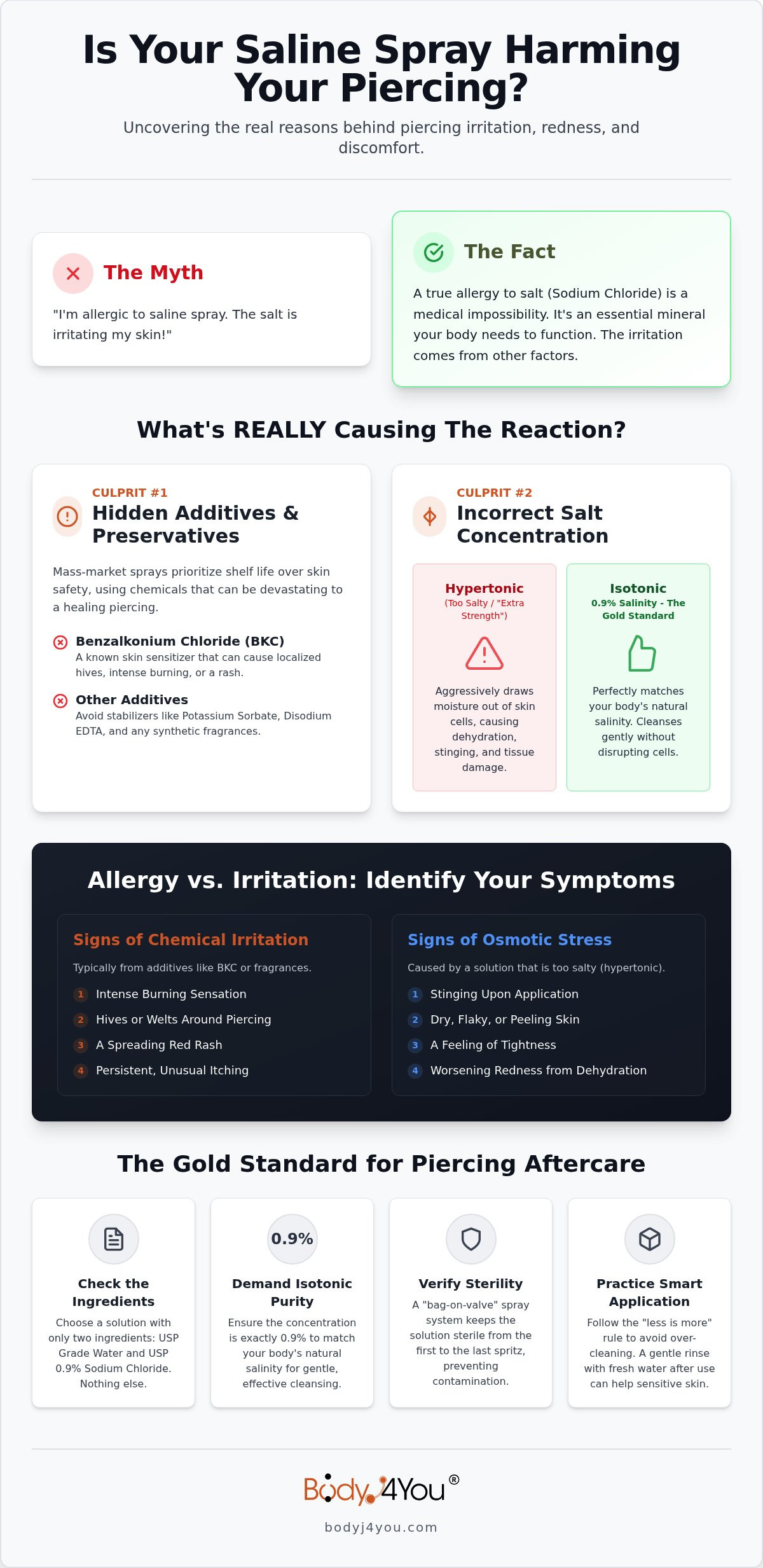
A true biological allergy to sodium chloride is a medical impossibility. Salt is a fundamental electrolyte, an essential mineral, and a core component of your body's internal chemistry. Because your cells rely on salt to function, your immune system does not recognize it as a foreign invader. However, this scientific fact does not diminish the very real discomfort you may be feeling. If your skin is flaring up, the question "can you be allergic to saline spray" is often a search for a label for significant physical irritation.
What many perceive as an allergy is typically a localized reaction to the spray’s concentration or the presence of hidden additives. Your skin barrier acts as a protective shield, but a new piercing creates a temporary vulnerability. When you apply a solution that is too harsh or chemically complex, that barrier can become compromised. This leads to redness, itching, and inflammation that looks remarkably like an allergic reaction, even if the salt itself is harmless. Precision matters. Purity heals. Science protects.
To understand why your skin is reacting, we must look at the composition of Saline (medicine) and how it interacts with human tissue. Most clinical applications rely on a very specific balance to ensure the solution supports healing rather than hindering it.
Isotonic vs. Hypertonic Solutions
The concentration of your spray is the most common source of irritation. A solution containing 0.9% sodium chloride is considered isotonic, meaning it perfectly matches the salinity of your blood and tears. Isotonic saline is the biological standard for wound irrigation because it cleanses without disrupting cellular integrity. When you use "extra strength" sprays or homemade salt soaks, you often create a hypertonic environment. These high-salt solutions aggressively draw moisture out of your skin cells, leading to severe dehydration, stinging, and tissue damage. Sticking to a professional, pre-mixed isotonic spray ensures your piercing stays hydrated and calm.
The Myth of the Salt Allergy
Labeling your reaction as a salt allergy is a common misnomer for osmotic stress or chemical sensitivity. If you've wondered "can you be allergic to saline spray," rest assured that your body isn't rejecting the salt itself. Instead, the salt may be performing its job too efficiently by pulling moisture to the surface, which can cause flaking in those with naturally dry skin. This is a physical process, not an immune response. Your skin isn't fighting the solution; it's simply reacting to a lack of moisture or a harsh additive. By choosing a formula focused on ingredient integrity, you can eliminate the triggers that cause these "pseudo-allergic" flares and return to a peaceful healing journey.
The Hidden Culprits: Preservatives and Additives in Saline
While we established that salt itself is safe, the contents of a generic bottle often tell a different story. If you've been asking "can you be allergic to saline spray," the answer likely lies in the fine print of the ingredient list. Many mass-market brands prioritize shelf life over skin safety. They utilize preservatives that, while effective at killing bacteria in a closed container, can be devastating to a fresh piercing wound. These chemicals often trigger the very redness and itching you're trying to avoid.
Benzalkonium chloride (BKC) is the most frequent offender found in drugstore aisles. It's a powerful antimicrobial, but it's also a known skin sensitizer. When applied to a healing piercing, BKC can cause localized hives, intense burning, or a spreading rash. Other "soothing" additives like synthetic fragrances or essential oils might sound appealing, but they often lead to contact dermatitis. A pure, medical-grade solution avoids these risks entirely. You deserve aftercare that prioritizes your body's integrity.
Integrity starts with the delivery system. A bag-on-valve spray ensures that the solution remains sterile from the first application to the last. This technology separates the saline from the propellant, preventing contamination and ensuring you only apply what your skin needs. For those seeking the highest standard of care, choosing a Saline Piercing Aftercare Spray formulated without these harsh irritants is the best way to support your body's natural healing process. Purity is the foundation of recovery.
Common Additives to Avoid
Look closely at the label for ingredients such as potassium sorbate or disodium EDTA. These stabilizers are common in generic formulations but have no place on a delicate new piercing. It's also vital to avoid "multipurpose" solutions designed for contact lenses. These formulas contain buffers and cleaners that are safe for the eyes but far too harsh for an open wound. Following the Association of Professional Piercers aftercare guidance ensures you stay within the bounds of safety. The only ingredients you truly need are purified water and 0.9% sodium chloride.
The Danger of Homemade Salt Water
Mixing your own solution at home is a risk you don't need to take. Even if you use non-iodized sea salt, you cannot guarantee the sterility of your water or the cleanliness of your mixing container. DIY mixtures are almost always too concentrated, leading to the osmotic stress and dehydration we discussed previously. These batches are also prone to bacterial contamination within hours of mixing. For a safer, more reliable alternative, consult our sterile saline spray for piercings guide to learn why medical-grade production is the only way to ensure your piercing's longevity and health.
Allergy vs. Irritation: Identifying Your Piercing Reaction
Deciphering the signals your body sends during healing is a vital skill for any piercing enthusiast. While the inflammatory phase naturally involves some warmth and tenderness, an adverse reaction is a different matter entirely. If you are questioning can you be allergic to saline spray, you must first look at the pattern of your symptoms. A true chemical sensitivity usually presents as localized hives, an intense burning sensation, or a rash that begins to spread beyond the immediate site of the jewelry. This is your immune system responding to a synthetic additive, not the salt itself.
In contrast, simple irritation often looks like dry, flaking skin accompanied by mild, localized redness. This is frequently a result of over-cleaning or using a solution with an incorrect salt concentration, leading to osmotic stress. To accurately identify and treat allergies to wound therapies, one must look beyond the surface level and evaluate the timing and texture of the reaction. It is also essential to distinguish these reactions from a developing piercing bump, which is typically a localized pocket of scar tissue or fluid rather than a widespread skin sensitivity. Precision matters. Purity heals. Science protects.
The Jewelry Variable
Oftentimes, the saline isn't the culprit at all. Low-grade metals, particularly those containing nickel, are notorious for causing contact dermatitis that mimics a saline allergy. Saline can actually exacerbate this issue by trapping metallic ions against the skin through a process of evaporation, concentrating the irritant. If your irritation persists despite using a pure spray, consider switching to high-quality materials such as surgical steel or titanium. These biocompatible metals provide a stable foundation for recovery, ensuring your jewelry supports your aesthetic goals without compromising your health.
Reaction Checklist
Use this structured checklist to evaluate your piercing's current state and determine the best course of action:
- Is the skin peeling or tight? This usually indicates dehydration from over-cleaning or a hypertonic solution.
- Is there a raised, itchy rash? This is a hallmark sign of a chemical sensitivity to preservatives like BKC.
- Is there heat, throbbing, and yellow discharge? These are indicators of a potential infection that requires professional medical attention, not an allergy.
Identifying the root cause allows you to take the correct corrective action, preserving both your health and your self-expression. By understanding these distinctions, you move from a state of worry to one of empowered care.
How to Safely Use Saline Without Irritating Your Skin
Applying aftercare shouldn't be a source of stress. When you find yourself asking can you be allergic to saline spray, the issue is frequently found in the frequency of use rather than the liquid itself. Over-cleaning is the most common mistake made by enthusiasts during the healing process. Your body requires a stable environment to build new tissue, and excessive intervention can disrupt this delicate biological balance. Precision matters. Purity heals. Science protects.
Adhering to the "Less is More" rule is essential for a smooth recovery. Twice a day is the limit. Cleanse once in the morning and once at night to remove debris without stripping the skin of its protective barrier. If your skin appears angry, shiny, or excessively tight, it may be time to pause all products and adopt the LITHA (Leave It The Hell Alone) approach. Giving your immune system space to work without external interference can often resolve persistent redness faster than any topical solution.
The Rinsing Technique
For individuals with sensitive skin, the salt left behind after the spray dries can become a primary irritant. As the water evaporates, microscopic salt crystals remain on the surface. these crystals are sharp and can cause micro-tears in the healing fistula, leading to itching and inflammation. To prevent this, many specialists recommend a gentle rinse with distilled water five minutes after your saline application. This removes the excess salt while leaving the wound clean and calm. Always ensure you pat the area dry using sterile piercing cleaning swabs to avoid introducing lint or bacteria from household towels.
Managing Dryness
Chronic dryness can mimic the symptoms of a reaction, creating a cycle of discomfort that hinders self-expression. If your piercing site feels brittle or shows signs of flaking, introducing a single drop of jojoba oil or a specialized healing oil can provide the necessary lubrication. For those with established piercings or stretched lobes, a high-quality gauges balm helps maintain skin elasticity and prevents the cracking that often invites irritation. Moisture balance is as critical as sterility for tissue regeneration. By maintaining this equilibrium, you ensure your aesthetic journey is both beautiful and comfortable. Support your body's natural defenses by choosing a sterile aftercare spray designed for the highest standards of safety.
Choosing a Pure Aftercare Solution: The BodyJ4You Standard
Selecting the right aftercare is a decision that balances clinical necessity with personal well-being. If you have spent sleepless nights wondering can you be allergic to saline spray, the solution is often found in the integrity of the bottle you hold. BodyJ4You Saline Piercing Aftercare Spray is designed to eliminate the guesswork of recovery. Our formulation focuses on a precise 0.9% sodium chloride concentration, matching your body's natural chemistry to ensure an isotonic environment that supports cellular regeneration. By manufacturing locally in the USA, we maintain rigorous quality controls that generic, mass-produced imports often overlook. Our commitment is simple: purity, precision, and peace of mind.
The delivery system is just as critical as the ingredients themselves. We utilize a pressurized, fine-mist delivery system that ensures the solution remains 100% sterile from the first application to the very last drop. This advanced technology allows us to eliminate the need for harsh, irritating preservatives like benzalkonium chloride, which are the primary culprits behind skin sensitivities. When you choose a medical-grade spray, you aren't just cleaning a wound; you are protecting your investment in your personal aesthetic. Safe. Effective. Ethical.
Why Purity Matters for Healing
We approach skincare as a "Wise Guardian," believing that your body knows how to heal if given the correct, minimal tools. Our formula avoids the "kitchen sink" approach of drugstore brands, opting instead for natural origins and ethical production standards. This means no synthetic fragrances, no hidden stabilizers, and no unnecessary additives that could trigger a reaction. Prioritizing dermatological standards over drugstore convenience is the first step toward a successful piercing journey. You deserve a product that respects your skin's biological boundaries while empowering your path to self-expression.
Complete Aftercare Integration
A holistic recovery often requires more than just a single product. While our saline spray handles daily irrigation, some individuals may experience localized irritation or stubborn tissue changes. In these instances, you can seamlessly combine your saline routine with our piercing bump treatment oil. This targeted solution provides secondary support for sensitive areas, utilizing the same standards of purity that define our entire line. With over 20 years of experience in the body modification industry, we act as an expert mentor for your healing process, ensuring every step is backed by professional knowledge and regional pride.
Don't let the fear of "allergy" prevent you from enjoying your new look. By choosing a solution that prioritizes ingredient integrity and domestic manufacturing, you can move forward with confidence. Your piercing is a statement of identity; your aftercare should be a statement of quality. Shop the BodyJ4You Aftercare Collection today and experience the difference that professional-grade purity makes in your recovery.
Empower Your Healing Journey with Pure Aftercare
Your journey toward self-expression should be defined by confidence, not by the persistent discomfort of a flare-up. Understanding whether can you be allergic to saline spray is the first step toward a peaceful recovery. Your skin is likely reacting to hidden preservatives or osmotic stress rather than the salt itself. By distinguishing between simple dehydration and chemical sensitivity, you can take control of your healing process. Prioritizing ingredient integrity and proper application ensures your new piercing remains a source of pride.
We believe that your aftercare should be as refined as your aesthetic. With over 20 years of piercing expertise, our formulas are dermatologically safe for all piercing types and proudly made in the USA. You deserve a solution that acts as a protective guardian for your skin. Elevate your routine and protect your beauty by choosing a standard that values purity above all else. Purity heals. Science protects. Excellence remains.
Switch to Pure, Preservative-Free Saline Aftercare and give your body the gentle, effective support it needs to thrive.
Frequently Asked Questions
Can saline spray cause a rash around my piercing?
Yes, a rash can develop, but it's rarely caused by the salt itself. If you've asked can you be allergic to saline spray, consider that recent 2026 industry recalls have highlighted risks of microbial contamination in certain unverified brands. Contaminants like yeast can trigger significant skin eruptions. Most often, however, a rash is a reaction to harsh preservatives or an incorrect salt concentration that disrupts your skin's natural protective barrier.
What are the symptoms of a benzalkonium chloride sensitivity?
Symptoms typically include localized hives, a persistent burning sensation, or a rash that spreads beyond the piercing site. Benzalkonium chloride is a common antimicrobial that acts as a skin sensitizer for many individuals. If you experience these intense reactions, your body is likely signaling a chemical sensitivity to this specific additive. Prioritizing preservative-free formulations is the most effective way to eliminate these painful triggers and support your recovery.
Why does my piercing itch after I use saline spray?
Itching usually occurs because of localized dryness or the presence of leftover salt crystals. As the spray evaporates, microscopic salt remains on the skin, which can cause physical irritation or micro-tears. Itching is also a standard part of the inflammatory healing phase. To find relief, try a gentle distilled water rinse five minutes after application to remove excess salt while maintaining a clean, stable environment for your tissue.
Is it possible to over-clean a piercing with saline?
Yes, over-cleaning is a frequent mistake that can stall your recovery. Applying saline more than twice daily can strip the skin of essential oils and lead to severe dehydration. This disruption of the skin barrier makes the tissue more susceptible to irritation and external bacteria. Stick to a disciplined morning and evening routine to ensure your piercing remains stable, hydrated, and protected. Balance is the foundation of health.
Should I stop using saline if my skin is flaking?
You should reduce the frequency of application or pause use temporarily. Flaking is a clear indicator of osmotic stress, where the salt is drawing too much moisture from your skin cells. If your skin feels brittle, consider introducing a drop of jojoba oil to restore the lipid barrier. Moisture balance is just as critical as sterility. Your body requires a hydrated environment to successfully regenerate healthy new tissue during healing.
What is the best alternative if I am sensitive to saline sprays?
The best alternative is a pure, medical-grade isotonic solution that contains only purified water and 0.9% sodium chloride. Many users who think they need an alternative actually just need a formula free from benzalkonium chloride or other stabilizers. If your skin is exceptionally delicate, using a "LITHA" approach or rinsing with distilled water after saline application can provide the gentle care your body requires to thrive.
How do I know if it is a saline reaction or a nickel allergy?
Nickel allergies typically cause persistent, localized itching and redness that does not improve when you change your cleaning products. If you suspect your jewelry is the culprit, look for a spreading rash or skin that feels leather-like. Saline can sometimes trap metallic ions against the skin, making a metal allergy appear worse. Switching to biocompatible titanium or surgical steel jewelry is the most reliable way to confirm the source.
Can I use contact lens solution as a piercing spray?
No, you should never use contact lens solution on a healing piercing. These formulas are designed for the eyes and contain specific buffers, cleaners, and preservatives like EDTA that are far too aggressive for a fresh wound. Using these solutions can lead to chemical burns, extreme dryness, or delayed healing. Always choose a dedicated piercing aftercare spray that meets dermatological standards for safety, purity, and ethical production.


