


A piercing is not a fleeting trend or a mark of rebellion. It is a disciplined commitment to dermatological health, personal identity, and aesthetic refinement. We know that the process of convincing parents to allow a piercing often feels like a battle against restriction or misunderstanding. You deserve to feel empowered in your choices, provided those choices are rooted in safety, maturity, and care. Our role is to act as your expert mentor, bridging the gap between your creative vision and your parents' concerns regarding physical vulnerability.
This 2026 guide transforms your request from a source of conflict into a collaborative journey of trust. You'll learn how to replace technical overwhelm with a clear, safety-first plan that focuses on long-term wellness rather than fleeting hype. We will explore the current legal landscape, the necessity of sterile 0.9% sodium chloride aftercare, and how to select jewelry with the purity your parents expect. By the end, you'll have a professional strategy to secure a "yes" through thorough preparation, industry-standard knowledge, and a sincere commitment to your own well-being.
Key Takeaways
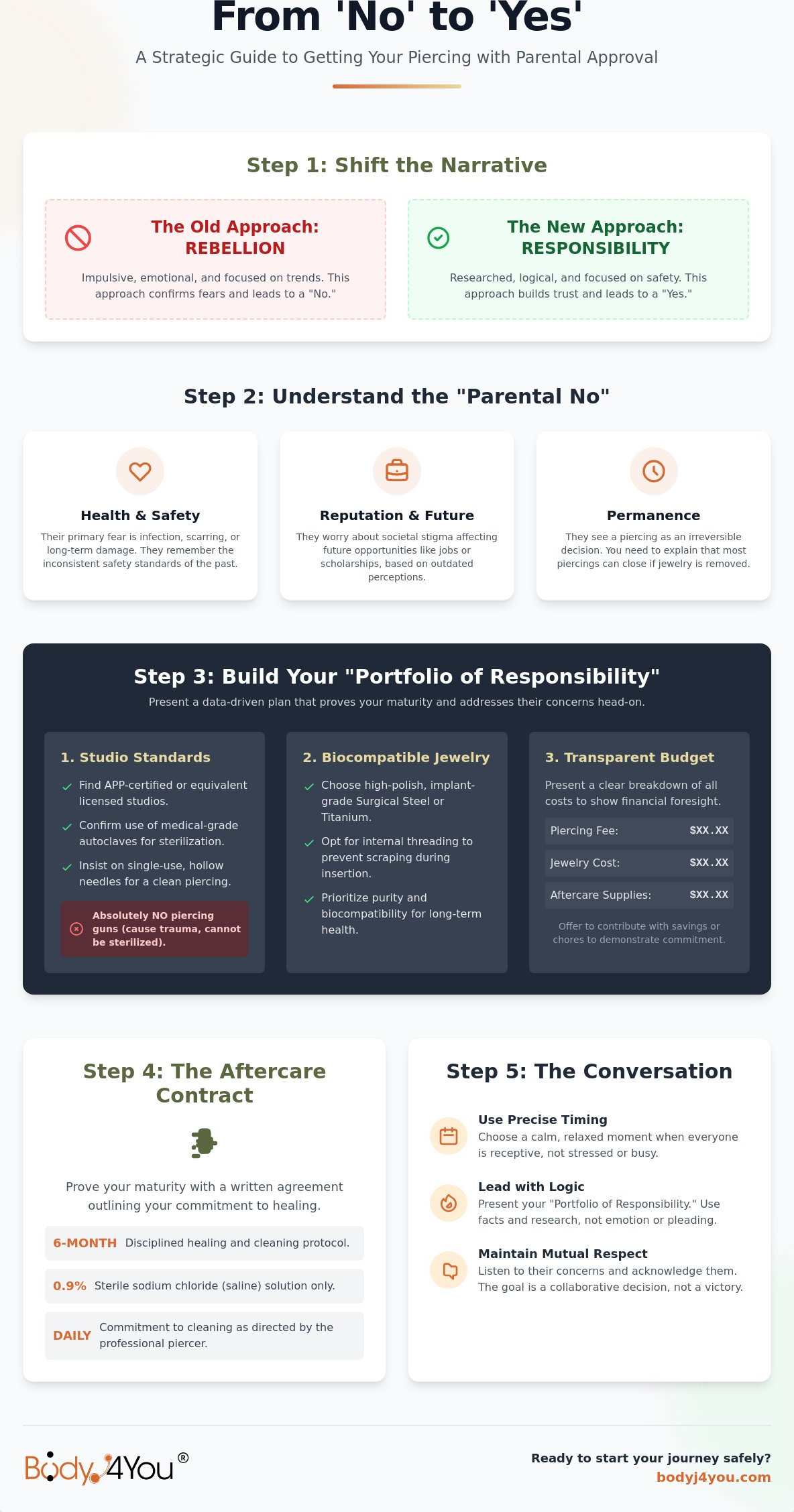
- Shift the narrative from rebellion to responsibility by addressing the three pillars of parental concern: health, reputation, and permanence.
- Master the strategy for convincing parents to allow a piercing by presenting a professional pitch centered on reputable APP-certified studios and high-quality materials.
- Prove your maturity with a written Aftercare Contract that outlines a disciplined, six-month protocol for dermatological safety and healing.
- Use logic and precise timing to guide the conversation, ensuring your request is heard during a moment of calm and mutual respect.
- Select jewelry such as high-polish surgical steel or internal threaded labrets to prioritize biocompatibility and long-term aesthetic refinement.
Understanding the 'Parental No': Why They Are Actually Worried
Parents aren't roadblocks. They are guardians. When you hear an initial "no," it's rarely a rejection of your personality or your desire for self-expression. Instead, it is a protective response rooted in three specific pillars: health, reputation, and permanence. Understanding this shift in perspective is the first step in convincing parents to allow a piercing. If you approach the conversation as an act of rebellion, you inadvertently confirm their fears that you're making an impulsive, immature choice. You must show them that you value your safety as much as they do.
The Psychology of the Wise Guardian
Your parents likely remember the piercing culture of the 1990s. During that era, safety standards were often inconsistent, and "mall kiosks" were the primary option for many. They might still associate body modification with unsanitary conditions or aggressive subcultures. You must recognize that their hesitation comes from a place of nurturing care. They want to protect your physical health, your future career opportunities, and your skin's integrity. By acknowledging these concerns, you move from a place of conflict to a place of mutual respect and logical discourse.
The Fear of Infection and Long-Term Damage
Many parents worry that a single needle will lead to permanent scarring, keloids, or dangerous infections. While these risks exist, they are largely preventable through professional technique and disciplined aftercare. The "mall kiosk" method, which uses blunt force piercing guns, is a relic of the past that causes unnecessary tissue trauma. Professional studios today use single-use, hollow needles that create a clean, precise channel for the jewelry. Modern sterilization techniques, including the universal adoption of medical-grade autoclaves and single-use equipment, have fundamentally transformed the safety landscape since 2001.
Societal Stigma vs. Modern Self-Expression
In 2026, the professional world views body modification through a lens of aesthetic refinement rather than social defiance. From corporate boardrooms to healthcare, curated ear stacks and subtle nostril studs are widely accepted as forms of personal grooming. When discussing the history of body piercing, you can show that this practice is a timeless human tradition, not a fleeting trend. Address the "permanence" argument by explaining that most piercings will safely close if the jewelry is removed during the healing phase. Use words like "curation," "balance," and "integrity" to describe your goals. This demonstrates that you value your body's biology as much as its beauty. This sophisticated approach is essential when convincing parents to allow a piercing because it proves you've done the academic work to support your aesthetic choice.
Building Your Professional Piercing Pitch
A successful pitch begins with an honest assessment of teen piercing risks, followed by a data-driven solution that prioritizes health. When you are focused on convincing parents to allow a piercing, your strongest tool is a "Portfolio of Responsibility." This isn't just a request; it's a presentation of facts, costs, and commitments. By gathering specific data on local studios and high-quality materials, you demonstrate that your interest is rooted in research rather than impulse. You are showing them that you have considered the biology of the procedure as deeply as the beauty of the result.
Researching the Studio Standards
Precision. Purity. Professionalism. These are the three pillars of a safe studio environment. Your pitch must highlight why you've chosen a specific location based on their use of medical-grade autoclaves and single-use needles. Explain to your parents that you are avoiding piercing guns because they cannot be truly sterilized and cause blunt force trauma to the skin. Instead, you are looking for a studio with Association of Professional Piercers (APP) membership or equivalent licensing. Mentioning the importance of internal threading in jewelry is also vital. This design ensures the screw thread is on the removable end, meaning no jagged edges pass through your fresh piercing during the initial insertion or later jewelry changes.
Choosing Parent-Approved Jewelry
The jewelry you select for your initial piercing acts as a stabilizer for your skin's healing process. Presenting Internal Threaded Labret Studs as your first choice is a brilliant move. These pieces are subtle, secure, and designed to minimize irritation. You should explain that "fashion jewelry" often contains nickel or other alloys that trigger the very infections and "piercing bumps" parents fear most. By insisting on Surgical Steel or titanium, you are choosing materials recognized for their high biocompatibility and dermatological safety. High-quality materials aren't just about aesthetics; they are about protecting your body's integrity while it heals. Including a pre-planned purchase of saline piercing aftercare spray in your pitch further proves that you are prioritizing a sterile environment from day one.
The Aftercare Contract: Proving Your Maturity
Maturity isn't a feeling. It's a system. When you're convincing parents to allow a piercing, a verbal promise often falls short because it lacks a verifiable structure. A written Aftercare Contract changes the dynamic from "I want" to "I will." This document should detail your commitment to a full 6-month healing protocol. It signals to your parents that you understand the long-term biological process involved in wound healing. By creating a physical agreement, you position yourself as a disciplined individual ready to manage a medical-grade recovery.
Your contract should include specific "check-in" dates. Suggest a brief weekly audit for the first month, followed by monthly reviews. During these moments, your parents can see the healing progress and confirm that the site is clean, protected, and undisturbed. This transparency eliminates the "out of sight, out of mind" anxiety that leads to parental worry. It also provides a structured way to budget for professional-grade supplies, such as Sterile Saline Spray for Piercings, ensuring you never run out of the essentials required for wound integrity.
The Science of Sterile Saline Aftercare
Precision is the enemy of infection. You must explain to your parents that homemade salt water solutions are dangerous because they are inconsistent and often non-sterile. A pressurized saline spray is the gold standard because it removes debris and crustal buildup without the need to touch the wound with your fingers. This minimizes the risk of cross-contamination and physical trauma. pH-balanced saline mimics the body's natural fluids to accelerate healing by providing an isotonic environment that supports cellular regeneration.
Daily Maintenance and Discipline
The most important rule in piercing recovery is the LITHA rule: Leave It The Hell Alone. This means no twisting the jewelry, no picking at scabs, and no sleeping on the fresh piercing. Explain that movement causes micro-tears in the healing tissue, which leads to irritation. You should also present a clear plan for how to handle Piercing Bumps if they occur. Knowing how to identify a simple irritation bump versus a true infection shows that you have the expertise to manage complications calmly. Incorporating your cleaning routine into your existing morning and nightly grooming habits proves that this isn't an extra burden, but a natural extension of your personal care routine.
Execution: How to Have the Conversation
Timing. Tone. Transparency. These are the three elements of a successful dialogue. When you're convincing parents to allow a piercing, the environment you choose is just as vital as the words you say. Avoid the rushed energy of a Monday morning or the exhaustion of a late night. Instead, look for a moment of calm, perhaps during a weekend walk or a quiet afternoon. Start the conversation with logic by using the "I've been thinking" opening. This phrasing signals that your request is the result of a deliberate, long-term reflection rather than a sudden whim.
Active listening is your greatest asset. When your parents speak, listen to their words without preparing your rebuttal. If they raise an objection, validate it. You might say, "I hear your concern about safety, and that's why I've researched professional studios." This approach prevents the conversation from devolving into an argument and keeps the focus on collaborative problem-solving. If the dialogue feels stuck, propose a "Trial Period." Ask them to let you wait 30 days while you maintain your responsibilities. Proving that your desire remains consistent over time is a powerful way of convincing parents to allow a piercing through sheer discipline.
Handling the 'No' Gracefully
Your reaction to a "no" is a diagnostic test of your maturity. If you respond with anger or frustration, you confirm their fears that you aren't ready for the responsibility. Instead, accept the decision with poise. Ask a clarifying question: "What specifically concerns you about this?" This helps you narrow down whether their fear is about health, social stigma, or permanence. Once you identify the specific barrier, you can set a follow-up date to discuss it again in three months, giving you time to gather more data or demonstrate consistent responsibility.
The 'Incentive' Negotiation
Link your request to a significant milestone. Whether it's a birthday, a graduation, or a personal achievement, framing the piercing as a reward adds a layer of merit to the request. You can also offer to fund the entire process yourself. This shows that you understand the value of the investment and are willing to sacrifice your own savings for it. To truly impress them, practice a "Pre-Aftercare" phase. Use Saline Solution on a minor scratch or an existing lobe piercing to demonstrate that you already have the habit of sterile maintenance. Ready to start your journey? Secure your professional aftercare supplies here to show your parents you're prepared from day one.
Post-Permission: Starting Your Journey Safely
Securing a "yes" is the beginning of a new responsibility, not the end of the conversation. The work you put into convincing parents to allow a piercing has built a foundation of trust that you must now protect through consistent action. Transitioning from a piercing seeker to a piercing caretaker means moving from theory to practice. Your parents will be watching the first few weeks closely to see if your commitment to health matches your initial pitch. By maintaining the same level of discipline you used to win their approval, you ensure that this experience remains a positive milestone for your entire family.
Selection of your initial jewelry is a critical safety decision. While you might be tempted by bold statements, your first piece should prioritize biology over bravado. High-polish surgical steel is the ideal choice for fresh piercings because its non-porous, ultra-smooth surface minimizes the risk of bacteria becoming trapped in microscopic scratches. This material is biocompatible, durable, and exceptionally easy to clean. Keep your Aftercare Contract visible, perhaps on a mirror or a shared family calendar, to show that your daily maintenance isn't a chore but a structured dermatological routine.
The First 48 Hours: Setting the Tone
Initial swelling, slight redness, and a touch of tenderness are normal biological responses to a new piercing. Do not panic, as your reaction will dictate your parents' comfort level. If you stay calm and follow your protocol, they will too. Precision is paramount during this phase. Using Piercing Cleaning Swabs allows you to deliver saline exactly where it is needed without disturbing the jewelry or the surrounding tissue. Document the healing process by taking a photo once a week. Showing these to your parents during your scheduled check-ins proves that their trust was well-placed and that you are managing the recovery with professional-grade care.
Long-Term Health and Style
Patience is the hallmark of a mature caretaker. While you may feel ready to swap your jewelry after a few weeks, most piercings require months to fully epithelialized. Changing your jewelry too early can cause micro-tears and set your healing back significantly. Wait for the "all clear" from your professional piercer before exploring more complex styles. Once your piercing has reached full maturity, you can begin to curate your look with advanced pieces like Industrial Barbells or intricate captive bead rings. By following through on every promise made during the process of convincing parents to allow a piercing, you've earned the right to express your aesthetic vision safely. Shop BodyJ4You’s professional aftercare and jewelry to start your journey right.
Step Into Your New Aesthetic with Confidence
Success in convincing parents to allow a piercing relies on your ability to pivot from a rebellion mindset to one of dermatological responsibility. By presenting a professional pitch, committing to a written contract, and selecting biocompatible jewelry, you prove that your choice is an act of refined self-expression. You aren't just getting a piercing. You are adopting a disciplined routine of health and care that respects your body's biology. This level of preparation transforms a request into a collaborative journey of trust and maturity.
At BodyJ4You, we act as your supportive specialist, bringing over 20 years of industry expertise to your journey. Our US-based manufacturing ensures the highest standards of quality control; we are niche specialists in piercing health and long-term aftercare. We believe your path to self-discovery should be safe, transparent, and empowering. Start your recovery on the right foot with the same precision and care that you used to win your parents' approval.
Build your professional aftercare kit with BodyJ4You’s Saline Spray and Healing Oils. Your maturity has brought you this far. Now, let your commitment to safety carry you through a successful and beautiful healing journey.
Frequently Asked Questions
How old do I have to be to get a piercing without parental consent?
In the United States, you must be 18 years old to legally consent to a body piercing on your own. For minors, regulations vary by state; some regions require only a notarized written consent form, while others demand that a legal guardian be physically present during the procedure. Always verify your local 2026 statutes and the specific studio's policy before scheduling an appointment.
What is the least painful piercing to start with?
The earlobe is widely recognized as the least painful and most accessible entry point into the world of body aesthetics. Because the lobe consists of soft, vascular tissue rather than dense cartilage, the sensation is brief and the recovery is typically straightforward. This makes the earlobe an excellent "proof of concept" when you are convincing parents to allow a piercing by demonstrating your ability to manage a healing wound.
How do I explain the difference between a piercing gun and a needle to my parents?
Explain that a piercing gun uses blunt force to ram a dull stud through the skin, which causes significant tissue trauma and unnecessary scarring. Professional piercers use single-use, hollow, medical-grade needles that create a clean and precise channel for the jewelry to rest in. Precision. Purity. Protection. Choosing a needle over a gun is a commitment to your body's long-term dermatological integrity.
What should I do if my parents say 'no' because of my school's dress code?
Propose a strategic compromise by timing the procedure for the start of summer break to allow the initial healing phase to conclude before classes resume. You can also research high-quality glass retainers that keep the piercing open while remaining virtually invisible during school hours. Showing that you have a plan to respect institutional rules proves the maturity and foresight required for convincing parents to allow a piercing.
Can I get a piercing if I have sensitive skin or allergies?
Yes, individuals with sensitivities can safely enjoy piercings by insisting on high-purity, biocompatible materials like implant-grade titanium or 316L surgical steel. These metals are specifically engineered to be non-reactive and are free of common allergens like nickel. By prioritizing material integrity, you ensure that your journey toward self-expression remains a wellness-oriented experience rather than a source of irritation.
How much does a professional piercing typically cost in 2026?
Industry standards for 2026 show that an earlobe piercing generally costs between $28 and $150, while cartilage and nose piercings typically range from $40 to $120. These figures represent the professional service fee and the expertise of the piercer. You should also budget for the cost of high-quality jewelry and sterile aftercare supplies to ensure a safe and successful healing process.
What are the signs of a piercing infection that I should tell my parents about?
You must alert your parents if you notice localized heat, persistent throbbing, or thick yellow or green discharge from the site. While minor redness and clear fluid are normal during the first 48 hours, foul odors or red streaks radiating from the wound are clinical indicators of an infection. Open communication ensures that any complications are handled with the stabilizing force of professional medical advice.
Is it possible to hide a piercing from my parents (and should I)?
While various retainers can hide a piercing, we strongly discourage concealing a body modification from your guardians. Hiding a wound prevents you from receiving proper care if a complication arises and fundamentally breaks the bond of trust necessary for healthy self-expression. True empowerment comes from a place of transparency, discipline, and mutual respect within your family unit.


