


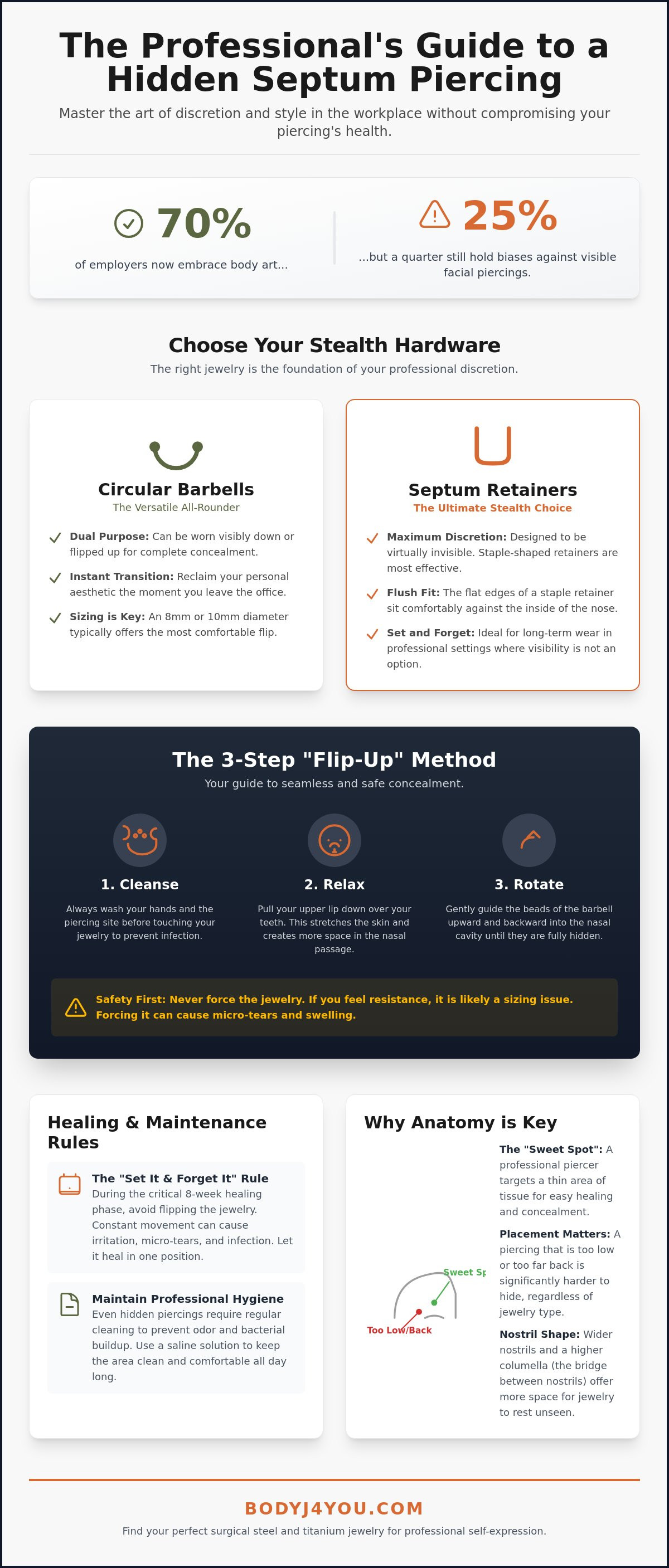
Did you know that while 70% of employers now embrace body art, roughly 25% still maintain strict biases against visible facial piercings in professional roles? This reality often leaves many people searching for the safest ways on how to hide a septum piercing for work without risking their healing progress or their reputation. It's exhausting to balance the constant anxiety of being caught by management with the physical discomfort of an irritated, frequently moved piercing. You deserve a solution that prioritizes your aesthetic freedom, your physical comfort, and your professional standing.
We're here to help you master the art of the stealth piercing. By choosing the right hardware and aftercare, you can ensure that your discretion never compromises your tissue health. This guide explores the best methods to keep your jewelry completely invisible while maintaining a healthy, smell-free piercing. You'll learn how to select the perfect retainer, manage the flipping process safely, and protect your professional image with total confidence.
Key Takeaways
- Learn why specific jewelry styles like circular barbells and dedicated retainers are the foundation of a completely invisible look.
- Discover how to hide a septum piercing for work during the critical 8-week healing phase without risking irritation or infection.
- Understand the "Set It and Forget It" rule to prevent micro-tears and bacterial growth caused by frequent jewelry movement.
- Master professional hygiene rituals using specialized tools to eliminate odors and keep your hidden jewelry comfortable all day.
- Identify high-quality materials like surgical steel that support both long-term stealth wear and your journey toward self-expression.
The Stealth Professional: Can You Actually Hide a Septum Piercing?
The septum piercing is a masterpiece of hidden self-expression. Unlike a brow or lip piercing, its placement is nestled within the nasal vestibule. This makes it the most versatile choice for the modern professional. If you've been wondering how to hide a septum piercing for work, the answer lies in the unique intersection of biology and design. While the history of body piercing shows various cultural reasons for visibility, today's professional environment often demands a more subtle approach. Choosing to "stealth" your piercing with specific jewelry is far superior to removing it entirely. Septum channels are notorious for closing rapidly; sometimes within hours. Keeping jewelry in place ensures the fistula remains stable, healthy, and open. It protects your investment while honoring your career.
The Anatomy of a Hidden Piercing
Success in concealment depends on your unique physical landscape. A professional piercer targets the "sweet spot," which is the thin, non-cartilaginous tissue located toward the tip of the nose. This area acts as a natural shelf. It provides a hollow space where jewelry can rest completely out of sight. The height of your columella, the fleshy bridge between your nostrils, dictates how much jewelry remains visible from a side profile. If your piercing is placed too low or too far back, hiding it becomes significantly more difficult. Wider nostrils offer more "real estate" for concealment, while narrower profiles require smaller, more specialized retainers or circular barbells. Understanding your anatomy is the first step toward a successful stealth strategy.
The "Flip" Method Explained
The flip is the gold standard for immediate discretion. To execute this safely, you must use a circular barbell or a U-shaped retainer. The process requires patience, precision, and care. Follow these steps for a seamless transition:
- Cleanse: Always wash your hands and the piercing site before touching the jewelry.
- Relax: Pull your upper lip down over your teeth. This stretches the skin and opens the nasal passage.
- Rotate: Gently push the beads of the barbell upward and backward into the nasal cavity.
Avoid forcing the jewelry if you feel resistance. Forcing a piece that is too wide for your nasal bridge can cause micro-tears, swelling, and unnecessary pain. If the jewelry won't budge, it's likely a sizing issue rather than a technique error. Respect your body's limits to maintain long-term tissue integrity. Safe. Subtle. Secure.
Choosing Discrete Jewelry: Retainers vs. Circular Barbells
Selecting the right hardware is the foundation of a successful stealth strategy. Your choice dictates your comfort, your safety, and your peace of mind. While many rings look appealing, only specific designs allow for the rotation required to remain unseen. Learning how to hide a septum piercing for work starts with choosing between the versatile circular barbell and the dedicated septum retainer. Each serves a distinct purpose in a professional's daily routine. They offer a blend of aesthetic freedom and workplace compliance.
Sizing is the most critical factor for a comfortable flip. A diameter of 8mm or 10mm is typically ideal for most anatomy. Smaller rings pass through the nasal opening with less resistance. This minimizes the risk of irritating the delicate mucous membrane. When you prioritize biocompatible materials like surgical steel or titanium, you mitigate the health risks of piercings such as nickel sensitivity or chronic inflammation. Quality jewelry provides the stability your body needs to maintain a healthy fistula while you navigate your career path.
The Versatility of Circular Barbells
Circular barbells, or horseshoes, offer an elegant balance of style and stealth. For these to work effectively, the gap between the two beads must be wide enough to clear the width of your septum. If the fit is too tight, you can carefully use a pair of ring-opening pliers to widen the gap by a millimeter. This small adjustment ensures the jewelry glides smoothly into the nasal cavity. The primary benefit is the immediate transition. You can flip your jewelry down the second you leave the office, reclaiming your personal aesthetic instantly. It's a simple way to maintain your identity without friction.
Septum Retainers: The Ultimate Stealth Choice
Retainers are the "invisible" specialists of the piercing world. Staple-shaped retainers are particularly effective because their flat edges sit flush against the inside of the nose. This makes them almost impossible to detect even during a close conversation. Clear glass or medical-grade acrylic options are essential for individuals working in high-security environments or medical fields where metal jewelry is restricted. If you're researching how to hide a septum piercing for work in a strict environment, these non-metallic options are your best defense. To ensure your retainer stays secure during physical activity, choose a piece with slightly flared ends. For those seeking reliable, high-quality hardware, exploring a professional collection of surgical steel jewelry can provide the professional edge you need. Reliable. Transparent. Disciplined.
Hiding a Fresh Septum: Safety, Healing, and Common Mistakes
The initial eight weeks of a septum piercing are a critical window for tissue stabilization. Your body is working tirelessly to form a healthy fistula during this time. If you are learning how to hide a septum piercing for work, the most vital rule is to "Set It and Forget It." Constant flipping is not just an inconvenience; it is a threat to your health. Every time you rotate the jewelry, you risk creating micro-tears in the fresh wound. These tiny openings are gateways for bacteria. They lead to swelling, prolonged redness, and potential infection. To avoid these complications, ask your piercer to flip the jewelry up into the hidden position immediately after the procedure. This ensures your piercing remains professional from day one without the trauma of daily movement.
Healing in the "Up" Position
Discretion requires discipline. Healing your piercing in the flipped-up position offers immediate professional compliance. It removes the temptation to fiddle with the jewelry during the day. However, you must ensure the jewelry is perfectly centered before it settles. A lopsided retainer can lead to a crooked channel. Check the alignment in a mirror with a flashlight during your cleaning ritual. You should wait until the full eight-week mark before you begin flipping the jewelry daily. Your body needs time. Your patience will be rewarded with a resilient, well-placed piercing.
Septum Aftercare While Hiding
Cleaning a hidden piercing requires a more targeted approach. Since the jewelry is tucked away, you can't rely on simple splashing to clear away debris. You must use a sterile saline spray for piercings to reach the tucked-away corners of your nasal vestibule. This ensures the site stays hydrated and free from "crusties," which are hardened lymph secretions. If these are not softened with a warm soak before movement, they can act like sandpaper against the healing tissue. Watch for warning signs like localized heat or a persistent irritation bump. These are signals that your body is struggling with the hidden placement. Stay vigilant. Stay clean. Stay professional.
Professional Maintenance: Keeping Your Hidden Piercing Healthy
Concealment should never lead to neglect. While your jewelry remains out of sight, it's still in constant contact with your body's internal environment. Understanding how to hide a septum piercing for work requires a commitment to a rigorous hygiene routine. A hidden piercing sits directly against the nasal lining where airflow is restricted. This lack of ventilation allows sebum, dead skin cells, and mucus to accumulate. Over time, this mixture creates "septum funk," a pungent odor that signals bacterial presence. A hidden piercing is a secret, but it shouldn't ever be a source of discomfort or hygiene concerns.
Precision cleaning is the solution to this hidden challenge. Traditional washing often misses the small gaps where the jewelry rests. Using piercing cleaning swabs allows you to target these specific areas with clinical accuracy. These swabs reach deep into the nasal vestibule to lift away debris without the need to flip the jewelry down. It minimizes movement. It reduces irritation. It maintains the integrity of the healing tissue. Cleaning your jewelry is an act of self-care that preserves your long-term aesthetic goals.
Daily Cleaning Routine for Stealth Piercings
A structured routine prevents common complications. Perform saline flushes twice daily to clear the nasal passages. If you notice stubborn buildup, use the "cup of water" trick during your shower. Fill a clean cup with warm, filtered water and submerge your nose for 60 seconds. This gentle soak softens hardened lymph secretions. Once softened, use a swab to gently clear the area around the jewelry balls. This ensures the jewelry remains mobile and free from "crusties" that can cause micro-tears during accidental movement.
Hydration and Tissue Health
The nasal vestibule is a delicate mucous membrane that requires constant moisture. When jewelry is flipped up, it can sometimes cause localized dryness or a "tugging" sensation. This is particularly problematic during allergy season or in dry office environments. Applying a tiny drop of Jojoba oil or Rosehip oil to the piercing site provides immediate relief. These oils are biocompatible and soothing. They prevent the jewelry from sticking to the skin. They lock in moisture. They support the body's natural barrier. If you're looking for high-quality botanical solutions, you can browse our collection of Jojoba oil and piercing aftercare to keep your tissue healthy. Safe. Clean. Discreet.
The BodyJ4You Approach to Professional Self-Expression
Your journey toward self-expression shouldn't be a choice between your career and your identity. At BodyJ4You, we believe in the power of professional stealth. Mastering how to hide a septum piercing for work is about more than just concealment; it's about maintaining your agency in a corporate landscape. For over two decades, we've stood as a trusted partner for the piercing community. We provide the tools you need to navigate these transitions with grace. Our commitment to your well-being is reflected in every piece of surgical steel and titanium hardware we offer. These materials are chosen for their purity, their durability, and their biocompatibility. Safety. Style. Success.
We take quiet pride in our heritage of regional manufacturing and ethical production. Every aftercare solution, from our saline sprays to our botanical oils, meets rigorous standards of integrity. We don't just sell jewelry; we provide a stabilizing force for your physical vulnerability. This disciplined approach ensures that your aesthetic refinement never comes at the cost of your health. By bridging the gap between beauty and biology, we empower you to grow personally and professionally without compromise. You can trust our experience to guide your long-term well-being.
Finding Your Perfect Stealth Jewelry
Browsing our collection of circular barbells and retainers is the first step toward a worry-free shift. Choosing the right gauge is vital for a stable fistula. While a standard 16G is common, the diameter is where you find your true fit. Smaller 8mm options offer a tighter, more secure flip, while 10mm diameters provide more comfort for wider anatomy. You're not just selecting a piece of jewelry; you're investing in a professional tool. Ensure you have the right aftercare tools, such as our saline sprays and cleaning swabs, ready to support your stealth journey from day one.
Expert Support for Every Step
We're here to guide you through the technical details of both biology and beauty. Our deep library of septum piercing resources covers everything from initial pain management to long-term tissue health. If you have sensitive skin, our support specialists can help you choose the right hypoallergenic materials to keep your piercing irritant-free. We prioritize the integrity of the individual over fleeting trends. Your safety is our heritage. Your style is our mission. Your success is our pride. Ready to start your professional transformation? Shop our Septum Jewelry Collection today and master the art of the hidden piercing.
Embrace Your Style with Professional Confidence
You now possess the specialized knowledge required to navigate the workplace without sacrificing your personal aesthetic. Success lies in the tripartite approach of selecting the right hardware, respecting the biological healing timeline, and maintaining clinical hygiene standards. By choosing high-quality surgical steel jewelry and adhering to a disciplined aftercare routine, you ensure that your piercing remains a healthy, invisible asset during business hours. Remember that patience during the initial eight-week window is your greatest tool for long-term discretion and tissue integrity.
Frequently Asked Questions
Does it hurt to flip a septum piercing up?
Flipping a healed septum piercing is generally painless, though you might feel a slight pressure or tickle during the movement. If you experience sharp pain, the jewelry diameter is likely too small or the piercing is still in the early stages of healing. Always ensure the area is hydrated with a saline solution before movement. This reduces friction against the delicate mucous membrane. Safe. Simple. Painless. This approach protects your tissue while maintaining your professional image.
Can I hide my septum piercing immediately after getting it pierced?
You can hide your piercing from day one by having your piercer flip the jewelry up immediately after the procedure. This is a common request for those learning how to hide a septum piercing for work. Once tucked away, you must leave it in the "up" position for the full 8-week healing window. This prevents irritation and ensures the channel forms correctly. It is the gold standard for immediate professional discretion.
Will flipping my septum piercing up and down make it heal slower?
Yes, frequent flipping significantly delays the healing process and increases the risk of infection. Every rotation creates micro-tears in the fragile tissue and introduces external bacteria into the wound. To maintain a healthy recovery, choose one position and stick with it for the duration of the healing phase. Patience is the foundation of a successful, irritation-free piercing journey. Respect your body's limits to avoid chronic inflammation or unsightly bumps.
What is the best jewelry for hiding a septum piercing?
Staple-shaped septum retainers and circular barbells are the most effective choices for total discretion. Retainers sit flush against the internal nasal walls, making them nearly impossible to detect from any angle. Circular barbells offer more versatility for after-hours wear if you prefer a traditional look. Look for high-quality surgical steel or titanium to ensure long-term comfort and safety in professional environments. Quality hardware supports your journey toward refined self-expression.
How do I stop my septum piercing from smelling when it is flipped up?
Preventing odor requires a consistent hygiene ritual involving saline flushes and specialized cleaning tools. The "funk" is caused by a buildup of sebum, dead skin cells, and trapped mucus around the jewelry. Use a saline spray twice daily to rinse the area thoroughly. Targeted cleaning with swabs ensures that hidden debris is removed before it can develop a pungent scent. Clean jewelry is the key to a fresh, healthy, and invisible piercing.
Is it possible for a septum piercing to fall out while it is hidden?
It's very rare for a septum piercing to fall out while hidden if the jewelry is properly fitted. Circular barbells are particularly secure because the threaded balls act as anchors against the nasal walls. If you use a retainer, choose a flared design or one with O-rings to prevent it from sliding. Checking the tightness of your jewelry beads weekly provides an extra layer of security. Secure hardware leads to a secure and confident professional image.
Can my boss tell if I have a septum piercing flipped up?
What if my septum is too thick to flip the jewelry?
If your anatomy makes flipping difficult, you likely need to widen the gap of your circular barbell. A professional piercer can use ring-opening pliers to slightly expand the jewelry without compromising its structural integrity. Alternatively, switching to a U-shaped retainer can provide the extra clearance needed for a thicker columella. Comfort and safety should always dictate your jewelry choices. Your anatomy is unique, and your jewelry should be tailored to fit your body's specific needs.


