

Up to 35% of individuals with new piercings report complications such as minor infections or persistent irritation. It's a startling statistic that highlights a common disconnect between aesthetic desire and biological reality. When you embark on a journey of self-expression, you aren't just wearing jewelry; you're managing a delicate wound. Understanding the specific piercing healing stages is essential to move from the initial puncture to a fully matured result. This guide provides the clinical precision and nurturing care you need to protect your health, your style, and your confidence.
You want your new look to feel settled, safe, and sophisticated. It's natural to feel a flash of anxiety over lingering redness or confusion when distinguishing between healthy "crusties" and signs of infection. We promise to demystify the recovery process by providing a clear biological roadmap from the first day through the full maturation of the fistula. We'll explore the three critical phases of healing, identify visual indicators of progress, and refine your aftercare routine for 2026 standards. This journey requires patience, purity, and the right expertise to ensure your piercing becomes a permanent part of your aesthetic identity.
Key Takeaways
- Understand the biological formation of the fistula to avoid the false sense of security that often leads to premature jewelry changes.
- Identify exactly what to expect during the three piercing healing stages so you can distinguish healthy "crusties" from potential complications.
- Learn why blood flow is the primary driver of recovery and why the 2026 "Golden Rule" is essential for long-term cartilage health.
- Master the modern "LITHA" strategy and sterile saline cleaning protocols to minimize tissue trauma while supporting your body's natural defense system.
- Gain a clear checklist to differentiate between common irritation bumps and genuine infections for a stress-free, confident recovery journey.
The Biological Reality of Piercing Healing
A piercing is a deliberate disruption of your body's primary defense system. It's more than a hole; it's a controlled wound that demands a sophisticated biological response. During the first 48 hours, your body treats the jewelry as a foreign object emergency. Your immune system, acting as a wise guardian, floods the area with white blood cells to prevent intrusion. This initial reaction is the foundation of all piercing healing stages. For a broader Body piercing overview, it's clear that successful recovery relies on your body's ability to transition from alarm to acceptance. Your body is essentially building a permanent bridge around the jewelry to protect its internal integrity.
The Concept of the Fistula
The ultimate goal of recovery is the formation of a fistula. This is a new tube of skin that grows around your jewelry, creating a protective tunnel between your internal tissue and the external environment. It's a delicate structure that requires months to mature, strengthen, and harden. A mature fistula allows you to change jewelry without causing internal trauma, irritation, or bleeding. However, if you remove your jewelry too early, the fistula can collapse almost instantly. This is the primary reason people "lose" their piercings; the tunnel simply disappears without the support of high-quality materials like surgical steel or titanium. Consistency in your care routine ensures this tunnel remains stable and healthy.
External vs. Internal Healing
Healing occurs from the outside in. This biological reality often creates a false sense of security for many enthusiasts. The skin on the surface might look closed, calm, and healthy within weeks, but the internal tunnel remains raw and vulnerable. Assessing your progress requires a "look but don't touch" approach. If you rely on the "it feels fine" metric, you risk introducing bacteria into the unhealed center of the wound. This premature confidence is the most common cause of setbacks. True success is found in the maturation phase, where the internal walls of the fistula have fully keratinized. You must respect the biological timeline. Your body prioritizes closing the surface to keep out pathogens, but the deep tissue work continues long after the redness fades. Understanding the piercing healing stages means knowing that what you see on the surface is only half the story.
The Three Scientific Stages of Piercing Recovery
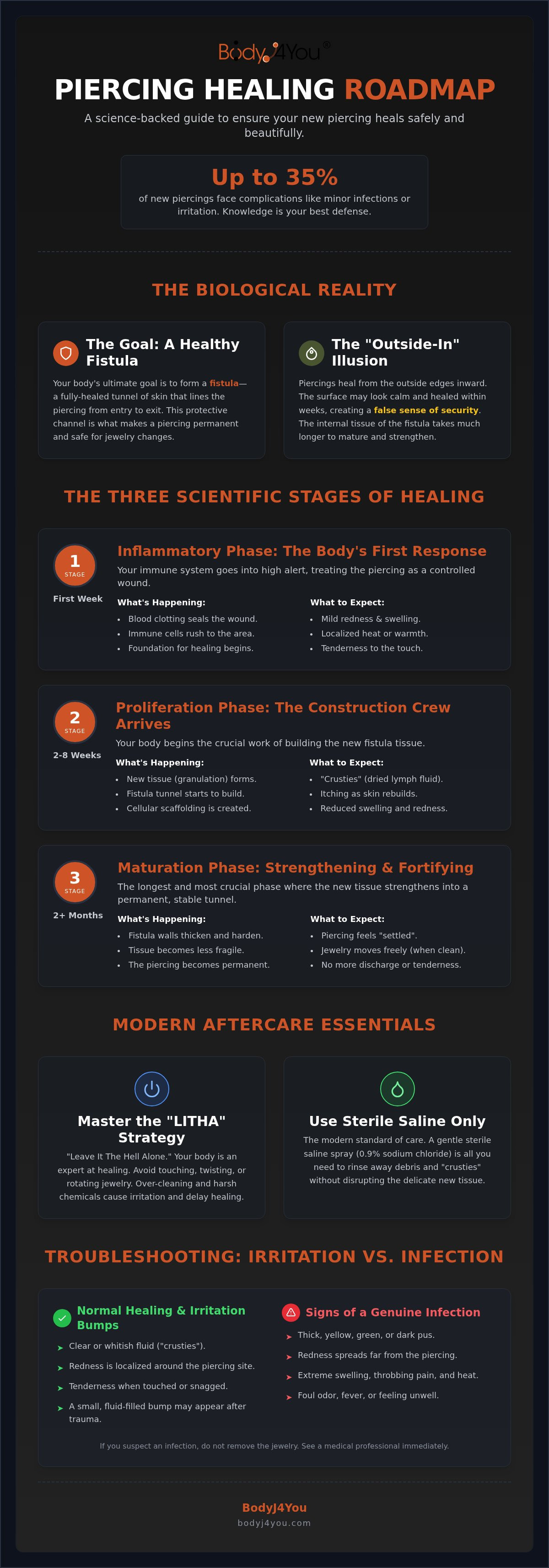
Success in your aesthetic journey depends on respecting the biological clock. Your body moves through three distinct piercing healing stages to transform a fresh wound into a stable, healthy channel. While every individual heals at a unique pace, the underlying cellular sequence remains constant. Recognizing these phases empowers you to provide the right care at the right time, ensuring your self-expression remains vibrant and irritation-free. It's a steady, logical progression that requires your body to act as a protective force.
Stage 1: The Inflammatory Phase
In the first week, your immune system initiates an immediate response. Hemostasis occurs almost instantly as blood clotting seals the wound edges around your jewelry. This is followed by inflammation, where localized heat, minor swelling, and redness indicate that your body is busy preventing intrusion. It's a period of high vulnerability. You can support this initial response by following a modern protocol using sterile saline spray for piercings to calm the area and remove debris without causing trauma. Avoid the urge to touch the site; your body is establishing its first line of defense.
Stage 2: The Proliferation Phase
From week two through month two, the focus shifts to construction. Your body begins building granulation tissue, which acts as a delicate cellular bridge to form the internal fistula. During this time, you'll likely notice "crusties" forming around the jewelry. Lymph fluid is a healthy byproduct of the proliferation stage that carries white blood cells and nutrients to the wound site. These secretions are often misunderstood as signs of infection, but they're actually indicators of a productive healing environment. This is the highest risk period for developing a piercing bump if the jewelry is snagged or shifted. Maintaining a steady routine with a high-quality Saline Piercing Aftercare Spray ensures these secretions don't harbor bacteria while the tunnel matures.
Stage 3: The Maturation Phase
This is the longest and most overlooked part of the piercing healing stages. Lasting from six months to over a year, the maturation phase involves the remodeling and strengthening of collagen fibers within the fistula. The tissue becomes tougher and more resilient. Even if the piercing looks perfect on the surface, the internal walls are still fortifying. Removing or downsizing jewelry too early can cause the unreinforced tunnel to collapse or scar. Soft tissue, like earlobes, may complete this phase faster, but cartilage requires significantly more time due to lower blood flow. Patience during this stage is the difference between a temporary piercing and a lifetime of healthy self-expression.
Healing Timelines by Piercing Type
Blood flow is the primary fuel for recovery. When tissue receives a constant supply of oxygenated blood, cellular repair moves with remarkable efficiency. This is why different piercing healing stages vary so drastically across the body. Soft, vascular tissue heals in a fraction of the time required for dense, avascular cartilage. In 2026, the industry standard for safety has evolved. We now advocate for the "Golden Rule": always add two months to any minimum estimated timeline. This buffer protects the internal fistula during its most vulnerable maturation phase, ensuring your self-expression stands the test of time.
Your internal biological clock is also influenced by lifestyle choices. Deep hydration and consistent sleep support the immune system's ability to manufacture collagen. Conversely, high stress or poor nutrition can stall progress, effectively resetting your timeline. Even the gauge of your jewelry plays a role. While it's a common myth that thinner jewelry heals faster, slightly thicker gauges often provide the stability necessary to prevent the "cheese-cutter" effect, where jewelry migrates through delicate tissue.
Soft Tissue: Lobes, Septums, and Tongues
- Ear Lobes: These are the most resilient areas. Expect 6 to 12 weeks for initial surface healing, but wait a full 6 months for complete maturation.
- Septum Piercing: Located in the "sweet spot" of thin tissue, a Septum Piercing typically requires a 3 to 4 month timeline to feel fully settled.
- Oral Piercings: The tongue and lip possess the fastest-healing tissue in the body. However, they also experience the most significant initial swelling, requiring diligent care during the first week.
Cartilage: Helix, Tragus, and Industrial
Cartilage exists in an "avascular zone," meaning it lacks its own direct blood supply. This biological reality extends the piercing healing stages significantly, often requiring 6 to 12 months for the tissue to fully remodel. During this time, the area is highly susceptible to the "Pressure Trap." Sleeping on a fresh cartilage piercing compresses the tissue and restricts what little blood flow exists, which can lead to persistent irritation or migration.
Complex placements like an Industrial Piercing are particularly demanding. Because a single bar connects two separate puncture sites, any movement at one end creates tension at the other. These dual-point piercings require perfectly synchronized healing. If one side becomes irritated, the entire timeline for the industrial assembly is impacted. Patience is your most valuable tool when managing these high-end aesthetic investments.
Optimizing the Healing Environment
Creating a stable sanctuary for your cells is the most effective way to support your body's natural recovery. The "LITHA" method, or "Leave It Like That Alone," remains the gold standard for 2026. It's a philosophy of non-interference that respects the biological wisdom of your immune system. Every time you touch, twist, or rotate your jewelry, you disrupt the delicate piercing healing stages. Your body does not need the metal to move; in fact, movement breaks the cellular seal and invites pathogens into the wound. Purity in your environment leads to purity in your results.
Material science is equally critical. Only biocompatible materials like implant-grade titanium and surgical steel should be used during the initial recovery. These metals are designed to exist within the human body without leaching toxins or causing allergic reactions. Internally, you can fortify the fistula from the inside out. Vitamin C and Zinc act as the essential building blocks for collagen synthesis. Without these micronutrients, the internal tunnel remains weak and prone to irritation or collapse. A wellness-oriented approach ensures your aesthetic journey is built on a foundation of health.
The Saline Standard
The era of harsh antibacterial soaps and DIY salt soaks has ended. Modern dermatological standards favor a 0.9% sodium chloride solution, which perfectly mirrors your body's natural chemistry. Homemade salt water is often unsterile and improperly balanced, leading to dehydration or chemical burns on the fragile granulation tissue. Using a professional Saline Piercing Aftercare Spray twice daily provides a clinical-grade cleaning without the trauma of physical contact. Simply mist the area to flush away debris and maintain an isotonic environment that encourages steady progress.
Jewelry Management During Healing
Precision in jewelry sizing is a vital yet frequently ignored step. Once the initial Stage 1 swelling subsides, typically between weeks four and six, it's necessary to "downsize" your jewelry. The long posts used during the initial puncture become a liability once the tissue calms, as they are prone to snagging and causing migration. However, you must never "twirl" your jewelry to break the seal of dried lymph fluid. This "crusty" layer is a protective barrier; forcing it to move creates micro-tears in the new skin tunnel. For most piercing healing stages, internal threaded labret studs are superior to hoops, as they provide the structural stability required for the fistula to harden and mature without constant movement.
Troubleshooting and Long-Term Maintenance
The path to self-expression is rarely a straight line. Even with a disciplined routine, your body may encounter a "Stage 2 Snag" during the piercing healing stages. This usually manifests as a small, localized bump near the entry or exit point. It is vital to remain calm and analytical. These bumps are frequently a result of physical trauma, such as a snagged towel, or a reaction to improper jewelry materials. They are not permanent scars. By identifying the root cause and adjusting your care, you can guide your tissue back to a state of equilibrium.
Distinguishing between irritation and infection is a critical skill for any enthusiast. In 2026, we utilize a specific safety checklist to determine when professional medical intervention is required. Seek a doctor if you experience radiating heat, thick green or yellow discharge, or a persistent fever. If your symptoms are limited to localized pinkness, itching, or clear fluid, you are likely dealing with simple irritation. Your immune system is a protective force; it often just needs a period of non-interference to resolve minor setbacks.
Managing Irritation Bumps
When localized swelling occurs, targeted intervention is necessary. Our Piercing Bump Treatment Oil is designed to soothe Stage 3 redness and support the skin's natural barrier. It provides a nurturing layer of protection for reactive tissue. For stubborn fluid buildup, a warm compress can encourage circulation and natural drainage. If the irritation persists despite perfect aftercare, the culprit is often the jewelry itself. Switching to a different jewelry material like implant-grade titanium or surgical steel can solve "unhealable" piercings by removing the source of the allergic reaction.
The Graduation Phase
Reaching the maturation milestone is a quiet but significant achievement. You have reached full maturation when the fistula is completely dry, the tissue is no longer tender to the touch, and the jewelry post feels loose within the channel. This indicates that the internal walls have keratinized and strengthened. When you are ready for your first swap, use the taper technique. A Surgical Steel Taper allows you to guide new jewelry into the fistula seamlessly, preventing the micro-tears that often occur when inserting jewelry blindly.
Ongoing care does not end once the piercing healing stages are complete. Even a five-year-old piercing requires occasional maintenance to remove dead skin cells and oils that can accumulate within the fistula. Continue to use high-quality materials and perform a gentle cleaning during your regular wellness routine. BodyJ4You has spent over two decades supporting this journey. We provide the clinical-grade aftercare and premium jewelry needed to ensure your self-expression remains as healthy as it is beautiful.
Mastering Your Recovery Journey
Understanding the piercing healing stages is more than a clinical exercise; it's a vital act of self-care. By respecting the biological formation of the fistula and adhering to the modern "LITHA" method, you protect the integrity of your aesthetic vision. True success requires a balance of patience, purity, and professional-grade materials. It's essential to remember that internal maturation continues long after the surface looks settled. Your body acts as a wise guardian, and with the right support, it'll transform your new piercing into a permanent, healthy part of your identity.
BodyJ4You brings over 20 years of body jewelry expertise to your recovery. We specialize in locally manufactured aftercare solutions and high-quality jewelry trusted by over one million customers worldwide. Our products bridge the gap between clinical wellness and personal aesthetics to ensure your journey is safe and aspirational. Shop BodyJ4You Sterile Saline Spray to protect your piercing through every healing stage. Your path toward empowered self-expression deserves an expert mentor who understands the delicate biology of beauty. Stay confident, stay patient, and enjoy your new look.
Frequently Asked Questions
How do I know if my piercing is in the first stage of healing?
You are in the initial inflammatory phase if the area exhibits redness, minor swelling, and localized heat within the first seven days. This is the body's immediate response to the wound; during this time, blood clotting seals the edges around your jewelry to prevent intrusion. It's a period of high vulnerability where your immune system acts as a protective force. Support this stage with a sterile saline mist to keep the area calm.
Is it normal for a piercing to still be "crusty" after three months?
Persistent crusties are often a healthy sign of ongoing tissue repair, especially in cartilage piercings. This dried lymph fluid is a byproduct of the proliferation phase and carries vital white blood cells to the wound site. While soft tissue might settle faster, cartilage often requires six to twelve months for full maturation. As long as the discharge is clear or pale yellow, your body is simply continuing its construction work.
Can I change my piercing jewelry if it doesn’t hurt anymore?
Absence of pain does not indicate that the piercing healing stages are complete. While the surface skin may feel comfortable, the internal fistula requires months to strengthen and keratinize. Changing jewelry prematurely can cause the unreinforced tunnel to collapse or suffer micro-tears. We recommend waiting for full maturation, which is marked by a loose-feeling post and a complete lack of discharge, before attempting your first jewelry swap for long-term stability.
What is the difference between a healing piercing and an infected one?
A healing piercing typically shows localized pinkness and clear discharge; an infection presents with radiating heat, thick green or yellow pus, and persistent fever. Irritation is often a response to physical trauma or low-quality materials. If you notice red streaks extending from the site or feel generally unwell, consult a medical professional immediately. Most minor setbacks can be managed by maintaining a pure environment and using high-quality surgical steel or titanium jewelry.
Why does my cartilage piercing feel like it’s healing then get sore again?
Cartilage piercings often experience a non-linear recovery due to their avascular nature, meaning they lack a direct blood supply. This makes the tissue highly reactive to minor snags, pressure, or changes in your overall health. A sudden return of soreness usually indicates that the delicate granulation tissue has been disrupted. Maintaining a steady routine with a pH-balanced saline spray helps stabilize these fluctuations and supports the long-term maturation of the internal skin tunnel.
Does sleeping on my piercing affect the healing stages?
Sleeping on a fresh piercing creates a pressure trap that significantly delays the piercing healing stages. Constant pressure restricts blood flow to the area and can cause the jewelry to migrate or heal at an awkward angle. This is particularly damaging for cartilage, which already struggles with low circulation. We suggest using a travel pillow or sleeping on your opposite side to provide the puncture site with the undisturbed environment it needs.
Should I move my jewelry around to keep it from getting stuck?
You should never rotate or move your jewelry during the recovery process. The outdated belief that jewelry can get stuck leads to micro-tears in the developing fistula and introduces bacteria into the raw internal tissue. Modern standards emphasize the LITHA method: Leave It Like That Alone. Your body does not need the metal to move to heal correctly. Total stability is the most effective way to encourage a smooth, irritation-free maturation.
What should I do if I missed a day of aftercare cleaning?
If you miss a day of cleaning, simply resume your twice-daily saline protocol the following morning. There is no need to over-clean the area to compensate, as excessive washing can dry out the tissue and stall the proliferation phase. Consistency is more valuable than intensity. Your immune system is a resilient guardian that continues to work even during minor lapses. Just ensure you return to a pure, sterile routine to keep your recovery on track.


