

Did you know that 1 in 9 people suffer from a nickel sensitivity, often triggered by the very jewelry meant to celebrate their identity? Choosing the perfect septum rings feels like a high-stakes balancing act between aesthetic flair and biological safety. You want a look that resonates with your soul. You need a material that respects your skin. You deserve a fit that feels like second nature. We understand that confusion over gauge diameters or the anxiety of hiding a piercing for a professional meeting can turn a moment of self-expression into a source of stress.
This guide empowers you to master the art of jewelry selection and long-term maintenance. By following our expert-led approach to styles and safety, you'll gain the confidence to protect your health while refining your aesthetic. We'll explore the critical differences between clickers and captive beads, explain how to choose hypoallergenic materials like surgical steel, and provide a roadmap for keeping your piercing vibrant and healthy for years to come.
Key Takeaways
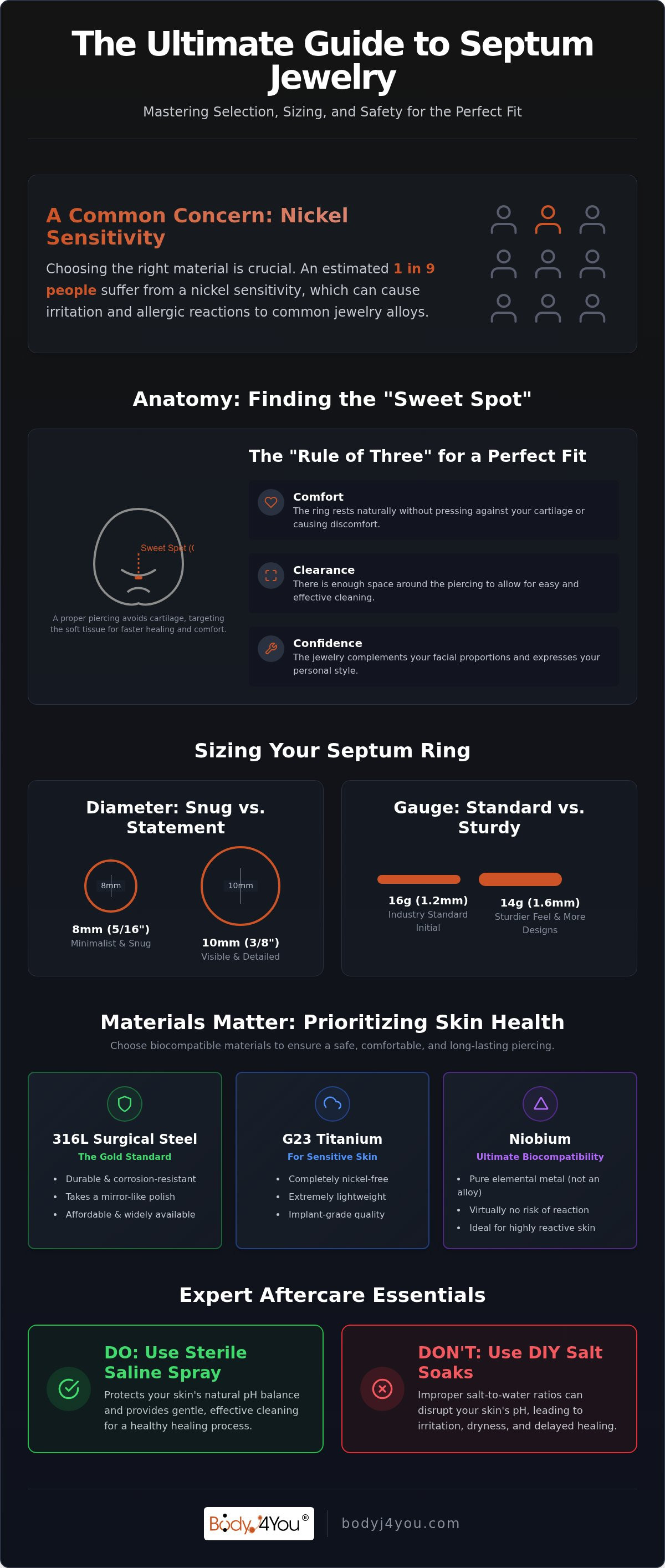
- Identify your unique "sweet spot" to ensure your jewelry rests comfortably in the columella rather than sensitive cartilage.
- Prioritize biocompatible materials like 316L Surgical Steel for your septum rings to maintain skin integrity and prevent allergic reactions.
- Compare the mechanics of clickers, horseshoe barbells, and captive beads to choose the style that best supports your daily routine.
- Protect your healing tissue by using sterile saline aftercare sprays instead of DIY salt soaks that can disrupt your skin's natural pH.
- Leverage professional sizing insights to select the perfect diameter and gauge for a look that's both secure and stylish.
Understanding Septum Jewelry: Anatomy, Fit, and the "Sweet Spot"
Your unique facial structure dictates how septum rings will sit. We advocate for the "Rule of Three" when evaluating any new piece of jewelry: Comfort, Clearance, and Confidence. Comfort means the ring rests without pressing against your cartilage. Clearance ensures there is enough space to clean the area effectively. Confidence is the result of a piece that perfectly complements your proportions. This placement is one of the most versatile options available. It allows for easy concealment when necessary, making it a favorite for those who balance a professional career with bold personal style.
Determining Your Ideal Diameter
The diameter of your ring determines how "snug" or "dropped" the jewelry appears. To find your perfect fit at home, measure the vertical distance from your piercing hole to the bottom edge of your nose. If you prefer a tight, minimalist look, an 8mm (5/16") diameter is often the standard choice. For those who want their jewelry to be a focal point, a 10mm (3/8") diameter provides more visibility and artistic detail. You can use a millimeter ruler or compare your current jewelry to these standard sizes to ensure a precise match.
Gauge Sizes: From Standard to Stretched
Thickness is measured in gauges, and precision here is non-negotiable for skin health. A 16g (1.2mm) needle is the industry standard for initial piercings. It offers enough surface area to prevent tissue irritation while remaining delicate. Many individuals eventually transition to a 14g (1.6mm) size. This provides a sturdier feel and accommodates more intricate clicker designs. If you desire a more substantial aesthetic, the septum can be stretched using specialized kits. This journey requires a disciplined approach, moving slowly through sizes to maintain the integrity of the columella tissue.
Materials Matter: Prioritizing Safety and Skin Health
Biocompatibility is non-negotiable for facial jewelry. Your body is a delicate ecosystem. Introducing foreign objects requires clinical precision to avoid adverse reactions. Poor material choices lead to more than just aesthetic failure; they cause physical distress. High-quality septum rings act as a bridge between your skin and your style, ensuring that self-expression never comes at the cost of wellness. The Association of Professional Piercers emphasizes Prioritizing Safety and Skin Health by selecting metals that meet specific ASTM standards for implant-grade quality.
Every piece of jewelry should be a protective force for your piercing. When materials lack integrity, the body often responds with inflammation or rejection. We believe in an empowered journey where the customer understands the biology behind the beauty. By choosing materials that respect your skin's natural pH and healing process, you ensure a lifetime of comfortable wear.
The Benefits of 316L Surgical Steel
316L Surgical Steel remains the gold standard for healed piercings. It offers a trifecta of value: durability, shine, and affordability. This material is prized for its corrosion resistance and its ability to take a mirror-like high polish. A smooth finish is essential because microscopic scratches can trap bacteria, leading to chronic irritation. BodyJ4You maintains strict quality control to ensure every piece meets these rigorous standards. This dedication to material integrity provides a stabilizing force for your piercing journey, offering a high-end aesthetic that feels both safe and aspirational.
Hypoallergenic Alternatives for Sensitive Skin
For those with extreme sensitivities, G23 Titanium is an ultra-lightweight, nickel-free alternative. While Surgical Steel is safe for the vast majority, research indicates that approximately 1 in 9 people suffer from nickel sensitivity. Titanium offers peace of mind without the added weight. Niobium serves as the "Wise Guardian" choice for the most reactive skin types. It's an elemental metal, meaning it's not an alloy, which virtually eliminates the risk of a reaction. While flexible materials like Bio-flex have their place for temporary medical procedures, they aren't recommended for long-term wear as they can harbor bacteria over time.
Low-quality metals often betray themselves through physical symptoms. Watch for these three warning signs of material failure:
- Discoloration: Green or black staining on the skin indicates oxidation from cheap base metals like copper.
- Irritation Bumps: Persistent bumps often signal a reaction to nickel or a poor surface finish.
- Persistent Itching: A constant "tickle" or burning sensation is a hallmark of a contact allergy.
If you experience these issues, it's time to upgrade your jewelry. You might consider browsing our collection of Surgical Steel captive bead rings to find a piece that balances safety with your personal style.
Septum Ring Styles: Clickers, Horseshoe Barbells, and Captive Beads
Self-expression is the heartbeat of body modification. Choosing between different septum rings is a journey of aesthetic refinement. Whether you seek a minimalist hoop, an ornate statement piece, or a sculptural design, the mechanism you choose dictates your daily experience. It's about finding a balance between your lifestyle and your look. Understanding Septum Piercing Healing and Aftercare ensures that your style choices never compromise your physical well-being. The right piece should offer three things: security, comfort, and visual harmony.
Septum Clickers: The Modern Standard
The clicker has revolutionized the industry. It utilizes a hinged bar that snaps securely into place with an audible "click." This design eliminates the need for specialized opening tools or the frustration of losing tiny, detached parts. Beginners often prefer clickers for their simplicity and ease of change. They are available in endless variations, moving from sleek polished bands to intricate filigree designs set with sparkling gemstones. Because the hinge is integrated, you can transition from a professional workday to a bold evening look in seconds.
Horseshoe Barbells and Circular Barbells
Functionality meets versatility in the horseshoe barbell. These are the premier choice for individuals who need to hide their piercing for professional or family events. The open design allows you to "flip" the jewelry up into your nostrils, making it invisible to the world. We recommend internal threading for these pieces. Internal threading means the screw is on the ball, not the bar. This prevents the metal threads from scraping your delicate tissue during insertion. It's the supportive specialist’s choice for maximum comfort and safety. You can further customize this look by swapping standard balls for spikes or colorful acrylic ends.
Captive Bead Rings (CBRs)
Captive bead rings offer a classic, 360-degree loop that is visually seamless. The bead is held in place by the natural tension of the metal ring itself. This creates a highly secure closure that is difficult to snag. CBRs are ideal for active lifestyles where jewelry loss is a concern, such as during high-impact sports or travel. For those seeking a professional, continuous silhouette, using captive bead rings provides a timeless aesthetic that remains a staple in the piercing community.
Matching your style to your face shape creates a balanced, high-end look. Rounder faces often benefit from the vertical elongation provided by a horseshoe or a teardrop clicker. Sharper, angular features are softened by the gentle, continuous curve of a standard hoop. As your "Wise Guardian," we offer one final tip: always test the tension or hinge of your jewelry with your fingers before insertion. A secure snap or a firm bead ensures your jewelry stays exactly where it belongs, protecting both your investment and your peace of mind.
Expert Aftercare and Daily Maintenance
Healing is a partnership between your body and your habits. We utilize a Problem-Solution-Proof approach to ensure your septum rings remain a source of pride, not pain. The problem often lies in over-cleaning or using harsh, non-sterile chemicals. The solution is a disciplined, minimalist routine that respects your biology. The proof is the thousands of successful piercings we've supported over two decades of industry presence. Many newcomers encounter "septum funk," which is a common accumulation of dead skin cells and sebum. Regular, gentle irrigation prevents this odor while maintaining the purity of the piercing site.
Avoid the temptation of homemade salt soaks. While they seem economical, DIY mixtures often lack the precise salinity required for human tissue. An incorrect ratio disrupts your skin's natural pH, leading to dryness and delayed healing. Instead, rely on dermatological standards to protect your physical vulnerability. Maintaining skin elasticity is also vital. Once your piercing has fully matured, applying natural oils like jojoba or rosehip can keep the tissue supple and resilient.
The Sterile Saline Protocol
Consistency is the cornerstone of health. We recommend using a sterile saline spray for piercings twice daily to flush out bacteria and debris. This works best when paired with the LITHA method: Leave It The Hell Alone. Excessive touching or rotating introduces pathogens and irritates the "sweet spot." "Crusties" are a natural part of the lymph drainage process, signifying that your body is actively sealing the wound.
Treating and Preventing Septum Bumps
Irritation bumps are a common hurdle, but they are rarely permanent. It's vital to distinguish between a keloid, which is a rare genetic scar tissue, and a standard irritation bump caused by friction, jewelry movement, or poor material quality. You can use piercing bump treatment oil to soothe localized swelling and encourage tissue recovery. For precision, use piercing cleaning swabs to reach the delicate folds of the nose without disturbing the jewelry.
Lifestyle Logistics: Flipping and Hiding
The ability to hide a piercing is a unique advantage of the septum. To perform the "Flip," gently push your upper lip down and slide a horseshoe barbell upward into the nostrils. You must wait until the piercing is fully healed, typically 6 to 8 weeks, before flipping jewelry frequently. Constant movement during the early stages creates micro-tears in the healing tissue. For the ultimate discreet look, a dedicated retainer offers a low-profile solution that remains invisible during professional or family events.
Protect your investment and your health by choosing the right tools for the job. You can find our specialized Saline Piercing Aftercare Spray to ensure your healing journey is as smooth and comfortable as possible.
Why BodyJ4You is the Specialist Choice for Septum Jewelry
Choosing jewelry for a facial piercing is an act of trust. For over 20 years, BodyJ4You has served as a "Wise Guardian" for the piercing community, bridging the gap between clinical safety and vibrant self-expression. We don't just sell products; we provide the tools for a safe and empowered journey. Our heritage is built on a foundation of transparency, reliability, and deep industry knowledge. We understand that your choice of septum rings is a deeply personal reflection of your identity. Because of this, we prioritize the integrity of your skin as much as the brilliance of your aesthetic.
We believe in a tripartite philosophy: Quality, Affordability, and Expert Support. This commitment ensures that every customer feels like a priority rather than a transaction. By positioning ourselves as a protective and stabilizing force, we help you navigate the complexities of materials and sizing with ease. Our goal is to ensure your piercing remains a healthy, beautiful part of your life for years to come.
Quality Control and Domestic Production
Domestic manufacturing is our shorthand for regulatory trust. Unlike mass-market retailers that outsource production to unverified facilities, we maintain strict control over our skincare and aftercare lines. Our Saline Piercing Aftercare Spray is manufactured locally to ensure it meets the highest standards of purity and efficacy. This regional focus allows us to monitor every ingredient, ensuring our products are safe for even the most sensitive tissue. We apply this same rigor to our jewelry. Every piece of 316L Surgical Steel undergoes testing for material integrity to prevent the allergic reactions often caused by cheap alloys. Our 20 year heritage isn't just a number; it's a record of reliable customer experiences and proven results.
Your Journey to Self-Expression Starts Here
Your aesthetic evolution should be a source of joy, not anxiety. We provide the expert mentorship needed to explore new styles with total confidence. Whether you're a first-time piercee or a seasoned collector, our curated selection offers something for every stage of your journey. We stand by our promise to deliver high-end aesthetics at accessible price points, ensuring that safety is never a luxury. Our team is here to support your growth, offering the specialized knowledge required to maintain a healthy and stylish piercing. Explore our curated collection of septum rings and find your perfect fit today. Let us be the supportive specialist that helps you express your true self with clarity and care.
Mastering Your Style with Confidence
Your journey with septum rings is a bridge between your biological wellness and your creative identity. We've explored how understanding your unique anatomy ensures a comfortable fit in the "sweet spot" and why prioritizing biocompatible materials like 316L Surgical Steel is non-negotiable for long-term health. By committing to a disciplined aftercare protocol and choosing the right jewelry mechanisms, you protect your body while refining your aesthetic. Expert care doesn't just prevent complications; it empowers you to wear your jewelry as a true reflection of your inner self.
BodyJ4You stands as your supportive specialist, offering over 20 years of industry experience to guide your selection. Our commitment to purity is reflected in our US-manufactured aftercare line and our hypoallergenic material standards. We invite you to Shop the BodyJ4You Septum Collection to find a piece that resonates with your personal growth. Your path to self-expression is a unique narrative, and we're honored to provide the stabilizing force you need to wear your jewelry with pride and safety. Step forward into your next aesthetic chapter with clarity and grace.
Frequently Asked Questions
How much do septum piercings hurt compared to other nose piercings?
Septum piercings generally rank lower on the pain scale than nostril piercings because they pass through the "sweet spot" rather than dense cartilage. Most people describe the sensation as a sharp, fleeting pinch that triggers a natural watery-eye reflex. While individual experiences vary, the procedure is remarkably swift. Proper placement is the key to minimizing discomfort and ensuring a smooth transition into the healing phase.
Can I change my septum ring myself, or do I need a professional?
You can change your jewelry yourself once the piercing has matured, typically after the initial 6 to 8 weeks. Beginners often find that clicker-style septum rings are the most user-friendly for independent changes. If you encounter resistance or any physical discomfort, it's best to wait. Always ensure your hands and the new piece are sanitized to maintain the integrity of the piercing site.
What gauge is a standard septum piercing for most people?
The industry standard for most septum piercings is 16 gauge (1.2mm). This specific thickness offers a perfect balance between structural stability and a refined aesthetic. While some individuals eventually stretch to a 14 gauge (1.6mm) for a bolder look, starting with a 16 gauge ensures the tissue heals without unnecessary stress. Maintaining this standard size during the first few months supports long-term piercing health.
How do I know if my septum ring is made of real surgical steel?
Genuine 316L Surgical Steel is identified by its mirror-like polish and its ability to resist corrosion over time. Real implant-grade septum rings won't cause skin discoloration or persistent itching, which are hallmarks of cheap alloys. We prioritize material purity to ensure a safe experience. If your jewelry maintains its shine and doesn't irritate your skin, it likely meets the high standards required for facial jewelry.
Is it normal for a new septum piercing to smell bad?
A mild odor is a normal biological occurrence often referred to as "septum funk." It's caused by the natural accumulation of sebum and dead skin cells around the jewelry. This isn't a sign of failure but a reminder to maintain your hygiene routine. Using a saline piercing aftercare spray twice daily will effectively flush out these oils, keeping the site fresh and your skin healthy.
Can I flip my septum ring up while it is still healing?
You should avoid flipping your jewelry while it is actively healing during the first 6 to 8 weeks. Constant manipulation introduces bacteria and causes micro-tears in the "sweet spot" tissue. If you need to hide the piercing, have a professional set it in the upward position initially. Once the site is fully matured, you can flip your horseshoe barbell freely without risking irritation or infection.
How long does a septum piercing take to fully heal?
A septum piercing typically takes 2 to 3 months for the initial healing phase, though full maturation can take up to 6 months. Even if the site looks healthy on the outside, the internal fistula requires time to stabilize. Consistency is your best ally during this window. Following a disciplined aftercare protocol ensures that your piercing remains a permanent and vibrant part of your self-expression.
What should I do if I have a bump on my septum piercing?
If a bump appears, you must first determine if it's a rare keloid or a common irritation bump. Most bumps are caused by friction or poor material quality and can be managed with targeted care. Applying a piercing bump treatment oil helps soothe the area and reduce localized swelling. Using specialized cleaning swabs allows for precision hygiene, ensuring you don't further aggravate the delicate tissue during the recovery process.


