

You’re at dinner when you feel a sudden, hollow lightness in your lip, only to realize your favorite decorative end is gone, lost to a loose thread you never felt slip. It’s a moment of pure frustration that forces you to choose between your aesthetic and your budget. We understand that your jewelry is an investment in your self-expression, and losing a piece feels like losing a part of your identity.
Choosing between a threadless vs internal threaded labret isn't just about style; it's about security, comfort, and long-term oral health. You deserve jewelry that feels weightless against your gums, stays locked in place during your busiest days, and allows for effortless style changes. In this 2026 comparison guide, we’ll demystify the technical mechanics of both systems. You’ll discover which connection offers the most reliable grip, how to prevent irritation in tight spots, and why the latest biocompatible standards are shifting the way we shop for labret jewelry. Whether you prioritize the structural integrity of threads or the versatile snap of a threadless pin, we’ll help you find the perfect fit for your lifestyle.
Key Takeaways
- Identify the mechanical differences between screw-in connections and tension-fit pins to ensure your jewelry remains secure and stable.
- Evaluate the comfort of flat-back designs to protect your delicate oral tissues from irritation, erosion, and plaque buildup.
- Master the technical nuances of threadless vs internal threaded labret systems to choose the right fit for your aesthetic and lifestyle needs.
- Learn professional maintenance steps, including the "pre-bend" technique for threadless tops and the use of saline spray to prevent mechanical failure.
Defining the Systems: What are Internal Threaded and Threadless Labrets?
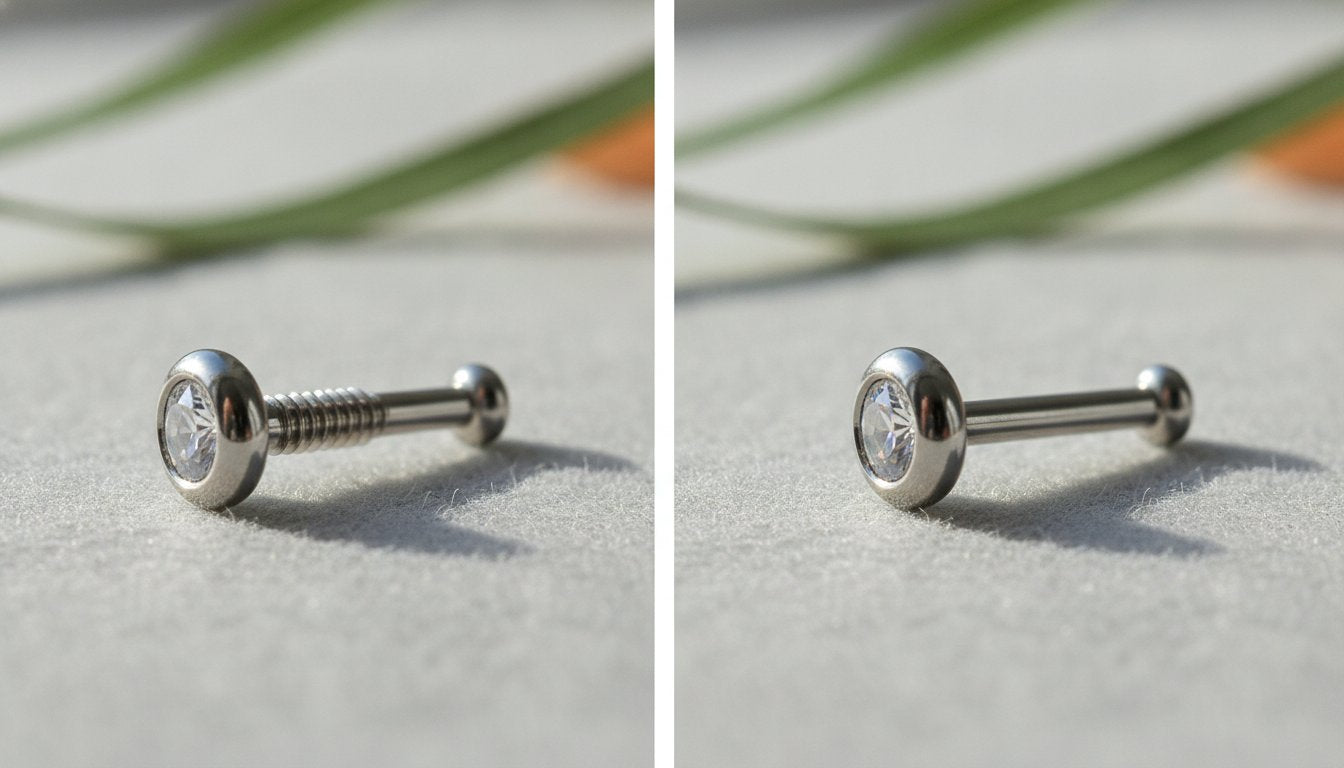
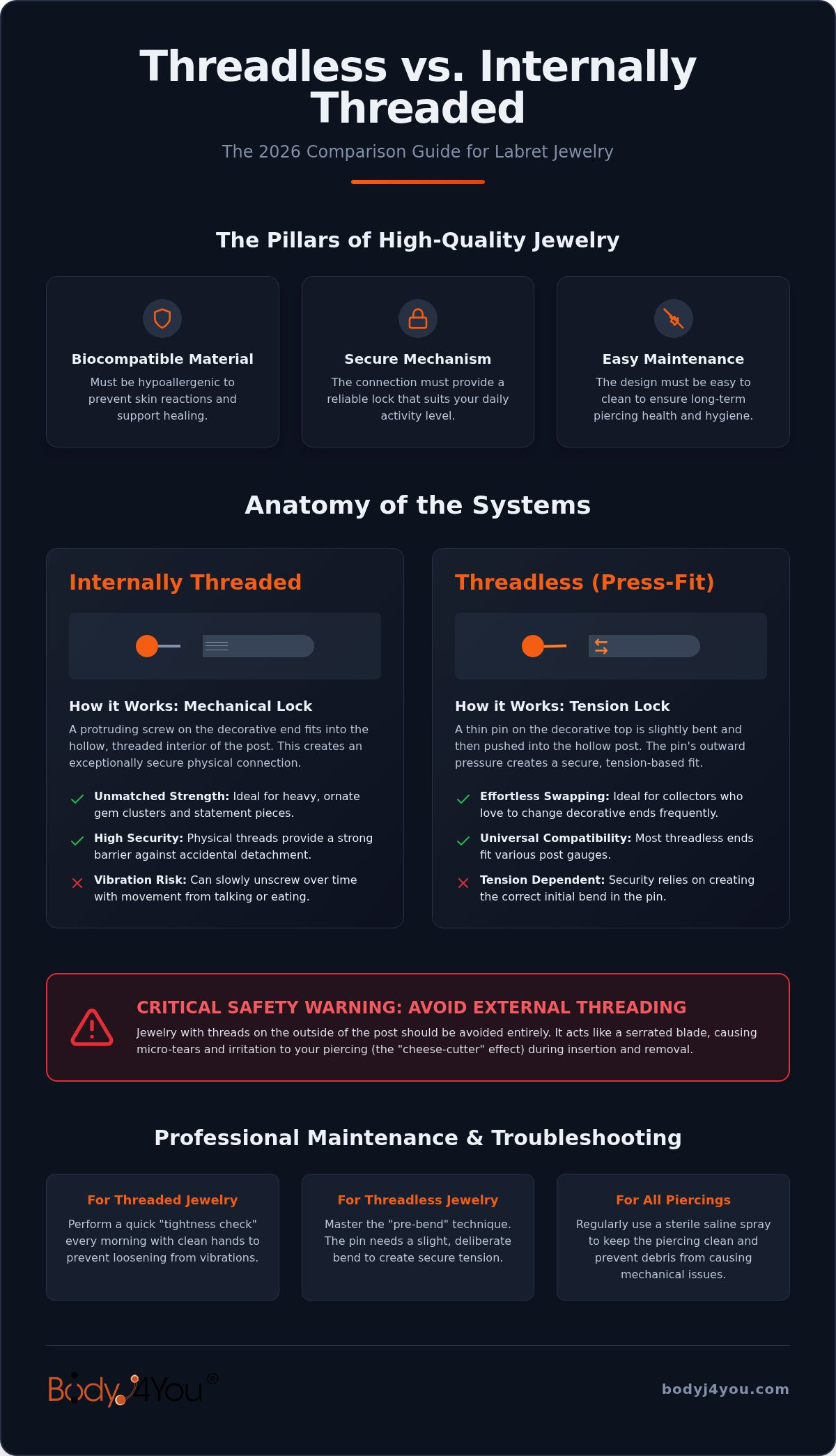
Precision matters. When you choose jewelry for a sensitive area like the lip, the mechanism is as vital as the metal. We advocate for systems that respect your body’s biology and support the healing process. External threading, where the screw threads are on the outside of the bar, should be avoided entirely. It acts like a serrated blade against your delicate skin during insertion and removal. Instead, professional standards focus on internal and threadless designs. These systems ensure the part of the jewelry that touches your tissue is polished and entirely smooth. It's a commitment to safety, comfort, and aesthetic integrity.
We evaluate every piece of high-quality jewelry through the Rule of Three:
- Material: The jewelry must be biocompatible and hypoallergenic to prevent adverse skin reactions or irritation.
- Mechanism: The connection must provide a secure, reliable lock that suits your daily activity level and movement.
- Maintenance: The design must be easy to clean to ensure the long-term health and hygiene of your piercing site.
Understanding the technical nuances of a threadless vs internal threaded labret will help you master these three pillars and protect your investment.
The Anatomy of an Internally Threaded Stud
This system is a triumph of micro-engineering. The decorative end features a protruding screw that fits into the hollow, threaded interior of the post. This creates a mechanical lock that is exceptionally difficult to jar loose. Because the threads are tucked away inside the bar, the exterior remains sleek. This is crucial for a labret piercing, as it prevents the "cheese-cutter" effect that causes micro-tears in the fistula. It remains the professional choice for those wearing heavy gold clusters or large, ornate gemstones that require maximum structural security and a permanent feel.
The Mechanics of Threadless Jewelry
Threadless jewelry, often called press-fit, utilizes tension rather than screws to stay in place. The decorative top has a thin, straight pin that you manually bend. When you push this bent pin into the smooth, hollow post, it creates a constant outward pressure against the inner walls. This tension-lock is remarkably secure and won't unscrew over time like traditional jewelry might. A major benefit of this system is its universal compatibility. Most threadless ends are designed to fit various gauges of posts. It's the ideal system for collectors who love to swap their decorative ends frequently without needing to change the entire bar. It's fast, efficient, and incredibly safe for delicate or fresh piercings.
The Security Showdown: Tension-Lock vs. Mechanical-Lock
Security is the foundation of confidence. When you invest in premium body art, the last thing you want is for a decorative end to vanish during a meal or a workout. The debate over threadless vs internal threaded labret systems often centers on which one stays put when life gets loud. Both offer professional-grade security, but they achieve it through entirely different physics. Protect your piercing, your peace of mind, and your personal style by choosing the mechanism that matches your activity level.
The "Lost Top" phenomenon is usually the result of human error or mechanical wear. Threaded jewelry can slowly vibrate loose through the natural movements of talking and eating. Conversely, threadless jewelry only fails if the initial tension wasn't set correctly during installation. Understanding these failure points is the first step toward protecting your collection from accidental loss. For those who prioritize heavy-duty mechanical bonds, choosing high-quality Internal Threaded Labret Studs ensures a lifetime of reliability.
When Threads Win: Stability and Strength
Mechanical locks provide unmatched structural integrity. Because the connection is a physical screw-and-socket, it can handle significant weight without shifting. Structural security is the ability of a 14G internal thread to support a 5mm gem cluster. This is essential for larger, statement pieces that would otherwise catch on clothing or bedding. The threads act as a physical barrier against accidental detachment, making them the gold standard for heavy or ornate jewelry.
However, threads are not a "set it and forget it" solution. The constant motion of your mouth creates a counter-clockwise risk, where the top can slowly unscrew over days or weeks. We recommend a quick "tightness check" every morning with clean hands. Ensuring your jewelry is seated properly is a key part of maintaining your oral health and safety, as loose components can become choking hazards or damage tooth enamel. It’s a simple habit that preserves both your smile and your jewelry.
When Threadless Wins: Ease and Versatility
Threadless jewelry relies on a tension-lock system that eliminates the risk of cross-threading. Cross-threading occurs when a tiny screw is forced into a post at an angle, permanently stripping the metal and ruining the piece. With threadless systems, this frustration is impossible. It’s a modern approach that favors simplicity without sacrificing the grip you need for daily wear.
The secret lies in the "bend it to secure it" trick. By creating a slight curve in the pin, you ensure it grips the inside of the post with constant outward pressure. You can verify this with a simple "Pull-Test": gently tug on the top; if it resists, it’s secure. Many professional piercers prefer this for initial healing because it requires less fiddling near a fresh wound, reducing the risk of irritation. It is a clean, efficient, and versatile solution for the modern collector.
Labret-Specific Performance: Comfort, Oral Health, and Safety
Oral piercings live in a dynamic, high-moisture environment where jewelry isn't just an accessory; it's a constant neighbor to your teeth and gums. Choosing between a threadless vs internal threaded labret requires a deep understanding of how these mechanisms interact with your anatomy. We prioritize the preservation of your oral health by focusing on systems that minimize plaque traps and tissue erosion. Your jewelry should empower your self-expression without compromising your biological well-being.
Safety starts with the substance. Your labret must be crafted from biocompatible materials like ASTM F-136 Titanium or implant-grade Surgical Steel to prevent the leaching of irritants into your bloodstream. Using quality jewelry ensures that the surface remains non-porous and resistant to the bacterial biofilm that naturally forms in the mouth. Both internal and threadless systems excel here. They lack the jagged external threads that harbor "crusties" and harmful bacteria, making them significantly easier to keep clean during your daily hygiene routine.
Gum and Tooth Protection
The flat-back disk is the silent protector of your smile. In internally threaded systems, the precision-machined screw allows the decorative top to sit incredibly flush against the post. This creates a seamless profile that's less likely to catch on your teeth. This low-profile design is vital for preventing gum recession, which is a common concern for long-term labret wearers. If you're unsure about the thickness or diameter needed for a comfortable fit, consult our Ear Gauge Size Chart to find the exact millimeter equivalent for your specific piercing gauge.
Threadless bars offer a different kind of comfort. Because the post is entirely smooth, it's often gentler on the fistula during the initial stages of healing. There are no microscopic ridges to irritate the delicate new skin as it forms. This reduced friction supports a faster, more stable recovery period. It allows the jewelry to settle into its permanent home without causing unnecessary trauma to the surrounding tissue.
Ease of Use for Daily Wear
Changing jewelry inside the mouth is a feat of dexterity. Attempting to line up a microscopic screw while holding your lip in front of a mirror can be an exercise in frustration. This is where the "Mirror Test" favors the threadless system. The press-fit mechanism allows you to simply align the pin and snap it into place. It's a faster, more intuitive process that reduces the time you spend manipulating a sensitive piercing site. You don't need a piercer's help for every minor style update.
Snagging risks also vary between the two. While both are significantly safer than external threads, the mechanical lock of an internal thread is often preferred for those who wear scarves or use heavy towels frequently. The screw connection is less likely to be pulled out by a stray loop of fabric. Regardless of your choice, establish a weekly maintenance routine. Check the tightness of your threads or the tension of your pins to ensure your labret remains a secure, beautiful expression of your identity.
Troubleshooting and Maintenance: The Supportive Specialist's Guide
Your labret jewelry is a precision-engineered tool for self-expression. To maintain its integrity, you must understand the subtle mechanics that keep it secure. Whether you prefer the mechanical lock of threads or the tension of a press-fit pin, routine care prevents the frustration of lost tops or stuck bars. We've spent over two decades refining these techniques to help you protect your investment and your health. Mastery over your jewelry starts with consistent, gentle observation.
Buildup is the most common cause of jewelry failure in the oral environment. Saliva, skin cells, and plaque can migrate into the hollow socket of your labret post. This microscopic debris creates a physical barrier that prevents threads from fully seating or pins from creating proper tension. Regular irrigation is essential. If you notice your jewelry feels "crunchy" or refuses to tighten during your daily check, it's time for a deep clean. When comparing the maintenance of a threadless vs internal threaded labret, the cleaning process is similar, but the adjustment techniques are unique.
Adjusting Tension in Threadless Jewelry
Threadless jewelry is remarkably reliable, but only if the tension is set correctly. If your decorative top feels loose or slides out too easily, you must perform the "Art of the Pre-Bend." Start by inserting the pin roughly one-third of the way into the post. Apply gentle, steady pressure to bend the pin slightly against the edge of the tube. Slide the top the rest of the way in to test the resistance.
Be cautious of the "Snap Point." Bending the pin too aggressively or at a sharp 90-degree angle can weaken the metal, causing it to break. You are looking for a subtle, graceful arc. A perfectly tensioned top will produce a distinct, audible "click" when it seats fully into the bar. This sound is your confirmation that the jewelry is locked and safe for daily wear. If you don't hear that snap, remove the top and increase the bend slightly until the connection feels firm.
Preventing Thread Failure
Internally threaded jewelry requires a different set of habits to stay secure. The "Righty-Tighty" rule is your best defense against accidental loss. Develop a routine of checking your jewelry every morning with clean hands. A quick, gentle twist ensures the screw hasn't backed out due to the constant vibration of speaking, laughing, or eating. This simple habit can save you from the heartbreak of losing an expensive gemstone end.
If your jewelry feels stuck, don't reach for metal pliers. This dangerous mistake can permanently mar the polished finish or strip the delicate threads. Instead, put on a pair of clean latex or nitrile gloves. The added grip allows you to apply firm, controlled torque without slipping. If the jewelry remains immobile, or if you suspect the threads are stripped, visit a professional piercer. They have the specialized tools to remove the piece safely without traumatizing your tissue. Keep your threads and pins functioning perfectly by using Saline Piercing Aftercare Spray to clear away the daily buildup that causes mechanical sticking.
The BodyJ4You Choice: Quality Jewelry and Aftercare Synergy
Safety is not a luxury. It is the standard. At BodyJ4You, we have spent over twenty years curating collections that prioritize the biological integrity of your piercings. While the debate of threadless vs internal threaded labret systems often comes down to personal preference, we consistently position internal threading as the professional choice for absolute structural security. A mechanical lock provides a level of permanence that supports your journey toward confident self-expression without the fear of jewelry failure.
Choosing the right material is the next step in your aesthetic refinement. Surgical Steel offers a classic, durable, and cost-effective solution for healed piercings. For those with heightened sensitivities or fresh piercings, Titanium remains the gold standard due to its hypoallergenic properties and lightweight feel. Both materials are non-porous and meticulously polished to ensure they don't harbor bacteria. By combining high-grade metals with precise engineering, we ensure your jewelry remains as healthy as it is beautiful.
Jewelry Hygiene and Healing
Clean jewelry heals faster. The intricate channels in a threaded bar or the hollow tube of a threadless post are prone to collecting organic buildup. Integrating Sterile Saline Spray into your daily routine is the most effective way to prevent mechanical sticking or tension loss. Aftercare synergy is the combination of high-quality internal threading and sterile saline irrigation. This dual approach ensures your jewelry remains easy to change while keeping the piercing site free from infection.
Sometimes, even the most careful jewelry change can cause minor irritation. If your skin reacts with redness or swelling, using Piercing Bump Treatment Oil can help soothe the area and reduce inflammation. Our US-based manufacturing for aftercare ensures that every drop meets the highest dermatological standards. We don't just sell jewelry; we provide the tools for a lifetime of successful body art.
Finding Your Perfect Fit
Selecting your next piece should be an inspiring experience. Our collection of Internal Threaded Labret Studs is designed to meet the rigorous demands of both individual collectors and professional studios. We offer wholesale opportunities for professional studios seeking reliable threadless and threaded options that meet the highest quality control standards. Before you make your final selection, consult our expert checklist:
- Gauge: Ensure the thickness matches your piercing size.
- Length: Choose a bar that accounts for your specific anatomy.
- Material: Select Surgical Steel or Titanium based on your skin's needs.
- Mechanism: Decide between the snap of threadless or the lock of threads.
Your self-expression is personal. Your safety is our priority. Quality. Safety. Expression.
Empowering Your Aesthetic Journey
You now possess the technical insight required to master your jewelry collection with confidence. Whether you prioritize the absolute structural permanence of a mechanical lock or the effortless versatility of a tension-fit pin, your decision should always balance biological safety with personal comfort. We've explored how the choice of threadless vs internal threaded labret systems impacts your daily wear, oral health, and long-term maintenance routine. Remember that high-quality, biocompatible materials and dedicated aftercare are the essential pillars of a successful, irritation-free piercing experience.
With over 20 years of industry expertise, we are here to support your journey toward self-expression. We provide safe, high-quality materials alongside nurturing aftercare solutions to ensure your style remains as healthy as it is vibrant. Upgrade your look with BodyJ4You's premium Internal Threaded Labrets and experience the peace of mind that comes from professional-grade engineering. Your style is an evolving story. Wear it with pride and confidence, knowing you have the knowledge and the quality to protect your unique vision for years to come.
Frequently Asked Questions
Is threadless jewelry more likely to fall out than threaded?
Threadless jewelry is remarkably secure when the pin is properly tensioned. It doesn't rely on threads that can unscrew over time due to the natural movement of your mouth. When comparing threadless vs internal threaded labret security, neither is inherently more likely to fall out. Success depends on your maintenance habits. Threadless systems offer a "set it and forget it" reliability that many active individuals prefer for daily wear.
Can I use threadless tops on my internally threaded bars?
You cannot mix these two different systems. Internally threaded bars feature a screw-and-socket mechanism, while threadless bars are smooth, hollow tubes designed for friction-fit pins. Their diameters and internal structures are entirely different. Attempting to force a threadless top into a threaded post will likely strip the threads or bend the pin beyond repair. Always match your decorative ends to the specific post type you own to ensure a safe fit.
Which is better for a new labret piercing?
Threadless jewelry is frequently the professional choice for fresh piercings. It allows for a faster, gentler installation that minimizes trauma to the new fistula. The smooth exterior of the post is exceptionally kind to healing tissue. While both are safer than external threads, the ease of the threadless system reduces the manipulation that can lead to irritation or piercing bumps. It supports a clean, stable recovery process during those critical first weeks.
How do I know if my labret is internally or externally threaded?
Examine the end of the post after removing the decorative top. If the bar is a smooth, hollow tube and the screw is attached to the decorative top, it's internally threaded. If you see screw threads on the outside of the bar itself, it's externally threaded. We recommend replacing external threads immediately. This protects your skin from micro-tears and prevents bacterial accumulation that often leads to persistent irritation or infection.
What should I do if my threaded jewelry top keeps coming loose?
Start by cleaning the jewelry thoroughly. Plaque and saliva can create a "slick" surface that prevents a tight mechanical lock. Use a saline-soaked swab to clear the threads on both the top and the post. If the top still feels loose, ensure you're turning it fully to the right. Consistent daily checks are the best way to ensure your threadless vs internal threaded labret choice stays exactly where it belongs.
Is threadless jewelry harder to take out?
Threadless jewelry isn't harder to remove; it simply requires a different motion. Instead of twisting, you apply a firm, straight pull. If your skin is oily or the tension is high, use clean nitrile gloves for better traction. Most people find this easier than struggling with microscopic threads that can become stuck due to debris. It's a faster, more intuitive process that reduces the time you spend manipulating a sensitive piercing site.
Are threadless and press-fit the same thing?
Yes, threadless and press-fit are identical systems. Both terms describe jewelry that stays in place via a slightly bent pin creating tension inside a smooth post. This design is highly valued for its universal compatibility across different gauges. Whether you call it threadless or press-fit, you're choosing a modern standard that prioritizes ease of use and aesthetic versatility. It is an excellent choice for anyone who enjoys updating their look frequently.
Why is internal threading more expensive than external?
Internal threading requires high-precision machining and superior materials to ensure a perfect fit. Creating a hollow, threaded post is a more complex manufacturing process than simply cutting threads onto the outside of a wire. This extra effort results in jewelry that is smoother, safer, and more comfortable for long-term wear. It's an investment in your health that prevents the tissue trauma and irritation common with cheaper, externally threaded alternatives found in lower-quality collections.


